
抗通胀资产

Search documents
打响财富保卫战!通胀下的终极答案:这三样才是真硬通货
Sou Hu Cai Jing· 2025-11-25 10:12
Core Viewpoint - The article emphasizes the importance of three core assets—gold, green power certificates, and high-dividend core assets—as effective hedges against inflation in a diverse global inflation landscape since 2025 [1]. Group 1: Gold as a Hard Currency - Gold is increasingly recognized as a "final value anchor" in the 2025 monetary environment, with China's gold reserves rising to 73.9 million ounces, marking an increase of 70,000 ounces and a continuous accumulation for eight months [3]. - As of August 2025, gold accounted for 7.64% of China's reserve assets, reflecting the national acknowledgment of gold's value preservation attributes [3]. - The price of gold has risen over 12% in 2025, with domestic prices exceeding 480 yuan per gram, driven by global inflation expectations and risk aversion [3]. Group 2: Green Power Certificates as Policy-Driven Hard Currency - Green power certificates (referred to as "green certificates") have emerged as a new type of hard currency, supported by strong national policies aimed at promoting renewable energy [4]. - A significant policy document issued on March 18, 2025, established a dual-track mechanism for mandatory and voluntary consumption of green certificates, injecting long-term momentum into the market [4]. - From January to October 2025, the trading volume of green certificates increased by 215%, with some industry-specific certificates seeing prices rise by 35% since the beginning of the year [4]. Group 3: High-Dividend Core Assets as Equity Hard Currency - High-dividend core assets have become a crucial choice for combating rising prices, supported by stable cash flows and favorable policies [5]. - A policy issued on October 12, 2025, encourages long-term funds, such as social security and insurance funds, to increase their equity investment proportions, ensuring stability in long-term asset allocation [5]. - The average dividend yield of the CSI 300 high-dividend index stocks reached 4.2% in Q3 2025, significantly surpassing the 10-year government bond yield of 1.8025% [6]. Group 4: Configuration Logic of Hard Currencies - The inflation environment of 2025 necessitates a diversified asset allocation strategy rather than a singular focus, with gold serving as a "safety cushion" in asset portfolios [7]. - Gold should constitute 5%-10% of total household assets, while green certificates are suitable for long-term investors focusing on renewable energy projects [7]. - High-dividend core assets are recommended as a "yield engine" in portfolios, particularly in stable cash flow sectors like consumer goods and utilities [7].

“比特币钱包”的“无限金币漏洞”
Sou Hu Cai Jing· 2025-11-18 15:42
Core Insights - The article discusses the evolution of Bitcoin reserves among companies, particularly focusing on MicroStrategy's aggressive investment strategy since 2020, which has influenced other companies to follow suit [1][2][4][5][10] Group 1: MicroStrategy's Investment Strategy - MicroStrategy began purchasing Bitcoin in August 2020, initially acquiring approximately 21,454 BTC for $250 million, followed by another purchase of 16,796 BTC for $175 million, totaling over 38,000 BTC by the end of 2020 [1] - By the end of 2021, MicroStrategy's Bitcoin reserves had grown to 105,000 BTC, with significant purchases funded through various debt instruments, including a $1.05 billion zero-coupon bond [2] - In 2025, MicroStrategy's holdings reached 649,870 BTC, with an average purchase price of $66,385, reflecting a total investment of $33 billion [5] Group 2: Market Trends and Company Responses - The Bitcoin market experienced significant volatility, with prices dropping below $20,000 in 2022, yet MicroStrategy continued to accumulate Bitcoin, albeit at a slower pace [4] - By 2023, as the market recovered, MicroStrategy's strategy involved smaller, more cautious purchases, resulting in a total of over 130,000 BTC acquired that year [4] - Other companies, such as Metaplanet and Semler Scientific, began to enter the Bitcoin market, with Metaplanet purchasing hundreds of BTC and Semler acquiring 581 BTC for $40 million [4][10] Group 3: Financing and Leverage - The financing strategy employed by MicroStrategy involved leveraging debt to purchase Bitcoin, which allowed the company to increase its market capitalization as Bitcoin prices rose, creating a cycle of investment and growth [8] - The use of zero-coupon bonds and convertible debt has been a key aspect of MicroStrategy's approach, allowing for potential equity conversion without immediate cash outflow [2][8] - However, this strategy carries inherent risks, as a decline in Bitcoin prices could lead to significant financial strain due to the accumulated debt [8][10] Group 4: Industry Impact and Future Outlook - The trend of companies investing in Bitcoin has gained momentum, with over 172 companies reported to have entered the market by 2025, raising $12.5 billion in financing [7][10] - The article highlights the potential for a "bubble" as companies increasingly rely on Bitcoin for their financial strategies, raising concerns about the sustainability of such models [10] - As of 2025, the Bitcoin market remains highly volatile, with significant price fluctuations impacting company valuations and strategies, necessitating careful management of investments and debt [10]
未来五年投资主线生变?有色板块强势崛起,四大支撑逻辑浮出水面
Sou Hu Cai Jing· 2025-11-17 17:10
Core Viewpoint - The traditional sector of non-ferrous metals is experiencing a remarkable surge, challenging the dominance of technology stocks, with a cumulative increase of 52.84% in the Shenwan non-ferrous metals industry index as of September 2025, surpassing the long-standing leader, the communications sector [1] Demand and Supply Dynamics - Global economic initiatives like "new infrastructure" and "energy transition" are driving significant demand for non-ferrous metals, with projections indicating a sixfold increase in demand for key metals like lithium, cobalt, and nickel by 2040 compared to 2020 levels [3] - The supply side faces constraints due to long mining cycles, with new copper or lithium mines taking 5 to 10 years to develop, and low capital expenditure from major mining companies limiting future supply [5] - Environmental regulations are tightening globally, with countries like China and Indonesia implementing stricter mining policies, further constraining supply [5] Macroeconomic Support - The Federal Reserve's initiation of a rate-cutting cycle in 2025 is expected to weaken the dollar, making non-ferrous metals cheaper for global buyers and stimulating demand [7] - Non-ferrous metals are viewed as "anti-inflation assets," enhancing their appeal amid ongoing inflationary pressures [7] Valuation and Performance - The average price-to-earnings ratio for the non-ferrous metals sector is around 15-20 times, compared to 30-40 times for technology stocks, indicating a higher potential return on investment with lower risk [10] - Non-ferrous metal companies have shown strong performance, with many reporting impressive earnings growth that outpaces their stock price increases, leading to improved return on equity (ROE) and cash flow [10] Investment Opportunities - Investors are encouraged to focus on "new energy metals" such as lithium, cobalt, nickel, copper, aluminum, and rare earths, which have the highest demand growth certainty [12] - Preference should be given to companies with high resource self-sufficiency, as they are better positioned to benefit from rising metal prices and have stronger cost control [13] - Long-term holding strategies are recommended, with a diversified approach through industry index funds like the Non-Ferrous 50 ETF and Non-Ferrous ETF Fund to mitigate risks [13] Structural Opportunities - Within the non-ferrous metals sector, there are structural opportunities, particularly in precious metals like gold, which benefit from the Fed's rate cuts and geopolitical risks [15] - Industrial metals such as copper and aluminum are directly benefiting from expanding supply-demand gaps, while smaller metals like antimony and cobalt may present investment opportunities due to supply disruptions and specific demand factors [15]

帮主郑重:美联储鹰派大军压境,12月降息悬了!
Sou Hu Cai Jing· 2025-11-16 09:39
Core Viewpoint - Recent statements from multiple Federal Reserve officials indicate a collective hawkish stance, opposing the idea of a rate cut in December, which has created uncertainty in the market regarding interest rate expectations [1][3]. Group 1: Federal Reserve Officials' Statements - Dallas Fed President Logan stated that he opposes a December rate cut unless there is clear evidence of faster inflation decline [3]. - Minneapolis Fed President Kashkari expressed strong opposition to the October rate cut, citing unexpected economic resilience [3]. - San Francisco Fed President Daly suggested it is too early to determine if a December rate cut is warranted, reflecting a cautious approach among Fed officials [3]. Group 2: Economic Indicators - Inflation remains stubbornly high at around 3%, significantly above the Fed's target of 2%, prompting concerns about its impact on low- and middle-income households [3]. - Economic performance has been stronger than anticipated, with stable corporate earnings and a job market that, while slowing, has not collapsed [3]. - Fed Governor Musalem indicated that the economy might rebound next year, suggesting that aggressive monetary policy is unnecessary at this time [3]. Group 3: Implications for Investors - The delay in rate cuts is likely to put short-term pressure on dollar assets, with high-valuation sectors like technology potentially facing continued volatility [3]. - Investors are advised to focus on "anti-inflation" assets such as gold, energy stocks, and resource-related investments, which tend to perform well in high-interest rate environments [3]. - Maintaining cash reserves is recommended, as the Fed's inaction may lead to increased market volatility, providing opportunities to acquire undervalued assets [3]. Group 4: Historical Context - Historical patterns suggest that the Fed's periods of indecision often present opportunities to invest in gold, as seen during the transitions in leadership under Greenspan in 1987 and Bernanke in 2008 [4]. - Patience is emphasized as a strategy for long-term investors, waiting for the market to fully abandon hopes of rate cuts before making significant investments [4].

白银破53美元创纪录!回顾1980年和2011年两次冲顶,这次能否打破“50美元魔咒”?
Sou Hu Cai Jing· 2025-10-14 12:25
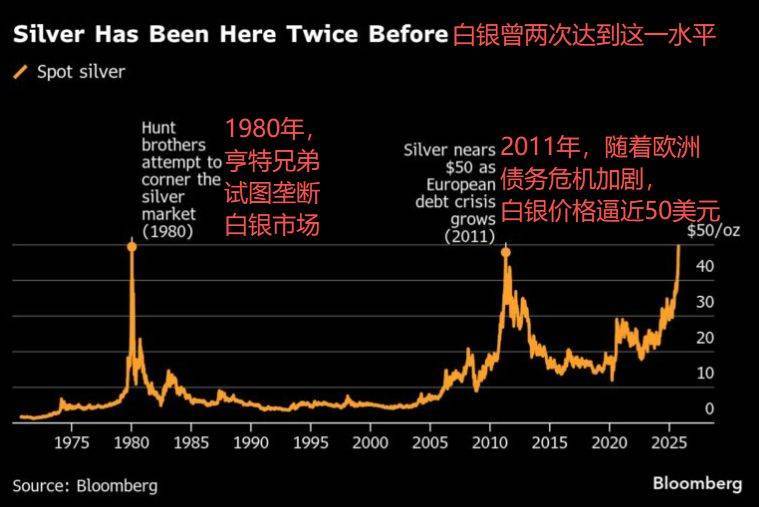
Core Viewpoint - Silver prices have surged to a historical high of $53 per ounce, reflecting a significant increase of approximately 80% since early 2025, outpacing gold's 57% rise during the same period. The London market is experiencing unprecedented tightness in supply, leading to delays in delivery and increased transportation costs for silver [1][3][11]. Historical Context - The current surge in silver prices is reminiscent of past market events, notably in 1980 and 2011, where speculative trading led to significant price spikes followed by sharp declines. In 1980, silver prices soared to $50.35 due to market manipulation by the Hunt brothers, while in 2011, prices approached $50 amid quantitative easing and inflation concerns [3][5][6][7]. - The 1980 price spike was driven by a concentrated effort to monopolize the silver market, resulting in a dramatic increase in prices followed by a market crash known as "Silver Thursday" [5][6]. - In 2011, the price increase was fueled by macroeconomic factors, including low interest rates and geopolitical tensions, leading to a speculative bubble that eventually burst [6][7][8]. Current Market Dynamics - The recent price increase is attributed to a combination of rising debt and fiscal risks, ongoing regional conflicts, and uncertainty in monetary policy, which have heightened demand for silver as a safe-haven asset [11]. - Significant inflows into silver through exchange-traded funds (ETFs) have led to a shortage of physical silver in the market, creating a self-reinforcing cycle where tight supply drives prices higher, attracting more investment into ETFs [11][12]. - Industrial demand for silver, particularly in solar panels, electric vehicles, and consumer electronics, is also a contributing factor, with industrial usage accounting for 59% of silver consumption [12]. Price Comparisons and Future Projections - Adjusted for inflation, the historical peaks of silver prices in 1980 and 2011 would correspond to approximately $200 and $70 per ounce today, respectively. This indicates that even if silver surpasses $50, it would still be significantly lower than historical extremes when adjusted for purchasing power [15]. - Forecasts suggest that silver prices could reach $65 per ounce by 2026, with some analysts predicting a 20% increase over the next year [15]. - However, there are concerns about the current market being overbought, with technical indicators suggesting a potential for price corrections in the near term [15].
美银Hartnett:货币贬值交易远未结束,黄金明春有望冲击6000美元
Hua Er Jie Jian Wen· 2025-10-13 11:40
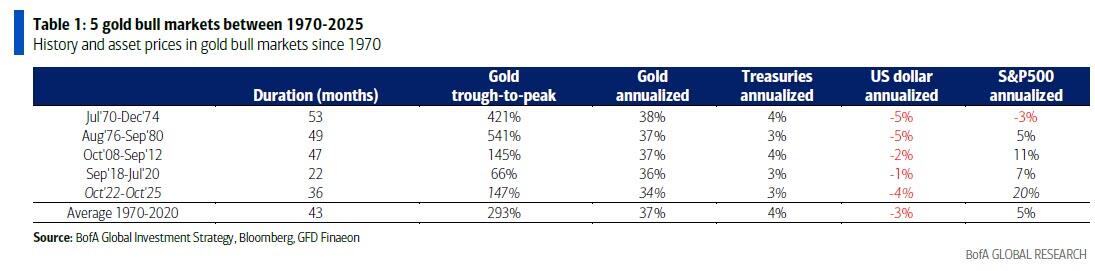
Core Viewpoint - The long-term outlook for currency devaluation trades remains positive, with expectations that gold prices could reach $6,000 by spring next year based on historical bull market performance [1][2]. Group 1: Market Adjustments and Opportunities - The recent adjustment in the precious metals market, where gold failed to break $4,000 and silver faced pressure around $50, is attributed to short covering in dollar trades, creating better entry points for future price increases [1][2]. - Institutional and private client allocations to gold are still low, at 2.3% and 0.5% respectively, indicating a lack of structural bullish positioning in the market, which provides ample room for future price increases [4][2]. Group 2: Historical Data and Projections - Historical data from past bull markets shows an average gold price increase of approximately 300% over a duration of 43 months, suggesting a potential peak of $6,000 for gold by spring 2024, contingent on a 28% increase in investor purchases [2][3]. - The average performance of gold from 1970 to 2020 indicates significant price increases during bull markets, with the most recent cycle (October 2022 to October 2025) projected to yield a 147% increase [3]. Group 3: Policy and Economic Factors - Factors supporting long-term gold price increases include anticipated changes in Federal Reserve policy, government stimulus measures, and potential gold revaluation similar to historical precedents in 1934 and 1973 [5][2]. - Policies like Argentina's rescue plan are seen as typical examples of "prosperity bubble policies," which tend to raise inflation expectations and boost demand for inflation-hedging assets like gold [5]. Group 4: Commodity Market Dynamics - A significant shift in the commodity market is noted, with the current ratio of oil to gold prices indicating that 61 barrels of oil are now needed to purchase one ounce of gold, compared to 15 barrels in June 2022, marking an unusual historical phenomenon [6]. - Expectations for oil prices to potentially drop to $50 per barrel could provide a favorable environment for inflation control and consumer welfare, while also meeting the energy demands of AI development [9]. Group 5: Future Price Predictions - The company has raised its gold price forecast for 2026 to $5,000 per ounce, with an average price projection of $4,400, while silver prices are expected to rise to $65 per ounce, with an average of $56.25 [10].
黄金价格暴涨!各国央行还在抢,特朗普下台前能涨到七千美元?
Sou Hu Cai Jing· 2025-10-09 08:10
对于金价未来走势,市场不乏乐观预测。有美国分析家认为,到 2028 年底至 2029 年初(特朗普任期可 能结束的时间段),国际黄金价格或飙涨至 7000 美元 / 盎司,届时国内饰品黄金价格可能达到 1600- 2000 元 / 克。这一预测虽显激进,却反映出市场对黄金的信心 —— 只要特朗普政府持续推动宽松货币 政策、美国经济风险未得到有效缓解,黄金作为避险与抗通胀资产的吸引力就不会减弱。对普通民众而 言,需理性看待金价波动,若出于投资目的购金,还需充分考虑自身风险承受能力,避免盲目跟风。 美国的降息预期与经济风险,更是为金价上涨添了 "一把火"。特朗普对美联储政策不满,强压之下美 国 9 月已实施一次降息,且有消息称他希望未来将利率降至 0 左右 —— 当前美国利率约 4.5%,这意味 着巨大的降息空间。一旦美元进入持续降息周期,美元汇率大概率走弱,而以美元定价的黄金、石油等 国庆假期期间,国际黄金价格一路飙升,突破 4000 美元 / 盎司大关,这波涨势让不少人直呼 "意外"。 对正筹备婚礼的年轻人来说,金价上涨直接改变了婚嫁消费计划 —— 原本的 "五金" 需求不得不缩减为 "三金",毕竟饰品黄金价 ...

央行降准!普通人最该做的不是存钱,而是这 2 件事
Sou Hu Cai Jing· 2025-09-13 09:47
Group 1 - The essence of the reserve requirement cut is to increase liquidity in the market, allowing banks to lend more, but merely saving money may lead to losses due to inflation [1][3] - Current deposit interest rates are at historical lows, making savings less effective as inflation may erode purchasing power [3] - The influx of liquidity may drive up asset prices in stock and real estate markets, presenting opportunities for investment rather than passive saving [3] Group 2 - Individuals should focus on restructuring asset allocation to ensure money is actively working for them, seeking investments that can outpace inflation [1][5] - Emphasis on investing in "anti-inflation" assets such as quality stocks, index funds, and gold, which have historically provided better returns than savings [3][4] - The importance of balancing risk and return by diversifying investments across high-risk and low-risk assets to optimize potential returns in a low-interest environment [3][7] Group 3 - The reserve requirement cut signals a shift from a defensive to an offensive investment strategy, encouraging individuals to seize opportunities rather than merely protect their savings [5][6] - Personal development and skill enhancement are crucial for individuals to adapt to economic changes and seize high-income opportunities [4][7] - Building a strong network and understanding market trends can lead to better investment and career opportunities, emphasizing the need for proactive engagement [7][8]
金价创历史新高!黄金股现涨停潮,800亿巨头中金黄金强势封板
2 1 Shi Ji Jing Ji Bao Dao· 2025-09-01 08:57
Core Viewpoint - The A-share market experienced fluctuations on September 1, with the ChiNext index leading gains, while the Shanghai Composite Index showed narrow movements. Gold concept stocks surged significantly, driven by rising international gold prices, which reached historical highs [2]. Market Performance - The ChiNext index outperformed other indices, indicating strong investor interest in growth sectors [2]. - Gold stocks such as Zhejiang Fu Holding, Zhongjin Gold, Huayu Mining, Hunan Gold, and Western Gold hit the daily limit, while others like Chifeng Jilong Gold, Zhaojin Mining, Shandong Gold, and Sichuan Gold rose over 7% [2]. Gold Price Movement - International gold prices opened high and continued to rise, with COMEX gold futures increasing by over 1%, peaking at $3,557.1 per ounce, marking a new historical high. Spot gold prices also broke through $3,480 per ounce, nearing the historical high set in April [2]. Economic Outlook - According to China International Capital Corporation (CICC), the U.S. is entering a prolonged phase of fiscal dominance and monetary coordination. Recent personnel changes support this assessment [2]. - Looking ahead, under fiscal dominance, the liquidity of the U.S. dollar may trend towards abundance, benefiting global risk assets. The potential for debt monetization, financial repression, and rising inflation may favor gold and other inflation-hedged assets [2].


达利欧“告别”桥水
Shang Hai Zheng Quan Bao· 2025-08-01 06:59
Core Viewpoint - Ray Dalio, the founder of Bridgewater Associates, has sold all his shares and exited the board, marking the end of an era for the firm [1][3] Group 1: Leadership Transition - Bridgewater has completed the transition of power, with Dalio's exit symbolizing an "ideal conclusion" to ownership transfer [3] - Dalio had previously transferred all voting rights to the board and stepped down from key positions, although he remained involved in company affairs until now [3] - The transition process was lengthy and complicated, with various CEO combinations and even a lawsuit involved [3] Group 2: Financial Performance - Bridgewater's assets under management have decreased significantly, from $168 billion in 2019 to $92.1 billion by the end of 2024 [4] - The decline in management size is partly due to the implementation of a size cap on the flagship Pure Alpha fund to improve performance [4] - After the size cap, the fund's performance improved, achieving a return of 11.3% in 2024 and 17% in the first half of 2025, compared to a mere 5.9% over the previous five years [4] Group 3: Investment Strategy - In the first quarter of this year, Bridgewater significantly reduced its position in SPDR S&P 500 ETF while acquiring over 5.4 million shares of Alibaba, making it the largest individual holding [7] - The firm has also made substantial investments in gold ETFs, indicating a preference for safe-haven assets amid increasing global economic uncertainty [7] Group 4: Dalio's Economic Views - Dalio has warned about unprecedented levels of debt in countries like the U.S., predicting potential debt crises and significant currency devaluation [6] - He advises investors to avoid debt-related assets and instead invest in gold and Bitcoin as inflation-resistant "hard currencies" [6]