
碳酸锂供需平衡

Search documents
大越期货碳酸锂期货早报-20260116
Da Yue Qi Huo· 2026-01-16 02:15
Report Industry Investment Rating - Not provided in the report Core Viewpoints - Supply - Last week, lithium carbonate production was 22,535 tons, a 0.51% week - on - week increase, higher than the historical average. In December 2025, production was 99,200 physical tons, and the predicted output for next month is 97,970 tons, a 1.23% decrease. The import volume in December 2025 was 26,000 physical tons, and the predicted import volume for next month is 22,500 tons, a 13.46% decrease [8][9]. - Demand - Last week, the inventory of lithium iron phosphate sample enterprises was 96,094 tons, a 3.80% week - on - week decrease, and the inventory of ternary material sample enterprises was 18,432 tons, a 0.80% week - on - week decrease. Next month's demand is expected to strengthen, and inventories may decline [8][9]. - Cost - The CIF price of 6% concentrate decreased on a daily basis, lower than the historical average. The cost of externally purchased spodumene concentrate was 152,997 yuan/ton, unchanged from the previous day, with a production profit of 6,514 yuan/ton. The cost of externally purchased lepidolite was 148,815 yuan/ton, a 0.84% daily decrease, with a production profit of 4,536 yuan/ton. The production cost at the recycling end is generally higher than that at the ore end, and the production profit is negative, resulting in low production enthusiasm. The quarterly cash production cost at the salt lake end is 32,231 yuan/ton, significantly lower than that at the ore end, with sufficient profit margins and strong production motivation [9][10]. - Market Outlook - The supply - demand pattern is shifting towards supply - led. The lithium carbonate 2605 contract is expected to fluctuate in the range of 157,560 - 166,240 yuan/ton. The main logic is the emotional fluctuations caused by news under the tight supply - demand balance [9][13]. Summary by Directory 1. Daily Viewpoints - Supply - Last week's production increase, and predicted decreases in next month's production and import. The cost of 6% concentrate decreased [8][9]. - Demand - Decreases in the inventory of lithium iron phosphate and ternary material sample enterprises last week, and expected strengthening of next month's demand [8][9]. - Cost - Different production costs and profits for various raw material sources, with the salt lake end having obvious advantages [10]. - Market - The 2605 contract is expected to fluctuate within a certain range, and the main logic is related to supply - demand balance and news sentiment [9][13]. - Factors - Positive factors include the production cut plan of lepidolite manufacturers and the decrease in lithium carbonate imports from Chile. Negative factors include the continuous high supply at the ore/salt lake end with limited decline [11][12]. 2. Fundamental/Position Data - **Lithium Carbonate Market Overview** - Price - The price of battery - grade lithium carbonate decreased by 2.45% to 159,000 yuan/ton, and the price of industrial - grade lithium carbonate decreased by 2.51% to 155,500 yuan/ton. The prices of other related products also showed different degrees of change [16]. - Supply - The weekly operating rate increased, and the monthly output of some products decreased. For example, the monthly output of lithium iron phosphate decreased by 2.17% to 403,900 tons [18]. - Demand - The inventory of downstream enterprises decreased, such as the 3.80% decrease in the weekly inventory of lithium iron phosphate sample enterprises to 96,094 tons [18]. - **Supply - Lithium Ore** - Price - The price of 6% lithium ore CIF decreased. The price of spodumene (6%) was 2,060 US dollars/ton, a 1.90% decrease [16]. - Production - The production of domestic lithium mines showed different trends in different periods. For example, the production of lithium mica increased by 3.95% to 10,010 tons in a certain month [18]. - Import - The monthly import volume of lithium concentrate increased by 27.59% to 677,528 tons, with a significant increase in imports from Australia [18]. - **Supply - Lithium Carbonate** - Operating Rate - The weekly and monthly operating rates of lithium carbonate from different sources showed different trends. For example, the weekly operating rate of lithium carbonate production from lithium ore was 87.14%, a 4.33% increase [18]. - Production - The monthly production of lithium carbonate increased in some months. In December 2025, the production was 99,200 tons, a 4.04% increase [18]. - Import - The monthly import volume of lithium carbonate decreased in some cases. The import volume from Chile decreased by 26.84% to 10,824.66 tons [18]. - **Supply - Lithium Hydroxide** - Capacity Utilization - The weekly capacity utilization rate of domestic lithium hydroxide showed different trends in different years [39]. - Production - The monthly production of lithium hydroxide was 30,450 tons in a certain month, and the export volume also changed over time [40][44]. - **Lithium Compound Cost - Profit** - Different raw materials have different cost - profit situations. For example, the production profit of externally purchased spodumene concentrate and lepidolite was positive, while the recycling end generally had a negative profit [10][47]. - **Inventory** - Lithium carbonate inventory - The total inventory decreased by 0.23% to 109,679 tons, with different trends in the inventory of smelters, downstream enterprises, and others [10]. - Lithium hydroxide inventory - The monthly inventory of lithium hydroxide from different sources also showed different trends [54]. - **Demand - Lithium Battery** - Price - The price of some batteries showed different trends. For example, the price of 523 square batteries changed over time [58]. - Production - The monthly production of battery cells, such as power ternary and power lithium iron phosphate, showed different trends [58]. - Sales - The monthly sales volume of new energy vehicles and the export volume of lithium batteries also changed [58][80]. - **Demand - Ternary Precursor** - Price - The price of ternary precursors showed different trends. For example, the price of 5 - series (single - crystal/power type) average was 119,250 yuan/ton, a 1.45% increase [16]. - Production - The monthly production of ternary precursors was 85,120 tons in a certain month, and the supply - demand balance also changed [63][66]. - **Demand - Ternary Material** - Price - The price of ternary materials showed different trends. For example, the price of 5 - series (single - crystal/power type) average was 205,000 yuan/ton [68]. - Production - The weekly operating rate of ternary materials and the production volume also changed [68]. - **Demand - Lithium Iron Phosphate/Phosphate** - Price - The price of lithium iron phosphate and phosphate showed different trends. For example, the price of power - type lithium iron phosphate changed over time [72]. - Production - The monthly production of lithium iron phosphate and phosphate showed different trends [75]. - **Demand - New Energy Vehicle** - Production - The production of new energy vehicles, including plug - in hybrids and pure - electric vehicles, showed different trends [80]. - Sales - The sales volume and sales penetration rate of new energy vehicles also changed [80][81].
碳酸锂期货价格“狂飙”,谁是关键“推手”?
Zhong Guo Zheng Quan Bao· 2026-01-13 12:55
Group 1 - The core viewpoint of the news is that the lithium carbonate futures market has experienced a significant surge in prices, with the main contract reaching a new high of 174,060 yuan/ton, marking a cumulative increase of 37.34% since the beginning of 2026 [1][2]. Group 2 - The strong performance of lithium carbonate futures is primarily attributed to the recent adjustment in export tax rebates, which will decrease from 9% to 6% starting April 1, 2026, and will be completely eliminated by January 1, 2027 [2]. - This policy is expected to lead to increased orders from overseas clients in the first quarter, as they aim to take advantage of the existing tax rebate, thereby boosting the production of batteries and cathode materials [2]. - Additionally, geopolitical tensions in Africa, particularly in Mali and Rwanda, have negatively impacted lithium mining and transportation, further tightening supply [2]. Group 3 - The current market dynamics show a shift in sales strategies among upstream lithium salt manufacturers, with an increased willingness to sell spot orders while long-term contract deliveries are decreasing [3]. - Downstream, cathode material manufacturers are showing a lower acceptance of high-priced lithium carbonate, leading to a cautious market sentiment and reduced actual transactions [3]. - Inventory levels have seen a mixed trend, with total market inventory increasing by 300 tons to 110,000 tons, while downstream inventory decreased by 2,400 tons to 37,000 tons, indicating a strong inventory performance overall [3][5]. Group 4 - The fundamental supply and demand situation for lithium carbonate is currently strong, with driving factors present on both sides of the market [4]. - Concerns have arisen regarding the approval of new mining projects without self-built mines, which may affect future lithium supply [5]. - On the demand side, there has been a slight upward adjustment in production from downstream cathode manufacturers, and most clients have accepted an increase in processing fees [5]. Group 5 - The core contradiction in the current lithium carbonate market lies in the locked inventory held by traders and downstream players, which is not flowing into the market, thus supporting strong prices [6]. - Short-term expectations suggest that the reduction in export tax rates may strengthen market demand, with prices likely to remain strong, although caution is advised regarding potential price volatility and regulatory measures [6]. - For the year 2026, the supply-demand balance for lithium carbonate is expected to shift towards a tighter market, potentially raising the price midpoint [6].
开年狂涨38%,碳酸锂期货“20万”关口博弈加剧
Di Yi Cai Jing· 2026-01-13 11:17
Core Viewpoint - The lithium carbonate price has experienced significant volatility, with discussions intensifying around the possibility of it reaching the 200,000 yuan/ton mark due to various market dynamics and policy changes [2][5]. Price Movement and Market Dynamics - As of January 13, lithium carbonate futures surged to a high of 174,000 yuan/ton, marking a 38% increase since the beginning of the year, with a rise of 50,000 yuan/ton [2][3]. - The price fluctuations were influenced by a recent policy change regarding export tax rebates, which is expected to stimulate short-term demand from battery manufacturers [3][4]. - The market is currently experiencing a "not-so-dull" season, with demand significantly exceeding expectations compared to the same period in 2025 [4]. Supply and Demand Factors - The fundamental improvement in the supply-demand balance is a core support for the recent price increase, with supply constraints due to regulatory changes and long construction cycles for overseas mines [4][6]. - Demand from the commercial vehicle and energy storage sectors is notably increasing, shifting industry expectations from oversupply to a tight balance [4][6]. Market Sentiment and Future Outlook - The rapid price increase has led to divergent views among institutions regarding the potential for lithium carbonate to return to the 200,000 yuan/ton level, with some predicting a balanced supply-demand scenario by 2026 [5][6]. - Analysts caution that if prices continue to rise and exceed 200,000 yuan/ton, it may lead to cost pressures on downstream demand due to simultaneous increases in other battery materials [7]. - Regulatory measures have been implemented to stabilize the lithium carbonate futures market amid heightened speculative trading, indicating a need for caution among investors [7].
碳酸锂月度策略报告-20260105
Guang Da Qi Huo· 2026-01-05 05:13
1. Report Industry Investment Rating - No relevant information provided in the document. 2. Core Viewpoints - In January 2026, the destocking pace slowed down, and both supply and demand weakened. The market will shift from destocking to inventory accumulation, with an estimated inventory increase of at least about 5,000 tons. The fundamental weakening is expected to have a phased negative impact on prices. However, due to the current inventory structure and the medium - to - long - term bullish trading logic for lithium prices, there will still be restocking demand when prices fall [4]. 3. Summary According to the Table of Contents 3.1 Price - The monthly main contract of lithium carbonate rose 26%, and the prices across the industry chain strengthened. For example, the closing price of the main contract of lithium carbonate futures increased from 96,420 yuan/ton on November 28, 2025, to 121,580 yuan/ton on December 31, 2025, with an increase of 25,160 yuan/ton [5][6]. 3.2 Inventory - The weekly social inventory of lithium carbonate decreased by 168 tons to 109,605 tons. Specifically, downstream inventory decreased by 894 tons to 38,998 tons, inventory in other links increased by 910 tons to 52,940 tons, and upstream inventory decreased by 184 tons to 17,667 tons [4][5][19]. 3.3 Theoretical Delivery Profit and Import - Export Profit - The document presents charts of lithium carbonate import profit, theoretical delivery profit, theoretical delivery profit of lithium carbonate produced from lithium spodumene and lithium mica, and export profit of lithium hydroxide, etc., but no specific profit data is summarized [28][29]. 3.4 Production 3.4.1 Lithium Carbonate - Weekly production increased by 259 tons to 22,420 tons. Lithium spodumene - derived lithium production increased by 60 tons to 13,924 tons, lithium mica production increased by 70 tons to 2,936 tons, salt - lake lithium production increased by 70 tons to 3,145 tons, and recycled material - derived lithium production increased by 59 tons to 2,415 tons. In January 2026, the production of lithium carbonate is expected to decrease by 1.2% month - on - month to 97,970 tons, with salt - lake, mica, and recycled lithium production decreasing by 0.3%, 6.4%, and 7.4% respectively, and lithium spodumene - derived lithium production increasing by 0.7% [4][5][41]. 3.4.2 Ternary Materials - In January 2026, the production of ternary materials is expected to decrease by 4.43% month - on - month to 78,180 tons [4][5]. 3.4.3 Lithium Iron Phosphate - In January 2026, the production of lithium iron phosphate is expected to decrease by 10.03% month - on - month to 363,400 tons [4][5][72]. 3.4.4 Lithium Batteries - In January 2026, the production of ternary power batteries is expected to decrease by 6.15% month - on - month to 28.7 GWh, the production of lithium - iron power batteries is expected to decrease by 9.77% month - on - month to 90.01 GWh, and the production of lithium - iron energy - storage batteries is expected to increase by 0.99% month - on - month to 63.15 GWh [4][5][81]. 3.5 Terminal 3.5.1 New Energy Vehicles - The Passenger Car Association expects that the auto market will have a good start in January 2026. New energy vehicles are expected to have a slight increase of 5% in the first quarter, but a 36% decrease compared to the fourth quarter of 2025 [4][5][86]. 3.5.2 Energy Storage - The document presents charts of energy - storage battery capacity, start - up rate, bidding, winning bids, and installation, but no specific summarized data is provided [89][90]. 3.6 Supply - Demand Balance - The document presents charts of the monthly supply - demand balance of lithium carbonate and lithium ore, but no specific summarized balance data is provided [91][92]. 3.7 Options - The document presents charts of historical volatility, historical volatility cone, and the put - call ratio of option trading volume and open interest of lithium carbonate closing prices, but no specific summarized data is provided [93][95][96].
特朗普称美国将暂时“管理”委内瑞拉
Dong Zheng Qi Huo· 2026-01-05 01:13
Report Industry Investment Ratings No relevant content provided. Core Views of the Report - The domestic economic outlook is expected to improve in Q1 2026, but short - term geopolitical risks may suppress risk assets [1][18]. - The short - term strengthening of the US dollar index is due to rising geopolitical risks after the US's actions in Venezuela [3][12][13]. - The stock index long - position strategy should be continued, while the bond market may still face downward pressure after a rapid rise [19][22]. - Different commodities have different trends. For example, palm oil may face supply pressure, and copper prices are mainly affected by macro factors [24][52]. Summary by Directory 1. Financial News and Comments 1.1 Macro Strategy (Gold) - The arrest of the Venezuelan president by the US has increased geopolitical tensions, but the impact on the financial market is expected to be limited. Short - term precious metals may face correction risks [10]. 1.2 Macro Strategy (Foreign Exchange Futures - US Dollar Index) - The US's actions in Venezuela have raised geopolitical risks, causing the US dollar index to strengthen in the short term. The US dollar is expected to rise in the short term [3][12][13]. 1.3 Macro Strategy (US Stock Index Futures) - The US air strike on Venezuela may cause short - term market risk aversion, but the market risk appetite is expected to improve. US stocks are expected to operate in a volatile and slightly stronger manner [15][16]. 1.4 Macro Strategy (Stock Index Futures) - The domestic economic outlook is expected to improve, but short - term geopolitical risks may suppress risk assets. The long - position strategy for stock indices should be continued [18][19]. 1.5 Macro Strategy (Treasury Bond Futures) - The new fee rate regulations are short - term positive for the bond market, but cannot reverse the bearish sentiment. It is recommended to consider short - selling at high prices [2][22]. 2. Commodity News and Comments 2.1 Agricultural Products (Soybean Oil/Rapeseed Oil/Palm Oil) - In December 2025, Malaysian palm oil production and exports decreased, and the inventory may exceed 3 million tons. It is advisable to wait for India's increased purchases and consider going long at low levels [23][24][25]. 2.2 Agricultural Products (Soybean Meal) - CBOT soybeans declined due to poor export prospects. Domestic soybean crushing is expected to decrease in January. Soybean meal is expected to decline with CBOT soybean futures prices [28][29]. 2.3 Agricultural Products (Sugar) - The global sugar market is expected to have a small surplus in 2025/26. The sugar price may be sensitive to weather and production changes. Pay attention to the actual stocking and sales progress [30][32][33]. 2.4 Agricultural Products (Cotton) - The US cotton export demand is weak, and the Indian import tariff exemption has expired. The external market is expected to remain in a low - level shock. Be wary of the risk of a decline in Zhengzhou cotton [38][39]. 2.5 Black Metals (Rebar/Hot - Rolled Coil) - Before the New Year's Day holiday, the inventory of five major steel products continued to decline, but the speed slowed down. The steel price is expected to fluctuate in the short term, waiting for the accumulation of market contradictions [44][45]. 2.6 Black Metals (Steam Coal) - The price of steam coal in the northern port market was stable on December 31, 2025. The demand is weak, and attention should be paid to the coal mine's production in January [45][46]. 2.7 Black Metals (Iron Ore) - The Samarco mine expansion project was suspended. The iron ore price is expected to continue to fluctuate. Pay attention to the steel mills' raw material replenishment after January [47][48]. 2.8 Non - ferrous Metals (Copper) - Macro factors have a great impact on copper prices. Fundamentally, short - term price increases are restricted. It is recommended to buy at low prices [52]. 2.9 Non - ferrous Metals (Nickel) - Indonesia's supply contraction expectation is being realized. Unilaterally, it is advisable to consider going long at low levels. For arbitrage, pay attention to the 03 - 05 reverse spread opportunity [55][56]. 2.10 Non - ferrous Metals (Lithium Carbonate) - There may be short - term callback pressure, and it is recommended to consider going long at low levels in the medium term [58][59][60]. 2.11 Non - ferrous Metals (Polysilicon) - Polysilicon enterprises have raised spot quotes. It is advisable to consider going long at low levels, but investors should hold positions carefully [60][61]. 2.12 Non - ferrous Metals (Industrial Silicon) - The current production reduction scale of industrial silicon is insufficient to reverse the inventory accumulation pattern in 2026. It is recommended to short at high prices after a rebound [63][64]. 2.13 Non - ferrous Metals (Tin) - The supply and demand contradictions of tin are alleviated, and attention should be paid to the risk of price decline caused by the withdrawal of funds [68]. 2.14 Non - ferrous Metals (Lead) - The fundamental contradictions of lead are marginally alleviated. It is recommended to take a wait - and - see approach both unilaterally and in terms of arbitrage [69][70]. 2.15 Non - ferrous Metals (Zinc) - The short - term fundamentals of zinc have no obvious contradictions. Unilaterally, wait for the opportunity to take profits at high prices; for arbitrage, take a wait - and - see approach [71][72][73]. 2.16 Energy Chemicals (Carbon Emissions) - The EU carbon price is expected to be volatile and slightly stronger in the short term [74]. 2.17 Energy Chemicals (Crude Oil) - The short - term risk premium of crude oil prices may rise moderately, and the long - term supply growth depends on US investment [75][76].
连涨6日 碳酸锂主力合约突破13万关口!多股大涨
2 1 Shi Ji Jing Ji Bao Dao· 2025-12-26 03:24
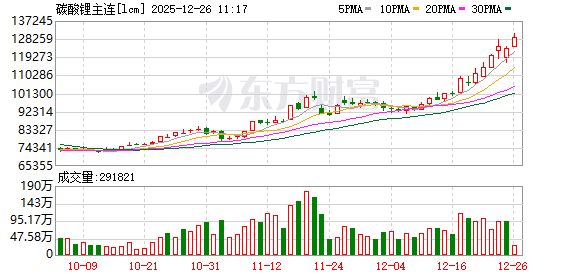
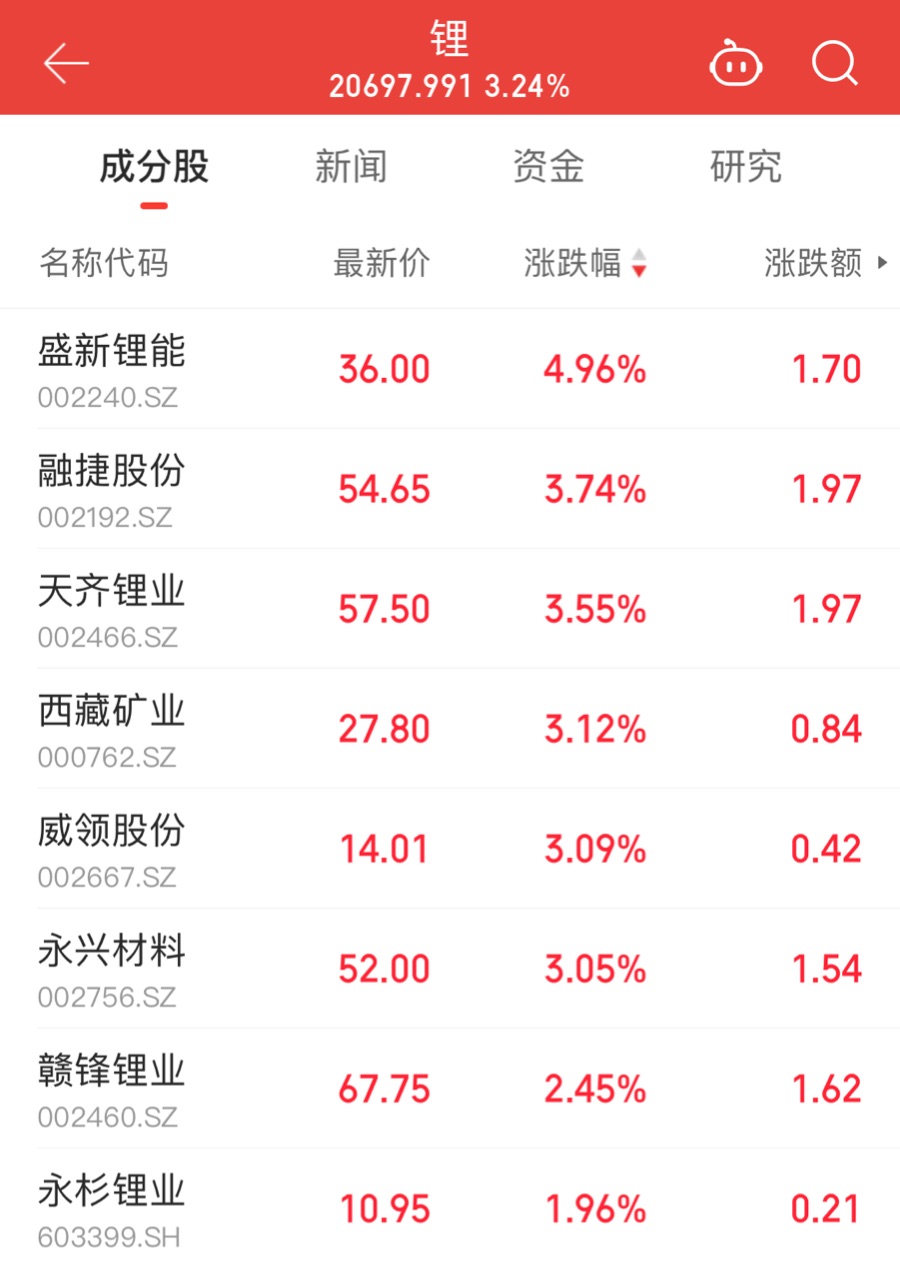
Core Viewpoint - The lithium carbonate market has experienced a significant breakthrough, with the main contract rising over 8% to surpass 130,000 yuan/ton, marking a new high since November 2023, and a year-to-date increase of 67.29% [2] Group 1: Market Performance - The lithium carbonate main contract has seen a continuous increase for six trading days, becoming one of the best-performing commodities [2] - The lithium mining sector in the A-share market responded positively, with the lithium mining index rising by 3.24%, and leading stocks such as Shengxin Lithium Energy, Rongjie Co., and Tianqi Lithium Industries seeing gains of over 3% [2] Group 2: Supply and Demand Dynamics - The recent price surge is attributed to expectations of supply contraction in the upstream industry, particularly following announcements from major companies Hunan Youneng and Wanrun New Energy regarding production cuts [2] - Hunan Youneng plans to reduce phosphate material output by 15,000 to 35,000 tons starting January 1, 2026, while Wanrun New Energy will cut production by 5,000 to 20,000 tons from December 28, 2025 [2] Group 3: Regulatory Actions - In response to the rapid price increase, regulatory bodies have implemented measures to prevent excessive speculation, including adjustments to trading limits on lithium carbonate futures contracts [3][4] - The Guangzhou Futures Exchange announced changes to minimum order quantities and daily opening limits for specific contracts to manage market volatility [4] Group 4: Future Market Outlook - Analysts suggest that the lithium carbonate market is characterized by a "strong reality and strong expectation resonance," but caution against short-term volatility risks [4] - The overall sentiment indicates a tight balance between supply and demand, with expectations of price fluctuations in the near term [4] - South China Futures predicts that 2026 will be a significant year for global energy storage demand, potentially driving lithium carbonate prices higher, while also noting constraints from supply elasticity and alternative pricing effects [5]

连涨6日,碳酸锂主力合约突破13万关口!多股大涨
2 1 Shi Ji Jing Ji Bao Dao· 2025-12-26 03:09
Core Viewpoint - The lithium carbonate market has experienced a significant breakthrough, with the main contract rising over 8% to surpass 130,000 yuan/ton, marking a new high since November 2023. The cumulative increase for the year has reached 67.29%, making it one of the best-performing commodities in the market [1]. Group 1: Market Performance - The lithium carbonate main contract has seen a continuous rise for six consecutive trading days, with a year-to-date increase of 67.29% [1]. - The lithium mining sector in the A-share market responded positively, with the Wind lithium mining index rising by 3.24% on the same day, and several leading stocks, including Shengxin Lithium Energy, Rongjie Co., and Tianqi Lithium, seeing gains of over 3% [1][2]. Group 2: Supply and Demand Dynamics - The recent price surge in lithium carbonate is attributed to expectations of supply contraction in the upstream industry. Major companies in the lithium iron phosphate sector, Hunan Youneng and Wanrun New Energy, announced production cuts, which are expected to reduce output significantly [3]. - Current market conditions show a strong balance between supply and demand, with robust long-term demand expectations. However, there are concerns about potential demand weakening due to production cuts in January [3][5]. Group 3: Regulatory Actions - In response to the rapid price increase, regulatory authorities have implemented measures to prevent excessive speculation. The Guangzhou Futures Exchange announced adjustments to trading limits for lithium carbonate futures contracts, including increasing the minimum order size and setting daily opening limits for certain contracts [4]. Group 4: Future Outlook - Analysts suggest that while the market is currently in a tight supply-demand balance, the potential for price fluctuations exists due to production cuts. The overall price trend is expected to remain strong, with a focus on maintaining a balance between supply and demand [5]. - The year 2026 is anticipated to be a significant year for global energy storage demand, which may drive lithium carbonate prices higher, although there are constraints on the upper price limit due to supply elasticity and alternative product pricing [5].
碳酸锂期货价格持续上涨 但基本面不确定因素仍较多
Qi Huo Ri Bao· 2025-12-19 00:09
Core Viewpoint - Lithium carbonate futures prices have risen over 44% since October, driven by market expectations of increased demand and supply uncertainties [1] Supply and Demand Dynamics - The resumption of production at the Jiangxiawo lithium mine next week and the launch of Jiangxi Qiangyu New Materials project have raised concerns about supply growth [1] - Analysts note that the resumption of the Jiangxiawo lithium mine is a key variable affecting supply-demand balance, with expectations of increased supply in January [1][2] - Current lithium carbonate inventory depletion has slowed, with a weekly depletion of 1,044 tons reported, down from previous levels of around 2,000 tons [2][3] Market Sentiment and Price Trends - Despite the recent price increases, there are concerns about whether the demand growth expected for 2026 will materialize, leading to potential shifts in market dynamics [1][2] - Analysts suggest that the current price levels may already reflect optimistic market expectations for 2026, indicating a potential premium [2] - The market is experiencing a reduction in bullish factors and an increase in bearish factors, raising the risk of price corrections if prices rise too quickly [2][3] Future Outlook - The uncertainty in the lithium carbonate market remains significant, with potential impacts from seasonal demand fluctuations and the resumption of lithium mining operations [3] - Downstream manufacturers' production data for the first quarter of next year will be a key focus for the market, especially in light of declining electric vehicle sales [3]
突发!联合出兵,“美军发动致命打击”!特朗普:夺回石油权益
Xin Lang Cai Jing· 2025-12-18 23:37
Group 1: U.S. Military Actions and International Relations - U.S. President Trump threatened to reclaim oil rights from Venezuela, claiming they were illegally taken from American companies [14][15] - The U.S. military conducted a strike on a vessel identified as a terrorist organization in the Eastern Pacific, resulting in four deaths [16] - The U.S. and Ecuador are collaborating on a short-term operation to enhance Ecuador's capabilities against drug trafficking [18] Group 2: Economic Indicators and Federal Reserve Policy - The U.S. Consumer Price Index (CPI) for November rose by 2.7% year-on-year, lower than market expectations, indicating a cooling inflation trend [19] - The likelihood of the Federal Reserve lowering interest rates in January increased from 26.6% to 28.8%, with traders anticipating a reduction of 62 basis points [19] Group 3: Lithium Market Dynamics - JPMorgan raised its target price for lithium carbonate to $18,000 per ton, significantly above the current spot price of approximately $13,500 per ton [19] - The report highlights that while global lithium supply is increasing, it is not keeping pace with explosive demand growth [20] - Lithium carbonate futures prices have risen over 44% since October, indicating strong market activity [20] Group 4: Supply and Demand Factors in Lithium Market - The resumption of production at the Jiangxiawo lithium mine and the launch of the Jiangxi Qiangyu new materials project have raised concerns about supply growth [20] - The weekly inventory reduction of lithium carbonate has slowed, with a decrease of 1,044 tons reported, impacting market demand expectations [21] - Analysts express uncertainty regarding the lithium carbonate market, noting potential shifts in supply-demand dynamics and the impact of seasonal demand fluctuations [22][23]


碳酸锂周报:去库趋势延续,价格延续震荡-20251215
Chang Jiang Qi Huo· 2025-12-15 05:03
Group 1: Report Overview - Report Title: Carbonate Lithium Weekly Report [2] - Report Date: December 15, 2025 [3] Group 2: Weekly Viewpoint Supply Situation - Last week, the weekly output of carbonate lithium increased by 170 tons to 24,065 tons, and the November output increased by 3% month-on-month to 103,740 tons. The Ningde Jianxiawo mine has not resumed production, and production enterprises in Yichun and Qinghai have received notices for the re-review of mining rights transfers, affecting supply. In the third quarter, Australian mines achieved cost control, and the room for further cost reduction is extremely limited. Most mainstream Australian mines have reduced their capital expenditure for fiscal year 25. [5] - In October 2025, China imported 652,000 tons of lithium concentrate, a month-on-month decrease of 8.3%. The top three countries in terms of import volume were Australia, Zimbabwe, and Nigeria. Lithium concentrate imports from Australia decreased by 15% month-on-month, imports from Zimbabwe were 150,000 tons, a month-on-month increase of 41%, and imports from Nigeria were 120,000 tons, remaining flat month-on-month. In October, carbonate lithium imports were 23,881 tons, a month-on-month increase of 21.9%, with 14,800 tons imported from Chile, accounting for 62%. [5] - The CIF price of imported lithium spodumene concentrate increased week-on-week, causing some manufacturers producing carbonate lithium from purchased lithium ore to face cost inversion. Enterprises with their own ore and salt lakes have some profit support, while lithium hydroxide manufacturers face greater cost pressure. [5] Demand Situation - In October, the overall production schedule increased month-on-month, and the production schedule of large cell factories increased by 8% in September. In November, the total output of power and other batteries in China was 176.3 GWh, a month-on-month increase of 3.3% and a year-on-year increase of 49.2%. The total export of power and other batteries was 32.2 GWh, a month-on-month increase of 14.1% and a year-on-year increase of 46.5%. The sales volume of power and other batteries was 179.4 GWh, a month-on-month increase of 8.1% and a year-on-year increase of 52.2%. The trade-in policy and the extension of the new energy vehicle purchase tax policy are expected to continue to support the rapid growth of sales in the Chinese new energy vehicle market. [6] Inventory Situation - This week, carbonate lithium inventory showed a de-stocking state, with the factory inventory of carbonate lithium decreasing by 75 tons, the market inventory decreasing by 5,615 tons, and the futures inventory increasing by 4,128 tons. [6] Strategy Suggestion - From the supply side, the Ningde Jianxiawo mine is still shut down. In November, the domestic carbonate lithium output increased by 3% month-on-month, and in October, 652,000 tons of lithium concentrate were imported, a month-on-month decrease of 8.3%. The total import volume of carbonate lithium in October was about 24,000 tons, a month-on-month increase of 22% and a year-on-year increase of 3%. Downstream demand is strong, and the de-stocking trend continues. It is expected that subsequent lithium salt imports from South America will supplement the supply. From the demand side, the terminal demand for energy storage continues to be good, but the production schedule in December is expected to decline slightly. In November, the production schedule of cathode materials increased by 2% month-on-month, and in October, it increased by 4% month-on-month. The risk of mining certificates in Yichun persists. With profit restoration, lithium extraction from ore continues to increase in production, and the cost center has shifted upward. The expectation of the Ningde Jianxiawo mine resuming production within the year has been dashed, and the downstream production schedule exceeds expectations. Attention should be paid to the disturbances at the ore end in Yichun. Downstream buyers are actively purchasing carbonate lithium, the de-stocking trend continues, and the inventory of traders has accumulated. It is expected that the price will continue to fluctuate. It is recommended to continuously monitor the progress of mining certificates in Yichun mines and the resumption of production at the Ningde Jianxiawo lithium mine. [7] Group 3: Key Data Tracking Price Data - Data on the spot tax-included average price of carbonate lithium in Shanghai Nonferrous Metals from April 1, 2019, to October 9, 2025 [9] - Data on the average price of 99.2% industrial-grade carbonate lithium from June 13, 2023, to October 13, 2025 [18] - Data on the average price of imported lithium concentrate (Li2O: 6%-6.5%) from January 2, 2019, to May 26, 2025 [21] - Data on the average price of power-type lithium iron phosphate from February 8, 2021, to September 19, 2025 [43] - Data on the market price of ternary material 8-series NCA type from January 1, 2021, to November 6, 2025 [47] Production Data - Data on the weekly production of carbonate lithium from 2021 to 2025 [10][11] - Data on the monthly production of carbonate lithium from 2021 to 2025 [12][13] - Data on the production of power and other batteries (including monthly values, values of lithium iron phosphate, and year-on-year growth rates) from January 2020 to October 2025 [24] - In November 2024, the production of carbonate lithium from different raw materials accounted for 19.56% from salt lakes, 23.05% from lithium mica, and 45.37% from lithium spodumene [25][26] - Data on the monthly production of ternary materials from 2021 to 2025 [32][33] - Data on the monthly production of lithium iron phosphate from 2021 to 2025 [36][37] Inventory Data - Data on the weekly inventory of carbonate lithium from 2021 to 2025 [14][15] - Data on the monthly factory inventory of carbonate lithium from 2021 to 2025 [19][20] Import Data - Data on the import volume of lithium spodumene from 2021 to 2025 [40][41] - Data on the import volume of carbonate lithium from 2021 to 2025 [44][45]