
经济刺激计划

Search documents

加息预期继续推动 日债收益率再触历史高点
Xin Hua Cai Jing· 2025-12-01 09:11
Core Viewpoint - The Japanese government bond market is experiencing increased volatility, with yields reaching historical highs due to expectations of interest rate hikes by the Bank of Japan, particularly affecting the 2-year and 10-year bonds [1][3]. Group 1: Interest Rate Expectations - The 2-year Japanese government bond yield rose by 3.3 basis points to 1.025%, marking the first time it has surpassed 1% since 2006 [1]. - The 10-year bond yield increased by 6.1 basis points to 1.871%, both yields reaching their highest levels since June 2008 [1]. - Bank of Japan Governor Kazuo Ueda indicated that the central bank will weigh the pros and cons of raising interest rates in the upcoming policy meeting, signaling a potential rate hike [3]. Group 2: Currency and Economic Impact - The Japanese yen strengthened to 155.55 against the dollar, following concerns over the yen's depreciation, which had previously approached historic lows near 158 yen per dollar [3]. - The depreciation of the yen is raising concerns about its negative impact on consumer spending, prompting the government and central bank to be vigilant [4]. - Analysts suggest that the combination of a weak yen and expectations of significant economic stimulus provides favorable conditions for a rate hike by the Bank of Japan [6]. Group 3: Market Dynamics and Investor Sentiment - The rapid rise in bond yields is attributed to increasing expectations that the government's economic stimulus plan may be larger than previously anticipated, raising concerns about the sustainability of Japan's long-term fiscal situation [4]. - Changes in the supply-demand dynamics of the government bond market are making yields more susceptible to upward pressure, especially with the Bank of Japan's plans to abandon its yield curve control framework by March 2024 [4]. - There is growing reliance on foreign investors for purchasing Japanese government bonds, which may lead to a more cautious stance from these investors amid concerns over fiscal deterioration due to new stimulus measures [4].

日本股债双杀,日经225一度跌超1000点,加密货币21万人爆仓
2 1 Shi Ji Jing Ji Bao Dao· 2025-12-01 09:03
Group 1 - Japan's stock market faced a significant decline, with the Nikkei 225 index dropping over 2% to 49,224.94 points, and closing down 1.89% at 49,303.28 points [1][2] - Japanese government bonds plummeted due to renewed expectations of interest rate hikes, with the 2-year bond yield surpassing 1% for the first time since 2008, and the 10-year yield rising to 1.85%, marking the highest levels since June 2008 [1][2] - The probability of a Bank of Japan interest rate hike in December increased to 64%, as Governor Kazuo Ueda signaled a potential adjustment to the monetary policy [2] Group 2 - The cryptocurrency market continued to decline, with Bitcoin falling to around $86,000, down 5.34%, and Ethereum dropping over 5%, while other cryptocurrencies like Solana and Dogecoin fell more than 7% [2] - Over the past 24 hours, more than 210,000 individuals in the cryptocurrency market faced liquidation, totaling approximately $639 million [2]
刚刚,日央行“口风”突转,日股急挫!
Jin Rong Shi Bao· 2025-12-01 09:01
Group 1 - The Japanese stock market experienced a significant decline on December 1, with the Nikkei 225 index dropping over 2%, making it one of the most notable downturns in the Asia-Pacific market for the day [1] - Market expectations regarding a shift in the Bank of Japan's monetary policy rapidly increased, serving as a direct catalyst for the stock market's sharp decline [1] - Bank of Japan Governor Kazuo Ueda indicated that the central bank would weigh the pros and cons of raising policy rates at the upcoming monetary policy meeting on December 19, suggesting a potential end to ultra-loose monetary policy [1] Group 2 - Concurrently with the stock market decline, the Japanese government bond market faced large-scale sell-offs, with the 2-year Japanese government bond yield surpassing 1% for the first time since 2008 [2] - The 5-year and 10-year government bond yields rose to 1.35% and 1.85%, respectively, marking new highs since 2008, indicating accelerated selling by investors [2] - The Japanese government announced a comprehensive economic stimulus package worth approximately 21.3 trillion yen, with a significant portion of the funding coming from a supplementary budget for the fiscal year 2025 [2]
日本先出事了,一个自爆的状态,中美都在趁它病要它命
Sou Hu Cai Jing· 2025-11-28 16:14
Group 1 - Japanese Prime Minister Kishi Nobuo made controversial remarks regarding Taiwan, echoing former Prime Minister Shinzo Abe's stance that "Taiwan's issues are Japan's issues" [1] - Japan's government debt has reached over 250% of its GDP, significantly higher than the United States, with interest payments consuming a substantial portion of tax revenue [3][4] - Japan's economy has contracted for the first time in a year and a half, with a 1.8% annualized decline in GDP for the third quarter [3] Group 2 - The Japanese financial market is experiencing a rare "triple hit" of stock, bond, and currency declines, with the Nikkei 225 index dropping 3.22% and 10-year government bond yields reaching a new high of 1.76% since 2008 [4] - The Japanese yen has depreciated significantly, falling below 155 against the US dollar and 180 against the euro, exacerbating import costs and pushing companies to relocate production overseas [6] - The Japanese government has proposed a 21.3 trillion yen economic stimulus plan, equivalent to 3.5% of Japan's GDP, with 17.7 trillion yen needing to be financed through debt [3]

新债规模激增75%!日本拟增发11.7万亿日元国债为经济刺激计划融资 长期财政状况持续惹担忧
智通财经网· 2025-11-27 06:48
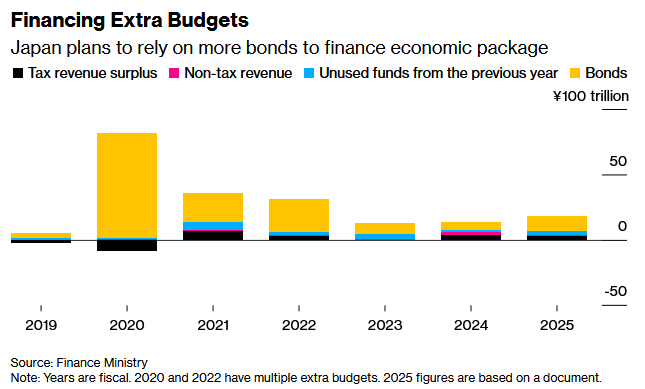
Core Points - The Japanese government plans to issue more new bonds to finance its economic stimulus package, with the new bond scale expected to exceed the previous fiscal year's level [1][4] - The supplementary budget for fiscal year 2025 is estimated at approximately 18.3 trillion yen, funded by issuing 11.7 trillion yen in government bonds [1][4] - The government aims to control borrowing by utilizing a tax revenue surplus of 2.9 trillion yen, about 1 trillion yen in non-tax revenue, and approximately 2.7 trillion yen in unused funds from the previous fiscal year [1][4] Economic Stimulus Plan - The comprehensive economic stimulus plan approved by the Japanese government amounts to 21.3 trillion yen, marking the largest stimulus measure since the pandemic began [4] - The plan addresses various areas, including inflation relief, strategic industry investment, and defense spending [4] - Specific allocations include 2.95 trillion yen for inflation response, 1.5 trillion yen for key sectors like AI and shipbuilding, and 1.3 trillion yen for defense [5][6] Fiscal Concerns - Concerns about Japan's long-term fiscal situation under Prime Minister Kishi's administration have led to increased investor anxiety, with long-term government bond yields reaching over 20-year highs [7] - The dollar to yen exchange rate is reported at 155.95, while the 20-year and 30-year government bond yields are at 3.329% and 3.677%, respectively [7] - To stabilize market sentiment, Prime Minister Kishi indicated that the total government bond issuance for the current fiscal year would be lower than the previous year, with a total issuance of 40.3 trillion yen expected for fiscal year 2025 [9]
日本拟增发2年期和5年期国债 为经济刺激计划筹措逾7万亿日元
Sou Hu Cai Jing· 2025-11-27 00:15
Core Points - The Japanese government plans to increase the issuance scale of 2-year and 5-year government bonds in the revised debt issuance plan for the fiscal year 2025 to fund economic stimulus measures [1] - The total planned government bond issuance for the current fiscal year, ending in March, will increase by approximately 7 trillion yen (about 44.7 billion USD) from the original 171.8 trillion yen [1] - The issuance amounts for 10-year, 20-year, 30-year, and 40-year government bonds will remain unchanged [1] - The government is expected to increase the issuance scale of discount treasury bills by about 6 trillion yen and may raise the monthly issuance of 2-year and 5-year bonds by 100 billion yen each starting in January [1] - The revised issuance plan will be submitted for discussion at the government bond market underwriting meeting and then presented for cabinet review [1]
日本经济虚弱难以消受“猛药”
Jing Ji Ri Bao· 2025-11-26 22:39
Core Points - The Japanese government approved a massive economic stimulus plan totaling 21.3 trillion yen (approximately 135.4 billion USD) amid rising tariffs from the U.S., a return to economic recession, high government debt, soaring living costs, and weak household consumption [1] - Japan's economy has shown signs of negative growth, with the GDP declining at an annualized rate of 1.8% in Q3, reflecting the impact of U.S. tariffs, particularly on the automotive sector [1][2] - The core Consumer Price Index (CPI) in Japan rose by 3.0% year-on-year in October, marking the 50th consecutive month of increase, with significant price hikes in rice and other essential goods [2] - The capital markets are reacting negatively, with the yen depreciating significantly against the dollar, reaching a 10-month low, and long-term government bonds facing sell-offs, pushing yields to multi-year highs [3] - The economic stimulus plan includes 17.7 trillion yen from supplementary budgets and 2.7 trillion yen from tax cuts, aimed at addressing living costs and inflation, but is viewed skeptically by economists regarding its effectiveness [4] - The government's abandonment of the annual fiscal surplus target raises concerns about Japan's fiscal health, with current debt levels exceeding twice the economic output [4][5] - The stimulus measures may exacerbate inflation rather than alleviate it, as increased government borrowing could lead to higher interest rates, further depreciating the yen and raising import prices [5] - There are warnings from political figures about the potential for a "Truss shock" scenario in Japan, similar to the UK experience, if fiscal policies are not managed responsibly [6]
高市早苗拟大幅举债推行17.7万亿日元经济刺激计划 日债收益率飙升至20年新高
智通财经网· 2025-11-26 12:29
Core Points - The Japanese government, led by Prime Minister Fumio Kishida, plans to issue more new bonds to finance its economic program, exceeding last year's levels, raising concerns about public finances and rising yields [1][4] - The supplementary budget will involve the issuance of at least 11.5 trillion yen (approximately 73.5 billion USD) in bonds, despite a record tax revenue forecast of 80.7 trillion yen for the current fiscal year [1] - The new debt burden is significantly higher than the 6.7 trillion yen issuance required for the economic measures under former Prime Minister Shigeru Ishiba [1] - The supplementary budget, which includes 17.7 trillion yen in new spending, is set to be approved by the cabinet [1] - Concerns about Japan's long-term fiscal situation under Kishida's leadership have unsettled investors, with long-term government bond yields reaching their highest levels in over two decades [4] - Kishida attempted to reassure the market by stating that the total bond issuance for the current fiscal year will be lower than last year's total of 42.1 trillion yen for both initial and supplementary budgets [4]

终于要出手了?高市早苗:日本政府已做好准备,随时采取“必要”行动干预日元
Hua Er Jie Jian Wen· 2025-11-26 12:09
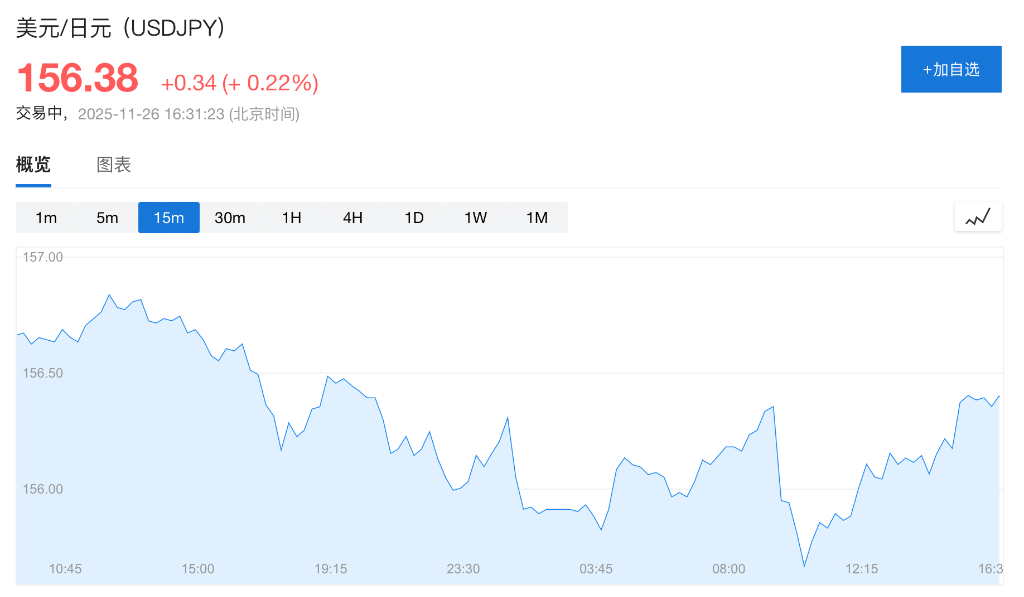
Core Points - Japanese Prime Minister Sanae Takaichi emphasized the government's readiness to monitor exchange rate fluctuations and take necessary actions to ensure fiscal sustainability and defend the economic stimulus plan [1][4] - The market is closely watching whether the Japanese authorities will shift from verbal warnings to actual intervention, especially during the low liquidity period created by the U.S. Thanksgiving holiday [1][4] Group 1: Government Actions and Statements - The Japanese government is prepared to monitor the nature of exchange rate fluctuations, distinguishing between those driven by economic fundamentals and speculative behavior [1] - Takaichi defended the economic stimulus plan, stating it is not "reckless spending" and committed to reducing Japan's debt-to-GDP ratio [1] - The Prime Minister highlighted that ensuring Japan's fiscal sustainability is the most important priority [1] Group 2: Market Conditions and Potential Interventions - The upcoming U.S. Thanksgiving holiday and subsequent low trading volumes create an ideal environment for potential currency intervention by Japanese authorities [4] - Historical data indicates that Japan tends to intervene during such low liquidity periods to achieve significant price impacts with less capital [4] - The key challenge for Japanese authorities is to effectively curb excessive depreciation of the yen without depleting foreign exchange reserves [4]
高市经济学“猛药”恐毒害日本
Zhong Guo Jing Ji Wang· 2025-11-25 13:18
Economic Stimulus Plan - The Japanese government approved a total economic stimulus plan of 21.3 trillion yen, with 17.7 trillion yen from supplementary budget arrangements and 2.7 trillion yen from tax cuts [1] - The spending is divided into three categories: 11.7 trillion yen for "living security and price measures," 7.2 trillion yen for "crisis management and growth investment," and 1.7 trillion yen for "strengthening defense and diplomacy" [1] Economic Performance - Japan's GDP decreased by 1.8% year-on-year in the third quarter, marking the second negative growth since Q1 2024 [2] - The decline is attributed to the negative impact of U.S. tariffs on the automotive industry, which has been severely affected [2] - The Japanese government has revised its economic growth forecast for FY2025 from 1.2% to 0.7% due to ongoing challenges [2] Inflation and Consumer Prices - The consumer price index (excluding fresh food) rose by 3.0% year-on-year in October, marking the 50th consecutive month of increase [2] - Significant price increases were noted in rice (up 40.2%), chocolate (up 36.9%), and coffee beans (up 53.4%) [2] - The depreciation of the yen is contributing to rising consumer prices, with imported price increases being passed on to domestic retail [2] Market Reactions - Concerns over Japan's fiscal deterioration have intensified, leading to a depreciation of the yen, which fell to its lowest level in 10 months [3] - The yield on newly issued 20-year government bonds reached 2.810%, the highest in 26 years, while the 10-year yield hit approximately 1.8%, the highest since 2008 [3] - The Tokyo stock market has experienced declines, with the Nikkei 225 index dropping below 49,000 points [3] Fiscal Policy Changes - The government has abandoned its goal of achieving an annual fiscal surplus, which is seen as a significant policy shift [4] - The scale of supplementary budgets has increased dramatically post-pandemic, with the current budget reaching 17.7 trillion yen [4] - Concerns are raised about the sustainability of expansionary fiscal policies without reliable funding sources, drawing parallels to the UK's "Truss shock" [4] Economic Cycle Concerns - The large-scale economic stimulus measures may not effectively address high inflation and could potentially exacerbate the situation [5] - Analysts suggest that the government's approach may lead to a "vicious cycle" where stimulus measures fail to alleviate economic pressures [5] - Critics argue that the government's fiscal policies are neither "active" nor "responsible," with calls for a reassessment of the current strategy [6]