
结构性货币政策工具

Search documents
统筹完善发展金融“五篇大文章”
Xin Lang Cai Jing· 2026-02-26 21:46
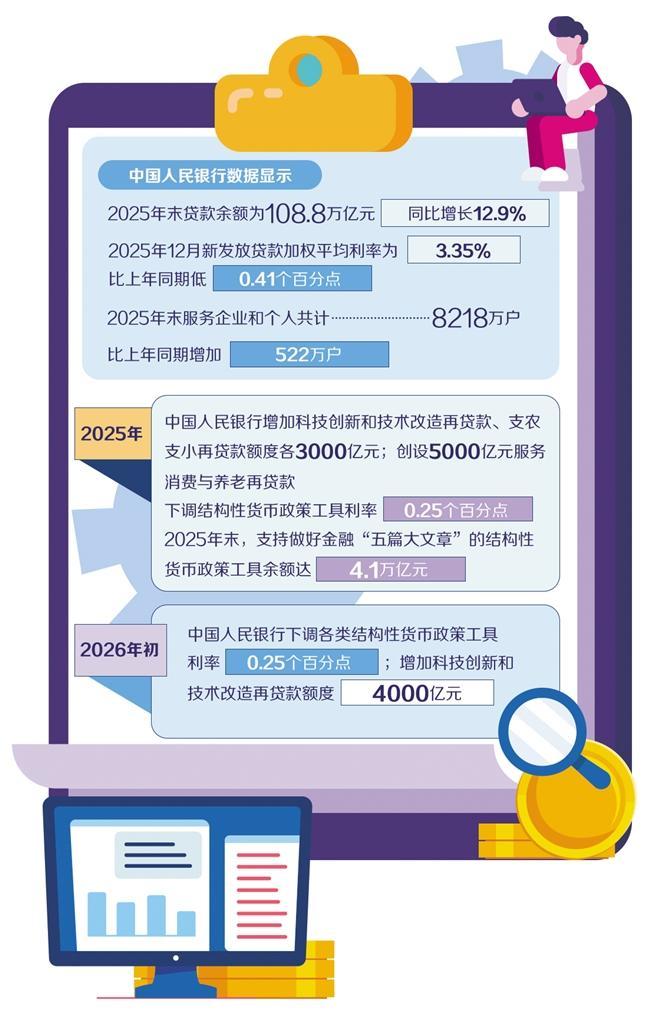
Group 1 - The core viewpoint of the articles emphasizes the importance of financial support in facilitating China's economic transformation and high-quality development, particularly through the implementation of the "Five Major Financial Articles" strategy [2][8][9] - By the end of 2025, the loan balance reached 108.8 trillion yuan, reflecting a year-on-year growth of 12.9%, with the average interest rate for new loans at 3.35%, down by 0.41 percentage points from the previous year [1][2][3] - The number of enterprises and individuals served by financial institutions increased to 82.18 million, an increase of 5.22 million from the previous year, indicating improved access to financing [2][3] Group 2 - The People's Bank of China (PBOC) has enhanced its structural monetary policy tools, increasing the quotas for re-loans aimed at technological innovation and agricultural support by 300 billion yuan each, and creating a 500 billion yuan re-loan for consumer and elderly care services [3][5] - As of the end of 2025, the balance of structural monetary policy tools supporting the "Five Major Financial Articles" reached 4.1 trillion yuan, demonstrating a significant commitment to optimizing financial structures [3][9] - The PBOC plans to further lower the interest rates of various structural monetary policy tools by 0.25 percentage points in early 2026, and increase the quotas for re-loans for technological innovation and transformation by 400 billion yuan [3][9] Group 3 - Financial institutions are increasingly focusing on supporting small and medium-sized enterprises (SMEs) and technology-driven companies, with a reported 28.6% increase in technology loans as a proportion of total loans by the end of 2025 [7] - The loan balance for technology-oriented SMEs reached 3.6 trillion yuan, growing by 19.8%, which is 13.6 percentage points higher than the overall loan growth rate [7] - The issuance of technology innovation bonds in the interbank bond market reached 1 trillion yuan, with 390 entities participating, indicating a robust market for financing innovation [7] Group 4 - The banking sector is adapting to the "Five Major Financial Articles" strategy by restructuring its capabilities and integrating more deeply into the industrial ecosystem, with large commercial banks playing a leading role [8][9] - The focus on key areas such as technological self-reliance and rural revitalization is becoming more pronounced, with different types of banks exploring differentiated services [8][9] - The PBOC aims to maintain a relatively loose monetary policy to support balanced credit growth and enhance financial services for the real economy, which is crucial for economic stability and growth [9]

LPR连续九个月“按兵不动” 年内仍存下行空间
Zhong Guo Zheng Quan Bao· 2026-02-24 20:38
Group 1 - The People's Bank of China announced that the one-year Loan Prime Rate (LPR) remains at 3.0% and the five-year LPR at 3.5%, unchanged for nine consecutive months, indicating potential downward space within the year [1] - The stability of the LPR aligns with market expectations, as the policy interest rates have not changed, and banks are lacking the motivation to lower LPR quotes due to a sustained low net interest margin of 1.42% [1] - Factors such as strong export performance and rapid development in high-tech manufacturing have contributed to the LPR's stability, with the central bank implementing a structural monetary policy package in January 2026 [1] Group 2 - The chief economist at CITIC Securities anticipates a high certainty of interest rate cuts within the year, with the timing dependent on the recovery of credit demand [2] - It is expected that after the initial rate cuts from structural monetary policy tools, a reduction in policy rates may occur in the second quarter, leading to a subsequent decline in LPR and guiding down loan rates for businesses and households [2] - There is a possibility that regulatory authorities will significantly lower the five-year LPR and combine it with fiscal subsidies to further reduce residential mortgage rates [2]
LPR连续九个月“按兵不动”年内仍存下行空间
Zhong Guo Zheng Quan Bao· 2026-02-24 20:28
Core Viewpoint - The People's Bank of China has maintained the Loan Prime Rate (LPR) at 3.0% for the 1-year term and 3.5% for the 5-year term, indicating a stable monetary policy environment with potential for future rate cuts [1] Group 1: Current LPR Situation - The LPR has remained unchanged for nine consecutive months, reflecting a stable pricing basis for February [1] - The net interest margin for commercial banks has been low at 1.42%, reducing the incentive for banks to lower LPR quotes [1] - The current financing costs for the real economy are relatively low, with the average interest rate for new corporate loans at approximately 3.2%, down about 20 basis points year-on-year [1] Group 2: Future Expectations - There is a high certainty of interest rate cuts within the year, with the timing dependent on the recovery of credit demand [2] - It is anticipated that after initial structural monetary policy rate cuts, a reduction in policy rates may occur in the second quarter, leading to a subsequent decline in LPR [2] - Regulatory authorities may guide a significant reduction in the 5-year LPR, potentially combined with fiscal subsidies to lower residential mortgage rates further [2]
2月MLF续作加量3000亿,短期内降准的可能性较小
Sou Hu Cai Jing· 2026-02-24 12:34
Core Viewpoint - The People's Bank of China (PBOC) announced a 600 billion MLF operation to maintain liquidity in the banking system, indicating a continued supportive monetary policy stance amid potential tightening pressures [1][2]. Group 1: MLF Operations - On February 25, 2026, the PBOC will conduct a 600 billion MLF operation with a one-year term, marking the 12th consecutive month of increased MLF issuance [1]. - The MLF rollover in February is 300 billion, which is less than the previous month's 700 billion, indicating a smaller increase in liquidity [1]. Group 2: Liquidity and Economic Stability - The net liquidity injection in February reached 900 billion, continuing a trend of net injections for 10 months, although slightly lower than the previous month's 1 trillion [1]. - The increase in MLF and other liquidity measures aims to support major projects and stabilize macroeconomic operations, especially with the early issuance of local government bonds [1][2]. Group 3: Monetary Policy Implications - The significant increase in mid-term liquidity injections suggests a reduced likelihood of a reserve requirement ratio (RRR) cut in the short term, indicating a period of observation following the introduction of structural policies in January [2]. - The PBOC's actions are intended to counter potential liquidity tightening effects while ensuring stable funding for government bond issuance and maintaining credit support from banks [2].
LPR报价已经连续9个月不变
Sou Hu Cai Jing· 2026-02-24 12:34
Core Viewpoint - The People's Bank of China has maintained the Loan Prime Rate (LPR) unchanged for nine consecutive months, with the 1-year rate at 3.0% and the 5-year rate at 3.5%, indicating a stable monetary policy environment amid low net interest margins for banks [1][2]. Group 1: LPR and Monetary Policy - The LPR has remained stable due to unchanged policy rates, which serve as a pricing basis for the LPR [3]. - The net interest margin for commercial banks is at a historical low of 1.42%, reducing the incentive for banks to lower LPR quotes [1][3]. - The central bank's focus on maintaining low financing costs has resulted in a stable monetary policy, with no significant new operations in total tools since the last economic work conference [4]. Group 2: Economic Outlook and Future Actions - Analysts predict a high certainty of interest rate cuts within the year, contingent on the recovery of credit demand, with a close watch on financial data in the first quarter [7]. - The potential for a comprehensive policy rate cut in the second quarter is anticipated, especially in response to external trade pressures and to stimulate domestic consumption and investment [6][7]. - The central bank may also implement targeted measures to lower the 5-year LPR significantly to address high mortgage rates and stimulate housing market demand [7].
1月份金融数据“开门红”成色十足
Jin Rong Shi Bao· 2026-02-24 02:16
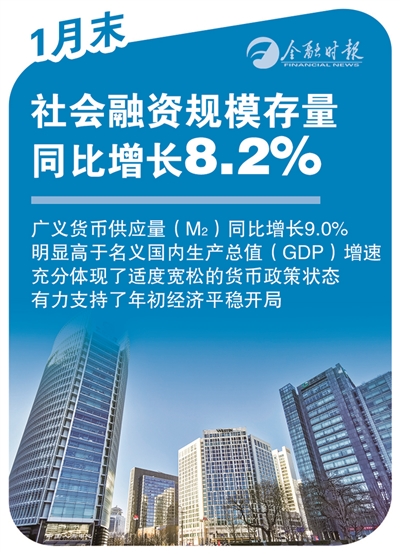
Core Viewpoint - The latest financial statistics released by the central bank indicate that the growth rates of M2 and social financing remain high, creating a favorable monetary environment for economic recovery [1][3]. Monetary Policy and Financing Growth - As of the end of January, the stock of social financing increased by 8.2% year-on-year, while M2 grew by 9.0%, significantly outpacing nominal GDP growth, reflecting a moderately loose monetary policy [3][4]. - The proactive macroeconomic policies, including a reduction in the structural tool interest rate by 0.25 percentage points and increased government bond financing, are key drivers of this growth [3][4]. - In January, government bond financing reached 976.4 billion yuan, an increase of 283.1 billion yuan compared to the same period last year, with its share in total social financing at 13.5%, the highest since 2021 [3][4]. Direct Financing Channels - Besides government bonds, corporate bonds and equity financing are also accelerating, with a focus on providing diversified funding support for high-tech and emerging industries [4][5]. - Companies are increasingly considering a "short loan + long bond" financing model to balance funding costs and durations for project investments and R&D [4]. Credit Growth and Demand Recovery - By the end of January, the balance of RMB loans was 276.62 trillion yuan, growing by 6.1% year-on-year, which is still above nominal economic growth [6][7]. - The first quarter typically sees high credit issuance, and early policy implementation can yield quicker results [6]. - Major projects are driving increased project loan disbursements, with the National Development and Reform Commission announcing a total investment of approximately 295 billion yuan for early construction projects [6]. Support for the Real Economy - In January, new loans to enterprises reached 4.45 trillion yuan, with over 70% being medium- and long-term loans, providing substantial support for manufacturing and emerging industries [7][8]. - Personal loans are also experiencing stable growth due to increased consumer spending ahead of the holiday season, supported by favorable policies extending personal consumption loan interest subsidies [7][8]. High-Quality Development Financing - The growth of inclusive small and micro loans reached 37.16 trillion yuan, with a year-on-year increase of 11.6%, indicating a shift of credit resources towards high-quality development sectors [8][9]. - The central bank's structural monetary policy tools, such as re-loans, are effectively supporting consumption and innovation, with significant increases in funding for small and medium-sized enterprises [9][10]. Future Monetary Policy Focus - Experts suggest that future monetary policy should emphasize structural optimization, as the economy transitions to medium-high growth and faces challenges such as high household leverage and bank asset quality [10].
浙江:用好结构性货币政策工具助力民营经济发展
Zhong Guo Jin Rong Xin Xi Wang· 2026-02-23 09:52
Core Viewpoint - The article highlights the implementation of structural monetary policy tools by the People's Bank of China to support technological innovation and equipment upgrades in enterprises, particularly in Zhejiang province, which is expected to enhance the productivity and financial health of local businesses [1][2][3]. Group 1: Policy Initiatives - The People's Bank of China has introduced eight measures to enhance structural monetary policy tools, aiming to guide financial resources towards key sectors and weak links in the economy [1][3]. - Zhejiang banks have quickly responded to these initiatives by facilitating financing for equipment upgrades and technological transformations, utilizing measures such as expedited approvals and interest rate discounts [1][2]. Group 2: Financial Support for Enterprises - A specific case is highlighted where a loan of 30 million yuan was provided to a company for its technological upgrade project, which is expected to generate over 100 million yuan in new output [1]. - Agricultural Bank of China tailored a five-year loan plan of 85 million yuan for a company, which is designed to match the project construction cycle and alleviate short-term financial pressure, saving the company approximately 225,000 yuan annually in financial costs [2]. Group 3: Economic Impact and Future Projections - By 2025, Zhejiang plans to utilize innovative re-loan methods, establishing a special quota of 20 billion yuan for supporting agriculture and small enterprises, aiming to drive over 200 billion yuan in new loans in foreign trade, consumption, and technological innovation sectors [2]. - Cumulatively, by the end of 2025, loans exceeding 210 billion yuan will be issued in specific fields supported by technological innovation and consumption, positioning Zhejiang among the top provinces in the country for these financial tools [2].
全国首批!湖北银行成功落地湖北省首笔民营企业再贷款业务
Sou Hu Cai Jing· 2026-02-13 09:05
Core Viewpoint - The successful implementation of the first private enterprise re-loan business by Hubei Bank, amounting to 1 billion yuan, marks the official launch of the central bank's newly established structural monetary policy tool in Hubei [1][2]. Group 1 - Hubei Bank has prioritized lending to private enterprises with strong core technologies and promising market prospects, as well as those involved in green and low-carbon transitions and supply chain security [1]. - The bank aims to serve over 10,000 small and micro private enterprises with a loan balance of 55 billion yuan by the end of 2025 [1]. - The People's Bank of China has provided expert guidance to ensure the efficient and compliant processing of the first re-loan transaction [1]. Group 2 - Hubei Bank plans to enhance its long-term financial service mechanisms for private enterprises, aiming to improve the quality, efficiency, coverage, and cost of financing services [2]. - The bank will explore innovative models such as "re-loan + credit loan" and "re-loan + supply chain finance" to facilitate the transmission of monetary policy and support the high-quality development of Hubei's private economy [2].
广东落地全国首批民营企业再贷款 哪些民企可申请?
Guang Zhou Ri Bao· 2026-02-13 07:32
Core Viewpoint - The implementation of the first batch of private enterprise re-loans in Guangdong marks a significant step in supporting the high-quality development of the private economy, with a total of 2.5 billion yuan allocated to local banks for this purpose [1]. Group 1: Policy Implementation - The People's Bank of China (PBOC) has introduced a 1 trillion yuan re-loan policy aimed at supporting private small and micro enterprises [1]. - The Guangdong branch of the PBOC has developed detailed implementation plans and guidelines to ensure the effective rollout of the re-loan policy [1]. - Key measures include establishing a management system, calculating credit limits for re-loans, and enhancing policy communication to foster consensus among stakeholders [1][2]. Group 2: Financial Institutions and Loan Characteristics - Eligible financial institutions for applying for private enterprise re-loans include urban commercial banks, rural commercial banks, rural cooperative banks, rural credit cooperatives, village banks, and private banks [4]. - The re-loan program supports lending to private small and micro enterprises, with loan terms available in three durations: 3 months, 6 months, and 1 year [4][5]. - The interest rates for these loans are set at 0.95% for 3 months, 1.15% for 6 months, and similar terms for 1 year, with collateral requirements generally based on pledges [5]. Group 3: Future Directions - The PBOC's Guangdong branch plans to continue leveraging structural monetary policy tools like re-loans to ensure that private small and micro enterprises benefit from more policy incentives [2]. - There is an emphasis on collaboration between fiscal and financial policies to sustain the momentum of support for the private economy in Guangdong [2].

中国:中国人民银行结构性货币政策工具入门-China_ A primer on the PBoC‘s structural monetary policy instruments
2026-02-11 15:40
Summary of the PBoC's Structural Monetary Policy Instruments (SMPIs) Industry Overview - The report focuses on the People's Bank of China (PBoC) and its structural monetary policy instruments (SMPIs) as a response to economic challenges in China, particularly in the context of monetary policy and fiscal coordination. Key Points and Arguments 1. Increasing Importance of SMPIs - The PBoC has prioritized SMPIs in its policy toolkit, utilizing targeted easing measures such as rate cuts and quota expansions to facilitate precise credit allocation to key sectors while minimizing liquidity spillovers into asset markets [1][3][4]. 2. Recent Actions by the PBoC - On January 15, the PBoC cut interest rates on all SMPIs by 25 basis points, with the interest rate on the Pledged Supplementary Lending (PSL) lowered to 1.75% and re-lending rates to 1.25%. The re-lending quota for science-tech innovation was increased by RMB400 billion, and for agriculture and small businesses by RMB500 billion, with a specific allocation of RMB1 trillion for private SMEs [3][4]. 3. Reasons for the Rising Significance of SMPIs - The PBoC is using SMPIs to replace foreign exchange (FX) purchases as a primary method of base money creation. SMPIs provide targeted funding to align with Beijing's strategic financial objectives, particularly the "five major mandates" outlined at the 2023 Central Financial Work Conference [4][36]. 4. Potential Decline of SMPIs - While SMPIs are currently significant, their role may diminish over time as the PBoC may revert to conventional monetary policy to manage funding costs. The instruments may blur the lines between monetary and fiscal policy, potentially compromising the PBoC's independence [5][59]. 5. Historical Context of SMPIs - SMPIs have gained traction since the mid-2010s due to declining FX inflows and the need for targeted monetary support. Prior to 2014, FX purchases were the main channel for base money creation, but this shifted as the PBoC began using lending to banks as a primary tool [7][10]. 6. Operational Mechanism of SMPIs - SMPIs operate on a "lend first, borrow later" basis, where banks extend loans to priority sectors and the PBoC reimburses a portion of the principal. This mechanism aims to ensure targeted deployment of funds while maintaining risk-sharing [42][43]. 7. Connection with Fiscal Policy - SMPIs often intersect with fiscal policy, creating synergies that enhance their impact. For instance, fiscal subsidies complement monetary incentives, which can lower borrowing costs for manufacturers and support consumption [51][52]. 8. Drawbacks of Monetary-Fiscal Coordination - The coordination between monetary and fiscal policies raises concerns about the PBoC's role as a monetary authority, potentially leading to distortions in funding costs and market signals. This could compromise the PBoC's focus on price stability and economic growth [54][55]. 9. Future Outlook for SMPIs - The PBoC is expected to continue relying on SMPIs for growth support without resorting to high-profile measures that could destabilize markets. Future policies may focus on expanding quotas and lowering lending rates to address economic headwinds [56][58]. 10. Impact on Monetary Base and M2 - SMPIs contribute to the expansion of the monetary base by injecting reserves into banks, which supports broad money supply growth. As FX inflows decline, SMPIs help maintain liquidity in the banking system [50]. Additional Important Content - The report highlights the PBoC's strategic focus on the "five major mandates" of finance, which include technology finance, green finance, inclusive finance, pension finance, and digital finance, aimed at aligning financial resources with national priorities [36][37]. - The effectiveness of SMPIs is contingent on the transmission mechanisms amid weak private demand, as evidenced by negative household loans in late 2025 [41]. This comprehensive overview captures the essential elements of the PBoC's SMPIs and their implications for China's monetary policy and economic landscape.