
美国GDP

Search documents
美元指数震荡蓄力冲击 美联储动向成关键指引
Jin Tou Wang· 2026-01-13 02:31
Core Viewpoint - The US dollar index is experiencing a slight rebound, supported by hawkish comments from Federal Reserve officials and a resilient US economy, despite political pressures on the Fed [1][2]. Group 1: Economic Indicators - The US unemployment rate for December was reported at 4.4%, slightly below expectations, alleviating concerns about the labor market [2]. - The Federal Reserve's stance indicates no immediate reason for interest rate cuts, with GDP growth projected between 2.5% and 2.75% for 2026 [1]. Group 2: Market Performance - The dollar index has shown a fluctuating upward trend since the beginning of January, rising from 97.905 to around 98.90, with a cumulative increase of over 1% [2]. - The dollar index is currently trading above the 5-day and 10-day moving averages, indicating a bullish trend [2]. Group 3: Support and Resistance Levels - Key support has shifted to 98.87, previously a resistance level, with additional strong support between 98.40 and 98.50 [3]. - The 99.00 level is identified as a critical short-term resistance, with potential upward movement towards 99.22 and further resistance at 99.50 and 100.00 [3].
张瑜:美国经济的冷与热:总量向上,民生向下——美国三季度GDP点评
一瑜中的· 2025-12-26 16:03
Core Viewpoint - The third quarter GDP of the United States exceeded expectations, with a quarter-on-quarter annualized growth rate of +4.3%, up from +3.8% previously and above the expected +3% [2][38] - The economic data indicates a K-shaped recovery, where overall economic growth contrasts with declining living standards for many, highlighting a significant wealth gap [4][13] Group 1: Economic Disparities - AI-related investments continue to drive economic growth, with a contribution of +0.4% to GDP growth in Q3, while traditional non-AI investments show negative growth [6][14] - The wealth effect from AI is concentrated among the top 20% of income earners, who hold approximately 87% of all stock assets, leaving the majority of the population unable to benefit from this growth [7][23] - 67% of wage-dependent individuals are classified as "living paycheck to paycheck," with a significant portion unable to cover daily expenses, contributing to rising credit defaults and declining consumer confidence [7][23] Group 2: Employment and Consumer Behavior - The job market remains weak, particularly for low-wage positions, with new job creation in these sectors expected to be below 100,000 annually starting in 2024 [8][29] - AI's contribution to economic growth does not translate into job creation, instead replacing entry-level positions, leading to higher unemployment rates among younger demographics [8][30] - The housing market is also struggling, with high mortgage rates and rising home prices making homeownership increasingly unattainable for average earners [9][35] Group 3: GDP Data Analysis - Q3 GDP growth was primarily driven by strong consumer spending, particularly in services, while durable goods consumption remained weak [6][42] - Private investment showed a decline, with inventory investment improving but still negative, indicating ongoing challenges in traditional sectors [6][43] - Net exports weakened significantly due to a contraction in imports, while government spending increased, contributing positively to GDP growth [6][46]


美国GDP的虚假繁荣:AI行业热火朝天 其他行业黯淡过冬
Sou Hu Cai Jing· 2025-12-25 10:41
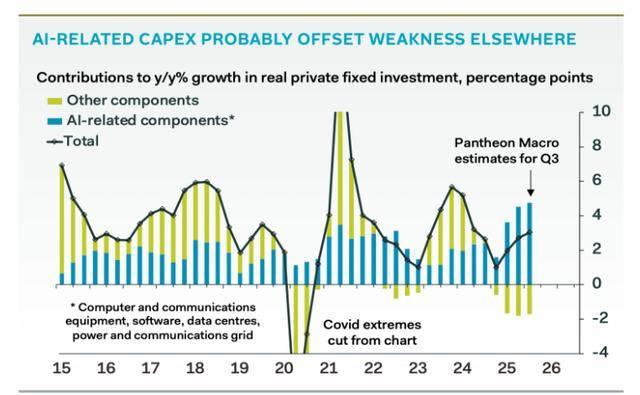
Group 1 - The U.S. GDP grew by 4.3% year-on-year in Q3, significantly exceeding analysts' expectations of 3.2% [1] - Wall Street traders reacted positively to the strong GDP data, leading to a multi-day rise in U.S. stock markets [1] - Some analysts raised concerns that the GDP growth may largely be attributed to contributions from the AI sector, while non-AI sectors are reportedly shrinking [1] Group 2 - Pantheon Macroeconomics reported that private fixed investment in Q3 only increased due to AI-related spending, with all non-AI sectors experiencing declines [2] - Deutsche Bank analysts noted that investment in AI-related industries is crucial for GDP growth, suggesting that without tech-related spending, the U.S. would be close to recession [4] - Major companies in the AI sector, including Alphabet, Meta, Microsoft, Amazon, and Oracle, are projected to spend $399 billion on AI this year, with future spending expected to exceed $600 billion [4] Group 3 - A significant portion of AI capital expenditures is supported by debt, with net supply of new debt related to AI expected to exceed $200 billion by 2025, doubling from the previous year [6] - Goldman Sachs indicated that 30% of the net supply of dollar credit this year is related to AI, with expectations for further increases next year [6] - By 2030, cumulative investments by these tech giants in AI data centers are projected to reach $4 trillion, surpassing the inflation-adjusted cost of the Apollo moon landing program by tenfold [6][8]
美国GDP公布后,美元、美债走低,黄金收涨!
Jin Rong Shi Bao· 2025-12-24 08:00
Group 1 - The core viewpoint of the articles indicates that the U.S. GDP grew at an annualized rate of 4.3% in Q3, surpassing the 3.8% growth rate of Q2, driven by increased consumer spending, exports, and government spending [1][2] - Consumer spending, which accounts for about 70% of the U.S. economy, increased by 3.5% in Q3, up from 2.5% in Q2, contributing 2.39 percentage points to GDP growth [2] - Exports rose by 8.8%, contributing 1.59 percentage points to GDP growth, while government consumption and investment added 0.39 percentage points [2] Group 2 - Non-residential fixed investment grew by only 2.8% in Q3, significantly lower than the 7.3% growth in the previous quarter, indicating potential concerns regarding business investment [1] - Despite the strong GDP growth figures, financial markets reacted calmly, with the U.S. dollar index falling by 0.35% and U.S. Treasury yields showing mixed movements [1] - Economists suggest that while the economy maintained growth momentum in Q3, potential pressures from a federal government "shutdown" could lead to a slowdown in Q4, with projections for 2025 GDP growth possibly dropping to 2% or lower [2]
美国三季度GDP折年增速反弹至4.3%
HTSC· 2025-12-24 07:01
Economic Growth - The annualized GDP growth rate for the US in Q3 2025 rebounded to 4.3%, exceeding Bloomberg's consensus estimate of 3.3%[1] - The year-on-year GDP growth rate increased by 0.2 percentage points to 2.3%[1] Consumer and Investment Trends - Private consumption growth accelerated from 2.5% to 3.5%, contributing 2.4 percentage points to GDP, indicating strong resilience in consumer spending[1] - Private investment growth (excluding inventory) slowed from 4.4% to 1.0%, contributing only 0.2 percentage points to GDP[2] Trade and Exports - Export growth rebounded to 8.8%, while import growth continued to decline, leading to a narrowing trade deficit that contributed 1.6 percentage points to GDP[2] - The trade deficit decreased by $0.1 trillion to $0.96 trillion, representing 4.0% of GDP, down 0.5 percentage points from Q2[2] Government Spending - Government investment and consumption growth rebounded to 2.2%, contributing 0.4 percentage points to GDP[3] - Federal government defense investment and consumption accelerated significantly, turning from -5.3% to 2.9%[3] Inventory and Future Outlook - Inventory drawdown's negative impact on GDP narrowed to 0.2 percentage points from 3.4 percentage points in Q2[3] - Despite strong Q3 performance, potential government shutdown may lead to a technical slowdown in Q4, with estimates suggesting a GDP growth reduction of over 1 percentage point[4]
美国2025年三季度GDP数据点评:25Q3美国GDP:过时的数据,过度的反应
Soochow Securities· 2025-12-24 04:05
Economic Performance - Q3 2025 US GDP grew at an annualized rate of +4.3%, significantly exceeding Bloomberg analysts' consensus of +3.3% and Atlanta Fed's GDPNow estimate of +3.5%[1] - The GDP price index increased by +3.8%, compared to an expected +2.7% and a previous value of +2.1%[1] Consumption and Inventory - Strong consumer spending contributed +2.39% to GDP growth, with a quarterly increase of +3.5%, up from +1.68% in the previous quarter[1] - Inventory changes had a marginal contribution of -0.22%, improving from -3.44% in the previous quarter, indicating a reduction in inventory drag[1] Investment Trends - Fixed asset investment growth slowed to +1% in Q3, down from +4.4% in Q2, with non-residential fixed asset investment decreasing to +2.8%[1] - AI-related industry investment growth decelerated, with contributions to GDP from computer information equipment and software dropping significantly[1] Market Reactions - Initial market reactions to the strong GDP data indicated fears of economic overheating, leading to a rise in the dollar index and US Treasury yields, while equities and commodities fell[1] - Following the initial reaction, asset prices reversed, with US Treasury yields and the dollar declining, while equities rebounded[1] Future Outlook - Q4 2025 GDP growth is expected to significantly cool due to government shutdown impacts, with consumer spending showing signs of decline[2] - The Congressional Budget Office estimated a potential -1.5% impact on Q4 GDP due to the government shutdown, alongside high base effects from Q3[2] Core Economic Indicators - The Private Domestic Final Purchases (PDFP) annualized growth rate remained stable at +3.0%, only slightly up from +2.9% in the previous quarter, indicating resilient core economic growth[1] - Daily consumer spending growth has recently dropped to +0.156% year-on-year, suggesting a potential drag on Q4 GDP[2]
美国第三季度实际 GDP 年化季率初值录得 4.3%,核心 PCE 物价指数年化季率初值为 2.9%
Xin Lang Cai Jing· 2025-12-23 13:54
Core Insights - The initial annualized GDP growth rate for the United States in Q3 is recorded at 4.3%, significantly exceeding the expected 3.3% and the previous value of 3.8% [1] - The core PCE price index annualized rate is reported at 2.9%, aligning with market expectations and higher than the previous rate of 2.6% [1] - The actual personal consumption expenditures (PCE) quarterly rate is noted at 3.5%, markedly above the expected 2.7% and the prior value of 2.5% [1]
【comex白银库存】12月5日COMEX白银库存较上一日减少4.66 吨
Jin Tou Wang· 2025-12-08 11:10
根据美国经济分析局(BEA)的数据,2025年前三个月GDP同比下降0.6%。第二季度则增长了3.8%。BEA 对第三季度经济结果的初步估算计划于12月23日发布。亚特兰大联邦储备银行在12月5日的最新估算显 示,第三季度年化GDP增长率为3.5%。 消费者支出占美国GDP的近70%,但他们对经济状况仍持悲观态度。密歇根大学的消费者信心调查在12 月录得53.3,较11月上升4.5%,但比去年同期下降了28%。 12月5日,COMEX白银库存录得14216.50吨,较上一日减少4.66 吨;comex白银上周五(12月5日)收 报58.88美元/盎司,上涨2.31%,comex白银价格日内最高上探至59.90美元/盎司,最低触及57.32美元/盎 司。 【要闻回顾】 美国财长贝森特周日表示,迄今为止,今年的假日购物季表现"非常强劲",预计美国经济将在年底保持 稳健。他在接受采访时说:"经济表现比我们预期的更好。我们在几个季度实现了4%的GDP增长。尽 管"民主党导致"政府停摆,我们今年仍将以3%的实际GDP增长收官。" 最新comex白银库存数据: | 日期 | comex白银库存量(吨) | 增持/减持(吨 ...
哈塞特:如有机会愿意出任美联储主席 主张更大幅度降息
Sou Hu Cai Jing· 2025-11-12 20:08
Core Viewpoint - The White House National Economic Council Director Hassett has expressed willingness to accept the position of Federal Reserve Chair if nominated, advocating for more aggressive interest rate cuts in December [1] Summary by Relevant Sections - **Interest Rate Policy** - Hassett suggests that the Federal Reserve should implement a larger rate cut, ideally by 50 basis points, although he anticipates a more modest 25 basis points cut [1] - He expresses surprise at Powell's lack of aggressive rate cuts given the prolonged government shutdown and better-than-expected inflation data [1] - **Economic Impact of Government Shutdown** - Hassett estimates that each week of government shutdown results in a reduction of approximately $15 billion in U.S. GDP [1] - **Inflation Data** - The inflation data for September was reported to be lower than expected, which may influence future monetary policy decisions [1]
海外周报20251026:美国CPI势弱,联储10月降息几无悬念-20251026
Soochow Securities· 2025-10-26 12:32
Inflation Data - September US CPI was below expectations, with a month-on-month increase of +0.3% compared to the expected +0.4%[1] - Core CPI also underperformed, rising +0.2% month-on-month against an expectation of +0.3%[1] - Year-on-year CPI increased by 3.0%, slightly below the expected 3.1%[1] Housing Inflation - The Owner's Equivalent Rent (OER) component saw a significant drop from +0.38% to +0.13%, marking a new low since the pandemic[1] - Housing inflation's contribution to overall CPI was notably affected by this OER decline, which has a high weight of 26% in the CPI calculation[1] Market Trends - Major global stock indices rose due to better-than-expected corporate earnings and easing trade risk sentiment, with the S&P 500 and Nasdaq increasing by 1.9% and 2.3% respectively[1] - Gold prices fell sharply by over 5% due to profit-taking from previous highs, while WTI crude oil surged by 6.9% to $61.5 per barrel[1] Federal Reserve Outlook - Analysts expect the Federal Reserve to cut rates by 25 basis points in both October and December meetings, with the policy rate likely dropping to 3.75% by year-end[2] - The market is increasingly betting on consecutive rate cuts due to tightening liquidity conditions and ongoing regional bank risks[1] Economic Growth Projections - Analysts have revised the Q3 2025 US GDP growth forecast upwards to 2.8%, while slightly downgrading Q4 2025 and Q1 2026 projections[2] - The consensus for PCE year-on-year growth has been adjusted downwards, with Q3 2025 now expected at 2.7%[2] Risks - Potential risks include unexpected policy shifts from Trump, excessive rate cuts leading to inflation rebound, and prolonged high rates causing liquidity crises in the financial system[2]