追涨杀跌

Search documents
中金:“赚过”,是波动送给我们的一场幻觉
Ge Long Hui· 2026-01-13 08:47
Core Viewpoint - High volatility in investments can significantly erode long-term compound growth, creating a "volatility tax" that impacts returns despite short-term gains [1] Group 1: Impact of Volatility - Investors often experience fleeting moments of profit, but high volatility can lead to actual losses due to emotional trading behaviors like "buy high, sell low" [1] - Under equal simple return conditions, higher asset volatility results in lower compound returns, with a trend of accelerated decline [1] Group 2: Recommendations for Investors - Diversification is the most fundamental and effective method to manage volatility [1] - Investors should assess their tolerance for net value fluctuations when allocating assets [1] - Building a "anti-fragile" system is essential, emphasizing the use of idle funds for investment [1] - Focus on risk-adjusted returns rather than just yield rankings, learning to evaluate metrics like the Sharpe ratio [1] - Embrace the philosophy that "slow is fast" in investing, as remaining invested allows time to work in favor of the investor [1]
蛤,赚到道心碎裂...
Ge Long Hui· 2026-01-05 10:59
Core Insights - A well-known influencer reportedly made over 80 million last year, highlighting the potential for significant gains in a bullish market [1] - The influencer's relatively small account size suggests that while gains can be substantial, they may not have a major emotional impact compared to larger accounts [1] - The characteristics of small accounts indicate that they can yield high returns in a bull market but are also susceptible to losses in a bear market [1] Market Performance - The market last year was characterized by aggressive buying and selling, with notable gains in stocks like Xinyisheng, Silver LOF, and the Nasdaq ETF [1] - The influencer's accounts showed impressive returns, with three accounts yielding returns of 123 million, 123 million, and 85 million respectively [1]
2025年全民追的“金” 藏着经济的秘密
Xin Lang Cai Jing· 2026-01-02 06:38
Group 1 - Gold has become a major topic in 2025, with prices reaching historical highs and experiencing significant volatility, attracting widespread investment interest [1][2][3] - As of December 31, the spot gold price reached $4,346.45 per ounce, with a yearly increase of 70%, marking the most remarkable market performance since 1980 [2] - The surge in gold prices has led to increased consumer demand for gold products, including wedding jewelry and investment bars, with banks and e-commerce platforms lowering entry barriers for gold purchases [3][4] Group 2 - The rise in gold prices is attributed to various global economic factors, including negative real interest rates, a shift in global monetary policy, and ongoing geopolitical tensions, which have heightened demand for gold as a safe-haven asset [7][8] - Central banks have been net buyers of gold for three consecutive years, using it as a reserve asset, which has provided strong support for gold prices [7][8] - The increase in gold prices reflects a broader distrust in fiat currencies, particularly the US dollar, as inflationary pressures persist and market confidence in the dollar diminishes [5][11] Group 3 - The continuous rise in gold prices may have mixed effects on the economy, potentially increasing the value of gold reserves while also raising costs for related goods and impacting trade balances [9][10] - As the largest consumer of gold globally, China's demand is approximately 1,200 tons annually, with a significant portion reliant on imports, which could exacerbate trade deficits due to rising gold prices [9][10] - The high gold prices could lead to inflation expectations spreading, affecting consumer prices for jewelry and other goods, thereby influencing the Consumer Price Index (CPI) [10][11]
新股上市割韭菜,尾盘大变脸,追高者10万变6万,明天还能出来吗?
Sou Hu Cai Jing· 2025-12-27 08:58
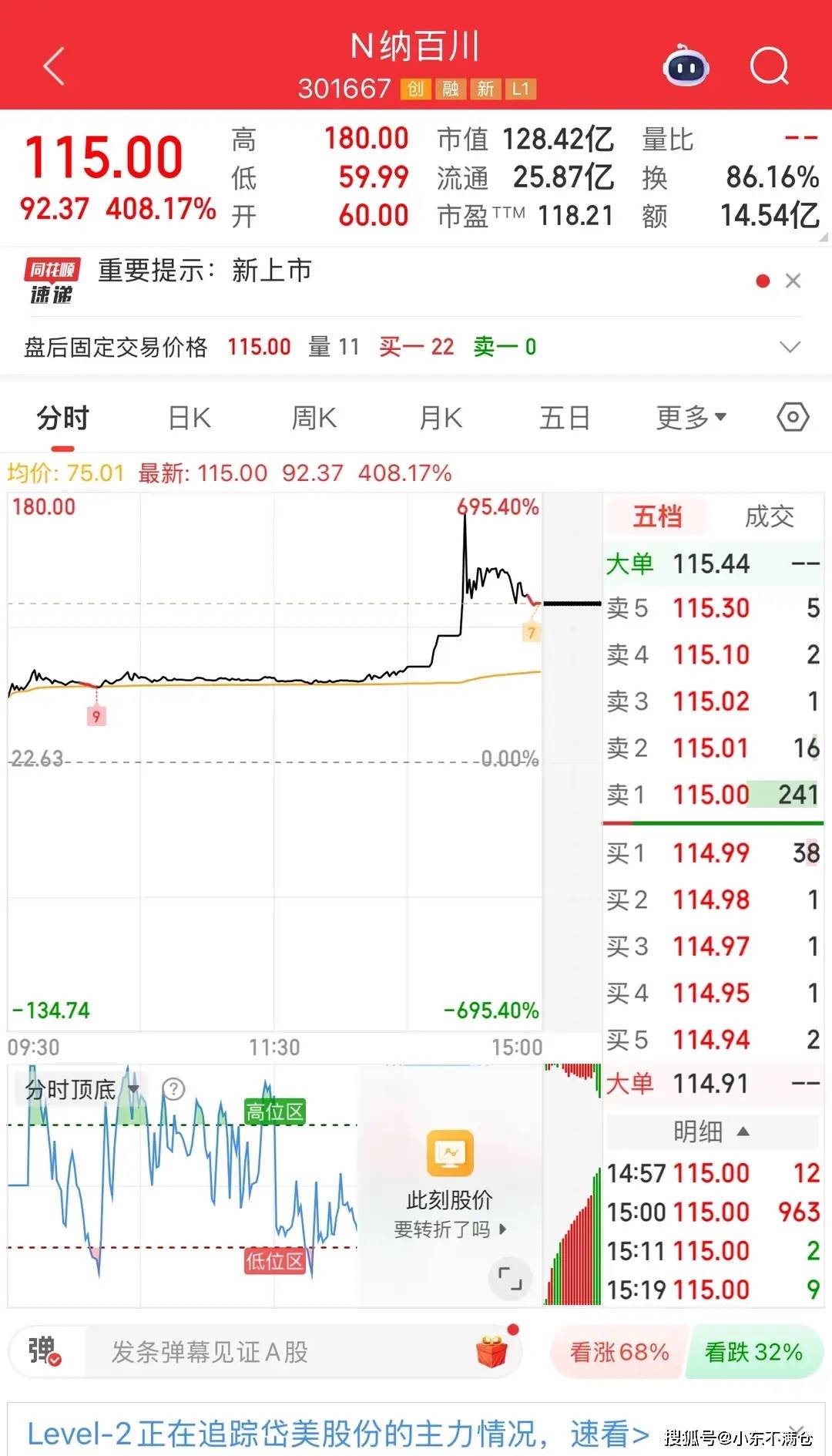
Group 1 - The stock "Nabichuan" had an initial offering price of 22.63 yuan and saw a significant increase of 165% at the opening, reaching over 60 yuan, which is typical for new stocks on their first day [4] - By the afternoon, the stock price surged to a peak increase of 642%, leading to substantial losses for late investors who entered at high prices, with a hypothetical investment of 100,000 yuan dropping to around 60,000 yuan by the close [6] - Nabichuan focuses on the research, production, and sales of thermal management products for power batteries, including battery liquid cooling plates and integrated battery boxes, while its competitor, Xihua Technology, specializes in high-end equipment components, primarily for wind power gearboxes [6] Group 2 - Financial projections for Nabichuan indicate revenues of 1.031 billion yuan, 1.136 billion yuan, and 1.437 billion yuan for the years 2022 to 2024, with net profits of 113.3 million yuan, 98.25 million yuan, and 95.43 million yuan respectively, showing a decline in net profit of 2.88% year-on-year for 2024 [6] - Investor sentiment is characterized by a tendency to buy at high prices, with comments reflecting a belief that prices could continue to rise despite significant losses, indicating a common behavior among retail investors [8][11] - The market reaction to new stocks often leads to volatility, with expectations of price corrections following initial surges, as seen in the anticipated opening price drop of around 33% for Nabichuan [10]

价值投资是万万不可行的?
集思录· 2025-12-18 14:15
所以投资最重要的事,是发挥自己的长处,只做自己能懂的事。千万不要干,自己搞不懂, 还偏要不懂装懂的去干。认真对待自己,搞清自己那些不懂,实际上是投资的第一步,跨不 过这一步,后面的也别想走。实际上90%的人,第一步都跨不过去,因为很简单,许多人喜 欢糊涂过一生。 yup77 要搞懂赚谁的钱的问题。二级市场追涨杀跌其实是股民互相伤害模式,而低估买入持股收息 才是正确打开模式。当然不否认有些人追涨杀跌非常成功,但是价值投资更适合大部分人。 价值投资是一种信仰,是一项艺术,是一门科学。 以我近30年的投资经验,化作36字,与集友共享 选股思路:低估值高分红,少圈钱多回购,有增长不套现(的公司) 操作思路:分散投长期持,暴跌买大涨卖,好心态乐知足 为什么这么说?是由于我最近看了大道的访谈有关,以前我一直不太关注价值投资,因为我 搞不懂。最近慕名看了大道的访谈,我明白了我为什么搞不懂价值投资。因为价值投资实际 上是极难的,难到什么程度?大道作为名符其实的杰出企业家,能够搞懂的企业也寥寥无 几。我作为一个毫无企业经营经验的人,凭什么能够搞懂企业的未来? 宿不移 0分。 标题里加上几个字: 我做 价值投资是万万不可行的 大 ...

如何看待沪深300的追涨杀跌?
雪球· 2025-12-16 08:53
Core Viewpoint - The article emphasizes that annual rebalancing of indices is a systematic process governed by transparent rules rather than subjective market judgments, highlighting the importance of understanding these rules for effective investment strategies [5][8][11]. Group 1: Annual Rebalancing - The second Friday of December marks the annual rebalancing day for most indices, leading to changes in sample stocks and their valuations [5][6]. - Criticism often arises regarding the inclusion of high-performing stocks and the exclusion of underperforming ones, but these changes are a result of established rules rather than market speculation [6][10]. - Understanding that rebalancing reflects adherence to rules rather than market sentiment is crucial for investors [8][35]. Group 2: Market Capitalization Indices - Market capitalization indices, such as the CSI 300 and SSE 50, aim to represent key companies in the market based on size and liquidity, rather than seeking to capitalize on market fluctuations [16][17]. - These indices naturally exhibit a tendency to include companies that have increased in size and performance while excluding those that have declined, which can be misinterpreted as "buying high and selling low" [18][19]. - The design of market cap indices prioritizes transparency and alignment with economic structures over short-term gains [20][21]. Group 3: Strategy Indices - Strategy indices, like dividend indices, focus on specific factors such as dividend yield rather than market capitalization [24][25]. - These indices adjust their components based on the stability of dividend payments, leading to a different risk-return profile compared to market cap indices [28]. - The mechanism of strategy indices allows for continuous alignment with predetermined financial metrics, rather than predicting future market movements [27][28]. Group 4: Understanding Index Characteristics - Market capitalization indices and strategy indices serve different purposes and are not mutually exclusive; they address distinct investment needs [31][32]. - Market cap indices provide a baseline for market returns, while strategy indices can be used for risk management and income generation [32][33]. - Misinterpretation of indices often stems from short-term emotional reactions rather than a proper understanding of their long-term rules [34][35].

每日钉一下(指数调仓会使指数追涨杀跌吗,我们该如何应对?)
银行螺丝钉· 2025-12-13 13:43
Core Viewpoint - The article discusses the investment strategies for index funds, emphasizing the importance of understanding index rebalancing and its impact on investment performance [6][7][8]. Group 1: Index Rebalancing - Index rebalancing refers to the adjustment of constituent stocks in an index according to specific rules, which can lead to buying high and selling low during market fluctuations [6][7]. - Regular rebalancing can cause indices like the CSI 500 and CSI 1000 to follow a pattern of buying stocks that have risen significantly and selling those that have fallen, potentially exacerbating market volatility [7][8]. Group 2: Historical Context - The phenomenon of indices chasing performance was observed during the 1990s tech bubble in the U.S., where stocks associated with the internet saw significant price increases, leading to their inclusion in major indices like the Nasdaq 100, which later suffered during the market correction [8]. Group 3: Solutions to Mitigate Risks - Two strategies are proposed to mitigate the risks associated with index rebalancing: 1. Consider strategy indices that do not rely on market capitalization for stock selection, thus avoiding the pitfalls of performance chasing [11][12]. 2. Explore enhanced index funds, which invest 80% in index constituents while using 20% for active management to avoid stocks with clear bubbles [13][14].

突然暴涨!北证50“一枝独秀”原因找到了!
Xin Lang Cai Jing· 2025-12-12 04:16
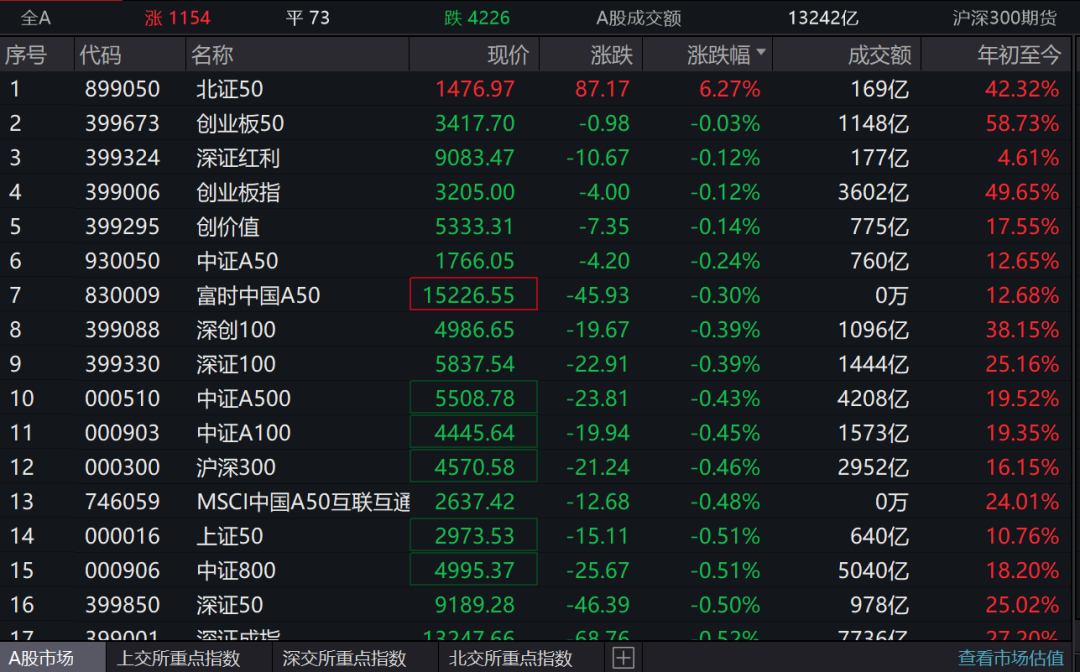
Market Overview - The overall market was relatively sluggish, but the North Exchange 50 index surged, rising over 6% during the afternoon session, making it the only index in the A-share market to show gains [1][14]. - The total trading volume in the A-share market reached 1,324.2 billion, with 1,154 stocks rising, 73 remaining flat, and 4,226 declining [2][15]. North Exchange 50 Performance - The North Exchange 50 index closed at 1,476.97, with a gain of 87.17 points, representing a 6.27% increase [2][15]. - The trading volume for the North Exchange 50 was reported at approximately 200 billion, which is a significant increase compared to the recent daily average of around 100 billion [5][16]. Fund Inflows and Investment Trends - The surge in the North Exchange 50 is attributed to passive inflows from newly opened two-year fixed-term theme funds, as the North Exchange 50 ETF has not yet been issued [4][18]. - There are currently 11 funds focused on the North Exchange, all of which are two-year fixed-term funds, indicating a growing interest from investors [18][19]. Investor Sentiment - There is a notable interest from retail investors in the North Exchange funds, with a significant increase in the number of views on these funds, suggesting a strong demand for entry into the market [22]. - The best-performing stocks in the North Exchange are primarily in the basic metals and aerospace software sectors, which are popular among investors due to their low market capitalization compared to similar sectors [22]. Investment Strategies - The market appears to be divided into two camps: one focusing on long-term value investing, while the other follows a "trend-following" strategy, which emphasizes buying into rising stocks and sectors [24][26]. - Recent reports suggest that "buying the dip" strategies may not perform as well as trend-following strategies, indicating a shift in investment approaches among market participants [25][26].
A股现在还是牛市吗?|投资小知识
银行螺丝钉· 2025-12-06 14:03
Group 1 - The A-share market typically experiences a small bull-bear cycle every 3-5 years, potentially reaching a 3-star level, as seen in early 2018 and early 2021; larger bull markets occur every 7-10 years, possibly reaching 1-2 star levels, exemplified by 2007 and 2015 [2] - The long-term annualized return for the A-share market, starting from 1000 points at the end of 2004 to approximately 5700 points by the end of November 2025, is around 8%-9%, with dividends pushing it to about 7600 points, resulting in an annualized return of around 10% [2] - The A-share market's bull markets are rarely characterized as slow; they are typically rapid, followed by periods of consolidation or decline [4] Group 2 - Recent significant price increases in the A-share market occurred mainly in late September 2024 and during a few trading days in August-September 2025, with major up days accounting for only 7% of total trading days [4] - In the third quarter of 2025, the ChiNext index saw a remarkable 50% increase, marking the largest single-quarter gain in the past decade [5] - Investors are advised to avoid two main pitfalls during bull markets: chasing prices and frequent trading, as market styles are expected to rotate quickly in 2025 [6]