成长风格

Search documents
股指周报:中美大国博弈仍在反复,关注四中全会是否利多提振-20251020
Zheng Xin Qi Huo· 2025-10-20 05:29
Report Industry Investment Rating No relevant information provided. Core Views - The US government shutdown and Sino-US frictions before the APEC meeting have led to a RISK OFF trading mode, negatively impacting overvalued and crowded AI technology assets. The upcoming 15th Five-Year Plan and the Fourth Plenary Session in China next week may bring unexpected positive effects; otherwise, the market may face further adjustment risks [4]. - Domestically, economic data remains weak, especially in consumption and real estate. Industrial enterprise capacity utilization has declined marginally, indicating slow progress in anti-involution policies and ongoing efforts to reverse deflation. Leading companies in pro-cyclical industries are expected to have better profit prospects [4]. - Domestic liquidity is generally loose, but the central bank has tightened funds in the open market. Passive ETF funds and margin trading funds have continued to attract capital, while industrial capital has increased its reduction, and foreign capital has flowed out significantly recently. Credit impulses have started to decline from their peak, weakening the positive impact of market liquidity [4]. - After a short-term small adjustment, the valuations of various indices remain at relatively high historical levels. The equity-bond risk premiums at home and abroad are at historical lows, and broad-based indices have limited attractiveness to allocation funds, but there are still structural opportunities [4]. - Overall, the limited liquidity in the large-scale market makes it difficult to drive continuous growth. During the window of positive macro-policy implementation, the market will choose a direction, with funds shifting from the aggressive growth style to the cyclical style for year-end valuation switching. It is recommended to adopt a high-selling and low-buying strategy for stock index futures next week, selling short IC and IM index futures on rebounds and buying long IF and IH index futures on sharp declines [4]. Summary by Directory 1. Market Review - **Global Stock Performance**: In the past week, the Dow Jones Index led the gains, while the Hang Seng Tech Index led the losses. The performance order was Dow Jones Index > FTSE Europe > FTSE Emerging Index > Shanghai Stock Exchange 50 > Nikkei 225 > Germany DAX > CSI 300 > CSI 500 > Hang Seng Tech Index [8]. - **Domestic Stock Performance**: The Shanghai Composite Index fell by 1.47%, the Shenzhen Component Index by 4.99%, the ChiNext Index by 5.71%, and the Hang Seng Index by 3.97%, among others [9]. - **Industry Performance**: The banking sector led the gains, while the consumer services sector led the losses [12]. - **Futures Performance**: The basis rates of the four major stock index futures (IH, IF, IC, and IM) changed by 0.47%, 0.63%, 0.9%, and 0.88% respectively, and the delivery discounts of the four major futures converged to par. The inter - period spread rates (between the current month and the next month) of the four major stock index futures changed by - 0.55%, - 0.67%, - 1.05%, and - 0.57% respectively, and the inter - period discounts significantly widened. The inter - period spread rates (between the next quarter and the current month) of the four major stock index futures changed by - 0.66%, - 0.73%, - 1.27%, and - 0.58% respectively, and the forward discounts of each futures contract widened significantly [20]. 2. Fund Flow - **Margin Trading and Stabilization Funds**: Margin trading funds continued to flow in 15.42 billion yuan last week, reaching 2.46 trillion yuan, and the proportion of margin trading balance to the circulating market value of the Shanghai and Shenzhen stock markets increased by 0.08% to 2.63%. The scale of passive stock ETF funds decreased by 70.07 billion yuan to 3638.85 billion yuan last week, due to the market decline [23]. - **Industrial Capital**: In October, the cumulative equity financing was 13.56 billion yuan, with 1 company involved. Among them, IPO financing was 0.79 billion yuan, private placement was 12.77 billion yuan, and convertible bond financing was 3.8 billion yuan. The scale of equity financing decreased significantly. The market value of stock market unlockings last week was 78.4 billion yuan, an increase of 32.6 billion yuan from the previous week. The annualized reduction in October was 248.4 billion yuan, and the scale of reduction continued to increase marginally [26]. 3. Liquidity - **Monetary Injection**: Last week, the central bank's OMO reverse repurchase expired at 1021 billion yuan, with a reverse repurchase injection of 67.3 billion yuan, resulting in a net monetary withdrawal of 347.9 billion yuan. The MLF had a net injection of 300 billion yuan in September, and the overall liquidity supply was neutral to loose but tightened marginally [28]. - **Monetary Demand**: Last week, the net monetary demand from national debt issuance was 16.63 billion yuan, and from local debt issuance was 18.09 billion yuan. The total net monetary demand from the bond market was 557.58 billion yuan. The debt financing demand of local governments and national debt decreased significantly, while that of enterprises increased marginally [31]. - **Fund Price**: DR007, R001, and SHIBOR overnight rates changed by - 1.4bp, 3.8bp, and 0bp respectively to 1.41%, 1.36%, and 1.32%. The issuance rate of inter - bank certificates of deposit rebounded by 8.2bp, and the CD rate of joint - stock banks increased by 4.4bp to 1.67%. The overall fund price fluctuated at a low level and increased marginally [34]. - **Term Structure**: Last week, the yields of 10 - year, 5 - year, and 2 - year national bonds changed by - 1.6bp, - 1.4bp, and - 0.7bp respectively, and the yields of 10 - year, 5 - year, and 2 - year national development bonds changed by - 4.6bp, - 2bp, and 0.3bp respectively. The yield term structure continued to flatten, the long - end yields declined slightly due to stock market adjustments and weak economic data, and the short - end yields were relatively strong due to liquidity tightening. The credit spread between national bonds and national development bonds narrowed at the long - end, and the expectation of broad credit cooled down [38]. - **Sino - US Interest Rate Spread**: As of October 17, the US 10 - year Treasury yield changed by - 3.0bp to 4.02%, the inflation expectation changed by - 3.0bp to 2.27%, and the real interest rate remained unchanged at 1.75%. The Sino - US interest rate spread inversion narrowed by 3.42bp to - 219.43bp, and the offshore RMB appreciated by 0.28% [40]. 4. Macroeconomic Fundamentals - **Real Estate Demand**: As of October 16, the weekly trading area of commercial housing in 30 large - and medium - sized cities was 2.129 million square meters, a seasonal increase of 0.483 million square meters from the previous week, but a 49.7% decrease compared to the same period in 2019. The second - hand housing sales rebounded seasonally, but the overall real estate market still showed a weak peak season. The market sales were supported by rigid demand at a low level, and more incremental policies were awaited to boost the recovery [43]. - **Service Industry Activity**: As of October 17, the average daily subway passenger volume in 28 large - and medium - sized cities decreased by 0.8% year - on - year to 81.44 million person - times, but increased by 24.8% compared to the same period in 2021. The Baidu congestion delay index of 100 cities rebounded slightly from the previous week, and the service industry economic activity tended to grow naturally and stably but cooled down marginally [47]. - **Manufacturing Tracking**: The capacity utilization rate of the manufacturing industry stopped falling and rebounded. The capacity utilization rates of steel mills, asphalt, cement clinker enterprises, and coke enterprises changed by - 0.22%, 1.3%, - 2.87%, and - 0.94% respectively. The average operating rate of the chemical industry chain related to external demand decreased by 0.13% from the previous week. Overall, the internal and external demand of the manufacturing industry cooled down, the capacity utilization rate decreased marginally, and the external demand was under short - term pressure due to the resurgence of Sino - US trade frictions [51]. - **Goods Flow**: The goods flow and passenger flow remained at relatively high levels but declined marginally beyond the seasonal norm, indicating the pressure on the real economy. The transportation volume of highways and railways decreased beyond the seasonal norm, indicating a cooling of exports [56]. - **Imports and Exports**: In terms of exports, the resurgence of Sino - US trade frictions, the approaching expiration of the 90 - day exemption, and the end of the rush to export under tariff disturbances will increase the export pressure marginally in the future [58]. - **Overseas Situation**: The US economic data is strong. Although the US government shutdown has affected the release of CPI and non - farm payroll reports, the market still expects the Fed to cut interest rates twice in the remaining part of 2025, with a total reduction of about 50bp. The probability of an interest rate cut in October is as high as 99%, and the probability in December has risen to 94%. The expected end - of - year interest rate is between 3.5% - 3.75% [61]. 5. Other Analyses - **Valuation**: The equity - bond risk premium was 2.68%, an increase of 0.1% from the previous week, at the 48.3% quantile, below the central level. The foreign capital risk premium index was 3.62%, a rebound of 0.08% from the previous week, at the 18.5% quantile, indicating a low level of attractiveness to foreign capital. The valuations of the Shanghai Stock Exchange 50, CSI 300, CSI 500, and CSI 1000 indices were at the 90.1%, 83.9%, 93.6%, and 79.7% quantiles respectively in the past five years, at relatively high levels. The quantiles changed by 3.3%, - 3.1%, - 5%, and - 4.1% respectively from the previous week, indicating that the attractiveness of the cyclical style decreased marginally, while that of the growth style index increased marginally [64][69]. - **Quantitative Diagnosis**: According to the seasonal pattern analysis, the stock market in October is in a period of seasonal oscillatory rise and structural differentiation, with the cyclical style dominant and the growth style generally oscillating at a high level. The stock market in October generally has a good profit - making effect, and the style is easy to switch. Considering the high valuation of the growth style and the relatively weak real economy, but with positive macro - policy expectations in October, it is recommended to buy long stock index futures on sharp declines this week and bet on the oversold rebound opportunities of IC and IM [72].
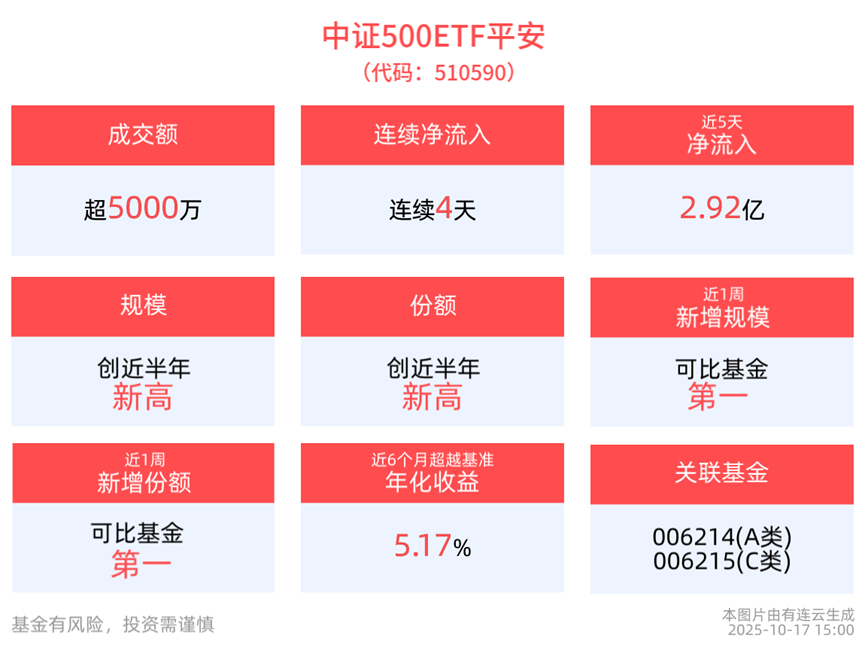
成长风格有望迎来反弹,中证500ETF平安(510590)规模创新高!
Xin Lang Cai Jing· 2025-10-20 01:46
Group 1 - The overall market showed a preference for value style over growth style, primarily due to increased uncertainty in US-China relations and significant selling pressure on growth stocks [1] - After a substantial adjustment, some growth style indices have entered a bottom divergence state, suggesting a potential rebound following the recent downturn [1] - It is advised to consider a stable allocation in the growth style, particularly in the CSI 500 Index, rather than chasing industry themes [1] Group 2 - The latest VAT invoice data indicates that "specialized, refined, and new" small giant enterprises have seen a sales revenue increase of 8.2% year-on-year, with high-tech manufacturing enterprises growing by 11.8% [2] - The research and technical service industry, a key area for technology integration and value transformation, reported a sales revenue growth of 22.3% year-on-year [2] - Strategic emerging industries are thriving, with high-tech industries and equipment manufacturing sales revenues increasing by 15.2% and 9% respectively [2] - The implementation of the "Artificial Intelligence +" initiative has led to significant sales revenue growth in integrated circuit manufacturing (17%), robotics (21.7%), and drone manufacturing (69.8%) [2] Group 3 - As of October 17, 2025, the CSI 500 Index has decreased by 2.98%, with individual stocks showing mixed performance [4] - The CSI 500 ETF has seen a recent decline of 2.45%, but has accumulated a 15.96% increase over the past three months [4] - The CSI 500 ETF has recorded a trading volume of 57.62 million yuan, with a turnover rate of 7.24% [4] - The CSI 500 ETF has experienced continuous net inflows over the past four days, totaling 292 million yuan [4] Group 4 - The CSI 500 ETF has achieved a net value increase of 21% over the past five years, with a maximum monthly return of 22.89% since inception [5] - The ETF's annualized return over the past six months has outperformed the benchmark by 5.17% [5] - The Sharpe ratio for the CSI 500 ETF over the past year stands at 1.41, indicating a favorable risk-adjusted return [6] Group 5 - The maximum drawdown for the CSI 500 ETF over the past six months is 7.07%, with a relative benchmark drawdown of 0.14% [7] - The management fee for the CSI 500 ETF is 0.50%, and the custody fee is 0.10% [7] - The CSI 500 ETF closely tracks the CSI Small Cap 500 Index, which reflects the overall performance of small-cap listed companies in the Shanghai and Shenzhen markets [7] - The top ten weighted stocks in the CSI Small Cap 500 Index account for 7.8% of the index, with notable companies including Shenghong Technology and Huagong Technology [7]

以史为鉴看本轮风格切换的时间和幅度
Changjiang Securities· 2025-10-19 23:30
Group 1 - The A-share market is currently experiencing an adjustment phase, with a shift from growth to value style, influenced by various short-term disturbances, differing from previous cycles [1][5][7] - A historical review from 2009 shows seven significant phases of style switching in the A-share market, indicating that such transitions are closely related to changes in fundamentals and economic cycles [5][6][7] - The current style switch is primarily driven by short-term factors such as external tariff concerns and profit-taking in the technology sector, rather than fundamental changes in the growth-value dynamic [7][8] Group 2 - The report highlights that the current value style dominance is characterized by two scenarios: upward market adjustments during economic improvements or downward adjustments due to rapid economic declines [6][7] - Historical data indicates that significant style switches often coincide with economic turning points or major policy adjustments, with the probability of switching increasing when the relative difference in ROE between value and growth indices widens [6][7][15] - The report anticipates that the ongoing trade tensions may lead to increased volatility, but the long-term "slow bull" trend remains intact, with specific investment directions suggested in both growth and value sectors [8][15]
AI有多少泡沫?--蓄力新高
2025-10-19 15:58
Summary of Conference Call Records Industry Overview - The focus is on the **AI industry** and its current market dynamics, particularly in the context of the U.S. stock market and technology sector [1][5][6]. Key Points and Arguments 1. **Market Adjustment and Investment Strategy** - Short-term market adjustments lack sufficient momentum, with a clear direction towards global economic recovery and loose monetary policies. Investors are advised to avoid panic selling and patiently wait for bottom-fishing opportunities, gradually increasing their positions [1][4]. 2. **Growth and Self-Controlled Sectors** - Priority should be given to growth sectors and self-controlled areas, such as **AI software and AI chips**, which are expected to see higher performance growth next year compared to this year. Other areas of interest include emotional consumption, traditional sectors like silicon materials and coal, and large financial sectors [1][4]. 3. **AI Industry Bubble Assessment** - The AI industry currently exhibits some level of bubble, but it is comparable to the high levels seen in 2002, rather than the peak of the 2000 tech bubble. There remains significant potential for further growth in the AI market [1][5]. 4. **Performance of U.S. Tech Sector** - Leading companies in the U.S. tech sector are performing well, with no significant underperformance noted. Although there are signs of economic recession, it has not reached a trend-level decline. The valuation of U.S. stocks is not excessively high compared to global markets, reducing the likelihood of a deep correction or bubble burst [1][6]. 5. **Growth Sector Resilience** - There is a low risk of a collapse in the growth sector. Key segments, such as battery cells, show strong growth potential with no significant downward turning points. Both revenue and profit are on a continuous upward trajectory, indicating strong investment value [1][7]. 6. **Domestic Computing Power Market** - The continuous rise in expectations for the domestic computing power market suggests that the market previously underestimated the performance of the tech sector. This reflects an increasing expectation of the industry's ceiling, indicating that the tech industry is still in an upward trend [1][8]. 7. **Market Style Transition** - The current economic and policy environment does not support a switch to value style investing. Growth fundamentals are more favorable, and the government appears to be supportive of the stock market, suggesting that growth style will continue to dominate [2][9][11]. 8. **Future Market Structure Changes** - After stabilization, the growth style is expected to remain dominant, but there may be rotations within growth sectors. Current economic trends, policy stimuli, and government attitudes towards the stock market suggest that a shift to other styles is unlikely [10][11]. Additional Important Insights - The market is currently influenced by geopolitical factors, including potential meetings between U.S. and Chinese leaders, which may affect market movements leading up to the end of the month [3][4]. - The overall sentiment indicates a cautious but optimistic outlook for the tech sector, particularly in AI and related fields, with expectations of sustained growth and investment opportunities [1][6][8].
风格轮动策略周报:当下价值、成长的赔率和胜率几何?-20251019
CMS· 2025-10-19 09:17
Group 1 - The report introduces a quantitative model solution for addressing the value-growth style switching issue, based on the combination of odds and win rates [1][8] - The recent performance of the growth style portfolio was -4.26%, while the value style portfolio returned -1.17% [1][8] Group 2 - The estimated odds for the growth style is 1.09, and for the value style, it is 1.12, indicating a negative correlation between relative valuation levels and expected odds [2][14] - The current win rate for the growth style is 63.24%, while the value style has a win rate of 36.76%, based on seven indicators [3][16] Group 3 - The latest investment expectation for the growth style is calculated to be 0.32, while the value style has an investment expectation of -0.22, leading to a recommendation for the growth style [4][18] - Since 2013, the annualized return of the style rotation model based on investment expectations is 27.59%, with a Sharpe ratio of 1.03 [4][19]
A股趋势与风格定量观察:量能超预期走弱,暂时调降看好程度
CMS· 2025-10-19 09:11
- The "Growth-Value Style Rotation Model" suggests overweighting growth stocks based on quantitative economic cycle analysis, where a high profit cycle slope and strong credit cycle favor growth, while high interest rate levels favor value. The model combines signals from fundamentals, valuation, and sentiment to recommend growth allocation[29][30][31] - The "Growth-Value Style Rotation Strategy" has achieved an annualized return of 13.10% since 2012, outperforming the benchmark's 7.77% annualized return. The strategy's annualized excess return is 5.33%, with a maximum drawdown of 43.07% compared to the benchmark's 44.13%[30][32] - The "Small-Cap vs Large-Cap Style Rotation Model" is constructed using 11 effective rotation indicators, including market sentiment concentration, Beta dispersion, and volatility risk. Currently, 7 indicators favor large-cap stocks, maintaining a recommendation to overweight large-cap style[33][34] - The "Small-Cap vs Large-Cap Style Rotation Strategy" has delivered an annualized excess return of 9.91% this year, with a shift from small-cap allocation in the first half to large-cap allocation in the second half. Since 2014, the strategy has consistently generated positive excess returns annually[34][35] - The "Short-Term Timing Strategy" integrates signals from fundamentals, valuation, sentiment, and liquidity. This week, the strategy turned cautious due to weak manufacturing PMI, high PE and PB valuation levels, and subdued market sentiment. Liquidity signals remain neutral[19][20][21] - The "Short-Term Timing Strategy" has achieved an annualized return of 16.52% since 2012, significantly outperforming the benchmark's 4.73%. The strategy's annualized excess return is 11.79%, with a maximum drawdown of 15.49% compared to the benchmark's 31.41%. This year, the strategy has delivered a return of 23.22%, with an excess return of 11.16%[21][24][27]

基金研究周报:成长风格大幅调整,黄金价格历史新高(10.13-10.17)
Wind万得· 2025-10-18 22:31
Market Overview - The A-share market experienced significant adjustments in the growth style while the value style remained relatively resilient, indicating a structural weakness overall. The ChiNext index, ChiNext 50, and other growth indices saw substantial declines, while the CSI Dividend index rose, reflecting a shift in investor preference towards high-dividend, low-valuation stocks for performance certainty and risk hedging. The Shanghai Composite Index fell by 1.47%, the Shenzhen Composite Index by 4.99%, and the ChiNext Index by 5.71% [2]. Industry Performance - The average decline of Wind's first-level industry indices was 2.34%, with 35% of the Wind Top 100 concept indices showing positive returns. The financial sector led with a weekly increase of 1.89%, while sectors like automotive, media, and electronics saw significant declines of 5.99%, 6.27%, and 7.14%, respectively. This indicates a cooling expectation for high-growth, high-valuation sectors amid current uncertainties [2][11]. Fund Issuance - A total of 10 funds were issued last week, including 4 equity funds, 4 mixed funds, 1 QDII fund, and 1 FOF fund, with a total issuance of 9.548 billion units [2][19]. Fund Performance - The Wind All Fund Index decreased by 2.07%, with the ordinary equity fund index down by 4.11% and the mixed equity fund index down by 4.35%. The bond fund index saw a minor decline of 0.04% [3][9]. Global Asset Review - Gold emerged as the standout performer last week, with COMEX gold prices surpassing $4,300 per ounce, reflecting a consistent optimistic outlook among investors for precious metals. In contrast, energy commodities declined due to concerns over global economic growth and demand expectations [5][7].

年内南向资金净流入突破1.2万亿港元,机构表示港股科技股成吸引南向资金买入的关键
Mei Ri Jing Ji Xin Wen· 2025-10-17 02:07
Group 1 - The Hong Kong stock market opened lower on October 17, with the Hang Seng Technology Index dropping over 2% at one point, while gold stocks saw widespread gains and innovative drug concepts remained strong [1] - Southbound funds net bought HK stocks worth 15.822 billion HKD on October 16, bringing the total net purchase for the year to 1,208.946 billion HKD, a new high for the year [1] - Several institutions believe that the continuous inflow of southbound funds is likely to support the upward movement of the Hong Kong stock market, with expectations for further increases in the fourth quarter [1][1] Group 2 - The latest valuation (PETTM) of the Hang Seng Technology Index ETF (513180) as of October 16 is 22.88 times, which is at a historical low valuation point, indicating potential upward momentum due to its high elasticity and growth characteristics [2] - The Hang Seng Technology Index remains in a historically undervalued range, suggesting that investors without a Hong Kong Stock Connect account can access core Chinese AI assets through the Hang Seng Technology Index ETF (513180) [2]
市场上有哪些常见的基金风格呢?|投资小知识
银行螺丝钉· 2025-10-16 14:56
Core Viewpoint - The article discusses various investment styles, emphasizing the importance of diversification and the cyclical nature of investment styles, suggesting that different styles can perform differently over time [5][12]. Group 1: Investment Styles - Balanced style is characterized by a diversified portfolio across multiple industries, typically resulting in smaller maximum drawdowns compared to the market [2]. - Deep value style, represented by Graham, focuses on valuation metrics such as low price-to-earnings (P/E) ratios, low price-to-book (P/B) ratios, and high dividend yields, with returns coming from both earnings growth and valuation recovery [5]. - Growth value style, exemplified by Buffett, emphasizes a company's profitability and cash flow, often investing in high return on equity (ROE) and stable cash flow stocks [7][8]. - Growth style prioritizes high revenue and earnings growth rates, showing a higher tolerance for valuations, with heavy investments in indices like the 300 Growth and ChiNext [9]. - Deep growth style targets early-stage industries where revenue and earnings have not yet reached high growth phases, common in venture capital but less so in public funds [10][11]. Group 2: Style Rotation and Strategy - Different investment styles do not move in tandem; style rotation occurs approximately every 3-5 years, although predicting the exact timing is challenging [12]. - The strategy involves maintaining a diversified portfolio with undervalued assets across different styles, adjusting allocations based on valuation changes within specific styles [12].

今年以来,哪些品种达到过高估?|第409期精品课程
银行螺丝钉· 2025-10-16 04:01
Core Viewpoint - The current market trend is structurally similar to the period from 2013 to 2017, with notable increases in A-shares and Hong Kong stocks since 2025, although not all sectors have risen uniformly [3][4][8]. Group 1: Market Comparison - The current market resembles the 2013-2017 period, characterized by a weak fundamental backdrop and declining corporate profits [7][8]. - In 2014, significant interest rate cuts stimulated the market, leading to a rapid increase in A-shares [5][6]. - The leading sectors during the previous bull market included financial stocks, followed by small-cap and growth styles, which eventually reached bubble valuations [6][10]. Group 2: Current Market Dynamics - The current market has seen a resurgence in small-cap stocks and growth styles, driven by declining interest rates and a recovery in certain sectors [9][50]. - Key sectors that have experienced significant gains include banking, Hong Kong pharmaceuticals, small-cap indices like 北证50, 科创50, and military industry indices, all of which have reached high valuations at various points [19][22][50]. - The banking index, for instance, saw a notable increase in Q2 2025, reaching high valuation levels before experiencing a pullback [20][21]. Group 3: Valuation Insights - The Hong Kong pharmaceutical index experienced substantial profit growth, with a year-on-year increase of 172.89% in Q1 2025, followed by a 59.75% growth in Q2 [23][22]. - Small-cap indices like 中证1000 and 中证2000 also reached high valuation levels, influenced by increased market liquidity due to lower interest rates [27][28]. - The 科创50 and 创业板 indices have shown strong performance, with significant profit growth rates of 30.79% in Q1 2025 and 13.39% in Q2 [34][30]. Group 4: Long-term Investment Perspective - The core source of long-term returns in equity investments is the growth in corporate profits, rather than just valuation changes [51][40]. - The formula for stock index fund returns emphasizes that net asset value is driven by valuation, earnings, and dividends, with long-term profit growth being the primary engine for returns [40][42]. - Historical data indicates that even in bear markets, the bottom points of indices can rise due to underlying profit growth, independent of valuation levels [42][46].