红利策略

Search documents
踏空科技后,这些知名基金经理反思出什么布局计划?
Di Yi Cai Jing· 2025-11-04 12:37
Group 1 - The article highlights the introspective reflections of fund managers in their quarterly reports, showcasing a blend of professional analysis, humor, and future predictions in response to market pressures [1][2][5] - Fund managers are candidly addressing their performance amidst a booming technology sector, with some acknowledging their strategies have not kept pace with market trends, leading to a sense of "missing out" [2][3][4] - The performance of funds has varied significantly, with 53 funds reporting over 100% net value growth year-to-date, particularly those heavily invested in technology [1] Group 2 - Fund managers like Jiao Wei from Yinhua Fund emphasize the importance of evaluating the long-term effectiveness of trading strategies during market fluctuations, suggesting that historical lessons are crucial for future success [2][7] - The article notes that some fund managers, despite underperforming, express a positive outlook on the overall market, indicating a willingness to learn from peers who have benefited from technology investments [3][5] - Concerns are raised about the extreme focus on technology stocks, with warnings of potential bubbles and the need for rational participation in the market [8][9] Group 3 - The article discusses the challenges faced by fund managers in maintaining a balance between risk management and seizing opportunities in a rapidly changing market environment [6][9] - There is a consensus among fund managers that the current market dynamics require a shift from short-term trading to a more sustainable long-term investment approach, emphasizing the importance of fundamental analysis [6][7] - The concept of "anti-involution" is highlighted as essential for the long-term growth of technology stocks, suggesting that a focus on value rather than price competition is necessary for sustainable development [9][10]
华安基金:港股通央企红利逆势上涨,高切低下红利价值凸显
Xin Lang Ji Jin· 2025-11-04 09:26
Market Overview and Key Insights - The Hong Kong dividend sector continued to rise last week, with the Hang Seng China Enterprises Dividend Total Return Index increasing by 1.33%, the Hang Seng Index by 0.97%, and the Hang Seng Tech Index by 0.24% [1] - In the context of high previous gains in the tech growth sector, some funds may seek to lock in profits towards the end of the year, benefiting the dividend style [1] - The U.S. Federal Reserve's recent decision to cut interest rates by 25 basis points to a range of 3.75%-4.0% and to stop balance sheet reduction is expected to maintain global liquidity [1] Fund and Investment Strategy - The Hong Kong stock market is likely to see a return of overseas funds due to the Fed's rate cut cycle, as the performance of the Hang Seng Index is negatively correlated with the U.S. dollar index and U.S. Treasury yields [2] - The dividend yield of the Hang Seng China Enterprises Dividend Index is 5.83%, significantly higher than the 4.28% of the CSI Dividend Index, with a price-to-book ratio of 0.63 and a price-to-earnings ratio of 7.16 [2] - The low interest rate environment and weak economic recovery in China are favorable for dividend strategies, with state-owned enterprises showing strong willingness and ability to distribute dividends [2] ETF Overview - The Huaan Hong Kong Stock Connect Central State-Owned Enterprises Dividend ETF (code: 513920) tracks the Hang Seng China Enterprises Dividend Index, reflecting the performance of high-dividend securities listed in Hong Kong with state-owned enterprises as major shareholders [3] - This ETF is the first in the market to combine the attributes of Hong Kong stocks, state-owned enterprises, and dividends [3] Top Holdings Performance - The top ten weighted stocks in the ETF include China Nonferrous Mining (4.9% weight, -5.2% weekly change), COSCO Shipping Energy (4.6% weight, +0.5% weekly change), and China Petroleum & Chemical Corporation (3.1% weight, +3.4% weekly change) [4]


险资三季度“扫货”银行股!红利低波ETF(512890)流通规模近250亿,成资金“压舱石”
Xin Lang Ji Jin· 2025-11-04 09:05
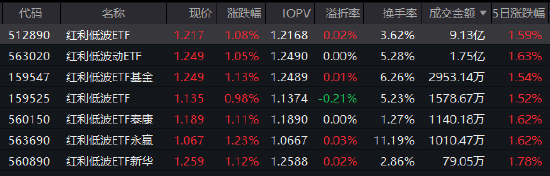
Market Overview - On November 4, the three major A-share indices collectively fell, with the ChiNext Index and Shenzhen Component Index both down nearly 2% [1] - In contrast, the Dividend Low Volatility ETF (512890) rose by 1.08%, closing at 1.217 yuan, with a turnover rate of 3.62% and a transaction volume of 9.13 billion yuan, leading among similar ETFs [1] Fund Performance - The Dividend Low Volatility ETF (512890) has seen significant net inflows, with 330 million yuan over the last 5 trading days, 410 million yuan over the last 10 days, and 3.51 billion yuan over the last 20 days, totaling 3 billion yuan over the last 60 days [2] - As of November 3, 2025, the ETF's circulating scale was 24.988 billion yuan [2] Holdings and Sector Trends - The top ten holdings of the Dividend Low Volatility ETF mostly saw price increases, including stocks like COFCO Sugar, Nanjing Bank, and Agricultural Bank, with a total market value of approximately 5.5 billion yuan [4] - Insurance capital has been increasing its holdings in bank stocks, with notable entries in major banks like Industrial and Agricultural Bank [4] Investment Insights - Analysts suggest that "insurance capital + industrial capital" may become a significant source of incremental funds for the banking sector, favoring stable, high-dividend bank stocks [5] - The banking sector is currently at a historical low in terms of holdings, indicating potential investment value, particularly in regional banks with high provisioning coverage [5] ETF Historical Performance - The Dividend Low Volatility ETF (512890) has achieved a cumulative return of 140.72% as of November 3, 2025, outperforming its benchmark and ranking 75th among 502 similar products [6] - The fund has consistently delivered positive returns for six consecutive years from 2019 to 2024, making it one of the few ETFs in the A-share market to achieve this feat [6]
价、质趋稳,核心营收能力增强:——上市银行3Q25业绩综述
Huachuang Securities· 2025-11-03 11:14
Investment Rating - The report maintains a "Recommendation" rating for the banking industry, indicating a stable outlook for investment opportunities [1]. Core Insights - The core revenue capacity of the banking sector has strengthened, with net interest margins stabilizing and asset quality remaining robust. The overall performance of listed banks in Q3 2025 shows a slight increase in profit growth due to reduced provisioning [1][5]. - The overall revenue and net profit growth rates for the 42 listed banks in Q3 2025 are 0.9% and 1.5% year-on-year, respectively, reflecting a marginal decline compared to the previous half-year [9][10]. Summary by Sections 1. Q3 2025 Performance Overview - Revenue growth has slightly declined, with non-interest income support weakening. The revenue growth rates for the 42 banks are 0.9% and 1.5% for net profit, with a decline in growth rates for joint-stock banks, city commercial banks, and rural commercial banks [9][10]. - The profit growth rate has slightly increased, primarily due to a reduction in provisioning efforts. The net profit growth rates for state-owned banks, joint-stock banks, city commercial banks, and rural commercial banks are 1.2%, -0.2%, 6.9%, and 3.6%, respectively [10]. 2. Key Operating Indicators - The asset quality indicators remain stable, with non-performing loan ratios holding steady at 1.15%. The provisioning coverage ratio has slightly decreased to 283.2% [10]. - The return on equity (ROE) for listed banks remains above 10%, although it has decreased by 0.38 percentage points year-on-year to 10.8% [10]. 3. Investment Recommendations - The report suggests a diversified investment strategy focusing on banks with high dividend yields and strong asset quality. It highlights the potential for mid-sized banks with high provisioning coverage ratios and low-valued joint-stock banks with improving ROE [5].





“老登”不行了,可能意味着一个时代的落幕
雪球· 2025-11-01 03:55
Core Viewpoint - The article discusses the decline of traditional industries in the A-share market, highlighting a shift in investment focus from established sectors like liquor and real estate to emerging technology stocks, indicating a broader change in market dynamics and investment strategies [5]. Group 1: Decline of Traditional Industries - The decline of traditional industries is fundamentally due to a systematic shrinkage of usage scenarios, with sectors like liquor and real estate facing structural challenges as consumer habits and market conditions evolve [8]. - The liquor industry is experiencing changes in drinking habits among younger consumers, while the real estate sector is hindered by a fundamental reversal in supply-demand dynamics [8]. - Although these industries still hold value, their profitability and growth potential have been reassessed, leading to a sentiment of inevitability regarding their decline [8]. Group 2: Challenges Faced by "Old Investors" - Investors, referred to as "Old Investors," face challenges by equating industry beliefs with investment truths, clinging to outdated notions such as the perpetual value of liquor and real estate without recognizing the shifts in consumer behavior and market trends [11]. - The real risk lies not in the obsolescence of industries but in the rigidity of thinking among investors [12]. Group 3: Effective Investment Strategies - Instead of fixating on the survival of specific industries, investors should return to the essence of investing by adhering to proven strategies, such as dividend strategies that focus on dynamically adjusting to capture high-yield stocks across various sectors [14]. - Cash flow strategies emphasize the importance of understanding a company's real cash-generating capabilities, particularly in traditional retail, where digital transformation can lead to improved cash flow [15]. - A diversified asset allocation strategy, incorporating stocks, bonds, and commodities, serves as a stabilizing force in navigating market changes while managing risk [15]. Group 4: Adapting to Change - The ultimate investment principle is to evolve with the times, as exemplified by Berkshire Hathaway's gradual investment in technology giants like Apple, reflecting respect for emerging trends rather than a betrayal of value investing [18]. - To avoid becoming "Old Investors," it is crucial to maintain an open mindset, understanding both the transformation opportunities in traditional industries and the underlying logic of emerging sectors [18]. - The transition from traditional industries to new sectors signifies not just the decline of a group but the inevitable evolution of an era, emphasizing the need to embrace change to seize investment opportunities [18].

红利风向标 | 险资年末加速举牌,红利策略或步入2.0阶段
Xin Lang Ji Jin· 2025-10-30 01:03
Core Insights - The article discusses various dividend-focused ETFs and their performance metrics, highlighting their respective returns and volatility compared to the Shanghai Composite Index [1][2]. Group 1: Dividend ETFs Performance - The latest dividend yield for the S&P Dividend ETF is reported at 5.18% [1]. - The S&P China A-Share Dividend Opportunity Index shows a one-year return of 3.48% with an annualized volatility of 12.19% [1]. - The Hong Kong Stock Connect Dividend ETF has a recent dividend yield of 5.72% [1]. Group 2: Index Performance Comparison - The S&P Hong Kong Stock Connect Low Volatility Dividend Index has a one-year return of 25.44% and an annualized volatility of 0.36% [2]. - The A500 Low Volatility Dividend ETF shows a one-year return of 7.34% with an annualized volatility of 9.87% [2]. - The CSI 800 Low Volatility Dividend Index has a one-year return of 0.06% and an annualized volatility of 10.17% [2]. Group 3: Market Context - The Shanghai Composite Index serves as a benchmark for comparison, with its one-year return at 22.21% and annualized volatility of 3.98% [2].

调侃、反思、分歧:基金三季报里的AI众生相
Sou Hu Cai Jing· 2025-10-29 10:19
Core Insights - The article highlights the significant role of technology, particularly AI, in driving the current bull market, with a focus on the performance of tech stocks and funds [1][2]. Group 1: Market Performance - The third quarter exhibited a "slow bull" market characteristic, with a few tech leaders driving substantial gains while other stocks contributed modestly [3]. - The CSI 300 index rose approximately 18% in Q3, with the top 10 stocks accounting for nearly half of the index's gains, predominantly from the tech sector [3]. - As of the end of Q3, 53 funds had a net value increase exceeding 100% for the year, with 35 of these heavily invested in technology [4]. Group 2: Fund Performance - Notable funds achieving "double hundred" growth in both returns and scale include Yongying Technology Selection and China Europe Digital Economy, with returns of 194.49% and 140.86% respectively [4][5]. - The top-performing funds in Q3 were primarily tech-themed, indicating a strong correlation between tech investments and fund performance [4]. Group 3: Manager Perspectives - Some fund managers expressed self-reflection on missed opportunities in tech investments, acknowledging their portfolios lagged behind the market's tech-driven gains [6][7]. - Others maintained a cautious optimism, recognizing the potential of AI while emphasizing the importance of fundamental analysis and historical lessons [9][10]. Group 4: Diverging Views on AI Sustainability - Some managers remain optimistic about the sustainability of AI growth, citing underestimation of the overseas computing power sector's performance and the early stages of AI industrialization [12][14]. - Conversely, others express caution regarding the sustainability of demand growth and the physical constraints on data center construction, which may limit hardware demand in the coming years [16][17]. Group 5: Risk Awareness - There is a recognition of the risks associated with high valuations in the AI sector, with some managers advising diversification to mitigate potential volatility [17][18].
险资举牌次数再创新高,这类资产是挚爱
Mei Ri Jing Ji Xin Wen· 2025-10-29 06:27
Group 1 - The core viewpoint of the articles highlights that insurance capital has reached a record high in shareholding activities this year, with 31 instances of stake acquisitions, surpassing the previous peak in 2020 and reaching the highest level since records began in 2015 [1] - Ping An Asset Management has increased its stake in China Merchants Bank H-shares to 18.04% by purchasing 3.278 million shares, indicating that the underlying client is likely to be insurance capital [1] - Analysts suggest that the insurance capital strategy has transitioned from a "buy-and-hold" phase (1.0) to a more selective and balanced approach (2.0) [1] Group 2 - This year, insurance capital has made 24 stake acquisitions, primarily in the financial and public utility sectors, with additional investments in electrical equipment, information technology, and healthcare [1] - Low valuations and high dividend yields are significant reasons for the selection of investment targets by insurance capital, as exemplified by the Agricultural Bank of China H-shares, where Ping An's average purchase price increased from HKD 4.2257 at the beginning of the year to HKD 5.6306 by October 20 [1] - The dividend yield of Agricultural Bank of China H-shares has decreased from 5.95% at the beginning of the year to around 4.4%, but it still offers a favorable spread compared to current life insurance product interest rates [1] Group 3 - Ping An's investment style is characterized as a "sweeping" approach, focusing solely on financial stocks, including Postal Savings Bank H-shares, China Merchants Bank H-shares, Agricultural Bank of China H-shares, China Pacific Insurance H-shares, and China Life H-shares [2] - Other companies exhibit a more diversified selection style, as seen with Great Wall Life's stake acquisitions in China Water Affairs, Datang Renewable, Qinhuangdao Port, and New天绿能, spanning public utilities and transportation sectors [2] - For investors looking to emulate insurance capital strategies, a focus on H-share banks can be achieved through the Hong Kong Stock Connect Financial ETF, which has a 60% weight in H-share banks, while those seeking a diversified style may consider the Hong Kong Central State-Owned Enterprises Dividend ETF [2]
港股红利ETF博时(513690)红盘震荡,慢牛行情下红利策略或仍具备持续性
Xin Lang Cai Jing· 2025-10-29 05:21
Core Insights - The Hong Kong Dividend ETF by Bosera (513690) has shown a recent increase of 0.45%, with a latest price of 1.12 CNY, and a weekly cumulative rise of 0.36% as of October 28, 2025 [3] - The overall coal supply and demand is improving, with stricter safety and production management expected in Q4, leading to a stable to strong coal price outlook [3] - The market is increasingly focused on dividend assets as domestic interest rates enter a downward cycle, with the Hong Kong market's overall valuation at a low point and a growing willingness among companies to distribute dividends [3] Market Performance - The latest scale of the Hong Kong Dividend ETF by Bosera is 5.869 billion CNY [4] - Recent fund flows have been balanced, with net inflows in 4 out of the last 5 trading days, totaling 26.7134 million CNY, averaging 5.3427 million CNY per day [4] - The ETF closely tracks the Hang Seng Hong Kong Stock Connect High Dividend Yield Index, which reflects the performance of high dividend securities listed in Hong Kong [4] Key Holdings - As of October 8, 2025, the top ten weighted stocks in the Hang Seng Hong Kong Stock Connect High Dividend Yield Index include Orient Overseas International, COSCO Shipping Holdings, Yancoal Australia, and others, accounting for 28.98% of the index [4]

险资举牌次数,创新高!红利策略进入2.0阶段?
券商中国· 2025-10-29 04:41
Core Viewpoint - The insurance capital's stake acquisition has reached a record high in 2023, indicating a shift in investment strategy from aggressive buying to selective investment [1][4][8]. Group 1: Stake Acquisition Trends - Insurance capital has made 31 stake acquisitions this year, surpassing the previous high in 2020 and marking the highest since records began in 2015 [1][4]. - Among the 13 insurance companies involved, China Ping An's Ping An Life led with 12 acquisitions, while China Postal Life followed with 3 [4][5]. - The latest acquisition was by China Postal Life, which increased its stake in China Tonghao H-shares to approximately 5.17% [4]. Group 2: Investment Strategies - Analysts suggest that the insurance capital's investment strategy has transitioned from a "buy-and-hold" approach to a more balanced and selective strategy [3][8]. - The focus of investments has been primarily on undervalued stocks with high dividends, particularly in the financial and public utility sectors [6][8]. - China Ping An's investment style is characterized by continuous buying and holding of financial stocks, while other companies like Great Wall Life have a more diversified selection [6][7]. Group 3: Market Outlook and Future Strategies - The insurance capital is expected to accelerate its allocation towards dividend stocks, with an estimated increase of nearly 320 billion yuan in 2025 [8]. - The shift towards dividend stocks is seen as a response to rising valuations and a narrowing selection of viable stocks [8]. - The industry is also adjusting product structures to enhance the proportion of equity assets in response to low interest rates and regulatory encouragement [8][9].