牛市

Search documents
中证A500ETF(159338)盘中翻红,近5日净流入近4亿元,A股仍存上涨空间
Mei Ri Jing Ji Xin Wen· 2025-11-28 03:13
Core Viewpoint - The market is likely still in a bull market phase, but may enter a period of wide fluctuations in the short term [1] Group 1: Market Outlook - Compared to previous bull markets, there is still significant room for index growth [1] - The duration of the bull market may be more important than the magnitude of the increase, influenced by national policies promoting a "slow bull" market [1] Group 2: Short-term Market Behavior - The market may lack strong catalysts in the short term [1] - Year-end behavior of some investors may trend towards caution, leading to a focus on market consolidation and fluctuations [1]

牛市远未结束!申万宏源王胜最新专访:当很多人担心人工智能泡沫的时候,或许它就还不是真正的“泡沫”
申万宏源研究· 2025-11-28 03:01
Core Viewpoint - The bull market is far from over, and concerns about an artificial intelligence bubble may be premature, suggesting that it might not be a true "bubble" yet [2] Group 1 - The current market sentiment indicates that many investors are worried about the sustainability of the artificial intelligence sector, but this could be an overreaction [2] - Historical trends show that technological advancements often face skepticism before achieving widespread acceptance and growth [2] - The potential for artificial intelligence to drive significant economic growth and innovation remains strong, indicating a positive outlook for the sector [2]



国信证券首席经济学家荀玉根:牛市远未结束
经济观察报· 2025-11-28 02:13
Core Viewpoint - The current bull market is still in its early stages, drawing parallels to the historical "5·19 market," which lasted two years with a 120% increase before policy withdrawal ended it. Current economic pressures and low CPI indicate that policy support is still needed [2][3]. Group 1: Market Analysis - The current bull market is expected to last 1-2 years, with signs indicating it is still early in the cycle. Characteristics typical of a late bull market, such as a surge of new investors and overconfidence among existing investors, have not yet emerged [2][3]. - The Shanghai Composite Index has reached a 10-year high despite a challenging macroeconomic environment, suggesting a disconnect between stock market performance and economic fundamentals [3]. Group 2: Economic Context - The Chinese economy is experiencing "growing pains" during its transition, reminiscent of the period from 1998 to 2000, characterized by overcapacity in traditional industries and a downturn in real estate [3]. - Real estate constitutes 60% of household wealth in China, with property prices in first-tier cities dropping by 30%-50%. For instance, property values in Shanghai have decreased by 35%, leading to significant wealth erosion for residents [3]. Group 3: Policy Implications - To reverse the trend of declining asset prices, policy intervention is crucial. Historical precedents show that timely policy measures can lead to rapid market recoveries, as seen in the "5·19 market" and the "9·24 market" [4]. - The external environment is shifting, with the Federal Reserve entering a rate-cutting cycle, which could provide more room for domestic policy easing in China [4]. Group 4: Future Outlook - The emergence of new economic sectors, particularly in intelligent manufacturing, is becoming evident. Innovations such as the DeepSeek-R1 model and humanoid robots are setting the stage for a significant industrial upgrade [5]. - China's manufacturing sector is benefiting from a large pool of graduates and engineers, which enhances its cost advantages and positions it for a successful transition from old to new economic drivers [5].

国信证券首席经济学家荀玉根:牛市远未结束
Jing Ji Guan Cha Wang· 2025-11-28 01:01
Group 1 - The current bull market is still in its early stages, with characteristics of a late bull market, such as a surge of new investors and complacency among old investors, not yet observed [1] - Historical reference to the "5.19 market" indicates that bull markets typically last 1-2 years, and the current cycle has only lasted one year, suggesting further potential for growth [1] - The macroeconomic environment is challenging, with the stock market performing strongly despite economic difficulties, reminiscent of the period from 1998 to 2000 [2] Group 2 - The key to resolving economic issues lies in halting the decline in asset prices, similar to the policy interventions seen in 1999 that spurred market growth [3] - The external environment is favorable for China, as the Federal Reserve is entering a rate-cutting cycle, which could provide room for domestic policy easing [3] - The emergence of new economic sectors, particularly in intelligent manufacturing, is expected to drive industrial upgrades and surpass the old economy's dominance [4] Group 3 - Intelligent manufacturing is gaining traction, with significant advancements such as the DeepSeek-R1 model achieving performance comparable to OpenAI's models at a lower cost [4] - The cost advantages of Chinese intelligent manufacturing are highlighted by the large number of engineering graduates, which supports the sector's growth [4] - The successful transition from old to new economic drivers is anticipated, with intelligent manufacturing expected to play a crucial role in this transformation [4]

不出意外,接下来,A股会重演2024年行情了
Sou Hu Cai Jing· 2025-11-28 00:02
Group 1 - The Shanghai Composite Index has reached 4000 points this year, but the actual increase is limited when excluding the major banks and a few tech stocks, suggesting that many weighted industries are still around 3000 points [1] - If major stocks do not experience a rebound, the longer the time passes, the more unfavorable it will be for the index, indicating that the current bull market may have peaked at 4000 points [1] - The market is characterized by a localized bull market rather than a comprehensive one, with many stocks not performing well, and significant declines in tech assets occurring twice this year [3] Group 2 - There is a lack of significant profit effects in the market, with no noticeable increase in new account openings or discussions about the stock market, indicating a disconnect between the index performance and investor sentiment [5] - The trading volume has dropped significantly, with the market operating at bear market levels, and core weighted industries like liquor, securities, insurance, and banks showing low daily trading volumes [5] - The market requires incremental capital to drive growth, which can only come from rebounds in sectors like securities and real estate, similar to the market behavior seen in September 2024 [5][7]

牛市远未结束!申万宏源王胜最新专访:当很多人担心人工智能泡沫的时候,或许它就还不是真正的“泡沫”
申万宏源研究· 2025-11-27 06:29
Core Viewpoint - The bull market is far from over, and concerns about an artificial intelligence bubble may be premature, suggesting that it might not be a true "bubble" yet [2] Group 1 - The current market sentiment indicates a strong belief in the sustainability of the bull market, particularly in sectors related to artificial intelligence [2] - Analysts are observing that while some investors express caution regarding AI investments, the underlying fundamentals may still support growth [2] - The potential for AI technologies to drive significant economic value is highlighted, suggesting that the market may be underestimating their long-term impact [2]

证券市场周刊-第43期2025
2025-11-26 14:15
Summary of Key Points from the Conference Call Industry Overview - The current market is experiencing a healthy bull market characterized by policy support, liquidity, and asset allocation driving long-term trends [8][9][10] - The stock market has evolved into a key driver of economic growth, alongside consumption, investment, and exports, contributing to a positive feedback loop of wealth effect and consumption recovery [9][10] Core Insights and Arguments - The bull market is supported by a significant amount of household savings, currently at 170 trillion yuan, which is increasingly being directed towards equity investments as low-yield savings products lose appeal [8][9] - The sales of equity funds are recovering, with new stock accounts surpassing 25 million, indicating a positive response to policy directions [8][9] - The market's healthy rise is attributed to the performance of quality companies, which serve as stabilizers during market fluctuations, emphasizing the importance of value investing [10] - The bull market is expected to continue beyond the 4000-point mark, with market divergences being a sign of healthy development rather than a signal of a market peak [10] Additional Important Insights - The market is witnessing a rotation among sectors, moving from technology stocks to new energy and consumer sectors, which helps prevent rapid accumulation of market bubbles [9][10] - The dual support from policy and liquidity has solidified the foundation of the bull market, with ongoing positive signals from the government and a reasonable monetary environment maintained by the central bank [9][10] - The "Golden Dawn" awards recognize 521 listed companies for their value creation and ESG practices, promoting high-quality development and guiding investors towards quality targets [12][48] Financial Data Highlights - The national public budget revenue from January to October was 18.65 trillion yuan, a year-on-year increase of 0.8%, while expenditures were 22.58 trillion yuan, up 2% [39] - The stamp duty revenue from securities transactions reached 162.9 billion yuan, reflecting an 88.1% year-on-year increase [39] This summary encapsulates the essential insights and data from the conference call, providing a comprehensive overview of the current market dynamics and the performance of listed companies.
认知:是投资升阶的充要条件
雪球· 2025-11-26 08:24
Group 1 - The core viewpoint is that the current bull market in A-shares is still ongoing, despite market fluctuations, as it is determined by national policies and the realization of capital market value [4][6]. - The process of debt reduction is still in its early stages, indicating that the market's recovery is complex and slow [4]. - Economic indicators such as consumer spending, housing prices, and private enterprise investment remain weak, suggesting that deflationary pressures have not changed [5][6]. Group 2 - Technical indicators like K-line combinations, moving averages, and trading volume are essential for stock trading, serving as the foundation of technical analysis [11]. - Fundamental analysis focusing on performance and valuation is crucial for value investors, but it may not significantly improve the success rate for most retail investors due to information lag [13][14]. - National policies and geopolitical factors are vital for identifying market trends and investment opportunities, acting as catalysts for bull markets [15]. Group 3 - Understanding broader trends and logical analysis is key to identifying potential high-performing stocks and serves as a basis for long-term investment decisions [17]. - Maintaining the right rhythm and mindset is critical for successful trading, emphasizing the importance of patience and clarity in decision-making [18][19]. - A comprehensive understanding of all the aforementioned factors contributes to an investor's cognitive development, which is essential for achieving higher investment success [20][21][22].

又有8家券商获批综合账户试点,券商ETF连续4日“吸金”累计近3.9亿元,机构:板块具备较高配置吸引力
2 1 Shi Ji Jing Ji Bao Dao· 2025-11-26 02:51
Group 1 - The three major indices opened lower, but the brokerage sector was active during the session, with the brokerage ETF (159842) rising by 0.09% and trading volume exceeding 600 million yuan, indicating a premium trading trend [1] - The brokerage ETF (159842) has seen a net inflow of funds for four consecutive trading days, accumulating nearly 390 million yuan [1] - The brokerage ETF tracks the CSI All Share Securities Companies Index, which consists of up to 50 securities company stocks to reflect the overall performance of the industry [1] Group 2 - Overall financial valuations are low, increasing the probability of a bull market, with non-bank financials expected to have significant earnings elasticity due to accelerated inflows of resident funds [2] - The securities sector is likely to benefit from the bull market's Beta effect, leading to greater earnings elasticity [2] - Regulatory encouragement for ETF development, market capitalization management by listed companies, and long-term capital inflows are favorable for the securities sector, potentially serving as a key underlying factor in the current bull market [2] Group 3 - Brokerages are expected to benefit not only from market recovery but also from successful transformations that provide unique Alpha growth potential, enhancing profit quality [2] - The combination of policy expectations, improved funding conditions, and internal growth drivers enhances the profitability outlook for the brokerage sector, making it highly attractive for allocation [2]





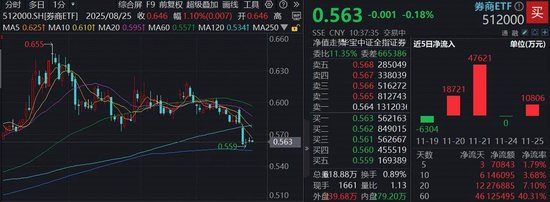
顶流券商ETF(512000)低位蓄力,超7亿资金密集涌入,机构:券商可能是这一轮牛市的重要暗线,超额潜力较高
Xin Lang Ji Jin· 2025-11-26 02:49
Group 1 - The overall market sentiment is improving, with the brokerage sector showing slight fluctuations and a minor decline of 0.18% in the top brokerage ETF (512000) [1] - The brokerage ETF (512000) has seen a net inflow of 108 million yuan on the latest trading day, with a cumulative net inflow exceeding 700 million yuan over the past five days [1] - Financial sector valuations are considered low, with an increasing probability of a bull market, and non-bank financials expected to have significant earnings elasticity [3] Group 2 - The brokerage sector is benefiting from the beta effect of the bull market, with potential for greater earnings elasticity due to successful transformations and improved profit quality [3] - The acceleration of mergers and acquisitions in the securities industry is noted, with plans for major firms to consolidate, aiming for economies of scale and synergy [3] - The current price-to-book (PB) ratio for the brokerage sector is 1.35, positioned at the 69th percentile over the past three years, indicating potential for upward movement in the long term supported by economic fundamentals and policy [3] Group 3 - The brokerage ETF (512000) and its linked fund (007531) passively track the securities company index, with top ten weighted stocks including major firms like East Money and CITIC Securities [4]