
AI产业

Search documents
台企业界人士谈“十五五”规划:冀优势互补 共同发展
Zhong Guo Xin Wen Wang· 2025-12-18 07:04
Core Viewpoint - The "15th Five-Year Plan" proposed by the Chinese Communist Party aims to enhance cross-strait industrial cooperation and provides new opportunities for Taiwanese businesses in mainland China [1][2]. Group 1: Economic and Industrial Cooperation - The "15th Five-Year Plan" outlines macro strategies for economic and social development, creating vast new spaces for cross-strait industrial collaboration [1]. - Taiwanese business leaders emphasize the need for accelerated industrial transformation and upgrading, particularly in AI and high-end intelligent manufacturing [1][2]. - The plan focuses on building a modern industrial system, promoting high-level technological self-reliance, and developing a strong domestic market, which presents opportunities for Taiwanese businesses in technology innovation and market expansion [1][2]. Group 2: Specific Industry Focus - Human-shaped robots are identified as a key area for future cross-strait industrial cooperation, leveraging mainland China's strengths in technology applications and Taiwan's competitiveness in semiconductor chips and precision machinery [2]. - The "Belt and Road" initiative is seen as an opportunity for Taiwanese companies to expand into overseas markets by integrating with local industrial advantages [2]. - There is a call for deeper cooperation across various chains, including industrial, financial, and talent chains, to align with the industrial development directions outlined in the "15th Five-Year Plan" [2]. Group 3: Event and Participation - The annual cross-strait entrepreneurs summit attracted around 800 participants, including members of the cross-strait entrepreneurs council, business leaders, and scholars [2].
全球白银市场正迎来历史性时刻,短短数周内开启连续刷新纪录的上涨行情
Sou Hu Cai Jing· 2025-12-18 06:58
Core Viewpoint - The global silver market is experiencing a historic surge, with prices reaching new highs due to supply-demand imbalances, Federal Reserve interest rate cuts, and increased investment inflows [1][3][4]. Group 1: Price Movement - On December 17, 2025, spot silver prices broke through key levels of $65 and $66 per ounce, reaching a peak of $66.51 per ounce, marking a historical high [3][4]. - Year-to-date, silver prices have increased by approximately 120% to 130%, significantly outpacing gold's rise of about 60% [3][4]. Group 2: Driving Factors - The surge in silver prices is attributed to three main factors: supply-demand imbalance, changes in monetary policy by the Federal Reserve, and a significant influx of investment [4][5]. - Supply constraints are evident as 70%-80% of global silver comes from by-product mining, limiting the ability to increase production in response to price rises [5][6]. - The Federal Reserve's interest rate cuts, including three reductions in 2025, have made silver more attractive as a non-yielding asset [7]. - Investment demand has surged, with notable increases in ETF holdings and futures positions, reflecting a strong interest in silver [8]. Group 3: Future Outlook - Short-term projections indicate potential for price corrections, while medium to long-term perspectives remain optimistic due to ongoing supply shortages and robust industrial demand [9][10]. - Industrial demand for silver is expected to grow significantly, driven by sectors such as solar energy, electric vehicles, and AI, which are reshaping the traditional demand structure [12][13]. - The global silver supply deficit is projected to widen, with estimates suggesting a shortfall of 95 million ounces in 2025, increasing to 118 million ounces in 2026 [13][14]. Group 4: Investment Recommendations - Investors are advised to exercise caution in chasing high prices and to focus on risk management, particularly given the current high price levels [15][16]. - Monitoring macroeconomic indicators, such as Federal Reserve policies and geopolitical developments, is crucial for adjusting investment strategies [16].


紧紧抓住AI产业机会!私募展望2026年:看好这些细分板块
券商中国· 2025-12-18 03:47
Core Viewpoint - The article emphasizes the transformation of China's private equity industry from quantity expansion to quality improvement, highlighting the launch of the "Golden Yangtze" private equity empowerment plan by Changjiang Securities, which aims to create a professional and systematic growth platform for private equity [1][5][6]. Group 1: Market Trends and Opportunities - The AI industry is expected to be a major focus in 2025, with significant investment opportunities arising from technological advancements and capital expenditures from global giants, making it one of the standout sectors in the A-share market [3][7]. - The 2026 investment landscape will be shaped by various strategies and core variables, with discussions held at a recent salon event involving over 50 private equity fund managers and industry experts [3][9]. Group 2: Private Equity Development - The private equity industry is experiencing steady growth amid regulatory improvements and economic recovery, with a shift towards long-term investments and a focus on multi-dimensional evaluations rather than just performance [5][6]. - Since its launch in June, the "Golden Yangtze" empowerment plan has attracted over 900 excellent managers and 3,300 products, demonstrating strong industry recognition for a professional and systematic empowerment platform [6]. Group 3: Investment Strategies - In the electronics sector, investment opportunities are identified in AI hardware, AI end-side devices, and semiconductors, with a particular focus on high-tech PCB products driven by the demand for AI servers [7][8]. - The AI smart glasses market is highlighted as a significant opportunity, with expectations for a major sales increase in 2026, potentially leading to a broader market trend similar to the TWS earphones boom in 2019 [8]. - Recommendations for semiconductor investments include focusing on leading platform companies and those achieving breakthroughs in niche markets, while also considering the varying market dynamics across different semiconductor materials [8]. Group 4: Private Equity Ecosystem Empowerment - Changjiang Securities aims to provide comprehensive services to private equity managers, fostering an open and efficient service ecosystem, with strategic partners like Industrial Bank and Industrial Trust contributing to this empowerment [9][10]. - Discussions at the salon included insights on how capital providers can effectively select private equity managers, emphasizing the importance of evaluation systems and collaboration logic from the perspective of capital providers [10]. Group 5: Market Outlook and Strategies - Many private equity institutions maintain a positive outlook on the A-share market, believing that the overall valuation is reasonable and the medium to long-term fundamentals are solid [11][12]. - Investment strategies discussed include a focus on diversified asset allocation to mitigate risks and capture long-term value, with specific attention to sectors like advanced manufacturing and technology innovation [12][14].


基金经理及产品研究系列:东吴基金刘元海:AI产业趋势下,寻找从算力转向应用的布局机会
Guohai Securities· 2025-12-17 15:10
- The report primarily focuses on analyzing the investment system and representative products of Liu Yuanhai from Dongwu Fund, providing research references for FOF investors[1][6] - Liu Yuanhai's investment system emphasizes industry trend-driven investment, closely tracking technological innovation and industry penetration changes, and mainly participating in the growth stage of industries[8] - The Dongwu Mobile Internet A fund (001323) is a flexible allocation fund focusing on the mobile internet theme, with significant long-term performance outperforming the CSI 300 Index[12][13] - The fund's performance attribution analysis using the Fama-French five-factor model shows that its returns are mainly derived from market factor exposure and significant alpha, while value and investment factors contribute negatively[34][37] - The fund maintains a high equity position and high stock concentration, reflecting the fund manager's confidence in core holdings[42][43] - The fund's heavy positions are mainly in the TMT sector, with significant contributions from leading stocks in sub-sectors, although this also brings certain volatility risks[47][52][53]
大宗周期-有色金属行业主题报告
2025-12-17 02:27
Summary of Key Points from Conference Call Records Industry Overview - The reports focus on the non-ferrous metals industry, particularly gold, copper, aluminum, tin, lithium carbonate, and cobalt markets for the year 2026 [1][2][3][4][5][6][7][8][9][10][11][12][13]. Core Insights and Arguments Gold Market - Gold prices are expected to benefit from a weakening US dollar, anticipated Federal Reserve interest rate cuts, and potential policy uncertainties following Powell's departure, alongside ongoing global central bank gold purchases [1][4]. - The macroeconomic environment is projected to support gold's monetary and financial attributes, driving prices upward [2][3]. Copper Market - Supply constraints are anticipated due to diminishing resource endowments and stricter policies affecting overseas copper mining projects, limiting capacity expansion [1][5]. - Demand for copper is expected to rise significantly due to AI hardware and infrastructure development, with a projected compound annual growth rate of 50% in global computing power from 2025 to 2030 [5]. Aluminum Market - Domestic aluminum production capacity is nearing its limit, while high electricity prices overseas are increasing operational uncertainties [6][7]. - Strong growth in electric vehicle demand and historically low aluminum inventories suggest potential price elasticity for aluminum [6][7]. Tin Market - The tin supply is under pressure due to Indonesia's crackdown on illegal mining, slow recovery in Myanmar, and conflicts in the Democratic Republic of Congo, leading to a tightening global supply [8][9]. - Despite low processing fees in Yunnan and Guangxi, future demand for tin is expected to remain robust, particularly driven by the semiconductor industry and AI applications [9]. Lithium Carbonate Market - The lithium carbonate market is projected to maintain strong momentum in 2026, supported by rapid growth in electric vehicles and energy storage demand [1][10]. - Supply risks from domestic mica mines and a slowdown in overseas lithium resource expansion are noted, but demand is expected to remain strong [10]. Cobalt Market - The cobalt market is facing supply concerns due to tightened export policies from the Democratic Republic of Congo, which is expected to significantly reduce export volumes [3][11][12]. - The anticipated structural supply tightness is likely to persist, affecting global cobalt availability [12]. Additional Important Insights - The overall outlook for the industrial and energy metals sector is positive, with expectations of improved fundamentals and macroeconomic support driving growth [2][3][13]. - Companies with strong cost advantages and clear future prospects are recommended for investment, as they are expected to achieve significant volume increases and provide potential returns for investors [13].
中钨高新拟3.39亿加码高端刀具 完善钨产业链前9月扣非激增4倍
Chang Jiang Shang Bao· 2025-12-17 00:31
Core Viewpoint - The company Zhongtung High-tech (000657.SZ) is initiating a capacity expansion plan by investing approximately 339 million yuan in two projects related to AI PCB precision micro-tools and micro-drill intelligent manufacturing, aiming to add a total annual production capacity of 193 million units [1][2]. Group 1: Investment and Capacity Expansion - The investment will be divided into two main projects: 175.5 million yuan for the AI PCB precision micro-tool project, which will add 63 million units of annual capacity over three years, and 163 million yuan for the micro-drill intelligent manufacturing project, which will add 130 million units of annual capacity over two years [2][3]. - The company has previously announced a 140 million unit micro-drill expansion project in July 2025, indicating a strong commitment to the high-end tool sector [3]. Group 2: Market Demand and Performance - The rapid development of the AI industry is driving a rigid demand for high-end PCB tools, while the continuous upgrade of the electronic information industry is maintaining a fast-growing demand for micro-drills [3]. - The average monthly production capacity of the company's micro-drills has increased from over 60 million units in the first half of 2025 to over 80 million units by the end of October 2025, with the core product "Jinzhou Sanbao" accounting for over 50% of total sales [3][4]. Group 3: Financial Performance - For the first three quarters of 2025, the company reported revenues of 12.755 billion yuan, a year-on-year increase of 13.39%, and a net profit attributable to shareholders of 846 million yuan, up 18.26% year-on-year [4][5]. - The net profit excluding non-recurring items surged by 407.52% year-on-year to 781 million yuan, indicating strong operational performance and a solid foundation for the capacity expansion [4].

兴业证券策略首席张启尧:积极看好2026年A股市场投资机会
Xin Lang Cai Jing· 2025-12-16 12:11
Core Viewpoint - The chief strategy analyst of Industrial Securities, Zhang Qiyao, is optimistic about investment opportunities in the A-share market for 2026, citing limited negative external impacts and positive internal economic indicators [1] External Factors - Global trends in the AI industry, along with loose liquidity and a weak dollar, are expected to boost the A-share market [1] - The negative impact from overseas markets on the domestic market is anticipated to be limited [1] Internal Factors - The direction of the GDP deflator and nominal growth recovery is relatively clear, indicating a potential improvement in the economic fundamentals [1] - Nominal economic recovery and price increases are expected to support further enhancements in the fundamentals [1] - The recovery of domestic corporate profits is projected to be a significant highlight [1] Capital Flow - There is a trend of domestic residents reallocating wealth into the stock market, which is expected to deepen in 2026 [1] - Active equity funds are anticipated to achieve excess returns, while long-term capital from insurance funds and state-owned enterprises is expected to enter the market firmly [1] - The return of foreign capital to Chinese assets is also seen as a positive trend for 2026 [1]

兴业证券:化工周期拐点即将到来 新兴需求助力升级
Zhi Tong Cai Jing· 2025-12-16 06:39
Group 1: Chemical Industry - The chemical industry is expected to experience a cyclical recovery and industrial upgrade by 2026, following three years of bottom-range operation for chemical products [1] - The growth rate of ongoing projects in the industry continues to decline, and the new capacity release is nearing its end [1] - Domestic policies aimed at stable growth and the Federal Reserve entering a rate-cutting cycle are anticipated to support a mild recovery in traditional chemical product demand [1] - The "anti-involution" trend is expected to accelerate the cyclical turning point, benefiting core chemical assets with global competitive advantages, leading to profit and valuation recovery [1] - Sub-industries such as organic silicon, PTA, polyester filament, caprolactam, spandex, soda ash, PVC, glyphosate, and urea are expected to see profit recovery due to industry self-discipline and price control measures [1] Group 2: Pesticide Industry - The pesticide industry is entering a phase where inventory reduction is nearing completion, with signs of recovery in market conditions [2] - The global pesticide channel inventory is expected to approach reasonable levels by 2025, with some products already seeing price increases [2] - The industry is anticipated to shift towards capacity reduction in the next two years, favoring companies with cost advantages and strong market channels [2] - The concentration of the industry and the pricing power of leading enterprises are expected to increase [2] - Domestic companies are making significant progress in the research, production, and marketing of innovative pesticides, with leading firms likely to achieve high value-added upgrades [2] Group 3: Tire Industry - The tire industry is facing an upgrade in international trade barriers, which may present opportunities for companies with global layouts [3] - The EU's anti-dumping investigation against Chinese tires is expected to conclude by early 2026, potentially leading to higher tariffs [3] - If high anti-dumping duties are imposed, domestic semi-steel tire exports may be hindered, creating a demand gap in the EU market that could be filled by other regions [3] - This supply-demand mismatch may lead to price increases, benefiting leading tire companies with overseas production bases and expansion plans [3] Group 4: Emerging Industries - The path to carbon reduction is challenging, but the AI industry continues to thrive alongside the development of sustainable aviation fuel (SAF), bio-based materials, carbon capture, utilization, and storage (CCUS), electronic resins, liquid cooling materials, and lithium battery materials [4] - Europe is set to initiate its SAF era in 2025, with mandatory standards for bio-based plastics expected by 2027 [4] - CCUS is a core component of the European Green Deal, and similar policies are anticipated in China under its dual carbon strategy [4] - The demand for AI computing power remains strong, with electronic resins and liquid cooling materials identified as key upgrade directions [4] - AIDC storage is expected to become a significant growth area for lithium battery materials [4]
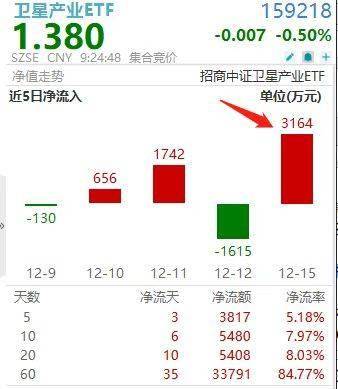
又见主力增持!卫星产业ETF(159218)单日净流入超3000万,“空天一体”持续发酵
Sou Hu Cai Jing· 2025-12-16 01:49
Group 1 - The satellite sector continues to thrive, with the first satellite industry ETF (159218) experiencing five consecutive increases, reaching a historical high, and seeing a single-day net inflow exceeding 30 million, with a total net inflow of over 530 million since the beginning of the year [1] Group 2 - Guosheng Computer believes that satellites are the core carrier of the commercial aerospace industry, and the launch speed is primarily determined by launch costs, with the key bottleneck being reusable rocket technology. A breakthrough in this technology would significantly accelerate the launch speed of low-orbit satellites in China [3] - The ongoing development of the AI industry is leading to a trend in building space computing power, which is opening up the commercial aerospace application market. With the breakthrough of the reusable rocket bottleneck, the commercial aerospace industry is expected to form a closed loop, promoting the industry into a high-speed growth phase [3]
柏诚股份:公司持续看好下游高科技产业赛道长期发展潜力
Zheng Quan Ri Bao Zhi Sheng· 2025-12-15 12:17
Core Viewpoint - The company remains optimistic about the long-term development potential of the downstream high-tech industry amid the rapid expansion of the global AI sector [1] Group 1: Company Strategy - The company focuses on its main business and adheres to a comprehensive layout strategy across multiple downstream industries [1] - The company is actively seizing market opportunities and enhancing both domestic and international market development [1] Group 2: Commitment to Shareholders - The company aims to create long-term investment value for its shareholders [1] - The company will comply with information disclosure obligations as soon as relevant business information meets the disclosure standards [1]