关税调整

Search documents
中国调整对美国进口商品加征关税措施
Wind万得· 2025-11-05 04:00
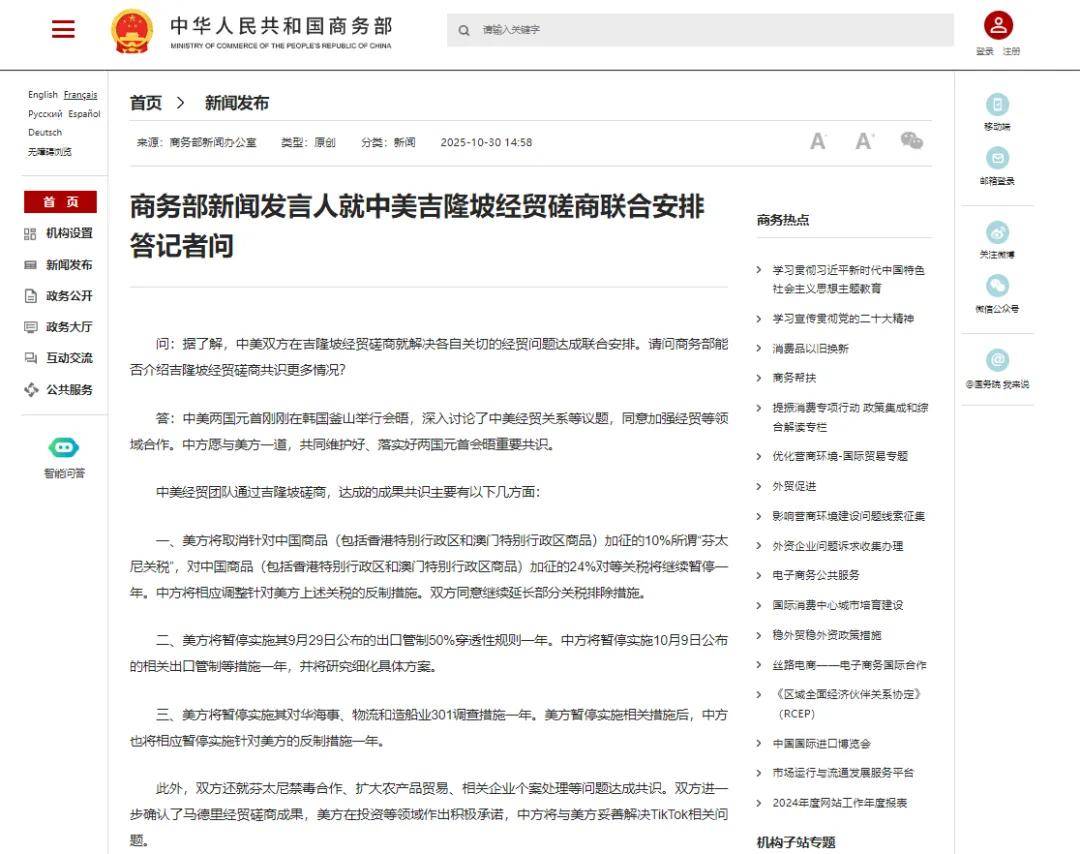
11月5日,财政部在网站发布2025年第9号、第10号公告,停止实施对原产于美国的部分进口商品加征关税措施、调整对原产于美国的进口商品加征 关税措施。 WBUY(万得交易快线) 一次开户,基金市场一键链接 线上批量下单,轻松多账户管理 组合资产穿透管理,实时监控底层持仓 专为机构打造 一站式基金投研、交易、管理平台 Wind金融终端输入命令 点" 阅读原文 ",申请Wind金融终端 ...


国务院关税税则委员会调整对原产于美国的进口商品加征关税措施
Yang Shi Xin Wen· 2025-11-05 03:52
原标题:国务院关税税则委员会调整对原产于美国的进口商品加征关税措施 编辑:高鑫 责编:张松涛 为落实中美经贸磋商达成的成果共识,根据《中华人民共和国关税法》、《中华人民共和国海关法》、 《中华人民共和国对外贸易法》等法律法规和国际法基本原则,经国务院批准,自2025年11月10日13时 01分起,调整《国务院关税税则委员会关于对原产于美国的进口商品加征关税的公告》(税委会公告 2025年第4号)规定的加征关税措施,在一年内继续暂停实施24%的对美加征关税税率,保留10%的对 美加征关税税率。 央视新闻消息,今天,国务院关税税则委员会发布关于调整对原产于美国的进口商品加征关税措施的公 告,详情如下: ...
澳大利亚给中国发货,加拿大农民急了
Guan Cha Zhe Wang· 2025-11-04 14:20
Core Viewpoint - Australia is set to ship its first batch of canola seeds to China in five years, marking a significant development in agricultural trade relations between the two countries [1][3]. Group 1: Trade Developments - A bulk carrier named "Armonia A" is scheduled to load approximately 60,000 tons of canola seeds in Esperance, Western Australia, and is expected to depart for Qingdao, China, on November 7 or 8 [1]. - This shipment is part of a trial run after China halted imports of Australian canola seeds in 2020 due to pest and disease concerns [1][3]. - At least three trial shipments have been ordered by China, with plans for delivery in the fourth quarter of this year [1]. Group 2: Market Dynamics - The Australian canola market is experiencing strong performance due to increased global demand, which has shifted from Canada amid ongoing trade disputes between Canada and China [3]. - Canada, previously the dominant supplier of canola to China, is facing challenges due to a 75.8% anti-dumping duty imposed by China, which has significantly raised export costs for Canadian farmers [4]. Group 3: Canadian Farmers' Concerns - Canadian farmers are expressing anxiety over their canola harvest, as they fear they may not be able to sell at expected prices due to the trade issues with China [4]. - In Saskatchewan, 67% of canola is exported to China, making the resolution of trade disputes a top priority for local farmers [4]. Group 4: Diplomatic Efforts - Canadian Prime Minister Justin Trudeau discussed unresolved trade issues, including agricultural products, with Chinese officials during the APEC summit [4][5]. - The Canadian Canola Council is urging the government to ease trade relations with China, suggesting that the removal of tariffs on Chinese electric vehicles could be a potential step towards resolving the canola trade dispute [5].

加拿大背弃美国?对华降税求合作,特朗普借题发挥,终止和加谈判
Sou Hu Cai Jing· 2025-11-04 09:15
Core Viewpoint - Canada has recently adjusted its tariffs on certain steel and aluminum products from China, indicating a shift in its trade policy amid economic pressures, which has led to tensions with the United States [1][8]. Group 1: Tariff Adjustments - On October 17, Canada announced a tariff revision document that reduces tariffs on certain steel and aluminum products from China, effective from October 15, with specific details to be released on November 5 [3]. - Canada previously imposed high tariffs on Chinese products, including a 100% tariff on electric vehicles and a 25% tariff on some steel and aluminum products, but has now softened its stance due to economic pressures [5][6]. Group 2: Economic Pressures - Canada's agricultural sector has been severely impacted by retaliatory tariffs from China, with canola oil exports from Saskatchewan dropping by 76% year-on-year in August [6]. - The manufacturing sector is also struggling, with companies facing over 30% higher costs for raw materials due to tariffs, leading to survival crises for many downstream industries [6][12]. Group 3: Political Dynamics - Canadian Prime Minister Carney has indicated a significant shift in Canada-U.S. economic relations, stating that they can no longer return to previous levels of closeness [8][10]. - The Canadian government is under pressure from local leaders to adjust tariffs, as provinces like Manitoba and Saskatchewan are experiencing severe economic impacts from the trade war [12]. Group 4: U.S. Response - President Trump reacted strongly to Canada's tariff adjustments by terminating all trade negotiations with Canada, citing a "fraudulent advertisement" as a pretext, but the underlying issue is Canada's warming relations with China [14][16]. - Trump emphasized the importance of tariffs for U.S. national security and economic interests, suggesting that Canada's tariff reductions could undermine U.S. policies [16][18]. Group 5: Future Considerations - The effectiveness of Canada's tariff adjustments will depend on the details released on November 5, China's response to Canada's requests, and the U.S. stance following the termination of trade talks [20]. - Canada is taking steps to reduce its dependency on the U.S. market, aiming to double exports to markets outside the U.S. over the next decade [10][22].
按一下此處編輯母版標題樣式文件名
citic securities· 2025-11-03 08:49
Group 1: Hong Kong and China Market Focus - The resilience of non-US exports is expected to support mainland foreign trade data, with a forecasted year-on-year growth of 4.5% for exports and 3.5% for imports in October 2025 [19][20]. - The meeting between the Chinese and US leaders is anticipated to ease uncertainties, positively impacting risk appetite for Hong Kong stocks, particularly benefiting companies like Tencent Holdings and Alibaba [22][23]. - The iShares Hang Seng Tech ETF is highlighted as a vehicle to capture opportunities in technology-related Hong Kong stocks [26]. Group 2: US Market Focus - Federal Reserve Chair Powell has downplayed the expectations for a rate cut in December, with market implied probabilities dropping from 85% to around 70% [34]. - The divergence within the FOMC regarding interest rate decisions indicates a complex economic outlook, with expectations for a potential 25 basis points cut in December still on the table [33][34]. - Companies like Digital Realty and Cameco are identified as key players, with Digital Realty benefiting from AI-driven demand and Cameco positioned to capitalize on nuclear energy expansion [44]. Group 3: Malaysia Market Focus - New agreements are expected to reduce uncertainties in trade with the US, providing a more supportive macro environment for companies like Petronas and the broader Malaysian economy [49][50]. - The iShares MSCI Malaysia ETF is noted as a means to invest in Malaysian equities, reflecting the positive outlook for the market [49].


亿联网络(300628):经营持续改善 海外产能转移稳步推进
Xin Lang Cai Jing· 2025-11-03 00:52
Core Insights - The company reported Q3 revenue of 1.648 billion, meeting expectations, with a year-on-year increase of 14.26% and a quarter-on-quarter increase of 14.11% [1] - Net profit attributable to shareholders was 718 million, slightly exceeding expectations, with a year-on-year increase of 1.95% and a quarter-on-quarter increase of 5.91% [1] - The improvement in operational performance is attributed to the stabilization of shipping schedules and the gradual resolution of issues related to international trade and overseas capacity transfer [1][2] Revenue and Profit Performance - For Q3, the company achieved a gross margin of 61.69%, which is a decrease of 4.88 percentage points year-on-year and 3.76 percentage points quarter-on-quarter [1] - In the first three quarters of 2025, the company reported revenue of 4.298 billion, a year-on-year increase of 4.59%, while net profit attributable to shareholders was 1.958 billion, a year-on-year decrease of 5.16% [1] Capacity and Market Strategy - The company is making progress in overseas capacity construction, aiming to meet 70% of U.S. demand in the second half of the year [2] - A dynamic adjustment mechanism for production and shipping based on market orders has been implemented to ensure stable delivery capabilities [2] - The company has established a pricing strategy with distributors, which has been well received, indicating healthy inventory levels [2] Product Line Performance - The company has seen a recovery in the delivery of previously unfulfilled orders from the first half of the year, with inventory at 1.192 billion, a 46.6% increase from the end of 2024 [3] - The meeting products segment is showing a recovery, while cloud office terminals continue to demonstrate sustainable growth potential [3] - New products are set to be launched in Q4, which are expected to enhance market competitiveness [3] Profit Forecast - The company forecasts net profits attributable to shareholders of 2.68 billion, 3.04 billion, and 3.40 billion for the years 2025, 2026, and 2027, respectively, with corresponding year-on-year growth rates of 1.1%, 13.6%, and 11.9% [4] - The projected price-to-earnings ratios for 2025, 2026, and 2027 are 18, 16, and 14 times, respectively [4]

中美达成四大经贸共识,阶段性胜利超预期,全球产业链迎稳步缓冲
Sou Hu Cai Jing· 2025-11-02 20:14
海事和造船领域也免不了谈判内容,美方暂停一年对华的301调查措施,换言之美国征收中国船舶入港 费这事儿按下暂停键,中方对应地也把对美国船舶的入港费暂停一年,短期内这给航运和全球供应链送 来了一口气。 芬太尼合作与农产品,特别是美国大豆问题,是被媒体放大的两点,官方通稿确认了芬太尼禁毒合作和 扩大农产品贸易的讨论,并在个案层面继续处理企业问题,芬太尼这块历史上就是敏感点,但双方在会 谈里取得了可执行的共识。 超预期的阶段性胜利,中美在吉隆坡握了手,但别以为那是终局,本篇把来龙去脉讲清楚,顺着时间线 把关键点一条条摆明,让你知道谁让步、谁暂缓、哪几项真能缓解全球产业链压力,而这些决定又会在 什么时候到期,就差把那张会议纪要摊你面前了。 9月29日,美国先放话要推50%穿透性出口管制规则,随后步子一大,中国也在10月9日回应,宣布自己 的相关出口管制——两边气氛一下子紧张起来,但随后在吉隆坡会谈里有了变化,一年期限的暂停被写 进了协议当中。 美方此前对中国产品征收的20%"芬太尼关税"先降到10%,现在又宣布取消多出的10%,留下10%作为 观测空间,一并把原来对中国产品加征的24%对等关税再延期一年,中美相互调整 ...
浙江鼎力
2025-11-01 12:41
Summary of Conference Call Company and Industry - **Company**: 鼎利 (Dingli) - **Industry**: Solar Energy and Equipment Manufacturing Key Points and Arguments 1. **Revenue and Profit Growth**: In the first three quarters of 2025, Dingli achieved revenue of 6.675 billion yuan, a year-on-year increase of 8.82%. Net profit reached 1.595 billion yuan, up 9.18% year-on-year. The net profit margin for Q3 was 23.19%, down 2.38 percentage points from Q2 [2][3][4] 2. **Impact of Tariffs**: The recent announcement of a 10% reduction in tariffs on solar products from China by the U.S. is expected to positively impact Dingli's future performance in the U.S. market. The company has been absorbing the increased tariffs without passing costs to customers [1][5][11] 3. **Quarterly Performance**: Q3 revenue was 2.339 billion yuan, a 2.83% year-on-year increase, but net profit decreased by 14.72% to 542 million yuan. The gross profit margin for Q3 was 36.12%, showing an 8% increase from Q2 but a decline of 1.48 percentage points year-on-year [2][3][4] 4. **Cost Management**: The company maintained stable operating expenses in Q3, with a total expense ratio of 8.74%. Sales expenses increased by nearly 30% due to tariff-related storage costs [3][4] 5. **Currency Fluctuations**: Currency exchange rate fluctuations, particularly with the U.S. dollar and Brazilian real, resulted in a loss of approximately 70 million yuan, impacting the net profit margin by 3 percentage points [3][4] 6. **Market Focus**: Dingli's revenue is expected to be predominantly from overseas markets, with an estimated 75%-80% of total revenue coming from international sales [4] 7. **Product Development**: The company is focusing on developing new products tailored for the U.S. and European markets to improve profitability and adapt to changing market conditions [8][17] 8. **Customer Engagement**: Dingli is actively engaging with customers regarding pricing adjustments for the upcoming year, influenced by tariff changes and market conditions [12][13] 9. **Market Outlook**: Despite challenges, Dingli remains optimistic about the U.S. market, especially with the recent tariff reduction news. The company anticipates a positive trend in orders and revenue growth in 2026 [14][27] 10. **European Market Strategy**: In Europe, Dingli is managing tariffs by adjusting product pricing and focusing on high-end products to mitigate the impact of tariffs on profitability [34][35] Other Important but Possibly Overlooked Content 1. **Inventory Management**: Dingli's inventory levels are stable, with sufficient stock to meet demand in the U.S. market for the remainder of the year [45][46] 2. **Emerging Markets**: The company is seeing rapid growth in emerging markets, particularly in the Middle East and Africa, which are expected to contribute significantly to future revenue [50][51] 3. **Domestic Market Challenges**: The domestic market is facing challenges due to reduced purchases from large clients, but there is growth in sales to small and medium-sized customers [63][64] 4. **New Product Launches**: Dingli is introducing innovative products, such as robotic solutions for various applications, which are in the early stages of market introduction [67][68] This summary encapsulates the key insights from the conference call, highlighting the company's performance, market strategies, and future outlook amidst changing tariff conditions and market dynamics.

会晤结束后,华尔街日报报道:“美高层表示,美国将立即降低关税,以换取配合。”
Sou Hu Cai Jing· 2025-10-31 23:10
Group 1 - The U.S. will immediately lower certain tariffs in exchange for cooperation from a specific Eastern country to combat the export of certain chemicals related to specific substances [1] - The U.S. Trade Representative stated that the Eastern country will relax restrictions on rare earth exports [1] - The Eastern country has agreed to make large-scale purchases of soybeans, with agricultural procurement set to start quickly [1] Group 2 - The claimed "achievements" by U.S. officials have significant limitations, with only a partial confirmation of the agreements, such as a reduction of certain tariffs from 20% to 10% after the Eastern country agreed to purchase a specific amount of agricultural products [3] - The issue of rare earth exports may require annual negotiations and could involve exchanges of rare earths for specific chips, with other aspects remaining unclear [3] - The market had previously overestimated the outcomes of the meeting, and the U.S. statements appear to be more of a self-promotional "performance" rather than a substantial breakthrough [3] Group 3 - Core interests and trade rule differences between the two parties remain unresolved, making it difficult to establish a long-term stable cooperative relationship through unilateral pressure and interest exchanges [4] - Historical experience suggests that confrontation will only exacerbate bilateral relations, while equal negotiation and mutual benefit are essential for resolution [4] - There is a hope for normal development of relations between the two parties to promote world peace and progress [4]
美国暂停对中国造船301调查、暂停对等关税、取消“芬太尼关税”!
Sou Hu Cai Jing· 2025-10-31 11:52
Core Points - The recent US-China economic talks in Kuala Lumpur have led to significant agreements, including tariff adjustments and export control suspensions [2][3] - Both sides have shown a commitment to dialogue and cooperation, aiming to enhance economic stability and certainty in their trade relations [3] Group 1: Tariff Adjustments - The US will cancel the 10% "fentanyl tariff" on Chinese goods, while the 24% reciprocal tariff will remain suspended for another year [2] - China will adjust its countermeasures in response to the US tariff changes [2] Group 2: Export Control Measures - The US will suspend the implementation of its 50% penetrative export control rules for one year, while China will also pause its related export control measures for the same duration [2][3] - Both countries will work on refining specific plans regarding these export controls [2] Group 3: Maritime and Logistics Measures - The US will suspend its 301 investigation measures related to China's maritime, logistics, and shipbuilding industries for one year, with China reciprocating by pausing its countermeasures [3] - The postponement of higher port fees for Chinese vessels docking in the US has been announced [4] Group 4: Broader Economic Cooperation - Agreements were reached on fentanyl cooperation, expanding agricultural trade, and handling specific corporate cases [3] - The US has made positive commitments in investment areas, and both sides are looking to resolve issues related to TikTok [3]