哑铃策略

Search documents
下半年,港股投资机会在哪里?|2025招商证券“招财杯”ETF实盘大赛
Quan Jing Wang· 2025-08-13 05:51
Core Viewpoint - The article discusses the strong performance of the Hong Kong stock market in the first half of 2025, driven by various factors, and suggests that this upward trend is likely to continue, particularly in the technology sector and through investment vehicles like ETFs [1][2][3]. Group 1: Factors Driving the Strength of Hong Kong Stocks - The Hong Kong stock market has shown strong performance, with the Hang Seng Index rising by 21% and the Hang Seng Tech Index increasing by 22% as of June 11, 2025 [2]. - Four main factors are identified as driving this strength: improved trade quality post-2018-2019 trade tensions, strong economic data post-tariff implementation, accelerated capital inflow from mainland investors, and attractive valuation levels compared to historical averages [2][3][4]. - As of June 16, 2025, the cumulative net inflow of mainland funds into the Hong Kong stock market reached 643.8 billion yuan, significantly higher than previous years [2]. Group 2: Investment Opportunities in Hong Kong Stocks - The characteristics of Hong Kong stocks include new vitality, high dividends, and low valuations, making them attractive for investment [5]. - The market has seen a significant increase in the market capitalization of new economy sectors, rising from 24.17% in 2015 to over 40% in June 2025 [5][6]. - The Hang Seng Index's price-to-earnings (PE) ratio is reported at 10.37, lower than the Shanghai Composite Index at 14.49, indicating a relative valuation advantage [8]. Group 3: Insurance Capital and Dividend Strategies - There has been a notable trend of insurance companies increasing their holdings in high-dividend stocks, with 15 instances of shareholding increases reported by seven insurance companies by May 31, 2025 [10][11]. - Insurance companies prefer dividend-paying assets due to accounting standards that allow for smoother profit reporting and the need to match long-term liabilities with stable cash flows [11][12]. - The S&P Hong Kong Low Volatility Dividend Index has a dividend yield of 6.02%, making it an attractive option in a low-interest-rate environment [12]. Group 4: Investment Strategies for Retail Investors - Retail investors are advised to consider dividend assets and low-volatility strategies, utilizing ETFs to diversify risk while seeking stable income [14][15]. - The S&P Hong Kong Low Volatility Dividend Index selects stocks based on high dividend yields and low volatility, ensuring a defensive investment approach [15][17]. - The index also incorporates quality filters to avoid high dividend traps, ensuring that dividends are sustainable and not a result of declining stock prices [17]. Group 5: Paths for Mainland Investors to Access Hong Kong Stocks - Mainland investors can access Hong Kong stocks through three main channels: opening a Hong Kong Stock Connect account, investing in ETFs, or using cross-border wealth management products [23]. - The Stock Connect program requires investors to meet certain asset and risk tolerance criteria, while ETFs provide a lower entry barrier and diversified exposure to the market [23].



建信期货股指日评-20250813
Jian Xin Qi Huo· 2025-08-13 02:16
Report Type and Date - Report Type: Stock Index Daily Review [1] - Date: August 13, 2025 [2] Researchers - Nie Jiayi (Stock Index), Contact: 021 - 60635735, Email: niejiayi@ccb.ccbfutures.com, Futures Practitioner Qualification Number: F03124070 [3] - He Zhuoqiao (Macro Precious Metals), Contact: 18665641296, Email: hezhuoqiao@ccb.ccbfutures.com, Futures Practitioner Qualification Number: F3008762 [3] - Huang Wenxin (Macro Treasury Bonds and Container Shipping), Contact: 021 - 60635739, Email: huangwenxin@ccb.ccbfutures.com, Futures Practitioner Qualification Number: F3051589 [3] Market Review - On August 12, the Wind All A index opened, fluctuated upwards, then bottomed out and rebounded, closing up 0.34%, but over 3000 stocks declined [6]. - In the index spot market, the CSI 300, SSE 50, CSI 500, and CSI 1000 closed up 0.52%, 0.61%, 0.41%, and 0.28% respectively, with large - cap blue - chip stocks performing better [6]. - In the index futures market, the IF, IH, IC, and IM main contracts closed up 0.64%, 0.72%, 0.70%, and 0.47% respectively (calculated based on the previous trading day's closing price) [6]. Market Outlook - In the external market, the tariff deadline between China and the US has been postponed by 90 days, which is in line with market expectations, and market risk - aversion sentiment has cooled down [8]. - According to two US government officials, two vice - chairmen of the Fed, Bowman and Jefferson, and Dallas Fed President Logan are considering running for the Fed chairman position when it becomes vacant next year, and Trump is expected to make a final announcement this fall, which further strengthens the expectation of interest rate cuts [8]. - In terms of funds, the trading volume of A - shares exceeded 1.9 trillion yuan again today. The Shanghai Composite Index is expected to break through last October's high, but whether it can hold the level depends on the external market environment and fundamentals. Attention should be paid to the disclosure of corporate semi - annual reports in August. Cautious investors can consider reducing positions and taking profits when the Shanghai Composite Index reaches the previous high and holding a lower position to cope with possible corrections [8]. - In terms of market style, the dumbbell strategy remains unchanged. The SSE 50 with stable earnings and the CSI 1000 with higher earnings repair elasticity may perform relatively better [8]. Industry News - China and the US agreed to suspend the implementation of a 24% tariff on each other's goods for another 90 days starting from August 12, 2025, while retaining the remaining 10% tariff. China will also take or maintain necessary measures to suspend or cancel non - tariff counter - measures against the US [31]. - According to Cailian Press, Cui Dongshu, the secretary - general of the Passenger Car Association, said that the Ministry of Industry and Information Technology has continuously released the list of new energy vehicles exempt from vehicle purchase tax in the first half of the year. The technology of tax - exempt models has improved steadily. In August, many pure - electric passenger cars have a cruising range of over 600 kilometers. The battery products of extended - range and pure - electric vehicles with high energy density are abundant. Since the second half of 2024, no hydrogen - fuel passenger vehicles have been launched. In 2025, 202 extended - range passenger vehicle models have been launched, and many extended - range heavy - truck models for commercial vehicles have also been introduced. Many competitive new energy vehicle models have been launched by independent traditional automakers [31]
温馨提示:中证红利质量ETF(159209)官宣年内第二次分红,今日10:30起复牌交易
Sou Hu Cai Jing· 2025-08-12 01:19
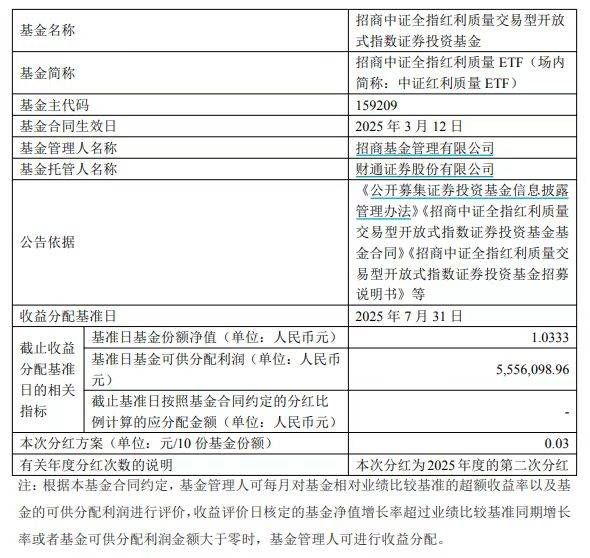
Group 1 - The core viewpoint of the news is the implementation of the second dividend distribution for the China Securities Red Chip Quality ETF (code: 159209), with a cash dividend of 0.003 yuan per share, representing a distribution ratio of 0.3% [1] - The fund will be suspended from trading on August 12, 2025, from the market opening until 10:30 AM, and will resume trading at 10:30 AM on the same day, prompting investors to plan their transactions accordingly [1] - Recent market research indicates the emergence of two differentiated investment paths due to the deepening of dividend investment strategies, with one focusing on deep value through high dividend and low volatility, and the other on value growth through high dividend and high profitability quality [1] Group 2 - The Hong Kong dividend low volatility ETF (520550) represents a deep value strategy, focusing on defensive sectors such as finance and utilities, with a current dividend yield close to 6% [1] - The China Securities Red Chip Quality ETF (159209) adopts a value growth strategy, emphasizing high dividend and high profitability quality, targeting sectors like consumption and pharmaceuticals, achieving a balance between defensiveness and growth [1] - Professional institutions suggest that conservative investors should focus on the Hong Kong dividend low volatility ETF for stable returns, while aggressive investors may consider the China Securities Red Chip Quality ETF for growth opportunities [2]

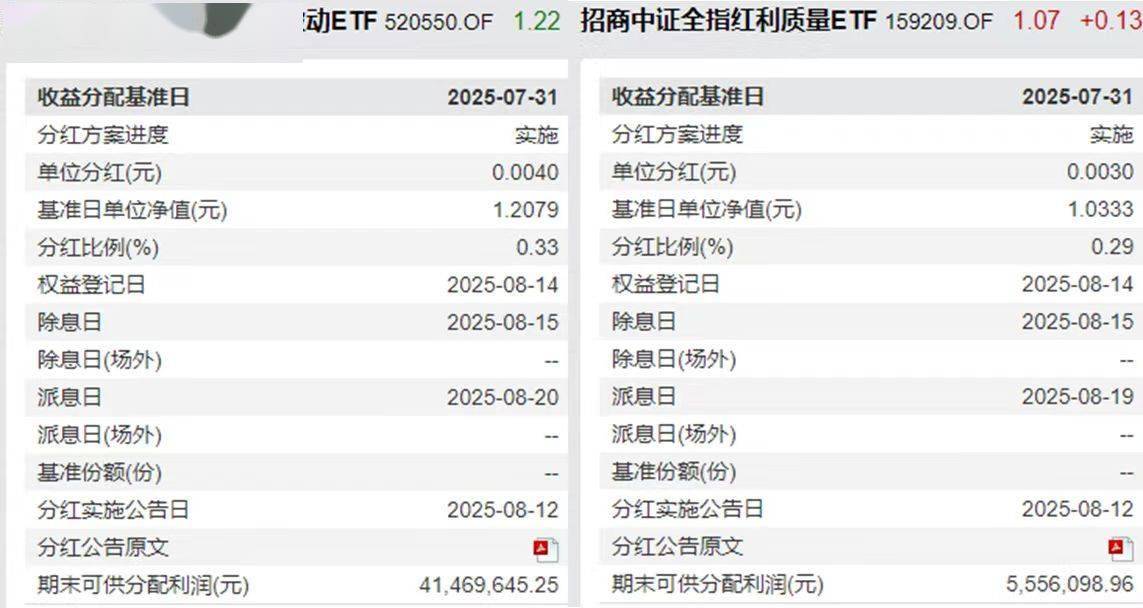
双红利ETF同步分红!港股红利低波ETF(520550)、中证红利质量ETF(159209)于8月14日权益登记
Sou Hu Cai Jing· 2025-08-12 01:13
Core Viewpoint - Two dividend ETFs under China Merchants Fund have implemented dividend distributions, highlighting the growing trend of dividend investment strategies in the market [1][2]. Group 1: Dividend Distribution Details - The CSI Dividend Quality ETF (code: 159209) distributed a cash dividend of 0.003 yuan per share, with a distribution ratio of 0.3% [1]. - The Hong Kong Dividend Low Volatility ETF (code: 520550) distributed a cash dividend of 0.004 yuan per share, with a distribution ratio of 0.33% [1]. - The Hong Kong Dividend Low Volatility ETF linked funds (Class A 024029/Class C 024030) have fully opened for subscription and redemption [1]. Group 2: Investment Strategies - The market has formed two main dividend investment strategies: - Deep Value Strategy: Represented by the Hong Kong Dividend Low Volatility ETF, which tracks the Hang Seng High Dividend Low Volatility Index, focusing on "high dividend + low volatility" factors, with a current dividend yield exceeding 8% [1]. - Value Growth Strategy: The CSI Dividend Quality ETF focuses on "high dividend + high profitability quality," selecting high-quality fundamentals in sectors like consumer and pharmaceuticals, with a historical yield of 3%-5% [1]. Group 3: Investment Recommendations - Current allocation suggestions recommend a dynamic balance to seize dividend opportunities, allowing investors to choose based on their risk preferences [2]. - Conservative investors may focus on the Hong Kong Dividend Low Volatility ETF, while aggressive investors may pay attention to the CSI Dividend Quality ETF [2]. - For portfolio allocation, a "barbell strategy" is suggested to dynamically adjust the proportion of the two product types, with regular rebalancing recommended [2].
财信证券宏观策略周报(8.11-8.15):指数短期维持高位震荡,关注哑铃策略及反内卷方向-20250810
Caixin Securities· 2025-08-10 09:48
Group 1 - The report indicates that the A-share market is currently experiencing a rebound near previous highs, but the momentum of the index's rise is lacking, as evidenced by a decrease in trading volume and a shift from technology to high-dividend styles, suggesting a defensive stance from some funds [5][8][12] - The report suggests that the market is likely to enter a period of consolidation, with a focus on rapid rotation among sectors and a potential continued decline in trading volume, indicating that a breakthrough in the index will require positive fundamental support [5][8][13] - Investment opportunities are highlighted in high-growth sectors, particularly in the "barbell strategy" focusing on high-dividend and small-cap stocks, as well as sectors benefiting from anti-involution policies such as steel, coal, and photovoltaics [5][14][15] Group 2 - The report notes that the Producer Price Index (PPI) showed a narrowing decline in July, validating the effectiveness of anti-involution measures in boosting prices, which will be a significant factor influencing the A-share index [8][9][14] - The report emphasizes the importance of monitoring tariff changes and export effects, as recent trade agreements between the US and other economies have led to increased tariffs, adding uncertainty to future US-China trade negotiations [9][12] - The report highlights the potential for high-dividend strategies to gain traction as market participants shift towards defensive positions, particularly in light of declining risk-free rates and the anticipated outflow of funds from the bond market [10][14]
哑铃策略火了!价值股+成长股双端布局,助投资者稳健应对市场轮动
Sou Hu Cai Jing· 2025-08-09 22:02
Core Viewpoint - The "barbell strategy" in capital markets attracts investors due to its risk diversification and balanced return characteristics, focusing on the simultaneous allocation of value stocks and growth stocks to leverage the strengths of both asset styles [1] Group 1: Complementary Role of Value and Growth Stocks - Value stocks are typically stable companies in mature industries with low price-to-earnings and price-to-book ratios, providing steady cash flow and strong defensive attributes, especially during market downturns [3] - Growth stocks are often in high-growth sectors like technology, renewable energy, and biomedicine, offering significant capital appreciation potential once earnings growth materializes, thus providing additional return elasticity in structural market conditions [3] - The barbell strategy requires investors to maintain a balanced weight between both ends to prevent returns from concentrating in a single direction during market style shifts, enhancing overall portfolio stability [3][4] Group 2: Implementation of a Steady Return Strategy - Effective implementation of the barbell strategy hinges on managing the allocation ratio between value and growth stocks based on market cycles, industry conditions, and individual risk tolerance [4] - In stable macro environments, increasing the weight of growth stocks can capture high-elasticity opportunities, while in risk-averse markets, increasing value stock allocation can limit portfolio drawdowns [4] - The selection of industries and individual stocks involves assessing the financial stability and cash flow sustainability of value stocks, while growth stocks require a focus on the realizability of growth logic, industry growth potential, and competitive landscape [4]

坚持哑铃策略 实现稳健收益
Zheng Quan Shi Bao· 2025-08-08 21:33
Group 1 - The "Dumbbell Strategy" is a common investment approach in the stock market, characterized by allocating funds primarily between value stocks and growth stocks, which have different investment focuses and operational modes [1] - Recently, the strategy faced challenges as value stocks, particularly in the banking sector, experienced a significant decline of around 10%, while growth stocks saw notable increases, leading to discussions on whether investors should shift focus entirely to growth stocks [1][2] - Historically, the Dumbbell Strategy gained popularity in recent years as institutional investors targeted value stocks, driving their reverse rise and making low-volatility, high-yield stocks a market highlight [1][2] Group 2 - Policies encouraging capital inflow into stocks have contributed to the attractiveness of both value and growth stocks, leading to the popularity of the "Dumbbell Strategy" [2] - The effectiveness of the Dumbbell Strategy has been observed, with value stocks showing stable performance and growth stocks delivering better investment returns until mid-June of this year [2] - Despite recent market fluctuations, the macroeconomic fundamentals and stable policy environment suggest that the market trend will be maintained, with institutional investors significantly altering the market landscape [3]
两融余额站稳2万亿,小盘行情狂飙不止
Sou Hu Cai Jing· 2025-08-08 09:34
同时,两市成交额维持在1万8千亿附近,距离2月行情高点一步之遥,显示量能依旧充足。 在流动性充裕与杠杆资金持续涌入的背景下,小盘股行情一路狂飙突进,目前已经成为市场最锋利的收益来源。 截至昨天,中证2000指数年内上涨25.55%,在宽基指数中位列第一。小盘指增因为专业获取超额,年内涨幅更为突出——同类规模第一的中证2000增强 ETF(159552)年内上涨45.66%,已经跑赢指数20个百分点。 资料显示,该ETF昨日获得8280万的资金净流入,创下成立以来的单日净流入新高。年初以来,中证2000增强ETF(159552)的规模暴涨45倍,目前已经突 破7亿。 截至8月7日,两融余额连续三个交易日站稳2万亿大关,不断逼向2015年历史高点。 2025年,小盘股的高弹性在流动性、政策扶持专精特新、与杠杆资金活跃的背景下被充分激活。但盛宴之下,风险信号若隐若现,当前中证2000指数滚动市 盈率已逼近146倍,处于近10年99%分位。 虽然中证2000高估值是历史常态,但是区间高位涨幅的背后是随时可能调整的风险。目前中证2000增强ETF(159552)的二季报也已提示风险:"由于小市 值风格上半年持续强势,市 ...

基金投顾盯上医药科技,狂赚30%
21世纪经济报道· 2025-08-07 08:06
Core Viewpoint - The article highlights a shift in investment strategies among fund advisory products, with a notable increase in allocations towards high-dividend and technology assets, while reducing exposure to consumer sectors [1][7][11]. Group 1: Fund Advisory Product Adjustments - In July, a total of 141 fund advisory products made adjustments, including 27 mixed equity and bond products and 64 equity products [1][6]. - Mixed equity and bond products increased their holdings in active equity funds while reducing allocations to index funds [1][6]. - Equity advisory products decreased their holdings in bond-oriented funds and increased their allocations to equity funds [1][6]. Group 2: Sector Allocation Changes - Fund advisory products overall reduced exposure to consumer sectors and increased allocations to pharmaceuticals, cyclical sectors, and technology [1][7]. - The highest increase in allocation was seen in the pharmaceutical and biotechnology sector (+0.47%) and non-ferrous metals (+0.31%), while the largest reductions were in food and beverage (-0.35%) and electronics (-0.23%) [7]. Group 3: Performance of Fund Products - Some equity advisory combinations have achieved over 20% excess returns this year, with specific products like Huabao Securities' Value Investment Fund V and Guolian Securities' Anxin Aggressive 90 showing returns of 30.88% and 25.59% respectively [9][10]. - Mixed equity and bond products with a higher proportion of equity funds also performed well, with returns of 14.72% and 12.92% for specific products [10]. Group 4: Market Outlook and Investment Strategies - Some advisory institutions maintain a relatively positive outlook on the market, citing improved funding conditions and potential inflows of external capital [11]. - Recommended investment directions include high-dividend stocks and technology assets, particularly in AI applications and semiconductors [11][12]. - The strategy of diversifying investments across different asset classes and markets is emphasized, suggesting a balanced approach to mitigate risks [12].

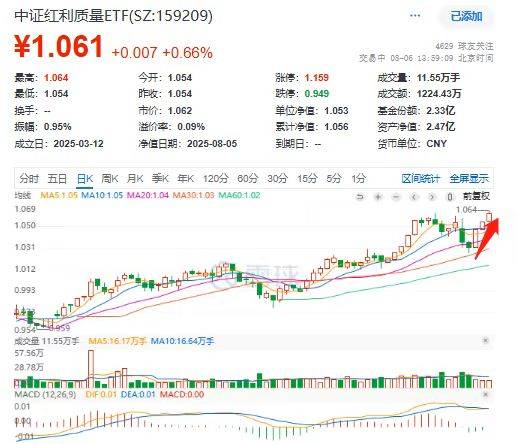
巴菲特好眼力!中证红利质量ETF(159209)三连阳创第19次历史新高
Sou Hu Cai Jing· 2025-08-06 06:14
Core Insights - The market sentiment remains positive, with the CSI Dividend Quality ETF (159209) rising by 0.66% and hitting a new high for the 19th time this year as of 1:59 PM on August 6 [1] - The trading volume is increasing, with a turnover rate of 4.97% and a transaction amount exceeding 12 million, indicating sustained capital interest [1] - The ETF employs a "dividend + quality" dual-factor screening mechanism to select high-quality companies that possess both "low valuation" and "high quality," aligning with Warren Buffett's value investment philosophy [1] Investment Strategy - The CSI Dividend Quality ETF (159209) and the Hong Kong Dividend Low Volatility ETF (520550) can be combined to create a cross-market "dumbbell strategy," balancing offensive and defensive positions while diversifying risks across two markets [1] - The product features low fees and monthly dividends, which may enhance long-term returns for investors [1]