缩表

Search documents
10月15日隔夜要闻:美股涨跌不一 油价跌超1% 鲍威尔讲话推动短债上涨 LVMH三季度营收意...
Xin Lang Cai Jing· 2025-10-14 22:55
来源:环球市场播报 欲览更多环球财经资讯,请移步7×24小时实时财经新闻 市场 10月15日收盘:美股涨跌不一,特朗普言论导致标普500指数收跌 10月15日美股成交额前20:美银证券下调英特尔评级 周二热门中概普跌,台积电跌2.29%,阿里巴巴跌2.37% 周二油价下跌逾1% 受贸易紧张局势与IEA报告影响 纽约期金涨约0.7%,亚太午盘创历史新高、逼近4200美元,纽约铜跌超2.6% 欧洲主要股指多数收跌 宏观 特朗普称战事已结束,但中东和平之路仍脆弱 特朗普向遭枪杀的政治盟友柯克追授总统自由勋章 特朗普:若米莱败选 美国不会对阿根廷慷慨 鲍威尔暗示再次降息 因招聘疲软加剧失业率上升风险 美司法部从柬埔寨大型"杀猪盘"骗局中没收150亿美元比特币 法国总理勒科尔尼赢得来自社会党的关键支持 印度押注2170亿美元核能计划 公司 用AI节约成本!高盛通知员工:今年计划进行新一轮裁员 Meta移除疑似用于针对移民海关执法局探员的Facebook主页 LVMH三季度营收意外增长1%,丝芙兰表现抢眼,ADR大涨8% 谷歌在印度南部砸下150亿美元建数据中心,打造美国之外最大AI枢纽 Tricolor事件恐非孤例 摩 ...


鲍威尔最新讲话:就业通胀前景变化不大,或将结束缩表
Jin Shi Shu Ju· 2025-10-14 17:31
Core Viewpoint - Federal Reserve Chairman Jerome Powell discussed the U.S. economic outlook and monetary policy, emphasizing the Fed's ongoing efforts to maintain economic and financial stability while adapting policies based on economic conditions rather than preset paths [1][3]. Economic Outlook - Current data indicates that the employment and inflation outlook has not changed significantly since September, despite some delays in government data due to the shutdown [3][4]. - Economic activity growth may be more robust than previously expected, with the unemployment rate remaining low as of August, although non-farm employment growth has slowed [3][4]. - The labor market shows signs of weakness, with rising risks to employment, as evidenced by low levels of layoffs and hiring, alongside declining perceptions of job opportunities among residents and businesses [3][4]. Inflation and Monetary Policy - The core Personal Consumption Expenditures (PCE) inflation rate was 2.9% year-on-year as of August, slightly up from earlier in the year, primarily due to rising core goods prices [4]. - Short-term inflation expectations have increased this year, while most long-term inflation expectations remain aligned with the Fed's 2% target [4]. - The rising risks in the labor market have influenced the Fed's assessment of risk balance, leading to a more neutral policy stance being deemed appropriate [4]. Federal Reserve Operations - Powell indicated that the balance sheet reduction may conclude in the coming months, with the Fed aiming to ensure sufficient liquidity in the financial system to manage short-term interest rates and market volatility [1][3]. - The tightening liquidity conditions and rising repo rates have led to temporary liquidity pressures, highlighting the need for a flexible approach to the balance sheet based on experiences since 2020 [1][3].
美股三大指数短线走高
Ge Long Hui A P P· 2025-10-14 16:38
Core Viewpoint - The S&P 500 index has turned positive, with the Dow Jones Industrial Average rising by 250 points, an increase of over 0.5%, while the Nasdaq is currently down by more than 0.3%. Additionally, Powell indicated that there may be a halt to the balance sheet reduction in the coming months [1] Group 1 - The S&P 500 index has shifted to a positive trajectory [1] - The Dow Jones Industrial Average has increased by 250 points, representing a rise of over 0.5% [1] - The Nasdaq index is experiencing a decline of more than 0.3% [1] Group 2 - Powell has suggested the possibility of stopping the balance sheet reduction in the upcoming months [1]
鲍威尔:可能会在未来数月停止缩表
Hua Er Jie Jian Wen· 2025-10-14 16:24
鲍威尔:可能会在未来数月停止缩表。 市场有风险,投资需谨慎。本文不构成个人投资建议,也未考虑到个别用户特殊的投资目标、财务状况或需要。用户应考虑本文中的任何 意见、观点或结论是否符合其特定状况。据此投资,责任自负。 风险提示及免责条款 ...
Fed Chair Powell hinted the central bank could be approaching the end of a more than three-year campaign to shrink a portfolio of Treasury securities it acquired to provide stimulus after the 2020 pandemic
WSJ· 2025-10-14 16:23
The central bank has been passively reducing its $6.6 trillion asset holdings since mid-2022, part of a technical effort to unwind its pandemic policies. ...

就在刚刚,美联储对外宣布了,美联储鲍尔森表示,如果通胀出现飙升,美联储将不得不采取行动,实现2%通胀率非常重要
Sou Hu Cai Jing· 2025-10-14 15:37
Core Viewpoint - The Federal Reserve's recent comments on inflation indicate a serious concern about rising prices, with a specific focus on maintaining the 2% inflation target, which has been a long-standing policy goal since 2012 [3][5][9] Inflation Indicators - The core PCE inflation rate, a key indicator monitored by the Federal Reserve, peaked at over 5% in 2023 but has since decreased to 3.9% as of August [3] - The Consumer Price Index (CPI) showed a decline from 9.1% in June 2022 to 3.7% in September 2023, yet essential items like food, housing, and healthcare continue to rise [5] Market Sentiment and Expectations - Public expectations for inflation remain high, with a survey indicating a 3.6% expectation for the next year, suggesting a lack of confidence in returning to the 2% target [5] - Market reactions to Federal Reserve signals have shown volatility, with the probability of interest rate hikes increasing from 15% to over 30% in early October [7] Monetary Policy Actions - The Federal Reserve has raised interest rates to a range of 5.25% to 5.50%, the highest level in 22 years, which increases borrowing costs for consumers and businesses [7] - The total credit card debt in the U.S. surpassed $1 trillion in Q2 2023, indicating significant financial pressure on consumers [7] Economic Challenges - The Federal Reserve faces a dilemma between managing rising debt levels among consumers and businesses and controlling inflation, which remains stubbornly high [9] - The potential for further interest rate hikes or balance sheet reduction could tighten market liquidity, impacting economic growth [11] External Factors - Ongoing trade issues, particularly between the U.S. and China, and rising international oil prices are contributing to inflationary pressures, complicating the Federal Reserve's policy decisions [5][9]
美联储 9 月 FOMC 会议纪要:就业疲软背景下大多数官员支持降息,通胀风险仍存
Sou Hu Cai Jing· 2025-10-08 18:41
(来源:吴说) 吴说获悉,美联储于 2025 年 9 月 16 至 17 日召开的联邦公开市场委员会(FOMC)会议纪要显示,美 国上半年实际 GDP 增速放缓,劳动力市场趋软,核心 PCE 通胀维持在年内高位。多数与会官员认为在 当前背景下适度宽松是合适的,并预期年内可能进一步降息。大多数成员强调通胀上行风险依然存在, 但就业下行风险有所增加。委员会将继续推进缩表进程,预计至 2026 年一季度,银行体系准备金余额 将降至约 2.8 万亿美元。 来源:市场资讯 ...
抛售1.6万亿美元,美债最大卖家曝光,但却不是中国
Sou Hu Cai Jing· 2025-09-27 22:39
Core Insights - The Federal Reserve has quietly sold $1.6 trillion in U.S. Treasury bonds over the past three years, surpassing the combined holdings of Japan and the UK, and significantly exceeding China's cumulative reduction of $500 billion [1][2] - This selling spree coincides with a complex economic strategy involving both liquidity withdrawal and interest rate cuts, revealing a precarious balance between debt management, inflation control, and political pressures [1][2] Group 1: Federal Reserve's Actions - The Federal Reserve's dual role as both regulator and seller of U.S. Treasuries has emerged, driven by inflation pressures that peaked at 9% in 2022, necessitating a monthly reduction of up to $95 billion in bond holdings [2] - Despite initiating a rate-cutting cycle in September 2024, the Fed's balance sheet reduction has continued, indicating a struggle to manage inflation risks while addressing labor market concerns [2][5] - The Fed's actions have led to a significant reduction in bank reserves, dropping below the $3 trillion psychological threshold, raising concerns about potential liquidity crises [6][7] Group 2: Market Dynamics and Buyers - Traditional allies like Japan and the UK have become major buyers of U.S. Treasuries, with Japan holding $1.15 trillion and the UK increasing its holdings to $899.3 billion, surpassing China [2][4] - A new player in the market is stablecoins, which are now required to hold short-term U.S. Treasuries as reserves, potentially leading to $1.6 trillion in Treasury holdings by stablecoins by 2028 [3] - The global trend of "de-dollarization" is accelerating, with central banks rapidly selling U.S. Treasuries and increasing gold reserves, reflecting a growing distrust in U.S. financial practices [7] Group 3: Political and Economic Pressures - Political pressures have influenced the Federal Reserve's decisions, with former President Trump publicly urging rate cuts and threatening the Fed's leadership, highlighting the tension between political and monetary independence [5] - The U.S. national debt has surpassed $37 trillion, with annual interest payments exceeding $1.2 trillion, prompting concerns about fiscal sustainability and the implications of interest rate changes [5] - The ongoing debate within the Fed regarding the balance between controlling inflation and maintaining liquidity reflects the complexities of current economic conditions [7]
美联储银行准备金跌破3万亿,缩表或提前结束,股债市场利好?
Sou Hu Cai Jing· 2025-09-26 03:59
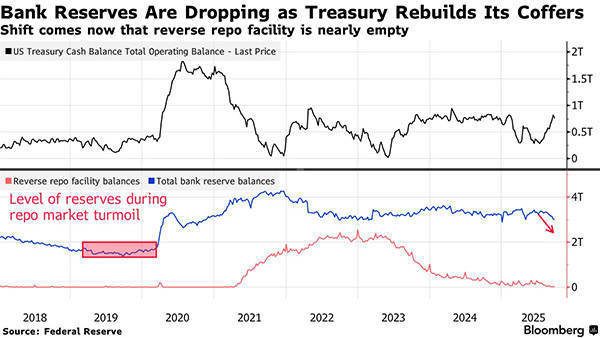
Group 1 - The core point of the articles highlights a significant decline in the reserves of the U.S. banking system, which has fallen below $3 trillion for the first time since January, indicating tightening liquidity conditions [1][3] - As of September 24, the reserves decreased by approximately $21 billion, reaching $2.9997 trillion, the lowest level in 2023 [1] - The decline in reserves is primarily driven by the U.S. Treasury's increased debt issuance since July to bolster cash reserves, which has absorbed liquidity from the Federal Reserve's balance sheet [3] Group 2 - The reduction in reserves is also influenced by the near depletion of the overnight reverse repurchase agreement (RRP) tool, leading to a decrease in bank reserves held at the Federal Reserve [3] - The tightening liquidity is gradually affecting the daily operations of the financial system, prompting the Federal Reserve to slow down its balance sheet reduction by decreasing the scale of maturing bond rollovers [3] - The effective federal funds rate has slightly increased to 4.09%, indicating upward pressure on financing costs, although it remains within the target range of 4% to 4.25% [3] Group 3 - Dallas Fed President Logan suggests abandoning the federal funds rate as the benchmark for monetary policy, advocating for a rate linked to the U.S. Treasury mortgage market to enhance policy stability and effectiveness [4]
全球财富重新分配!美联储降息后,中国接得住千亿资金吗?
Sou Hu Cai Jing· 2025-09-22 13:27
Core Viewpoint - The Federal Reserve has officially announced a 25 basis point interest rate cut, signaling the potential for one to two more cuts within the year, marking the beginning of a new easing cycle amidst a complex economic backdrop [1][4]. Group 1: Market Reactions and Expectations - The 25 basis point cut aligns with market expectations, avoiding excessive panic that could arise from a more aggressive cut [4]. - The probability of another rate cut in October has surged to 97.4%, indicating a clear trend towards monetary easing [4]. Group 2: Economic Context and Challenges - The current economic environment is characterized by high volatility and uncertainty, with the U.S. facing significant pressures from high interest rates [6][7]. - The U.S. banking sector is under strain due to rising interest expenses, which threaten financial stability [7]. - Economic growth is being hampered as borrowing becomes more difficult for businesses and consumer spending contracts, evidenced by low job growth and rising unemployment claims [7]. - The U.S. national debt has surpassed $37 trillion, with annual interest payments exceeding $1.2 trillion, raising concerns about long-term sustainability [7]. Group 3: Global Implications and Opportunities - The Fed's actions are expected to influence global capital flows, with potential benefits for emerging markets like China as capital returns [6][9]. - The easing of monetary policy may lead to improved employment conditions and reduced mortgage burdens in China, as the People's Bank of China is likely to follow suit with rate cuts [9]. - Historical data suggests that A-shares have a high probability of rising following Fed rate cuts, indicating potential investment opportunities in the Chinese market [9][10]. Group 4: Strategic Considerations for Investors - The current economic situation presents a chance for China to implement more aggressive monetary policies without fearing capital outflows [10]. - Future market movements may be influenced by sector-specific dynamics, with technology, new consumption, and green economy sectors likely to benefit first, while traditional overcapacity industries may face challenges [10][11].