资本市场

Search documents
引导要素资源服务新质生产力
Jing Ji Ri Bao· 2025-10-15 22:12
Core Viewpoint - The article emphasizes the importance of capital market reforms in supporting technological innovation and industrial transformation during China's "14th Five-Year Plan" period, highlighting the role of the Science and Technology Innovation Board (STAR Market) and the Growth Enterprise Market (GEM) in enhancing the adaptability of the multi-level market system [1][2]. Group 1: Capital Market Reforms - The capital market is enhancing its inclusivity to support high-tech, high-growth, and high-risk enterprises, providing a full chain of services from venture capital to IPO financing and mergers and acquisitions [2][3]. - The introduction of the registration system in the STAR Market and GEM has significantly improved the inclusivity of the listing process, with over 90% of new listings during the "14th Five-Year Plan" being high-tech enterprises [3][4]. - As of now, the market capitalization of the technology sector in A-shares exceeds 25%, surpassing the combined market capitalization of the banking, non-banking financial, and real estate sectors [4]. Group 2: Private Equity and Venture Capital - Private equity and venture capital funds have accelerated their development, becoming key drivers of technological innovation and industrial transformation, with a management scale of 14.4 trillion yuan and 150,000 projects under investment as of Q2 2023 [6][7]. - These funds have invested in 90% of companies listed on the STAR Market and the Beijing Stock Exchange, demonstrating their role as incubators and accelerators for innovation [7]. - The government has introduced supportive policies to optimize the venture capital ecosystem, enhancing fundraising, investment, and exit mechanisms [6]. Group 3: Quality of Listed Companies - The cultivation of new productive forces relies on high-quality listed companies, with regulatory measures in place to enhance information disclosure, corporate governance, and market-oriented mergers and acquisitions [8][9]. - In 2023, over 2 trillion yuan in cash dividends were distributed by listed companies, reflecting a commitment to shareholder returns and market stability [9]. - The number of major asset restructurings has increased significantly, with 1,234 disclosures in the first eight months of the year, indicating a trend towards optimizing resource allocation through mergers and acquisitions [9][10].
2025年新粤商特训营收官 129名企业高管受训
Zhong Guo Xin Wen Wang· 2025-10-15 19:56
Core Insights - The New Yue Business Training Camp concluded successfully on October 14, 2025, in Shenzhen, with 129 senior management personnel from high-quality small and medium-sized enterprises (SMEs) participating [1][2] - The training camp aims to assist high-quality SMEs in leveraging capital markets for growth, enhancing comprehensive services related to financing and listing [1][2] Group 1: Training Camp Overview - The training camp was organized by the Guangdong Small and Medium Enterprises Service Center and included three sessions held on August 28-29, September 11-12, and October 13-14, 2025 [1] - The focus was on enhancing capital market knowledge for specialized and innovative SMEs in key manufacturing industry chains in Guangdong [1] Group 2: Curriculum and Activities - The program included immersive learning courses covering topics such as capital market listing planning, financial auditing practices, investment strategies, listing compliance operations, and AI digital transformation for enterprises [1][2] - In addition to lectures, the training featured site visits to the Shenzhen Stock Exchange and the Shenzhen Financial Museum, allowing participants to experience the vitality and development of the capital market firsthand [2] Group 3: Future Plans - The Guangdong Small and Medium Enterprises Service Center plans to continuously optimize course design and introduce multi-level capital market resources, tailoring content to meet the actual needs of enterprises [2] - The initiative aims to build a comprehensive service system to provide more precise and efficient support for SMEs, contributing to high-quality economic development in Guangdong [2]
连平:资本市场环境发生三大变化,对其长远发展保持信心
Di Yi Cai Jing· 2025-10-15 03:09
Group 1: Liquidity Environment - The liquidity environment in the capital market is expected to remain accommodative, influenced by changes in global monetary policies, particularly in major economies like the EU, Japan, and the US [2][3] - The US Federal Reserve has cut interest rates by a total of 100 basis points since the beginning of 2024, indicating a shift towards a more accommodative monetary policy due to economic slowdown and rising unemployment [2][3] - China's monetary policy has also shifted from "prudent" to "moderately accommodative," marking a significant change in approach to support economic growth [3][4] Group 2: Investment Trends - Investment demand is likely to shift towards the capital market as traditional channels like real estate and high-yield financial products have seen significant declines in attractiveness and returns [5][6] - The real estate market has been in a deep adjustment phase since the second half of 2021, leading to reduced investor confidence and a lower likelihood of high returns [5][6] - The yield on financial products has dropped significantly, with many previously high-yield options now offering around 2%, which fails to attract medium-risk investors, further driving them towards the capital market [6] Group 3: Central Bank Support - The central bank has introduced innovative tools to directly support the capital market, including liquidity swaps for financial institutions and special loans for stock buybacks by listed companies [7][8] - The central bank's actions are aimed at stabilizing market fluctuations and boosting investor confidence, especially during periods of significant market volatility [8][9] - The establishment of a market operation framework through the China Investment Corporation (CIC) is expected to play a crucial role in maintaining market stability and supporting the capital market's development [9]
国联民生证券承销保荐有限公司保荐代表人王嘉先生致辞
Shang Hai Zheng Quan Bao· 2025-10-14 18:27
Group 1 - The company, ChaoYing Electronics, specializes in the printed circuit board (PCB) industry, with applications in automotive electronics, displays, storage, consumer electronics, and communications [1] - ChaoYing Electronics has established long-term stable partnerships with several globally renowned automotive electronics companies, leveraging its strong R&D capabilities, refined management, product quality, and timely delivery [1] - The company is actively expanding its data center product offerings, which will support its future growth and strategic objectives [1] Group 2 - The company aims to provide solid returns to investors and contribute to society following its successful listing on the Shanghai Stock Exchange [1] - The online roadshow is intended to enhance investors' understanding of ChaoYing Electronics' investment value and growth potential, encouraging participation in the current issuance [1]

Jim Cramer On FactSet: 'Holy Cow, It's Way Too Cheap' — Also Weighs In On Freeport-McMoRan
Benzinga· 2025-10-14 12:30
Group 1: FactSet Research Systems Inc. - FactSet reported fourth-quarter sales of $596.9 million, exceeding analyst expectations of $593.5 million, marking a 6.2% year-over-year increase [2] - Adjusted earnings per share for the quarter were $4.05, which fell short of the expected $4.13 [2] - FactSet shares increased by 1% to close at $285.99, with a market cap of $10.88 billion, trading significantly below its 52-week high of $499.87 [4] - The company's P/E ratio stands at 18.39, indicating a potentially attractive valuation, while the dividend yield is 1.54% [4] Group 2: Freeport-McMoRan Inc. - Freeport-McMoRan is set to release its third-quarter earnings on October 23, with analysts expecting earnings of 41 cents per share, up from 38 cents in the previous year [3] - Projected quarterly revenue for Freeport is $6.71 billion, slightly down from $6.79 billion a year earlier [3] - Freeport-McMoRan shares surged 4.7% to close at $42.78, with a market cap nearing $60 billion [4] - The stock has fluctuated within a 52-week range of $27.66 to $50.28, reflecting a strong recovery amid evolving global demand for copper and other metals [4]


最新税收数据显示:去年一揽子增量政策实施一年来我国经济向好态势不断稳固
Shang Hai Zheng Quan Bao· 2025-10-14 10:38
Core Insights - The implementation of a series of incremental and stock policies since September 26 last year has led to a steady recovery in invoice sales and tax revenue, reflecting a positive trend in China's economy [1][2][6]. Group 1: Economic Indicators - The growth rate of national enterprise sales revenue has shown a steady increase, with quarterly growth rates of 0.4%, 2.6%, 2.1%, 3.1%, and 4.4% from last year's third quarter to this year's third quarter [2]. - Tax revenue has turned positive after seven months of negative growth, with a cumulative increase since February this year, showing year-on-year changes of -0.4%, +2.6%, and +6.9% for the first three quarters [2]. Group 2: Capital Market Performance - Capital market-related tax revenue has increased significantly, with a year-on-year growth of 56.8%, and securities transaction stamp duty rising by 110.5% [3]. - The total market value of A-share listed companies surpassed 100 trillion yuan for the first time in August, and the Shanghai Composite Index reached a ten-year high in September [3]. Group 3: Industry and Tax Revenue Growth - The manufacturing sector's tax revenue grew by 5.4%, accounting for 31% of total tax revenue, with high-end manufacturing sectors like railway and aerospace seeing tax revenue growth of 31.5% [4]. - The domestic value-added tax increased by 3.2%, and corporate income tax rose by 4.1%, indicating improved profitability in various industries [4]. Group 4: Real Estate Market - The decline in real estate-related tax revenue has narrowed, with a year-on-year decrease of 9.8%, and a reduction of about 5% after accounting for tax incentives [5]. - The implementation of policies to stabilize the real estate market has led to a significant reduction in housing transaction costs, contributing to market stabilization [5]. Group 5: Consumer Activity - The policy of replacing old consumer goods has stimulated consumption, with machinery equipment purchases increasing by 9.7% year-on-year, and high-tech manufacturing equipment purchases rising by 11.8% [5]. - Retail sales of home appliances, such as refrigerators and televisions, have seen substantial growth, with increases of 55.4% and 35.3% respectively [5].
9月份税收收入增幅较高 经济向好带动财政收入稳步回升
Zheng Quan Shi Bao Wang· 2025-10-14 06:51
Group 1 - The core viewpoint of the articles highlights the positive growth in tax revenue, with a 6.9% year-on-year increase in the third quarter, driven by economic recovery and favorable policies [1][3] - The capital market service sector saw a significant tax revenue increase of 56.8% year-on-year, with securities transaction stamp duty rising by 110.5% [2] - The manufacturing sector's tax revenue grew by 5.4%, accounting for 31% of total tax revenue, indicating its crucial role in overall economic stability [2] Group 2 - Real estate-related tax revenue decreased by 9.8% year-on-year, but the decline has narrowed due to ongoing supportive policies, with a reduction of over 10 percentage points compared to the first three quarters of 2024 [2] - The implementation of a series of incremental policies has led to a steady recovery in invoice sales and tax revenue growth, reflecting improved corporate profitability and consumer activity [3] - The stock market's active trading environment contributed to the increase in tax revenue, with the total market capitalization of A-share companies surpassing 100 trillion yuan for the first time in August [1][2]
房产理财不香了?赚钱逻辑已改写,新投资环境靠新方法
Sou Hu Cai Jing· 2025-10-11 11:49
Group 1: Real Estate Market - The real estate market has shifted, with not all properties being difficult to sell; properties in core urban areas can sell quickly, while those in third-tier cities struggle [5][6] - Since the second half of 2021, the real estate sector has been in deep adjustment, indicating that buying property is no longer a guaranteed profit strategy [6][8] - The demographic trend shows a slowdown in young population growth, leading to demand concentrating in cities with industry and population inflow, causing price declines in non-core areas [8] Group 2: Investment Products - The yield on investment products has significantly decreased, with previously common 8% returns now mostly around 2%, primarily due to liquidity issues in underlying assets like real estate and local government financing [10] - Regulatory changes have altered the investment landscape, making it essential to evaluate the underlying assets of financial products rather than just their yields [12] Group 3: Monetary Policy and Economic Outlook - Global monetary policies are shifting towards easing, with the U.S. Federal Reserve reducing rates from 5.25%-5.5% to around 4%, and further cuts expected, potentially bringing rates below 3% [14][16] - China's monetary policy is also transitioning to a moderately loose stance, with expectations of rate cuts and a focus on stabilizing economic growth around 5% [17] - Lower borrowing costs from reduced mortgage rates and corporate financing will positively impact capital markets and corporate profitability, supporting long-term stock market growth [19] Group 4: Investment Strategy Recommendations - Households are advised to reassess their asset allocation, as many have a high percentage of wealth tied up in real estate, which poses risks [21] - A suggested asset allocation strategy includes emergency funds, stable investments, and growth-oriented investments to avoid liquidity issues [23] - Success in the new investment environment relies on patience and adapting to policy changes rather than relying on outdated strategies [25]
瑞达期货宏观市场周报-20251010
Rui Da Qi Huo· 2025-10-10 08:59
Section 1: Investment Rating - No investment rating for the industry is provided in the report. Section 2: Core Views - A-share major indices generally declined this week, with only the Shanghai Composite Index slightly rising. The ChiNext and STAR 50 indices weakened significantly, falling more than 2%. The four stock index futures also declined collectively, with the CSI 500 being the most resilient. After the National Day holiday, the A-share market opened higher, but there was profit-taking and fear of high prices, leading to a significant adjustment on Friday [6][11]. - Treasury bond futures had mixed performances this week. The current bond market has a mix of bullish and bearish factors. The economic data shows a pattern of "strong supply and weak demand," and the foundation for the recovery of effective demand is not yet solid, which provides some support for the bond market. However, in the absence of incremental positive news, the market is sensitive to negative news, and it is expected that Treasury bond futures will continue to be in a weakly oscillating pattern in the short term [6]. - The commodity market still shows a pattern of weak crude oil and strong gold. Since crude oil and gold have a large weight in the commodity index, it is expected that the commodity index will continue to fluctuate widely [6]. - The widening of the US-Japan interest rate differential has increased the expectation of a US dollar rebound. The dovish stance of the Federal Reserve limits the significant upward space. Japan's new political party is implementing fiscal stimulus and maintaining a loose stance, putting short-term pressure on the Japanese yen. The euro's trend mainly follows the inverse fluctuation of the US dollar [6][10]. Section 3: Summary by Directory 3.1 This Week's Summary and Next Week's Allocation Recommendations Stocks - The CSI 300 declined by 0.51%, and the CSI 300 stock index futures declined by 0.63%. The A-share market had a good start after the National Day holiday, but then adjusted due to profit-taking. The recommendation is to buy on dips [6][11]. Bonds - The 10-year Treasury bond yield declined by 0.10%, with a weekly change of -0.18 BP. The main 10-year Treasury bond futures rose by 0.09%. The bond market is in a mixed situation, and the recommendation is to wait and see cautiously [6]. Commodities - The Wind Commodity Index rose by 0.76%, and the China Securities Commodity Futures Price Index rose by 0.94%. The commodity market has a pattern of weak crude oil and strong gold, and the recommendation is to mainly wait and see [6]. Foreign Exchange - The euro against the US dollar declined by 1.45%, and the euro against the US dollar 2512 contract declined by 1.51%. The US dollar is expected to rebound, the yen is under pressure, and the euro follows the US dollar's inverse trend. The recommendation is to wait and see cautiously [6][10]. 3.2 Important News and Events - China has taken steps in extraterritorial jurisdiction, including export controls on rare earths and related technologies and adding foreign entities to the unreliable entity list. China and Italy held the 12th Joint Meeting of the Governmental Committee, and Premier Li Qiang met with the President of the European Commission [13]. - The US Federal Reserve showed a willingness to cut interest rates further this year, but many officials were cautious due to inflation concerns. Hamas announced that the Gaza war had ended. The OECD raised the global economic growth forecast, and the US government shutdown continued [15]. 3.3 This Week's Domestic and International Economic Data - The US 1-year inflation expectation in September was 3.38%. The eurozone's retail sales month-on-month rate in August was 0.1%. Germany's industrial output month-on-month rate in August was -4.3%, and its trade surplus was 17.2 billion euros. France's trade deficit in August was 5.53 billion euros. Japan's trade surplus in August was 105.9 billion yen [16]. - The central bank's open market operations had a net withdrawal of 164.23 billion yuan this week [18]. 3.4 Next Week's Important Economic Indicators and Economic Events - Next week, important economic data such as China's September export and import year-on-year rates, Germany's September CPI month-on-month rate, and the US September NFIB small business confidence index will be released [79].

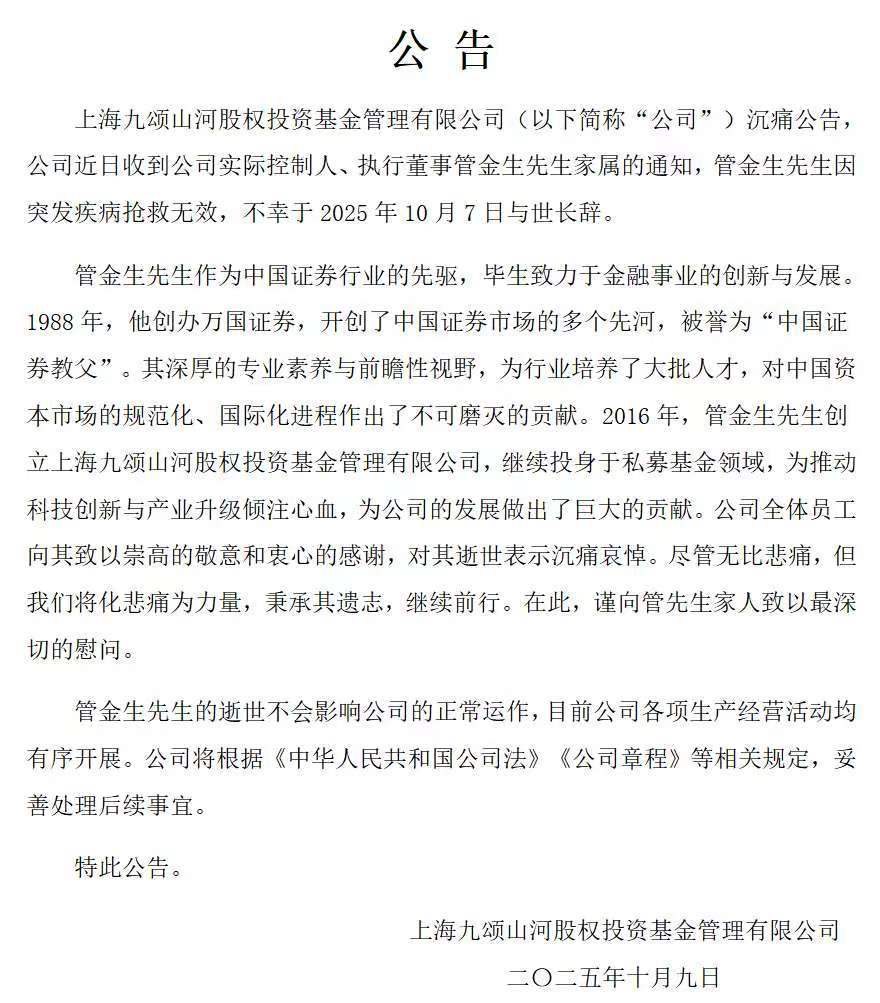
管金生去世!曾被称“证券教父”
Zhong Guo Zheng Quan Bao· 2025-10-10 03:15
10月9日晚,上海九颂山河股权投资基金管理有限公司(简称"九颂基金")公告,近日收到实际控制人、执行董事管金生家属 的通知,管金生因突发疾病抢救无效,不幸于2025年10月7日与世长辞。 来源:九颂基金微信公众号 少年出乡关:从外语到金融的跨越 1947年,管金生出生于江西省清江县(今樟树市)。青年时代,他以优异成绩考入上海外国语学院,主修法语;后赴比利时 布鲁塞尔自由大学深造,并获得工商管理硕士学位。 1980年代初,改革春潮拍岸,管金生从外语与涉外事务的岗位转入金融业。1982年进入上海国际信托;1988年,管金生受命 筹建中国最早的现代券商之一——万国证券。该公司由上海国际信托投资公司等10家股东共同出资3500万元人民币成立,管 金生出任副董事长、总经理兼总裁。 1990年上海证券交易所成立时,其交易规则、设备、交易员的培训等都有万国证券的参与。深沪两地的异地交易首先由万国 证券开通;无纸化交易也由万国证券率先推动。 到1992年,万国证券已成长为一家具有国际影响力的公司。彼时,管金生与原君安证券的张国庆、原申银证券的阚治东并称 为"中国证券教父"。 命运转折:"327国债事件" 1995年初春,"3 ...