期货交易

Search documents
锡连续主力合约日内涨6%,现报369970.00元
Mei Ri Jing Ji Xin Wen· 2026-01-12 01:56
Core Viewpoint - The main focus of the news is the significant increase in the price of tin futures, which rose by 6% to reach 369,970.00 yuan per ton [1]. Group 1 - Tin futures experienced a daily increase of 6% [1]. - The current price of tin futures is reported at 369,970.00 yuan [1].
集运指数欧线期货连续主力合约日内涨8%,现报1243.00点
Mei Ri Jing Ji Xin Wen· 2026-01-12 01:18
每经AI快讯,集运指数欧线期货连续主力合约日内涨8%,现报1243.00点。 ...
港口库存仍处于高位,甲醇价格承压
Hua Lian Qi Huo· 2026-01-11 15:26
1. Report Industry Investment Rating No information provided in the report. 2. Core Viewpoints of the Report - Coal prices are rebounding, driving up the cost side. The domestic methanol operating rate and production remain at a high level, while the international methanol operating rate has dropped to a low level. The import pressure in January has decreased, reducing the supply pressure. - Currently, the demand from some traditional downstream sectors is weak, the olefin profit is poor, the MTO maintenance plan in East China has been implemented, and the MTO industry is expected to have a reduced load, putting pressure on demand. - The import volume in January has declined from a high level, and there is an expectation of inventory reduction at ports. Although the macro - sentiment is good and methanol has risen for four consecutive weeks, the port inventory is still high and the downstream profit is poor, so the methanol price is expected to fluctuate mainly. - For unilateral and option trading, interval operation is recommended, with a reference interval of [2150, 2350] [13]. 3. Summary According to Relevant Catalogs 3.1 Methanol Supply and Demand Overview - **Inventory**: The inventory of Chinese methanol sample production enterprises is expected to be 45.11 tons, showing an increasing trend. The import volume is expected to decrease. Due to the opening of the arbitrage space for inland goods to flow to ports, the apparent import demand may weaken, and the port methanol inventory may decline [12]. - **Supply**: The weekly production of Chinese methanol is expected to be about 2.0511 million tons, with a capacity utilization rate of about 90.31%, a slight increase compared to the current period. The estimated arrival plan of imported methanol samples is 285,700 tons, including 186,100 tons of explicit and 99,600 tons of non - explicit. The domestic trade is estimated to be around 20,000 - 30,000 tons [12]. - **Demand**: With the implementation of the MTO maintenance plan in East China, the MTO industry is expected to have a reduced load. In terms of traditional demand, the operating rates of glacial acetic acid, formaldehyde, dimethyl ether, and chlorides have increased [12]. - **Industrial Chain Profit**: The import profit remains at a loss of - 202 yuan/ton. The profit of coal - to - methanol in Inner Mongolia remains stable at a loss of - 227 yuan/ton, and the downstream profit is in a large loss. The profit of MTO in East China remains at a loss of - 1446 yuan/ton [12]. - **Coal Price**: The slow approval of RKAB in Indonesia, the strict implementation of production control targets, and the expected export tariff will still dominate the market sentiment and drive up coal prices [12]. 3.2 Strategies - **MA605 Strategy**: Short MA605. As of January 8, the price of MA605 was 2231 yuan. The logic is that the port inventory is at a relatively high level, the downstream profit is poor, and the demand is under pressure. It is recommended to short on rallies [17]. - **PP - 3MA Strategy**: Short the PP - 3MA spread. As of January 8, the spread of the May contract was - 209 yuan. The logic is that in 2026, PP will still be in the peak production period, with greater supply pressure than methanol, while the new production capacity of methanol downstream is large, and the methanol demand is resilient. It is recommended to wait and see or short on rallies [18]. 3.3 Futures and Spot Prices - **Spot Price**: As of January 8, the spot price of methanol in Taicang, Jiangsu was 2220 yuan/ton [24]. - **Basis**: As of January 8, the basis relative to the May contract was - 11 yuan/ton [24]. 3.4 Supply - side - **Capacity Utilization and Production**: Last week (20260102 - 0108), the effective production capacity of Chinese methanol plants was 106.275 million tons/year, excluding 1.77 million tons/year of invalid production capacity. The production was 2,042,365 tons, a decrease of 6200 tons month - on - month. The plant capacity utilization rate was 91.42%, a month - on - month increase of 1.12% due to the decrease in the production capacity base [83]. - **International Operating Rate and Imports**: As of January 7, 2026, the methanol arrival volume in China during the period (20260101 - 20260107) was 373,300 tons, including 335,100 tons of foreign vessels (227,100 tons of explicit and 108,000 tons of non - explicit, with 83,400 tons of explicit in Jiangsu) and 38,200 tons of domestic trade vessels (13,300 tons in Jiangsu, 8800 tons of non - explicit in Zhejiang, and 16,100 tons in Guangdong) [91]. - **New Production Capacity in 2025**: China's new methanol production capacity in 2025 was about 7.43 million tons, with a capacity increase of about 7.3%, and most of the plants were equipped with downstream products such as MTO, acetic acid, and BDO [94]. - **New Production Capacity in 2026**: China's new methanol production capacity in 2026 is expected to be about 7.87 million tons, with a capacity increase of about 7.3% [95]. 3.5 Demand - side - **Apparent Consumption**: From January to November, the apparent consumption of methanol was 95.22 million tons, an increase of 9.75% [101]. - **Methanol - to - Olefin Operating Rate and Production**: The MTO operating rate was 89.28%, a month - on - month increase of 0.62%. Although the loads of many MTO enterprises in East China were reduced, the loads of inland enterprises increased, resulting in a slight increase in the weekly average operating rate after hedging [105]. - **Traditional Downstream Operating Rate**: The traditional downstream operating rate was low [109]. - **Downstream Purchasing Volume**: As of January 7, 2026, the order backlog of sample enterprises was 237,500 tons, an increase of 29,500 tons compared to the previous period, a month - on - month increase of 14.16% [122]. - **New Downstream Production Capacity**: The new downstream production capacity is expected to be high, with a corresponding methanol consumption of 10.52 million tons, indicating that the methanol demand remains resilient [125]. 3.6 Inventory - **Enterprise Inventory**: As of January 7, 2026, the inventory of Chinese methanol sample production enterprises was 447,700 tons, an increase of 25,100 tons compared to the previous period, a month - on - month increase of 5.94% [131]. - **Port Inventory**: As of January 7, 2026, the inventory of Chinese methanol port samples was 1.5372 million tons, an increase of 40,800 tons compared to the previous period, a month - on - month increase of 2.73%. The port inventory continued to accumulate, mainly in Zhejiang. The提货 at the mainstream storage areas along the Yangtze River in Jiangsu remained stable, while the delivery at the marginal warehouses along the river was weak due to the opening of the inland delivery space [133].
纯碱玻璃周报:宏观情绪扰动,玻碱反弹承压-20260111
Hua Lian Qi Huo· 2026-01-11 15:25
Report Summary 1. Industry Investment Rating No investment rating for the industry is provided in the report. 2. Core Views - **Soda Ash**: Supply is at a high level due to the resumption of maintenance - affected enterprises, with production reaching 75.36 million tons in the week of January 8, 2026, a week - on - week increase of 8.11%. Demand is weak as downstream float glass production lines have cold - repairs, and overall shipment rate dropped to 78.18%. Factory inventories have accumulated significantly, reaching 157.27 million tons, a year - on - year increase of 6.93%. Overall supply - demand is difficult to improve, and the 2605 contract is expected to fluctuate in the range of 1150 - 1280 [6]. - **Glass**: Supply is decreasing as two production lines had cold - repairs, with the average capacity utilization rate at 75.63%, a week - on - week decrease of 1.03 percentage points. Some regions saw improved sales due to market sentiment, and overall enterprise inventories decreased slightly to 5551.8 million heavy cases, a week - on - week decrease of 2.37%. However, high inventories still suppress the market, and the 2605 contract is expected to fluctuate in the range of 1070 - 1180 [9]. 3. Summary by Directory 3.1 Week - on - week Views and Strategies - **Soda Ash**: Supply increased, demand was weak, inventories accumulated, and the 2605 contract is expected to range from 1150 - 1280 [6]. - **Glass**: Supply decreased, inventories decreased slightly, but high inventories still pressured the market, and the 2605 contract is expected to range from 1070 - 1180 [9]. 3.2 Industrial Chain Structure - **Soda Ash**: Upstream includes natural soda mines, raw salt, synthetic ammonia, etc.; downstream includes agricultural fertilizers, glass, and daily detergents [12]. - **Flat Glass**: Upstream includes raw materials like quartz sand, limestone, soda ash, and fuels such as natural gas, coal - made gas, and petroleum coke; downstream includes real estate, automotive, and electronics industries [14]. 3.3 Futures and Spot Markets - **Glass**: As of January 9, 2026, the FG main contract closed at 1144, and the North China basis closed at - 124 yuan/ton. The FG5 - 9 spread closed at - 94 yuan/ton [21][29]. - **Soda Ash**: As of January 9, 2026, the SA main contract closed at 1228, and the North China basis closed at 22 yuan/ton. The SA5 - 9 spread closed at - 67 yuan/ton [25][29]. 3.4 Inventory - **Glass**: As of January 8, 2026, the total inventory of national float glass sample enterprises was 5551.8 million heavy cases, a week - on - week decrease of 2.37%, and an inventory days of 24.1 days, a decrease of 1.5 days from the previous period [9][33]. - **Soda Ash**: As of January 8, 2026, the total inventory of domestic soda ash manufacturers was 157.27 million tons, a week - on - week increase of 6.01 million tons, and a year - on - year increase of 6.93% [6][44]. 3.5 Supply - **Glass**: From January 2 - 8, 2026, the average capacity utilization rate was 75.63%, a week - on - week decrease of 1.03 percentage points, and the output was 105.92 million tons, a week - on - week decrease of 1.32% [9][49]. - **Soda Ash**: As of January 8, 2026, the production was 75.36 million tons, a week - on - week increase of 8.11%. The theoretical profit of ammonia - soda process was - 57.85 yuan/ton, a week - on - week increase of 39.65%, and that of combined - soda process (double - ton) was - 40 yuan/ton, a week - on - week decrease of 12.68% [6][57][59]. 3.6 Demand - **Glass**: As of December 31, 2025, the average order days of national deep - processing sample enterprises was 8.6 days, a week - on - week decrease of 10.7% and a year - on - year decrease of 16.1%. Engineering orders are winding down [64]. - **Soda Ash**: As of January 8, 2026, the shipment volume was 58.92 million tons, a week - on - week decrease of 18.99%, and the overall shipment rate was 78.18%, a week - on - week decrease of 26.15 percentage points [6][78].
格林大华期货区间整理月报-20260110
Ge Lin Qi Huo· 2026-01-10 07:21
1. Report Industry Investment Rating - No information provided 2. Core Views - Corn: Maintain a range - trading approach in the medium - term, focusing on the pressure at previous high points; follow the pricing logic of substitution and planting cost in the long - term, with emphasis on policy guidance [4][6][7] - Pig: In the short - term, supply and demand growth drive narrow price fluctuations; in the medium - term, supply pressure eases from April; in the long - term, supply pressure weakens after September. Consider low - buying opportunities for contracts after 2609 if sow inventory keeps falling [9][11][12] - Eggs: In the short - term, supply and demand are relatively balanced, and prices are stable. In February, the supply - strong and demand - weak situation may push prices down. In the medium - term, egg supply pressure remains. In the long - term, the rising scale of egg - chicken farming may limit price increases. Look for short - selling opportunities for near - term contracts [14][15][16] 3. Summary by Related Catalogs Corn Important Information - On the 9th, deep - processing enterprise purchase prices were slightly stronger. Northeast enterprises' mainstream purchase price was 2163 yuan/ton, up 5 yuan/ton; North China's average purchase price was 2253 yuan/ton, up 1 yuan/ton [4] - North and south port prices rose slightly on the 9th. Jinzhou Port's purchase price was 2265 - 2275 yuan/ton, up 10 yuan/ton; Shekou Port's transaction price was 2410 yuan/ton, up 10 yuan/ton [4] - As of January 9th, the number of corn futures warehouse receipts increased by 1900 to 36555 hands [4] - In the 2nd week of 2026, the grain - selling progress in Northeast China was 56%, higher than last year's 49% and the three - year average of 48%; in North China, it was 47%, compared with last year's 50% and the three - year average of 46% [4] - As of January 9th, the total corn inventory at four northern ports was about 1.56 million tons, and the inventory at Guangdong Port was 800,000 tons [4] - In the 2nd week of 2026, CGS's corn bidding purchase plan was 57,400 tons, with 73,600 tons actually transacted (77% success rate); the bidding sales plan was 304,900 tons, with 264,800 tons actually transacted (87% success rate); the two - way purchase and sales plan was 99,500 tons, with 30,600 tons actually transacted (31% success rate) [5] Market Logic - Medium - term: The corn market is a mix of bullish and bearish factors. New - grain selling is faster year - on - year, and downstream restocking provides support. However, imported corn auctions and rumors may limit price increases. Maintain a wide - range trading approach [6] - Long - term: Follow the pricing logic of substitution and planting cost, focusing on policy guidance [6] Trading Strategy - Maintain a wide - range trading approach in the medium - term. For the 2603 contract, focus on the pressure at 2270 - 2280; for the 2605 contract, focus on 2280, and if it breaks through, the pressure moves up to 2300 [7] Pig Important Information - On the 9th, the national average pig price was 12.61 yuan/kg, up 0.01 yuan/kg [9] - The official data shows that the number of fertile sows in October 2025 was 39.9 million, dropping below 40 million for the first time in 17 months [9] - From January to September 2025, the number of new - born piglets increased month - on - month (except in July). In October and November 2025, it decreased by 1% and 0.8% respectively, indicating a supply pressure relief from April [9] - As of January 8th, the average slaughter weight of pigs was 124.1 kg, down 0.29 kg from the previous week [9] - On January 9th, the price difference between fat and standard pigs was 0.36 yuan/jin, up 0.01 yuan/jin from the previous day [9] - As of January 9th, the number of pig futures warehouse receipts remained unchanged at 918 hands [10] Market Logic - Short - term: Supply and demand growth lead to price fluctuations with limited upside and downside. After mid - month, the return of the southern population may put pressure on southern prices, narrowing the north - south price difference [11] - Medium - term: Supply is expected to increase until March, but pressure will ease from April. Pay attention to the impact of diseases [11] - Long - term: Supply pressure exists until September. If the sow inventory continues to decline, consider low - buying opportunities for contracts after 2609 [11] Trading Strategy - Maintain a range - trading approach. For the 2603 contract, the pressure is at 11900 - 12000, and the support is at 11500 - 11600; for the 2605 contract, the pressure is at 12400 - 12500, and the support is at 12000 - 12100; for the 2607 contract, the pressure is at 13000, and the support is at 12700; for the 2609 contract, the pressure is at 14000, and the support is at 13500 - 13700 [12] Eggs Important Information - On the 9th, the national egg price was stable with slight increases in some areas. The average price in main production areas was 3.23 yuan/jin, up 0.01 yuan/jin; in main sales areas, it was 3.56 yuan/jin, up 0.01 yuan/jin [14] - On the 9th, the overall inventory was stable. The average production - link inventory was 1.04 days, unchanged; the circulation - link inventory was 1.11 days, up 0.01 days [14] - On the 9th, the average price of Hy - Line brown old hens in the mainstream market was 4.1 yuan/jin, unchanged. As of January 8th, the weekly culling age was 484 days, unchanged [14] - In December, the number of laying hens in production was about 1.344 billion. The theoretical estimated number in January is 1.334 billion [14] - As of January 9th, the number of egg futures warehouse receipts remained unchanged at 7 hands [14] Market Logic - Short - term: After continuous price increases, the supply and demand are balanced, and prices are stable. The current average price is between feed and breeding costs. In February, the supply - strong and demand - weak situation may push prices down [15] - Medium - term: The decline in culling age is insufficient, and chick replenishment is increasing. The egg supply pressure remains, and the spot price is expected to be low [15] - Long - term: The increasing scale of egg - chicken farming may limit price increases. Wait for the de - capacity process driven by over - culling [15] Trading Strategy - Given the pessimistic expectation for February's spot price, look for short - selling opportunities for near - term contracts after a price increase. Also, consider the reverse spread opportunity for the 2603/2604 contracts. For the 2603 contract, the first pressure is at 3030 - 3050, the second at 3060 - 3080. A break below 3000 may lead to further price drops. Don't be overly optimistic about the egg price in the second half of the year before over - culling occurs. Focus on the culling situation in the first quarter [16] Regional Grain - Selling Progress Northeast Region - In the 2nd week of 2026, the overall grain - selling progress in the Northeast was 56%, with 66% in Heilongjiang, 46% in Jilin, 62% in Liaoning, and 51% in Inner Mongolia [23] North China Region - In the 2nd week of 2026, the overall grain - selling progress in North China was 47%, with 41% in Hebei, 49% in Henan, and 51% in Shandong [25]
油粕日报:偏强震荡-20260109
Guan Tong Qi Huo· 2026-01-09 13:31
Report Industry Investment Rating - The overall investment rating for the oil and meal industry is a bullish and volatile trend [1][2] Core Viewpoints - The soybean meal market is expected to remain strong before the specific schedule for the release of imported soybeans is announced, and attention should be paid to policy guidance [1] - The palm oil market is likely to be strong due to bio - fuel policies, while the rapeseed oil premium has dropped significantly, and the soybean oil market lacks obvious driving factors. It is recommended to actively price at low levels and buy on dips in the medium term [2] Summary by Related Content Soybean Meal - An American private exporter reported selling 132,000 tons of soybeans to China for delivery in the 2025/26 season [1] - As of the week ending January 1, 2026, the net sales volume of US soybeans in the 2025/26 season was 877,900 tons, a 26% decrease from the previous week. The export sales volume so far this year is 29% lower than the same period last year, while the USDA predicts an annual decline of 13% [1] - There are rumors about the pre - holiday release of imported soybeans, but they are unconfirmed. The near - month contracts are affected by policies, and the soybean meal is expected to be strong before the release schedule is announced [1] Oils Rapeseed Oil - As of the week ending January 4, 2026, Canadian rapeseed exports increased by 22.1% to 147,800 tons compared to the previous week. From August 1, 2025, to January 4, 2026, Canadian rapeseed exports were 2.8088 million tons, a 40.5% decrease from the same period last year. As of January 4, the Canadian rapeseed commercial inventory was 1.0012 million tons [2] - The possible import of Canadian rapeseed due to the Canadian Prime Minister's visit to China has led to a significant drop in the rapeseed oil premium [2] Palm Oil - The Indonesian president said that Indonesia may seize 4 - 5 million hectares of palm oil plantations this year. Analysts predict that this, combined with the bio - diesel plan, may disrupt palm oil production and push up global palm oil prices [2] - Palm oil's bio - fuel policy may support future demand, and the palm oil market is expected to be strong [2] Soybean Oil - The soybean oil market is affected by the near - month soybean supply issue and currently lacks obvious driving factors for price fluctuations [2]
降维打击!为什么新浪财经APP是期货战场的“外挂级”存在?
Xin Lang Cai Jing· 2026-01-09 07:11
Core Viewpoint - The article emphasizes the superiority of the Sina Finance APP in the futures trading market, portraying it as an essential tool for traders to gain a competitive edge in a fast-paced environment. Group 1: Speed and Efficiency - In futures trading, a delay of 0.1 seconds can be detrimental, and the Sina Finance APP provides real-time data that is faster than competitors, allowing traders to react almost instantaneously to market changes [2][6]. - The APP is described as being able to deliver market insights even before official announcements, highlighting its predictive capabilities [2][6]. Group 2: Information Advantage - The APP is positioned as a powerful tool that condenses global market information into a single interface, enabling traders to access critical data quickly [3][7]. - It is suggested that using the APP transforms a trader from a passive participant into an influential player in the market, capable of impacting commodity prices with their actions [3][7]. Group 3: Seamless Trading Experience - The trading experience with the Sina Finance APP is likened to operating a modern aircraft, emphasizing its speed and efficiency in executing trades [4][8]. - The APP allows for immediate order execution based on traders' thoughts, providing a seamless experience that is crucial during volatile market conditions [4][8]. Group 4: Community Support - The APP fosters a sense of community among traders, providing access to expert insights and support during critical trading moments [5][8]. - It is portrayed as a platform where traders are not alone, but rather supported by a network of knowledgeable individuals, enhancing their trading experience [5][8]. Conclusion - The article concludes that using the Sina Finance APP empowers traders to navigate the complexities of the financial market effectively, positioning them as leaders rather than followers [5][9].


光大期货:1月9日农产品日报
Xin Lang Cai Jing· 2026-01-09 01:21
热点栏目 自选股 数据中心 行情中心 资金流向 模拟交易 客户端 蛋白粕: (侯雪玲,从业资格号:F3048706;交易咨询资格号:Z0013637) 周四,CBOT大豆收跌,市场在报告前调整头寸。分析师预计报告将下调美豆单产和单产,预计全球大 豆库存为1.2307亿吨。农业部还将发布截至12月1日的美豆库存数据。此外,美国农业部还证实向中国 出口销售13.2万吨大豆。出口销售报告显示,截至1月1日,美豆净销售75-130万吨。国内方面,两粕震 荡走高,大豆进口成本走高以及商品市场普涨均提振蛋白粕价格。巴西预计1月大豆出口240万吨,历史 高位,有利于国内远期供应保证。豆粕现货成交增加,其中2-4月基差合同为主。油厂和贸易商挺价, 下游适当减量远期合同。豆粕上下空间均有限,区间震荡思路不变。等待下周USDA供需报告指引。策 略上,双卖策略。 油脂: (侯雪玲,从业资格号:F3048706;交易咨询资格号:Z0013637) 周四,BMD棕榈油上涨,受印尼计划上调出口关税支撑,但库存预期预期限制涨幅。印尼官员表示, 因资金紧张,印尼可能提高棕榈油出口关税,以支持生物柴油任务。一项调查预计,马棕油12月库存升 至 ...


纽约金价8日小幅上涨
Xin Hua Cai Jing· 2026-01-09 01:15
资讯编辑:王芳琴 021-66896877 资讯监督:乐卫扬 021-26093827 资讯投诉:陈跃进 021-26093100 黄金和白银交易商、投资者正严阵以待,迎接正在进行的年度商品指数再平衡。预计未来几天内,价值 数十亿美元的期货合约将被抛售。花旗集团估计,为满足再平衡要求,约68亿美元的白银期货将被抛 售,而黄金期货的资金流出量也将大致相同。 免责声明:Mysteel发布的原创及转载内容,仅供客户参考,不作为决策建议。原创内容版权归Mysteel所有,转载需取得Mysteel书面授 权,且Mysteel保留对任何侵权行为和有悖原创内容原意的引用行为进行追究的权利。转载内容来源于网络,目的在于传递更多信息,方 便学习与交流,并不代表Mysteel赞同其观点及对其真实性、完整性负责。 高盛分析师表示,白银库存持续低迷意味着价格可能对流通高度敏感,这既增加了白银价格的上涨潜 力,也增加了其下跌风险。 纽约商品交易所黄金期货市场交投最活跃的2026年2月黄金期价8日上涨0.57%,收于每盎司4487.90美 元。 技术层面,2月黄金期货多头下一个上涨目标是突破4584.00美元强劲阻力价位。空头下一个短期 ...
中期协:12月全国期货交易市场成交额为90.81万亿元 同比增长58.55%
智通财经网· 2026-01-08 10:49
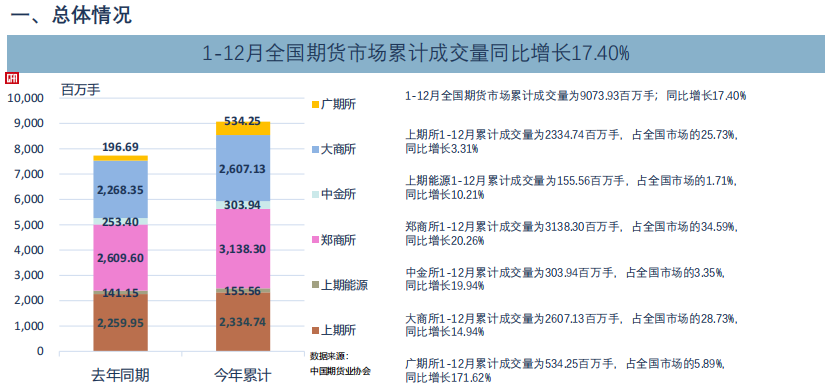
智通财经APP获悉,中国期货业协会最新统计资料表明,以单边计算, 12月全国期货交易市场成交量为9.51亿手,成 交额为90.81万亿元,同比分别增长45.17%和58.55%。2025年全国期货市场累计成交量为90.74亿手,累计成交额为 766.25万亿元,同比分别增长17.4%和23.74%。 上海期货交易所12月成交量为299,764,523手,成交额为423,558.38亿元,分别占全国市场的31.53%和46.64%,同比分 别增长59.7%和153.35%。12月末上海期货交易所持仓总量为10,570,870手,较上月末下降4.95%。1-12月上海期货交易 所累计成交量为2,334,742,107手,累计成交额为2,589,995.29亿元,同比分别增长3.31%和27.86%,分别占全国市场的 25.73%和33.8%。 上海国际能源交易中心12月成交量为10,387,653手,成交额为15,594.89亿元,分别占全国市场的1.09%和1.72%,同比 分别下降13.12%和32.14%。12月末上海国际能源交易中心持仓总量为470,890手,较上月增长0.29%。1-12月上海国际 能源 ...