量化投资

Search documents
基金经理夏普比率10强曝光!幻方陆政哲摘桂冠!量魁梁涛、杨湜郑彬领衔
Sou Hu Cai Jing· 2025-12-29 07:19
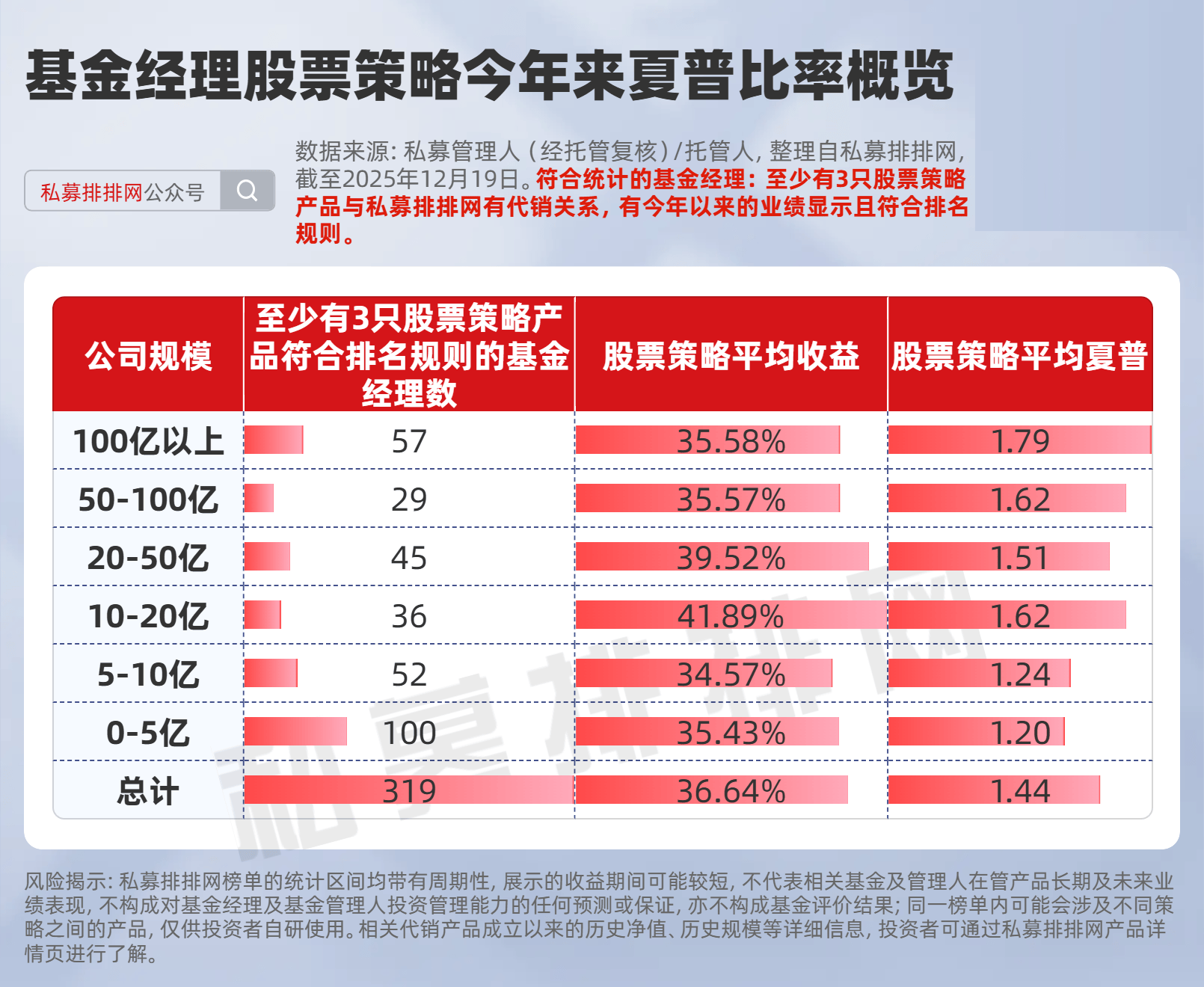
Market Overview - Since 2025, the A-share market has shown an upward trend with significant market activity and distinct structural characteristics. As of December 19, the Shanghai Composite Index, Shenzhen Component Index, and ChiNext Index have increased by 16.07%, 26.17%, and 45.79% respectively, with an average daily trading volume of 1.72 trillion yuan [1] - Sectors such as technology, military industry, and non-ferrous metals have performed well, with companies like Cambrian, BYD, and CATL reaching new highs. The North Securities 50 Index has seen a peak increase of over 60% this year [1] Private Fund Performance - Private fund managers have also demonstrated strong performance in stock strategies, with an average return of 36.64% as of December 19, outperforming the Shanghai Composite and Shenzhen Component indices [1] - A total of 319 fund managers have stock strategy products that meet ranking criteria, with varying performance based on fund size [2] Fund Manager Analysis by Size 100 Billion and Above - In the 100 billion and above category, 57 fund managers have an average return of 35.58% and a Sharpe ratio of 1.79. The top fund manager is Lu Zhengzhe from Ningbo Huansheng Quantitative [5][6] 50-100 Billion - Among the 29 fund managers in the 50-100 billion category, the average return is 35.57% with a Sharpe ratio of 1.62. The top three fund managers are Shi En from Yunqi Quantitative, Liang Tao from Liang Kui Private Equity, and Liu Xiaofang from Guangdong Dehui Investment [11][15] 20-50 Billion - In the 20-50 billion category, 45 fund managers have an average return of 39.52% and a Sharpe ratio of 1.51. The top three are Yuan Hao from Beijing Xiyue, He Yuqing from Yidian Najin, and Wu Libin from Fox Investment [18] 10-20 Billion - For the 10-20 billion category, 36 fund managers have an average return of 41.89% and a Sharpe ratio of 1.62. The top three are Zheng Bin from Yangshi Asset, He Zhenquan from Liangli Private Equity, and Zhou Yifeng from Beiheng Fund [20][24] 5-10 Billion - In the 5-10 billion category, 52 fund managers have an average return of 34.57% and a Sharpe ratio of 1.24. The top three are Chen Long from Youbo Capital, Chen Zhidan from Hongyan Asset, and Sun Min from Wuzhi Investment [25] 0-5 Billion - Among the 100 fund managers in the 0-5 billion category, the average return is 35.43% with a Sharpe ratio of 1.20. The top three are Qin Peihua from Fengyu Investment, Hu Qintian from Guangzhou Tianzhanhan, and Zeng Fengwen from Changyi Fund [28][30]


基金经理夏普比率10强曝光!幻方陆政哲摘得桂冠!量魁梁涛、杨湜郑彬领衔
私募排排网· 2025-12-29 03:39
Core Viewpoint - The A-share market has shown a significant upward trend since 2025, with notable increases in major indices and active trading volumes, indicating a strong structural market characteristic [2]. Market Performance - As of December 19, the Shanghai Composite Index, Shenzhen Component Index, and ChiNext Index have increased by 16.07%, 26.17%, and 45.79% respectively, with an average daily trading volume of 1.72 trillion yuan [2]. - Key sectors such as technology, military industry, and non-ferrous metals have performed well, with stocks like Cambrian, BYD, and CATL reaching new highs [2]. Private Fund Manager Performance - Among 319 fund managers with stock strategies, the average return is 36.64%, outperforming the major indices [2][3]. - The average Sharpe ratio for these fund managers is 1.44, with those managing over 10 billion yuan showing the best performance at an average Sharpe of 1.79 [3]. Fund Manager Rankings by Size - **100 Billion and Above**: 57 managers, average return 35.58%, average Sharpe 1.79 [3][4]. - **50-100 Billion**: 29 managers, average return 35.57%, average Sharpe 1.62 [8][11]. - **20-50 Billion**: 45 managers, average return 39.52%, average Sharpe 1.51 [12][15]. - **10-20 Billion**: 36 managers, average return 41.89%, average Sharpe 1.62 [17][20]. - **5-10 Billion**: 52 managers, average return 34.57%, average Sharpe 1.24 [21]. - **0-5 Billion**: 100 managers, average return 35.43%, average Sharpe 1.20 [24][27]. Notable Fund Managers - **Top in 100 Billion and Above**: Lu Zhengzhe from Ningbo Huansheng Quantitative, leading with a high Sharpe ratio [4][7]. - **Top in 50-100 Billion**: Shi En from Yunqi Quantitative, recognized for his quantitative investment experience [8][11]. - **Top in 20-50 Billion**: Yuan Hao from Beijing Xiyue, noted for his ability to combine fundamental and technical analysis [12][15]. - **Top in 10-20 Billion**: Zheng Bin from Yangshi Asset, with a focus on algorithmic trading [17][20]. - **Top in 5-10 Billion**: Chen Long from Youbo Capital, recognized for his investment strategies [21]. - **Top in 0-5 Billion**: Qin Peihua from Fengyu Investment, noted for his performance in the small fund category [24].

突破2600亿!指增“黄金时代”正在来临,来看大厂样本
券商中国· 2025-12-28 12:52
Core Viewpoint - The tightening regulation of performance benchmarks in the public fund industry is pushing all players towards a competitive landscape focused on these benchmarks, marking the beginning of a significant industry transformation [1] Group 1: Industry Trends - The index-enhanced strategy, which naturally aligns with benchmark constraints, has emerged as a significant structural trend in the market, with 177 new index-enhanced funds established in 2025, totaling over 975.18 billion yuan in new issuance, surpassing the total from 2022 to 2024 [2][3] - The performance benchmark is becoming a new guiding principle for the public fund industry, with regulatory actions aimed at promoting high-quality development, leading to a focus on performance assessment and management [2] Group 2: Market Response - By the end of Q3 2025, the scale of quantitative index-enhanced funds exceeded 260 billion yuan, showing significant quarterly growth [3] - The new products are primarily focused on broad-based indices like the CSI A500 and the Sci-Tech Innovation Index, while traditional indices like the CSI 300 and CSI 500 continue to thrive [4] Group 3: Competitive Landscape - A clear competitive hierarchy has formed among fund companies, with leading institutions like China Merchants Fund and Tianhong Fund establishing extensive index ecosystems, while mid-tier and smaller firms are attempting to carve out niches [5] - The top institutions are focusing on building comprehensive index ecosystems, while smaller firms are trying to specialize in specific strategies or niche indices [5] Group 4: Performance and Value Creation - As of December 26, 2025, 95.97% of enhanced index products achieved positive returns, with the highest return reaching 85.77%, indicating a strong performance across the board [6] - A significant portion of enhanced index products (86.01%) generated positive excess returns, with nine products exceeding 20% in excess returns compared to their benchmarks [6] Group 5: AI Empowerment - Tianhong's quantitative index-enhanced business has evolved into a crown jewel of passive investment, leveraging AI to achieve systematic and scientific investment strategies [9] - Over 70% of Tianhong's excess factors are derived from AI learning, showcasing a shift from traditional quantitative models to AI-driven approaches [10][11] - The team at Tianhong utilizes a comprehensive AI model that processes over 30GB of data daily to capture underpriced signals in the market, creating a highly engineered "alpha pipeline" [11][12]

量化周报:市场有望节前确认方向-20251228
GOLDEN SUN SECURITIES· 2025-12-28 12:27
- The report mentions the **A-Share Prosperity Index**, which is constructed using the Nowcasting target of the YoY growth rate of the net profit attributable to the parent company of the Shanghai Composite Index. The index is currently in an upward cycle, with a value of 19.26 as of December 26, 2025, representing an increase of 13.84 compared to the end of 2023[26][29][30] - The **A-Share Sentiment Index** is constructed based on market volatility and trading volume changes, dividing the market into four quadrants. Only the quadrant with "volatility up - trading volume down" shows significant negative returns, while the others show significant positive returns. The current sentiment signals are: bottom signal (bullish), top signal (bearish), and overall sentiment (bullish)[33][34][38] - The report highlights the **Beta Factor** as the dominant style factor in the current market. High Beta stocks have performed well recently, while factors such as leverage and residual volatility have underperformed. This is based on the pure factor returns and the correlation analysis of style factors[54][55][62] - The **CSI 500 Enhanced Portfolio** achieved a weekly return of 2.80%, underperforming its benchmark by 1.24%. Since 2020, the portfolio has generated an excess return of 47.91% relative to the CSI 500 Index, with a maximum drawdown of -6.60%[43][44][46] - The **CSI 300 Enhanced Portfolio** achieved a weekly return of 2.49%, outperforming its benchmark by 0.54%. Since 2020, the portfolio has generated an excess return of 40.99% relative to the CSI 300 Index, with a maximum drawdown of -5.86%[50][51][52]
主动量化周报:12月末或为建仓时点:小盘迎来强势期-20251228
ZHESHANG SECURITIES· 2025-12-28 12:26
- The report discusses the performance of BARRA style factors, highlighting that fundamental factors showed increased differentiation, with growth being preferred over value. Profitability-related factors entered a retracement phase, while trading-related factors like high turnover and short-term momentum provided significant excess returns. Additionally, mid-cap style factors outperformed, with both size and non-linear size factors showing positive excess returns[24][25] - The report identifies that high turnover stocks achieved an excess return of 0.9%, short-term momentum stocks provided 0.7%, and non-linear size factors contributed 0.7% in excess returns. Meanwhile, profitability-related factors like earnings quality and investment quality showed negative returns of -0.1% and -0.3%, respectively[25]
文本选股策略超额收益收窄
HTSC· 2025-12-28 11:32
Group 1 - The LLM-FADT text stock selection strategy has underperformed relative to the CSI 500 index by -1.5% this month, with a year-to-date excess return of 2.9% [1][18] - The LLM-FADT strategy has an annualized return of 29.05% since January 2017, with an excess annualized return of 26.56% relative to the CSI 500 index, and a Sharpe ratio of 1.13 [1][20] - The AI industry rotation model recommends holding non-bank financials, petrochemicals, beverages, steel, and utilities for the upcoming week, with an annualized return of 26.49% since 2017 [3][41] Group 2 - The AI theme index rotation model suggests holding petrochemical industry, 300 non-bank, Shenzhen dividend, and China construction indices for the next week, with an annualized return of 16.58% since 2018 [4][28] - The AI concept index rotation model has an annualized return of 22.29% since 2018, with a maximum drawdown of 19.19% [33][34] - The AI industry rotation model has a year-to-date excess return of 29.13% and an annualized excess return of 19.53% [39][41] Group 3 - The AI-enhanced stock selection strategy based on full-frequency fusion factors has achieved a year-to-date excess return of 19.98% relative to the all-A equal-weight benchmark [2][6] - The AI-enhanced CSI 1000 strategy has a year-to-date excess return of 24.24%, with an annualized excess return of 21.89% since 2017 [2][10] - The LLM-FADT strategy has shown more stability and smaller excess drawdowns compared to the BERT-FADT strategy since October 2024 [18][21]

中银量化大类资产跟踪:有色与贵金属领涨权益与大宗商品市场
Bank of China Securities· 2025-12-28 08:11
- The report tracks the performance of various stock market indices, including A-shares, Hong Kong stocks, and US stocks, highlighting their weekly, monthly, and year-to-date performance[1][16][17] - The report provides a detailed analysis of the performance of different stock market styles, such as growth vs. dividend, small-cap vs. large-cap, and micro-cap vs. CSI 800, including their relative crowding and excess net value[2][60][71] - The report includes a comprehensive analysis of the valuation and equity-bond cost-effectiveness of A-shares, with specific focus on PE_TTM and ERP metrics for various indices and sectors[3][41][49][51] - The report tracks the performance and crowding of different investment styles, such as momentum vs. reversal, and their relative excess returns[2][60][71] - The report provides insights into the impact of US bond yields on the performance of different stock market styles, such as large-cap vs. small-cap and growth vs. dividend[3][82][84] - The report includes a detailed analysis of the main fund indices, including their absolute and relative returns, and tracks the scale of public funds and their impact on the market[3][88][90][94] - The report provides a comprehensive overview of the commodity market, including the performance of various commodity indices in China and the US[3][123][125]

【金工】市场大市值风格占优,机构调研组合超额明显——量化组合跟踪周报20251227(祁嫣然/张威)
光大证券研究· 2025-12-28 00:20
Core Viewpoint - The report provides a comprehensive analysis of market performance, highlighting the positive and negative returns of various factors and strategies within different stock pools during the specified week [4][5][8]. Group 1: Factor Performance - In the large-cap market, beta, size, and non-linear market capitalization factors yielded positive returns of 1.31%, 0.62%, and 0.58% respectively, while the leverage factor had a negative return of -0.13% [4]. - In the CSI 300 stock pool, the best-performing factors included the early morning return factor (2.16%), year-on-year net profit growth rate (1.75%), and quarterly ROA year-on-year (1.68%), while the worst performers were large net inflow (-1.71%), price-to-book ratio factor (-1.83%), and downside volatility ratio (-2.05%) [5]. - In the CSI 500 stock pool, the top factors were quarterly operating profit growth rate (1.16%), quarterly net profit growth rate (1.11%), and standardized unexpected earnings (1.08%), with the price-to-earnings ratio factor (-2.74%), total asset gross margin TTM (-2.92%), and price-to-book ratio factor (-2.95%) performing poorly [5]. Group 2: Industry Factor Performance - The net asset growth rate factor performed well in the comprehensive and oil & petrochemical industries, while the net profit growth rate factor excelled in the comprehensive industry [6]. - The earnings per share factor showed strong performance in the oil & petrochemical and real estate sectors, and the TTM operating profit factor was notable in the environmental protection industry [6]. - The 5-day momentum factor exhibited momentum effects in the oil & petrochemical and public utilities sectors, while showing reversal effects in the beauty care, leisure services, and food & beverage industries [6][7]. Group 3: Strategy Performance - The PB-ROE-50 combination achieved significant excess returns, with a 1.31% excess return in the CSI 800 stock pool and a 1.36% excess return in the overall market stock pool, while it recorded a -0.62% excess return in the CSI 500 stock pool [8]. - Public and private fund research selection strategies yielded positive excess returns, with public fund strategies achieving a 1.88% excess return relative to the CSI 800 and private fund strategies achieving a 2.14% excess return [9]. - The block trading combination experienced a decline in excess returns, with a -1.94% excess return relative to the CSI All Index [10]. - The targeted issuance combination also faced a decline, with a -1.79% excess return relative to the CSI All Index [11].

量化组合跟踪周报 20251227:市场大市值风格占优,机构调研组合超额明显-20251227
EBSCN· 2025-12-27 11:06
Quantitative Models and Construction Methods 1. Model Name: PB-ROE-50 Combination - **Model Construction Idea**: The PB-ROE-50 combination is designed to capture excess returns by selecting stocks with favorable Price-to-Book (PB) and Return on Equity (ROE) characteristics within specific stock pools[24] - **Model Construction Process**: The model selects stocks based on PB and ROE metrics, focusing on stocks with high ROE and low PB ratios. The combination is rebalanced periodically to maintain its focus on these metrics. Detailed construction methodology is referenced in earlier reports[24] - **Model Evaluation**: The model demonstrates significant excess returns in certain stock pools, indicating its effectiveness in capturing value and profitability factors[24] --- Model Backtesting Results 1. PB-ROE-50 Combination - **Excess Return (Weekly)**: - CSI 500: -0.62% - CSI 800: 1.31% - All Market: 1.36%[25] - **Excess Return (Year-to-Date)**: - CSI 500: 2.48% - CSI 800: 18.55% - All Market: 20.81%[25] - **Absolute Return (Weekly)**: - CSI 500: 3.39% - CSI 800: 3.85% - All Market: 4.18%[25] - **Absolute Return (Year-to-Date)**: - CSI 500: 33.50% - CSI 800: 43.89% - All Market: 51.01%[25] --- Quantitative Factors and Construction Methods 1. Factor Name: Beta Factor - **Factor Construction Idea**: Measures the sensitivity of a stock's returns to market returns, capturing systematic risk[20] - **Factor Construction Process**: Calculated as the covariance of a stock's returns with market returns divided by the variance of market returns $ \beta = \frac{\text{Cov}(R_i, R_m)}{\text{Var}(R_m)} $ where $R_i$ is the stock return and $R_m$ is the market return[20] - **Factor Evaluation**: Demonstrates positive returns in the current week, indicating its relevance in capturing market trends[20] 2. Factor Name: Scale Factor - **Factor Construction Idea**: Captures the size effect by focusing on the market capitalization of stocks[20] - **Factor Construction Process**: Stocks are ranked by market capitalization, and the factor is constructed by taking the difference in returns between small-cap and large-cap stocks[20] - **Factor Evaluation**: Positive returns this week suggest the dominance of large-cap stocks in the market[20] 3. Factor Name: Nonlinear Market Cap Factor - **Factor Construction Idea**: Captures nonlinear effects of market capitalization on stock returns[20] - **Factor Construction Process**: Incorporates higher-order terms of market capitalization in the regression model to account for nonlinear relationships[20] - **Factor Evaluation**: Positive returns this week highlight its effectiveness in capturing nonlinear size effects[20] 4. Factor Name: Leverage Factor - **Factor Construction Idea**: Measures the impact of financial leverage on stock returns[20] - **Factor Construction Process**: Calculated as the ratio of total debt to equity, adjusted for industry and market effects[20] - **Factor Evaluation**: Negative returns this week suggest that high-leverage stocks underperformed[20] 5. Factor Name: Early Morning Return Factor - **Factor Construction Idea**: Captures the return patterns of stocks during early trading hours[12] - **Factor Construction Process**: Calculated as the return of a stock during the first trading hour of the day, adjusted for market and industry effects[12] - **Factor Evaluation**: Strong positive performance this week indicates its ability to capture intraday momentum[12] 6. Factor Name: Single-Quarter Net Profit YoY Growth Rate - **Factor Construction Idea**: Measures the year-over-year growth in net profit for a single quarter, reflecting profitability trends[12][14][18] - **Factor Construction Process**: $ \text{Growth Rate} = \frac{\text{Net Profit}_{t} - \text{Net Profit}_{t-1}}{\text{Net Profit}_{t-1}} $ where $t$ is the current quarter and $t-1$ is the same quarter in the previous year[12][14][18] - **Factor Evaluation**: Consistently positive performance across multiple stock pools highlights its robustness in capturing profitability[12][14][18] 7. Factor Name: 5-Day Reversal Factor - **Factor Construction Idea**: Captures short-term mean-reversion effects in stock prices[18] - **Factor Construction Process**: Calculated as the negative return of a stock over the past 5 trading days, adjusted for market and industry effects[18] - **Factor Evaluation**: Strong positive performance in the liquidity 1500 stock pool indicates its effectiveness in identifying short-term reversals[18] --- Factor Backtesting Results 1. Beta Factor - Weekly Return: 1.31%[20] 2. Scale Factor - Weekly Return: 0.62%[20] 3. Nonlinear Market Cap Factor - Weekly Return: 0.58%[20] 4. Leverage Factor - Weekly Return: -0.13%[20] 5. Early Morning Return Factor - Weekly Return: - CSI 300: 2.16% - CSI 500: 0.25% - Liquidity 1500: 1.22%[12][14][18] 6. Single-Quarter Net Profit YoY Growth Rate - Weekly Return: - CSI 300: 1.75% - CSI 500: 1.11% - Liquidity 1500: 1.58%[12][14][18] 7. 5-Day Reversal Factor - Weekly Return: - CSI 300: 0.77% - CSI 500: 1.04% - Liquidity 1500: 3.33%[12][14][18]
私募双十基金达53只,但斌占2只!近5/10年领跑产品揭晓!
Sou Hu Cai Jing· 2025-12-26 10:40
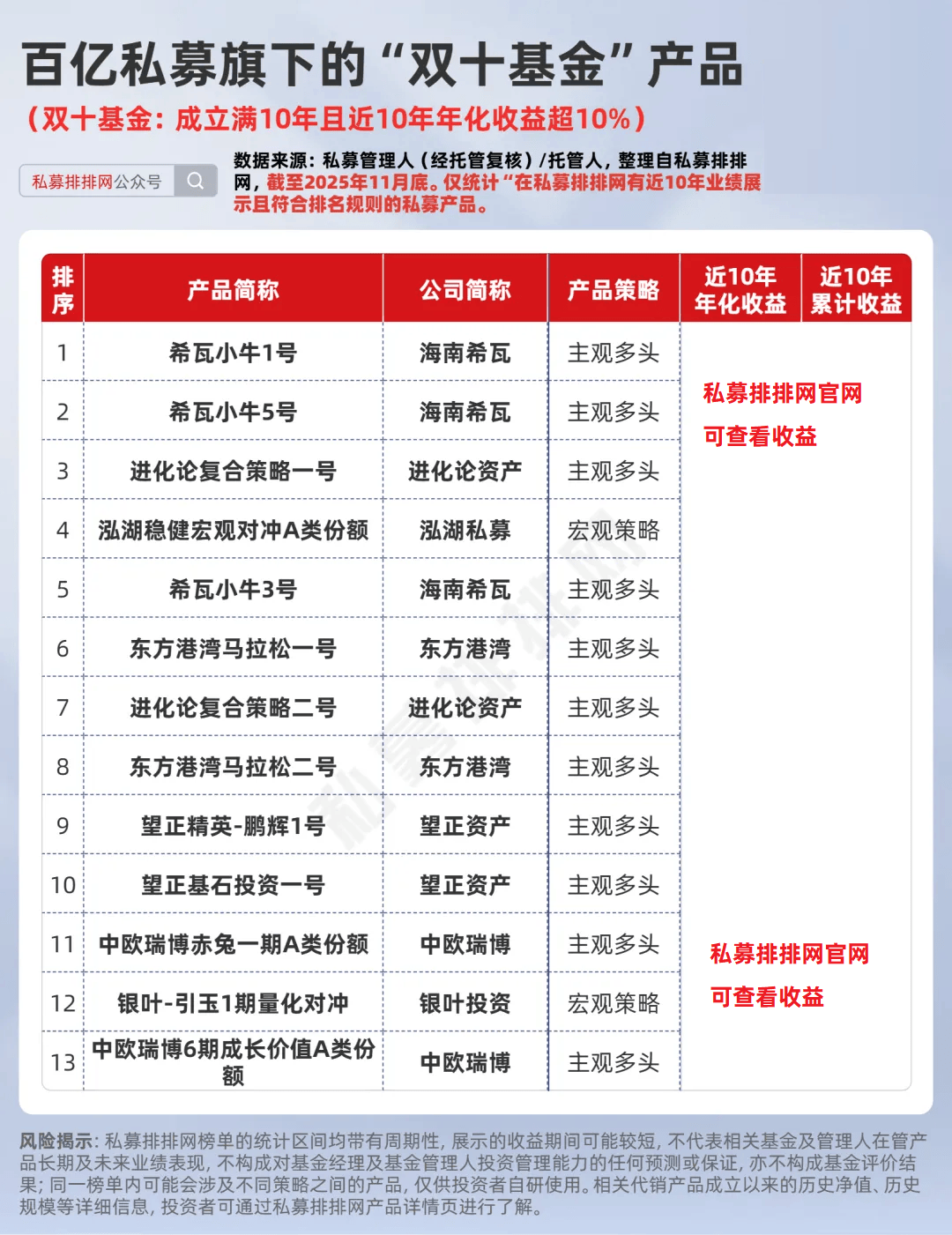
Core Insights - The article emphasizes the importance of long-term performance in investment strategies, highlighting that while short-term gains may be influenced by market beta, true investment skill is tested through long-term returns over 5 to 10 years [1] - It identifies a category of private funds termed "Double Ten Funds," which have been operational for over 10 years and have achieved an annualized return exceeding 10% over the past decade [2] Group 1: Double Ten Funds Overview - As of November 2025, there are 105 private funds that have been established for over 10 years, with 53 of them classified as "Double Ten Funds," representing approximately 50.48% of the total [2] - Among these, 13 funds belong to private equity firms with assets exceeding 10 billion, with notable firms including Hainan Xiwa and Dongfang Gangwan [2] Group 2: Performance Rankings - The article lists top-performing private funds based on their strategies, including subjective long/short, macro strategies, and multi-asset approaches, with a focus on those that have achieved high returns over the past five years [3][8] - The top-ranked subjective long/short fund is managed by Hainan Jingtong, with significant annualized returns noted [3] Group 3: Investment Strategies - The article discusses the investment focus of notable fund managers, such as Dan Bin from Dongfang Gangwan, who emphasizes the potential of artificial intelligence as a long-term investment theme [4][5] - It highlights that 14 of the "Double Ten Funds" reached historical net value highs in November 2025, with a majority being subjective long/short funds [5] Group 4: Quantitative and Multi-Asset Strategies - The article details the performance of quantitative long/short funds, noting that the average annualized return for the top 20 funds in this category is significant, with several large private equity firms represented [8][9] - Multi-asset strategy funds are also highlighted, with the top performers achieving notable annualized returns, indicating a diverse approach to investment [22][23]