
服务消费

Search documents
(经济观察)2025年中国消费“账单”呈现新趋势
Zhong Guo Xin Wen Wang· 2026-01-19 11:14
中新社北京1月19日电 题:2025年中国消费"账单"呈现新趋势 中新社记者 陈溯 "服务消费占比上升趋势明显,这是2025年中国消费一个非常典型的亮点。"北京大学光华管理学院副院 长张影表示。 随着生活水平提升,中国居民消费正从商品消费为主向商品和服务消费并重转变,服务消费潜力进一步 释放。 从企业销售看,2025年服务零售额比上年增长5.5%,快于商品零售额1.7个百分点,服务零售额占整体 零售额的比重在上升。从居民消费看,2025年服务性消费支出占居民人均消费支出的比重为46.1%。 2025年9月,中国商务部等9部门印发《关于扩大服务消费的若干政策措施》,更大力度提振服务消费, 释放服务消费潜能。2025年9月以来,服务零售额累计增速连续4个月回升。 ——新型消费方兴未艾 近年来,电子商务、直播带货等带动线上消费较快增长。2025年,网上零售额比上年增长8.6%。无人 值守店、仓储会员店等新零售模式零售额保持两位数增长。 中国2025年经济数据19日对外公布,数据显示,2025年中国消费"账单"呈现若干新趋势。 ——社零总额首破50万亿元 2025年,市场销售规模继续扩大,社会消费品零售总额50120 ...
国常会密集部署促消费:服务消费、以旧换新、下沉市场成新引擎
2 1 Shi Ji Jing Ji Bao Dao· 2026-01-19 11:00
Group 1: Overall Consumption Trends - The total retail sales of consumer goods in China exceeded 50 trillion yuan, growing by 3.7% year-on-year, ranking among the top in the global retail market [1] - In 2025, the retail sales of consumer goods in urban areas are expected to grow by 3.6%, while rural areas are projected to grow by 4.1%, indicating a faster growth rate in rural consumption [3] - The service retail sales are anticipated to increase by 5.5% year-on-year, outpacing the overall retail sales growth, showcasing significant growth potential [6][11] Group 2: Policy Initiatives - Recent State Council meetings have focused on expanding domestic demand and promoting consumption, indicating the importance of consumption for economic growth [2] - The government plans to implement policies to stimulate consumption, including enhancing service consumption and supporting new business models [2][8] - The introduction of a consumption upgrade policy, including trade-in programs for durable goods, aims to boost high-quality consumption [10] Group 3: Service Consumption Growth - Service consumption is becoming a new growth engine, with a shift from goods to a balanced focus on both goods and services [6] - The proportion of service consumption in per capita expenditure is expected to reach 46.1% in 2025, reflecting a growing trend towards service-oriented spending [6] - Various sectors, including tourism, entertainment, and cultural services, are experiencing double-digit growth, indicating a diversification of consumption patterns [6][10] Group 4: Downstream Market Potential - The potential of the lower-tier markets is being recognized, with policies aimed at stimulating consumption in these areas [5] - The county-level market is projected to account for 38.7% of total retail sales, highlighting the importance of rural consumption [3] - The ongoing development of digital infrastructure and e-commerce is facilitating rapid growth in digital and green consumption in lower-tier markets [5] Group 5: Future Outlook - The contribution of final consumption expenditure to economic growth is expected to reach 52% in 2025, solidifying its role as a key driver of economic stability [11] - Experts predict that consumption growth rates may accelerate in 2026, with retail sales expected to increase by approximately 5.0% [12] - Continued investment in social welfare, including pensions and education, is anticipated to enhance residents' consumption capacity in the near term [12]

轻工制造、纺织服饰行业周报:着力培育服务消费,体育赛事、IP+消费将直接受益-20260119
BOHAI SECURITIES· 2026-01-19 10:47
Investment Rating - The investment rating for the light industry manufacturing and textile apparel sectors is "Neutral" [5][52]. Core Insights - The report emphasizes the cultivation of service consumption, with sports events and IP+ consumption expected to benefit directly from new policies aimed at boosting service consumption [4][51]. - Recent government measures, including the "Several Measures to Promote the Quality Improvement and Efficiency Enhancement of the Service Industry" in Shanghai, aim to stimulate service consumption and enhance supply quality [12][51]. - The report highlights the expected performance of key companies, with Jia Mei Packaging forecasting a decline in net profit for 2025 by 43.02%-53.38%, while Wo Le Home is expected to see a growth of 40.78%-56.42% in the same period [41][42]. Industry News - The State Council is focusing on accelerating the cultivation of new growth points in service consumption, particularly in sectors like transportation, home services, performances, and sports events [4][12]. - The Shanghai government has introduced 28 measures targeting six key industries to enhance service quality and stimulate consumption [12][51]. Important Company Announcements - Jia Mei Packaging anticipates a significant decline in net profit for 2025, projecting a profit of 85.44 million to 104.42 million yuan, a decrease of 43.02%-53.38% year-on-year [41]. - Wo Le Home expects a net profit increase for 2025, estimating a profit of 171 million to 190 million yuan, representing a growth of 40.78%-56.42% year-on-year [41]. Market Review - From January 12 to January 16, the light industry manufacturing sector underperformed the CSI 300 index by 0.54 percentage points, while the textile apparel sector outperformed it by 0.02 percentage points [2][42]. - The light industry manufacturing index decreased by 1.11%, while the textile apparel index decreased by 0.55% during the same period [2][42]. Weekly Strategy - The report suggests continuous attention to sectors benefiting from the new service consumption policies, particularly in sports equipment, athletic apparel, and related fields [4][51].



2025全年GDP增长5.0%;国常会:研究加快培育服务消费新增长点等促消费举措|每周金融评论(2026.1.12-2026.1.18)
清华金融评论· 2026-01-19 10:33
Key Points - The core viewpoint of the article emphasizes the steady growth of China's economy in 2025, with a GDP growth rate of 5.0%, despite facing multiple pressures and challenges [8][9]. Group 1: Economic Growth - The preliminary calculation shows that the GDP for 2025 reached 14,018.79 billion yuan, reflecting a 5.0% increase from the previous year [8]. - The first industry added value was 933.47 billion yuan (3.9% growth), the second industry was 499.65 billion yuan (4.5% growth), and the third industry was 808.79 billion yuan (5.4% growth) [8]. - Quarterly GDP growth rates were 5.4% in Q1, 5.2% in Q2, 4.8% in Q3, and 4.5% in Q4, with a quarter-on-quarter growth of 1.2% in Q4 [8]. Group 2: Policy Initiatives - The State Council meeting highlighted the need to accelerate the cultivation of new growth points in service consumption and implement measures to boost consumption [9][10]. - The meeting emphasized the importance of improving the quality of service consumption and addressing issues related to credit, standards, and safety management [9][10]. - A long-term mechanism for promoting consumption will be established, including the "15th Five-Year Plan" for consumption expansion and urban-rural resident income increase plans [10]. Group 3: Financial Regulation - The Financial Regulatory Bureau's 2026 work meeting focused on summarizing 2025's work and planning key tasks for 2026, emphasizing risk prevention and high-quality development [11][13]. - The meeting underscored the importance of enhancing financial services to support economic stability and growth, with a focus on structural support and long-term capital guidance [13]. Group 4: Monetary Policy - The People's Bank of China announced several monetary policies aimed at supporting high-quality economic development, including a 0.25 percentage point reduction in various structural monetary policy tool rates [14]. - The policies aim to lower financing costs for the real economy and guide financial resources towards key sectors such as technology innovation and green transformation [14]. Group 5: Market Stability - The China Securities Regulatory Commission emphasized maintaining market stability and preventing extreme fluctuations, with a focus on long-term value investment [15]. - Measures will be taken to strengthen market monitoring and prevent market manipulation, ensuring a stable trading environment [15]. Group 6: Commodity Prices - International gold and silver prices reached historical highs, with gold at $4,671.07 per ounce and silver at $93.194 per ounce, driven by economic uncertainty and inflation pressures [16][17]. - The demand for gold and silver as safe-haven assets is expected to continue increasing, reflecting market concerns about future economic prospects [17]. Group 7: Hainan Free Trade Port - Hainan's offshore duty-free sales reached 4.86 billion yuan in the first month of closure, marking a 46.8% year-on-year increase [18]. - The strong performance of the duty-free market indicates robust consumer enthusiasm and highlights Hainan's role in promoting high-level opening-up [18].

重大工程纵深推进与战略:开年投资呈现积极迹象
CMS· 2026-01-19 09:33
Economic Growth - The GDP growth rate for Q4 2025 was 4.5% year-on-year, with an annual growth rate of 5.0%[3] - Seasonally adjusted Q4 GDP increased by 1.2% quarter-on-quarter, accelerating by 0.1 percentage points from Q3[3] Investment Trends - Investment conditions have shown marginal improvement since the beginning of the year, with high-frequency data indicating better performance in heavy industry[3] - Fixed asset investment, infrastructure, and real estate investment all recorded negative growth for the year, while manufacturing investment growth was less than 1%[3] Consumption and Exports - Service consumption grew by 5.5% for the year, with a production index growth of 5.0%, indicating demand outpacing supply[3] - Retail sales growth fell to 3.8%, highlighting weak consumer spending that cannot fully support domestic demand[3] Industrial Performance - The operating rate for asphalt enterprises rose to 27.2%, up by 1.8 percentage points week-on-week[8] - The operating rate for electric furnaces increased to 63.46%, with a year-on-year growth of 8.8%[10] Price Movements - The average price of cement in East China remained stable at 426 RMB/ton, while in Southwest China it was 512 RMB/ton[102] - The price of rebar increased by 10.43 RMB/ton to 3349.6 RMB/ton, reflecting upward price trends in the steel market[110] Risks and Outlook - Risks include geopolitical tensions, domestic policy implementation falling short of expectations, and potential global recession impacts[3] - If current trends in exports and service consumption continue, Q1 2026 economic growth is expected to outperform the second half of 2025[3]
2025年社零同比增长3.7%!消费ETF(159928)收涨0.39%结束四连阴,近5日净流入超16亿元!政策加码下消费动能将持续释放!
Sou Hu Cai Jing· 2026-01-19 09:33
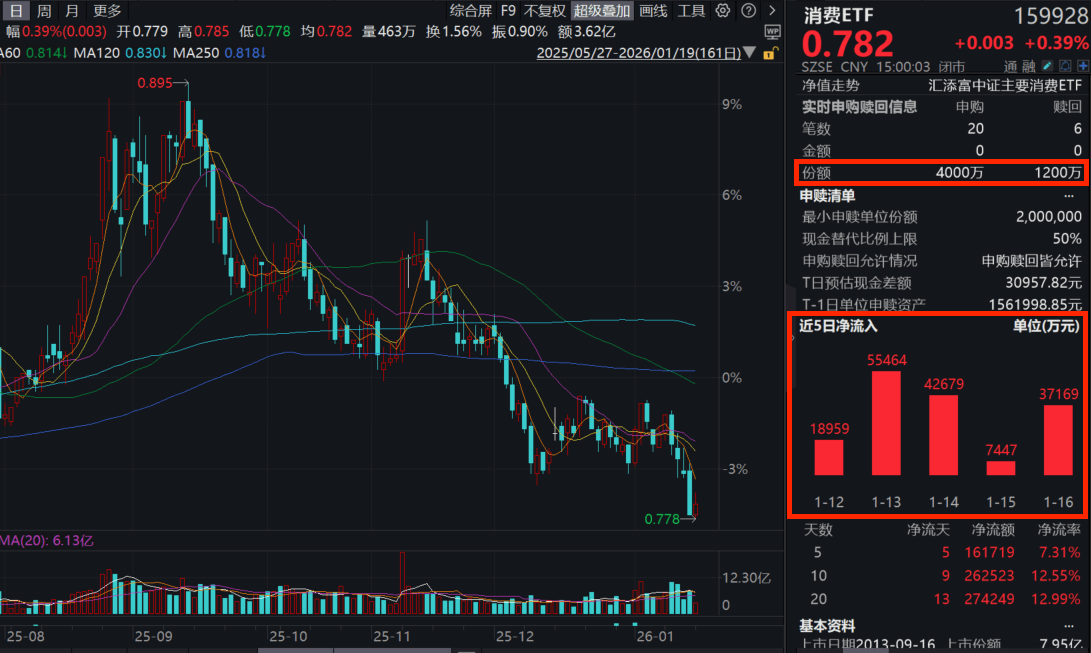
Group 1: Market Performance - A-shares experienced a slight increase with the consumer sector performing well, as evidenced by the leading consumer ETF (159928) rising by 0.39% and achieving a trading volume exceeding 360 million yuan [1] - The consumer ETF has seen a net subscription of 28 million units today, accumulating over 1.6 billion yuan in the past five days [1] Group 2: Economic Data - The National Bureau of Statistics reported that China's GDP for the year reached 14,018.79 billion yuan, reflecting a 5% growth year-on-year at constant prices [3] - In December 2025, the retail sales of consumer goods grew by 0.9% year-on-year, a decrease of 0.4 percentage points compared to November [3] - The per capita disposable income for residents in 2025 was 43,377 yuan, marking a nominal increase of 5% year-on-year, with a real growth of 5% after adjusting for price factors [3] Group 3: Consumer Trends and Policies - The focus on enhancing service consumption is evident, with a CAGR of approximately 9.6% in per capita service consumption from 2020 to 2024, expected to reach 46.1% of total consumption by 2024 [7] - The government aims to boost domestic demand and has outlined key tasks for 2026, emphasizing the importance of "domestic demand as the main driver" [3][7] - Policies are expected to support sectors such as elderly care, cultural tourism, and sports, with a focus on new consumption scenarios and enhancing service quality [4][8] Group 4: Investment Opportunities - The consumer ETF (159928) is noted for its resilience across economic cycles, with a TTM price-to-earnings ratio of 18.91, which is lower than 99% of the historical data over the past decade [4][9] - The top ten holdings in the consumer ETF account for over 68.55% of its weight, with significant representation from leading liquor brands and agricultural companies [9][10] - The Hong Kong Stock Connect Consumer 50 ETF (159268) is highlighted as an efficient investment vehicle for the consumer sector, particularly appealing to the younger generation [10]





数据点评 | 12月经济:被忽视的“积极变化”(申万宏观·赵伟团队)
申万宏源宏观· 2026-01-19 08:21
Core Viewpoints - The three major changes are the improvement in service consumption, the easing of the "crowding-out effect" from debt reduction, and the recovery of new economic vitality [1][3][94]. GDP Analysis - The GDP for Q4 2025 recorded a year-on-year growth of 4.5%, matching market expectations, despite a high base effect [1][4][96]. - The actual GDP growth on a seasonally adjusted quarter-on-quarter basis increased to 1.2%, up from 1.1% in Q3 [1][94]. - The secondary industry value-added growth rate fell significantly, reflecting weakened fixed investment and declining commodity consumption [1][4][94]. Consumption Insights - Retail sales in December showed a year-on-year decline of 0.4 percentage points to 0.9%, primarily due to a drop in retail sales of goods below a certain threshold [2][6][13]. - Service retail sales improved, with a cumulative year-on-year increase of 0.1 percentage points to 5.5%, indicating a recovery in non-food service consumption [2][14][94]. Investment Trends - Fixed asset investment in December fell by 1.2 percentage points to -13.2% year-on-year, with manufacturing and real estate investments also declining [6][19][95]. - The easing of the special refinancing bond issuance ratio has led to a positive improvement in infrastructure investment [19][95]. - The decline in investment is largely attributed to corporate debt repayment policies, which, while negatively impacting current investment, may benefit future cash flow [3][19][95]. Production Developments - Industrial value-added growth in December rose by 0.4 percentage points to 5.2%, with significant recovery in sectors with high "new momentum" such as pharmaceuticals and specialized equipment [2][37][52]. - Traditional sectors like automotive production showed a decline, reflecting the impact of intensified anti-involution policies [37][94]. Summary of Economic Structure Changes - The economic structure is increasingly differentiated during the policy transition, with traditional indicators showing weakness not necessarily indicating a lack of positive changes [3][46][94]. - The shift in consumption policies from goods to services has resulted in a decline in commodity consumption indicators, while service consumption indicators have shown significant growth [3][46][94].
东吴证券芦哲:服务消费持续升温 政策助力释放潜力
Di Yi Cai Jing· 2026-01-19 07:42
Core Viewpoint - In 2025, service consumption in China is expected to significantly outperform goods consumption, with a projected annual growth rate of 5.5% for service retail, compared to 3.8% for total social retail sales, indicating a continuous improvement in service consumption [1] Group 1: Service Consumption Growth - The growth of service retail reflects a rising enthusiasm among residents for cultural and sports services, showcasing a trend of consumption upgrading and an increasing share of service consumption in overall spending [1] - The policy framework is supportive, as six ministries jointly released a document at the end of November aimed at enhancing supply-side adjustments to further unleash the potential of service consumption [1] Group 2: Economic Implications - The positive momentum in service consumption is seen as a crucial driver for optimizing economic structure and facilitating consumption upgrades, highlighting the significant future development space in this sector [1]

GDP总量突破140万亿元,解读来了
21世纪经济报道· 2026-01-19 06:30
Economic Overview - In 2025, China's GDP reached 140.19 trillion yuan, growing by 5.0% year-on-year, successfully meeting the annual growth target of around 5% [5][26] - The economic growth exhibited a "front high, back low" trend, characterized by strong supply and weak demand [5] Industrial Performance - The industrial added value in 2025 was 41.7 trillion yuan, increasing by 5.8%, with manufacturing added value at 34.7 trillion yuan, growing by 6.1% [7][11] - High-tech manufacturing and equipment manufacturing saw significant growth, with added values increasing by 9.4% and 9.2% respectively [8][11] - New energy vehicle production exceeded 16 million units, maintaining the global lead for 11 consecutive years [11] Service Sector Growth - The service sector's added value reached 80.89 trillion yuan, growing by 5.4%, accounting for 57.7% of GDP [11][21] - Modern service industries such as information technology and business services experienced double-digit growth rates of 11.1% and 10.3% respectively [11] Trade and Consumption - China's total goods trade reached 45.47 trillion yuan, growing by 3.8%, with exports at 26.99 trillion yuan, increasing by 6.1% [15][24] - Retail sales of consumer goods totaled 50.12 trillion yuan, growing by 3.7%, with service retail sales outpacing goods retail sales [18][21] Investment Trends - Fixed asset investment (excluding rural households) was 48.52 trillion yuan, declining by 3.8%, with infrastructure investment down by 2.2% and real estate investment down by 17.2% [21][24] - Investment in high-tech industries such as information services and aerospace manufacturing grew by 28.4% and 16.9% respectively [21] Future Outlook - The government plans to implement a package of fiscal and financial policies to stimulate domestic demand in 2026, creating favorable conditions for economic growth [5][27] - The focus will be on enhancing the competitiveness of Chinese products, diversifying export markets, and upgrading export product structures [27][28]

旅游ETF涨超4%,旅游出行板块走高
Ge Long Hui· 2026-01-19 06:17
Group 1 - The tourism ETF has risen over 4% as the travel sector, including airlines, hotels, and scenic spots, shows significant activity ahead of the Spring Festival holiday [1] - Spring and Autumn Tourism data indicates that the number of bookings for the winter and Spring Festival holidays has exceeded last year's figures, with domestic travel during the New Year holiday reaching 142 million trips, a year-on-year increase of 5.2% [2] - The Ministry of Culture and Tourism, along with other departments, has issued guidelines to encourage employee tourism and cultural consumption, aiming to enhance the consumption environment and release potential spending power [2] Group 2 - The "Two New" policy for 2026 aims to boost domestic demand, with a focus on enhancing service consumption, which has significant growth potential compared to overseas markets [3] - The policy includes a special bond issuance of 62.5 billion yuan to support the replacement of old consumer goods, optimizing subsidy standards and implementation mechanisms [3] - Analysts suggest that the upcoming Spring Festival holiday will continue the positive trend seen during the New Year holiday, with a focus on companies with strong earnings growth in the travel chain and related industries [3] Group 3 - Leading tourism companies are expected to benefit from policy support, with anticipated growth in employee cultural and sports consumption driving demand in the short term [4] - Measures such as scenic area annual tickets and cultural consumption vouchers are expected to further release consumer demand, presenting potential growth opportunities for the industry [4]