
AI泡沫

Search documents
AI泡沫质疑声中的韧性市场
citic securities· 2025-12-22 10:21
Core Insights - The report emphasizes a resilient market amidst skepticism surrounding the AI bubble, suggesting that the market is driven by a combination of a rate-cutting cycle, technological prosperity, and a weakening dollar [2][50][54] - It highlights the strong performance of certain markets, particularly the Korean stock market, which surged by 21.7% in the fourth quarter due to robust semiconductor demand and a favorable AI supply chain [54] - The report anticipates a structural market trend where equities outperform bonds, technology outperforms defensive sectors, precious metals outperform energy, and emerging markets outperform developed markets [50][54] Asset Allocation - The report suggests a focus on high-yield bonds, emerging market stocks, and technology sectors as key investment opportunities in the current economic climate [57][58] - It notes that the U.S. stock market is expected to rebound, driven by improved earnings expectations and potential tax policy changes in January 2026 [77][78] - The report identifies five key long-term investment directions for Hong Kong stocks, including technology, healthcare, resource commodities, and consumer sectors [96][97] Economic Outlook - The report projects that the macroeconomic environment in China will remain stable in 2026, with expectations of a recovery in consumer and real estate sectors [91] - It highlights that the performance of the Hong Kong stock market is likely to benefit from both internal and external economic stimuli, including fiscal and monetary easing policies [96][94] - The report indicates that the AI sector remains robust, with expectations that the narrative around AI will continue to drive market interest and investment [57][71]
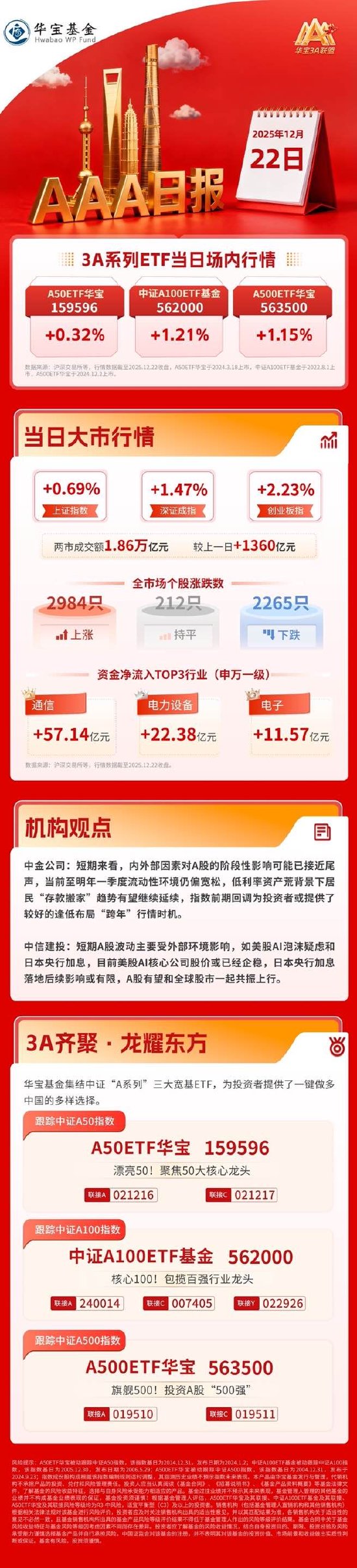
上证指数反攻站上3900点,海南自贸港概念股掀涨停潮 | 华宝3A日报(2025.12.22)
Xin Lang Cai Jing· 2025-12-22 09:21
Group 1 - The A-share market is experiencing a phase where internal and external factors affecting it may be nearing an end, with a relatively loose liquidity environment expected to continue until the first quarter of next year [2][6] - The trend of "deposit migration" among residents is likely to persist under the backdrop of low-interest-rate asset scarcity, providing a good opportunity for investors to position themselves for a "cross-year" market [2][6] - The A-share market's short-term fluctuations are primarily influenced by external factors such as concerns over the AI bubble in the US stock market and interest rate hikes by the Bank of Japan, with expectations that A-shares may resonate upward with global markets [2][6] Group 2 - Huabao Fund has launched three major broad-based ETFs tracking the China A-share indices, providing investors with diverse options for exposure to the Chinese market [2][6] - The A50 ETF focuses on the top 50 core leading companies, while the A100 ETF encompasses the top 100 industry leaders, and the A500 ETF covers a broader range of 500 companies [2][6] - The total trading volume in the two markets reached 1.86 trillion yuan, an increase of 136 billion yuan compared to the previous day, indicating active market participation [1][6]

?关税惊魂、AI狂热与“过山车式剧烈波动”! 六张图回顾美股“狂野的2025年”
Zhi Tong Cai Jing· 2025-12-22 08:54
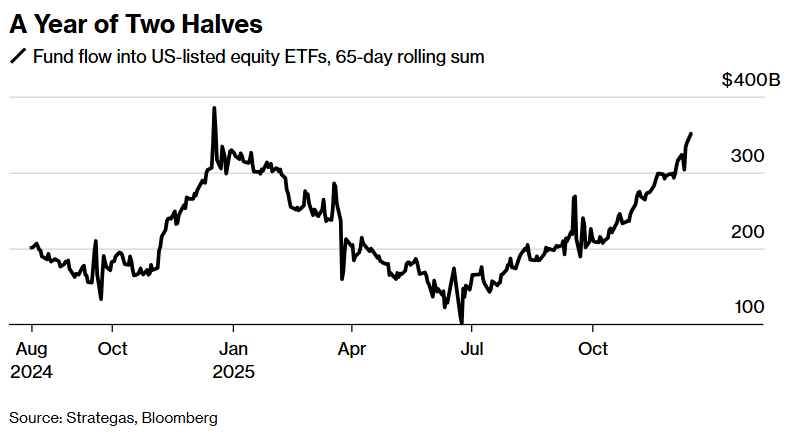
Core Viewpoint - The year 2025 has been characterized by extreme volatility in the U.S. stock market, driven by Trump's tariff policies, AI investment frenzy, and ongoing Federal Reserve monetary policy debates [1][2][3]. Group 1: Market Volatility - The S&P 500 index experienced a significant drop in April, nearing bear market territory due to Trump's aggressive tariff policies, followed by a rapid rebound as these policies were eased [1][2]. - The Cboe Volatility Index (VIX) surged above 50 in April, marking the highest level since the COVID-19 pandemic, before dropping back below 20 as market conditions stabilized [2][3]. - The S&P 500 index has risen approximately 16% year-to-date, recovering from a 15% decline in April, indicating a strong performance despite earlier volatility [3]. Group 2: Investment Trends - The market saw a significant outflow from ETFs in April, particularly from the Invesco QQQ Trust, which experienced its first net outflow in seven months, reflecting investor concerns over tariff impacts [4]. - Following the easing of tariff pressures, inflows into the Invesco QQQ Trust surged in May, indicating a recovery in investor sentiment [4]. - Wall Street's predictions for the S&P 500 index have fluctuated significantly throughout the year, with major banks adjusting their forecasts in response to changing market conditions [6]. Group 3: AI Investment and Market Dynamics - The AI investment wave, particularly around companies like Nvidia and Oracle, has led to unprecedented infrastructure spending, contributing to market highs [1][10]. - Concerns about an "AI bubble" have emerged, with some investors warning of potential risks associated with inflated valuations in the tech sector [7][8]. - The concentration of market capitalization among the top 10 stocks in the S&P 500 has reached nearly 40%, raising concerns about market risk and the sustainability of this concentration [9][11]. Group 4: Active Management Challenges - Active fund managers have struggled to outperform the S&P 500, with only 22% of large-cap active ETFs beating the index, the lowest rate since 2016 [12]. - The difficulty in managing portfolios amid high concentration in tech stocks has led to a significant underweighting of these sectors by active managers [12]. - Analysts predict that as market conditions become more favorable, active managers may find better opportunities for stock selection in 2026 [12]. Group 5: International Market Performance - Despite a strong rebound in the U.S. market, it has underperformed compared to international indices, highlighting a shift in investor sentiment towards global markets [14][15]. - The "American exceptionalism" narrative is showing signs of strain, as U.S. policies and economic uncertainties have led to a decline in the attractiveness of U.S. assets [15]. - International markets, including those in Canada, the UK, and Germany, have outperformed the U.S. benchmark indices, suggesting a potential shift in investment flows [15].






关税惊魂、AI狂热与“过山车式剧烈波动”! 六张图回顾美股“狂野的2025年”
Zhi Tong Cai Jing· 2025-12-22 08:27
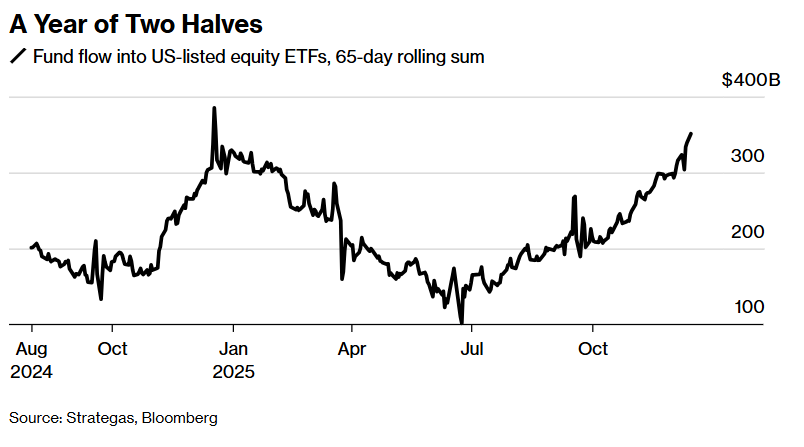
Core Viewpoint - The year 2025 has been marked by extreme volatility in the U.S. stock market, driven by factors such as Trump's tariff policies, AI investment enthusiasm, and ongoing Federal Reserve monetary policy debates [1][2][3]. Group 1: Market Volatility and Trends - The S&P 500 index experienced a significant drop in April due to Trump's aggressive tariff policies, nearly entering a bear market, but rebounded sharply as these policies were relaxed, leading to new highs driven by AI-related investments [1][2]. - The Cboe Volatility Index (VIX) spiked above 50 in April, marking the highest level since the COVID-19 pandemic, before falling back below 20 as market conditions stabilized [2][3]. - The S&P 500 index has risen approximately 16% year-to-date, recovering from a 15% drop in April, indicating a strong performance despite earlier volatility [3]. Group 2: Fund Flows and ETF Activity - April 2025 saw significant net outflows from ETFs, particularly those tracking the Nasdaq 100, as investors reacted to tariff concerns, marking the fastest withdrawal pace in over two years [4][7]. - Following the easing of tariff pressures, inflows into the Invesco QQQ ETF surged in May, indicating a recovery in investor sentiment [7]. Group 3: Analyst Predictions and Market Adjustments - Wall Street analysts rapidly adjusted their year-end targets for the S&P 500, initially lowering them due to tariff fears, then raising them again as market conditions improved [8][11]. - The historical context of such rapid adjustments was noted, with comparisons to the early days of the COVID-19 pandemic [12]. Group 4: Bubble Concerns and Valuation Levels - Concerns about an AI bubble emerged early in 2025, with notable investors warning of inflated valuations in tech stocks, particularly those benefiting from AI advancements [13][16]. - The S&P 500's current price-to-earnings ratio is among the highest levels seen this century, raising alarms about potential overvaluation [16]. Group 5: Market Concentration Risks - The top 10 stocks in the S&P 500 account for nearly 40% of the index, raising concerns about market concentration risks and the potential for increased volatility [17][21]. - The "Magnificent Seven" tech giants have driven significant market gains, but their dominance poses risks for diversified investment strategies [18][21]. Group 6: International Market Performance - Despite a strong rebound in the U.S. market, it has underperformed compared to international indices, highlighting a shift in investor sentiment towards global markets amid U.S. policy uncertainties [25][28]. - The narrative of "American exceptionalism" is weakening, as international markets have outperformed the U.S. due to concerns over domestic economic policies and rising deficits [28][29].


关税惊魂、AI狂热与“过山车式剧烈波动”! 六张图回顾美股“狂野的2025年”
智通财经网· 2025-12-22 08:23
Market Overview - The year 2025 has been characterized by extreme pricing trajectories in the U.S. and global stock markets, with the S&P 500 index experiencing significant volatility due to Trump's tariff policies and subsequent AI investment enthusiasm [1][2] - The S&P 500 index has risen by 16% year-to-date, recovering from a 15% drop in April, driven by strong corporate earnings and expectations of Federal Reserve interest rate cuts [3] Tariff Impact - Trump's aggressive tariff policies initially led to a rare market downturn, pushing the Nasdaq into a technical bear market, but a reversal in these policies allowed for a rapid recovery [2][3] - The Cboe Volatility Index (VIX) spiked above 50 in April due to tariff fears, marking the highest level since the COVID-19 pandemic, before dropping back below 20 as the situation stabilized [2] AI Investment Surge - The AI infrastructure investment wave, led by tech giants like Google, Microsoft, and Meta, has created unprecedented demand for AI computing capabilities, contributing to the stock market's recovery [1][2] - Concerns about an "AI bubble" have emerged, with some investors warning of potential risks associated with inflated valuations in the tech sector [13][16] Market Concentration Risks - The top 10 stocks in the S&P 500 now account for nearly 40% of the index, raising concerns about market concentration risks and the potential for increased volatility [17] - The "Magnificent Seven" tech giants, including Apple, Microsoft, and Nvidia, have been pivotal in driving the S&P 500 to new highs, but their dominance poses risks for diversified investment strategies [18][21] Active Management Challenges - Active fund managers have struggled to outperform the S&P 500, with only 22% of large-cap active funds beating the index, the lowest rate since 2016 [23] - The concentration of returns among a few tech stocks has made it difficult for active managers to achieve diversification and manage risk effectively [21][23] International Market Performance - The U.S. stock market has underperformed compared to international indices, with several countries' benchmarks significantly outperforming the S&P 500 in 2025 [25][28] - The narrative of "American exceptionalism" is showing cracks as U.S. policy uncertainty and rising deficits have led to a decline in the attractiveness of U.S. assets [28][29]

全球宏观及大类资产配置周报-20251222
Dong Zheng Qi Huo· 2025-12-22 07:46
1. Report Industry Investment Rating | Asset Category | Rating | | --- | --- | | Gold | Oscillation | | US Dollar | Bearish | | US Stocks | Oscillation | | A-Shares | Oscillation | | Treasury Bonds | Oscillation | [22] 2. Core Viewpoints of the Report - The US employment market continues to cool, inflation eases, and the Fed's policy focus remains on employment with future rate cuts as the baseline. Market expects a likely pause in rate cuts in January, and the new Fed Chair selection may reshape the rate cut path. Japan's central bank hiked rates, and overseas risk appetite rebounded. China's November economic data was weak, but the entry of state - owned funds boosted A - share confidence [4]. - Global commodity markets rebounded, with energy prices weakening and metals performing strongly. China's domestic commodity market sentiment improved [20]. - Different asset classes are expected to show oscillatory trends in the short - term, with the bond market likely to recover moderately [22]. 3. Summaries According to the Table of Contents 3.1 Macro Context Tracking - US: Non - farm data was mixed, employment cooled, CPI dropped unexpectedly, and the Fed's policy leans towards rate cuts. The new Fed Chair selection is pending, and candidates support significant rate cuts. - Japan: The central bank hiked rates by 25bp, but the stance was less hawkish than expected. - China: November economic data declined, with supply - demand imbalance. However, state - owned funds entered the market, boosting A - share confidence [4]. 3.2 Global Asset Class Performance Overview 3.2.1 Equity Markets - Most global stock markets corrected. Developed markets: S&P 500 rose 0.1%, Nikkei 225 fell 2.61%, etc. Emerging markets: Shanghai Composite Index fell 0.03%, Hang Seng Index fell 1.1%, etc. MSCI indices showed different trends, with frontier > developed > global > emerging [6][8]. 3.2.2 Foreign Exchange Markets - The US dollar index oscillated, appreciating 0.32%. The RMB appreciated against the US dollar, while some emerging market and developed market currencies had different trends, such as the Mexican peso depreciating 0.12% and the Brazilian real depreciating 2.06% [10][12]. 3.2.3 Bond Markets - Global major countries' 10 - year government bond yields oscillated narrowly. In developed countries, US bond yields dropped 3bp to 4.16%, while in emerging markets, China's bond yields dropped 1bp to 1.83% [15][16]. 3.2.4 Commodity Markets - The global commodity market rebounded. Energy prices weakened (WTI crude oil fell 1.72%, natural gas fell 1.83%), while metals were strong (LME copper rose 2.85%, LME aluminum rose 2.43%). Gold oscillated at a high level, and silver rose strongly [19][20]. 3.3 Weekly Outlook for Asset Classes 3.3.1 Precious Metals - Gold is expected to oscillate at a high level, with attention on whether it can break through the previous high. Silver prices rose sharply, but there is a risk of decline. The gold - silver ratio dropped to 65.6 [22][23][35]. 3.3.2 US Dollar - The US dollar is bearish due to the weakening labor market and falling inflation [22][36]. 3.3.3 US Stocks - US stocks are expected to oscillate with a slightly upward trend, supported by economic data for rate cuts, alleviated AI bubble concerns, and strong year - end seasonality [22][40]. 3.3.4 A - Shares - A - shares are expected to oscillate at a high level, affected by factors such as year - end capital holding [22][50][57]. 3.3.5 Treasury Bonds - The bond market is expected to recover moderately, with improved trading structure and favorable fundamentals [58]. 3.4 Global Macroeconomic Data Tracking 3.4.1 Overseas High - Frequency Economic Data - US: GDPNow model estimated Q3 growth at 3.47%, retail sales were resilient, inflation expectations dropped, and the employment market continued to cool. Bank liquidity is expected to improve, and corporate bond credit spreads rose slightly. November non - farm data was mixed, and CPI dropped [74][82][85]. 3.4.2 Domestic High - Frequency Economic Data - Real estate transactions were weak, and market pessimism persisted. November economic data showed a weakening trend, with investment, consumption, and credit data under pressure. CPI and PPI showed a K - shaped divergence, and exports outperformed expectations [86][98][109].
数万亿美元投资、成千上万新玩家--AI数据中心已成一场关乎全球经济命运的“新淘金”
Hua Er Jie Jian Wen· 2025-12-22 03:57
一场由人工智能(AI)驱动的基础设施"淘金热"正在重塑全球数据中心市场,其主角不再仅仅是科技巨 头,而是数以千计背景各异的新进入者,这股浪潮正吸引着数万亿美元的投资,并可能对全球经济产生 深远影响。 据彭博新闻社汇编的数据,这股建设热潮的规模空前。仅在2025年,美国的数据中心信贷交易额就已达 到至少1785亿美元。科技巨头甲骨文、Meta和Alphabet等公司已帮助将今年的全球债券发行总额推高至 超过6.57万亿美元。摩根大通预计,为给这场全球性的建设提供资金,发行人几乎将动用所有主要的债 务市场。 然而,这股热潮的核心变化在于市场参与者的构成。数据显示,未来规划的数据中心容量中,大部分将 由大型科技公司以外的"新玩家"和其它行业参与者建设。这一结构性转变在分散风险的同时,也带来了 新的隐忧:如果AI的商业前景被证伪,其崩溃可能通过这些新玩家波及全球经济的各个角落,触及股 权和债务市场的每一个环节。 大型科技公司自身也在调整策略,它们正越来越多地选择租赁而非自建数据中心,从而将巨额的债务负 担和建设风险转移给开发商。微软首席执行官Satya Nadella在预测计算能力将出现"过度建设"时,直言 这正是他 ...
美联储要降息100个基点?人民币进入6时代,美国疯狂押注国运
Sou Hu Cai Jing· 2025-12-22 03:52
Core Viewpoint - The U.S. stock market, particularly the AI sector, is facing significant challenges, with Oracle's disappointing earnings raising doubts about the sustainability of the AI bubble and the effectiveness of government interventions [2][4][6]. Group 1: Market Reactions - Oracle's poor performance led to a sharp decline in its stock price, with a maximum intraday drop of over 6%, while Nvidia's stock fell by approximately 4% [4]. - The Nasdaq index experienced a decline of up to 1.8%, indicating a broader downturn in tech stocks [4]. - The sentiment towards U.S. dollar assets has turned bearish, with any negative news from AI-related companies likely to trigger widespread sell-offs in the stock market [4]. Group 2: Government Proposals - U.S. Treasury Secretary Yellen proposed the creation of a "Trump Account," a new ETF fund for newborns that would hold U.S. stocks until they reach adulthood, funded by wealthy individuals [6][7]. - This proposal is seen as a way to support the stock market, but the financial market remains skeptical about its effectiveness in addressing the underlying issues [7]. Group 3: Economic Indicators - The current U.S. interest rate is between 3.5% and 3.75%, and there are discussions about a potential 100 basis point cut by 2026 to stimulate the job market [10][12]. - The focus has shifted from interest rate policies to the sustainability of the AI bubble and the cash flow of major tech companies [12]. Group 4: Safe-Haven Assets - There is a growing trend of investors seeking safe-haven assets, with increased purchases of gold and the Chinese yuan as alternatives to U.S. dollar assets [14]. - The yuan has appreciated against the dollar, reaching a high of 7.0315, reflecting a rise of over 5.3% since April [14]. - China's trade surplus has exceeded $1 trillion, with a record surplus of $1.18 trillion reported by the end of November, indicating strong economic fundamentals that attract global capital [14].

【财经分析】美国AI投资热潮:泡沫担忧隐现,后市怎么走?
Xin Hua Cai Jing· 2025-12-22 03:36
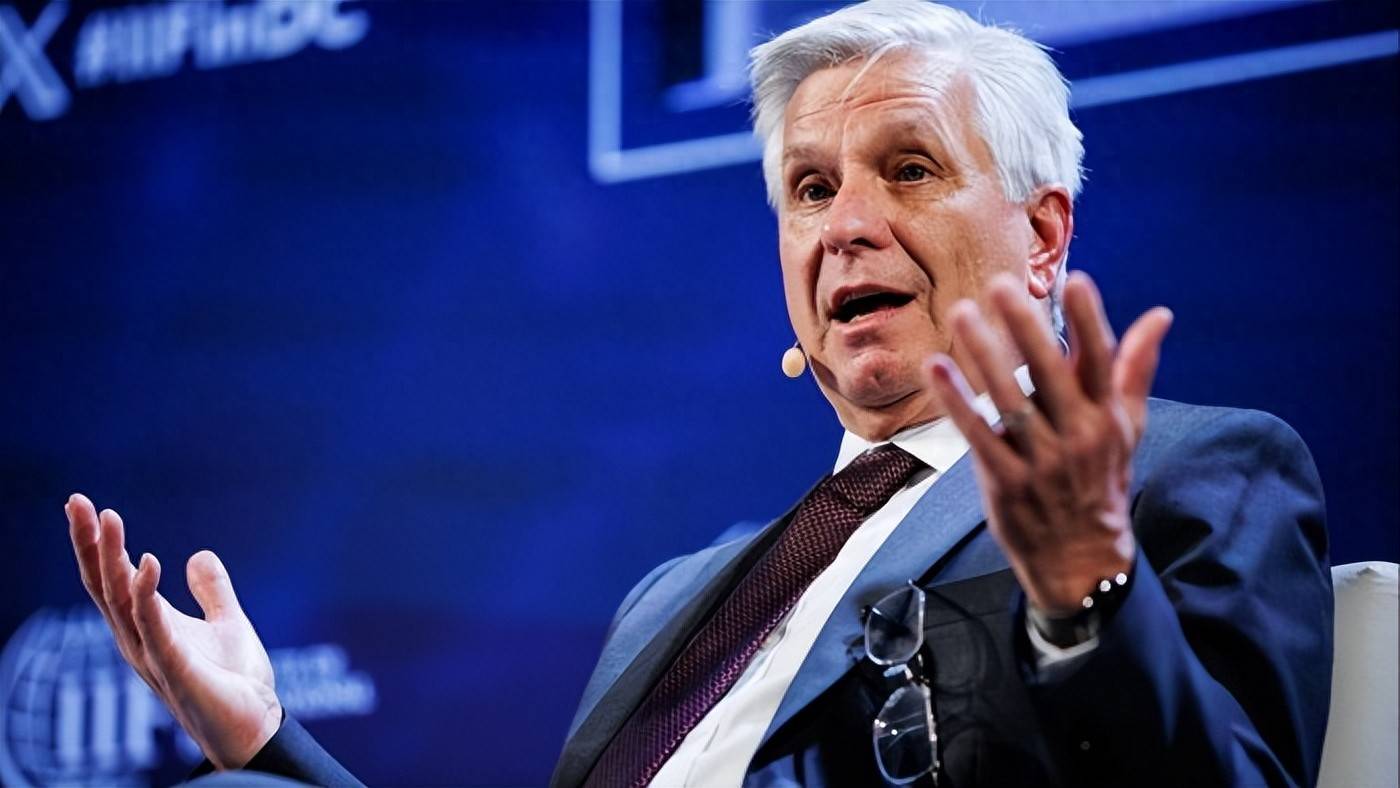
Core Viewpoint - The debate surrounding the "AI bubble" has intensified as the US stock market experiences volatility in AI stocks, with concerns about overvaluation and potential risks emerging in the sector [1][2]. Group 1: Market Dynamics - The AI sector has seen significant investment from major tech companies and investment institutions, driven by advancements in AI technology and applications over the past two years [1]. - Nvidia's strong quarterly report has temporarily renewed investor optimism, although star stocks have experienced substantial pullbacks from their peaks [1]. - The market capitalization of AI-related stocks has increased by over $19 trillion since the launch of the ChatGPT model in November 2022, surpassing the projected discounted capital income value of $8 trillion [4][5]. Group 2: Bubble Concerns - Analysts express concerns that the current market conditions resemble the late 1990s internet bubble, despite differences in the underlying fundamentals [4][5]. - Michael Burry warns that the accounting practices of large cloud and AI providers may underestimate asset depreciation, potentially inflating future earnings [5]. - Ray Dalio indicates that the market is currently in a bubble, which could lead to low investment returns over the next decade [6]. Group 3: Industry Risks - The AI sector is accumulating potential risks due to significant capital expenditures on data centers and infrastructure, with concerns about financing and debt levels among tech companies [7][8]. - The interconnections between companies, such as Nvidia, Oracle, and OpenAI, create systemic risks that could amplify if demand for AI services slows [7][8]. - A report from Accel predicts that AI data center capacity will increase by 117 GW by 2030, requiring approximately $4 trillion in capital expenditures, highlighting a significant gap between revenue and spending [8]. Group 4: Financial Strategies - Major tech companies have issued over $100 billion in bonds this year, a significant increase compared to previous years, raising concerns about their ability to generate long-term returns from their capital expenditures [9][10]. - Oracle's recent financial performance has raised alarms, with negative free cash flow and rising credit default swap rates indicating increased credit risk [11]. - The market is witnessing a shift in focus towards how companies will meet large-scale orders and whether they can achieve expected returns on their investments [11][12]. Group 5: Future Outlook - There is a growing belief that the investment landscape for AI may mature, leading to more cautious investment strategies as companies reassess their capital expenditures [12]. - Some analysts remain optimistic about the long-term potential of AI, suggesting that the expansion of AI applications from consumer to industrial sectors could drive future profitability [12].
有色金属日报 2025-12-22-20251222
Wu Kuang Qi Huo· 2025-12-22 02:08
1. Report Industry Investment Rating - No information provided regarding the industry investment rating in the report. 2. Core Viewpoints of the Report - The overall sentiment in the有色金属 market is influenced by factors such as the Fed's monetary policy, US economic data, and overseas supply disruptions. Different metals have varying price trends and influencing factors, and short - term price movements are expected to be affected by a combination of macro - factors and industry - specific fundamentals [4][7][10][12]. 3. Summary by Metal Copper - **Market Information**: On Friday, the LME 3M copper contract rose 1.22% to $11,870/ton, and the SHFE copper main contract reached 93,560 yuan/ton. LME copper inventory decreased by 3,875 tons to 160,400 tons. The domestic SHFE daily warehouse receipts increased by 0.1 to 46,000 tons. The domestic copper spot import loss was about 1,200 yuan/ton, and the refined - scrap copper price difference widened [3]. - **Strategy Viewpoint**: The Fed's loose monetary policy and the easing of concerns about the US stock AI bubble have a positive impact on sentiment. The copper ore supply remains tight, and the annual long - term contract benchmark is slightly higher than expected. The apparent consumption of refined copper in November was lower than expected, increasing the resistance to upward price movement. However, with less scrap copper substitution, the supply surplus pressure is not large. The short - term price is expected to remain high and volatile. The operating range of the SHFE copper main contract is 92,000 - 94,600 yuan/ton, and the LME 3M copper is 11,600 - 12,200 dollars/ton [4]. Aluminum - **Market Information**: Overseas supply disruptions pushed LME aluminum up, with the Friday closing price rising 1.32% to $2,955/ton, and the SHFE aluminum main contract reaching 22,245 yuan/ton. The SHFE aluminum weighted contract positions increased by 29,000 to 654,000 lots, and the futures warehouse receipts slightly decreased to 76,000 tons. Domestic aluminum ingot inventories increased slightly, and aluminum rod inventories decreased [6]. - **Strategy Viewpoint**: Global aluminum inventories continue to decline and are at relatively low levels compared to the same period in previous years. Coupled with overseas supply disruptions and a positive commodity atmosphere, aluminum prices are strongly supported. However, Mexico's increase in some aluminum tariffs and the off - season in the aluminum downstream industry pose pressure. The aluminum price is expected to fluctuate and accumulate momentum, with a rising center. The operating range of the SHFE aluminum main contract is 22,000 - 22,400 yuan/ton, and the LME 3M aluminum is 2,900 - 2,980 dollars/ton [7]. Lead - **Market Information**: Last Friday, the SHFE lead index rose 0.55% to 16,879 yuan/ton, and the LME 3S lead rose $16.5 to $1,973.5/ton. The domestic social lead inventories decreased by 420 tons to 1,950 tons [9]. - **Strategy Viewpoint**: The visible inventory of lead ore has increased, and the lead concentrate processing fee has remained flat. The operating rate of primary lead smelters has increased, while the operating rate of secondary lead has decreased marginally, and the operating rate of battery enterprises has remained stable. The domestic lead ingot supply has tightened marginally, and the visible inventory has remained relatively low. After the release of short - term macro - risks, the sentiment in the non - ferrous market is positive. The current lead price is at the lower end of the oscillation range, and it is expected to be strong in the wide - range in the short term [10]. Zinc - **Market Information**: Last Friday, the SHFE zinc index rose 0.19% to 23,081 yuan/ton, and the LME 3S zinc rose $8.5 to $3,073/ton. The domestic social zinc inventories decreased by 350 tons to 12,220 tons [11]. - **Strategy Viewpoint**: The visible inventory of zinc concentrate has increased, and zinc concentrate TC has stopped falling and stabilized. The shortage of domestic zinc ore is expected to ease marginally. The LME zinc ingot inventory has increased, and the LME zinc monthly spread has returned to a Contango structure. The domestic zinc ingot social inventory has continued to decline, and the spot basis has increased. After the release of short - term macro - risks, the sentiment in the non - ferrous market is positive. The zinc price is expected to be weak in the medium term but may have an upward impulse in the short term due to macro - sentiment [12][13]. Tin - **Market Information**: On December 19, 2025, the SHFE tin main contract closed at 343,040 yuan/ton, up 2.59%. The operating rate of tin smelters in Yunnan and Jiangxi is high and stable but lacks upward momentum. The demand for tin solder enterprises is stable, but the high tin price has suppressed downstream purchasing willingness, and the spot trading atmosphere is dull [14]. - **Strategy Viewpoint**: Although the short - term tin market demand is weak and the supply is expected to improve, the downstream inventory is low, and the bargaining power is limited. The short - term price is expected to fluctuate with market risk preference. It is recommended to wait and see. The operating range of the domestic main contract is 300,000 - 350,000 yuan/ton, and the overseas LME tin is 39,000 - 43,000 dollars/ton [15]. Nickel - **Market Information**: On Friday, the nickel price rebounded significantly, with the SHFE nickel main contract closing at 117,180 yuan/ton, up 2.84%. The nickel ore price remained stable, and the nickel iron price weakened again [16]. - **Strategy Viewpoint**: The nickel surplus pressure is still large. The nickel iron price has slightly declined, while the refined nickel price has dropped significantly. The refined nickel premium has reached the support level. It is necessary to wait for the nickel iron price to further decline to test the cash cost of the pyrometallurgical production line. It is recommended to wait and see in the short term. The short - term operating range of the SHFE nickel price is 110,000 - 125,000 yuan/ton, and the LME 3M nickel contract is 13,000 - 15,500 dollars/ton [17][18]. Lithium Carbonate - **Market Information**: Last Friday, the MMLC lithium carbonate spot index closed at 105,069 yuan, up 2.74% from the previous working day and 11.10% for the week [20]. - **Strategy Viewpoint**: The short - term supply recovery expectation has been falsified, and the bears are under pressure. The mid - term fundamentals are controversial, but the optimistic expectation is stronger. The long - position trend on the futures market has not ended. The lithium carbonate position is still high, and the intraday price fluctuates greatly. It is recommended to wait and see. The operating range of the GZCE lithium carbonate main contract is 108,600 - 117,200 yuan/ton [21]. Alumina - **Market Information**: On December 19, 2025, the alumina index fell 2.51% to 2,568 yuan/ton. The Shandong spot price fell 5 yuan/ton to 2,655 yuan/ton [23]. - **Strategy Viewpoint**: After the rainy season, the shipping from Guinea is gradually recovering, and the AXIS mine is resuming production. The ore price is expected to decline. The alumina smelting capacity surplus pattern is difficult to change in the short term, and the inventory accumulation trend continues. However, the current price is close to the cost line of most manufacturers, and the subsequent production reduction expectation is increasing. The overall non - ferrous sector is strong, and the cost - performance of short - selling is not high. It is recommended to wait and see in the short term. The operating range of the domestic main contract AO2601 is 2,400 - 2,700 yuan/ton [24]. Stainless Steel - **Market Information**: On Friday, the stainless - steel main contract closed at 12,720 yuan/ton, up 2.42%. The social inventory decreased to 1.0421 million tons, a 2.01% decrease from the previous period [26]. - **Strategy Viewpoint**: The overall trading atmosphere in the stainless - steel spot market is light, and the low - price warehouse receipt resources are actively traded, driving the continuous decline in social inventory. The market demand is mainly for rigid - demand purchases at low prices, and the acceptance of high - price resources is generally low. In the short term, the stainless - steel price is expected to continue to oscillate and bottom out, with limited upward space [27]. Cast Aluminum Alloy - **Market Information**: On Friday, the cast aluminum alloy price continued to rise, with the main AD2602 contract closing at 21,235 yuan/ton, up 0.59%. The trading volume decreased, and the warehouse receipts slightly decreased [29]. - **Strategy Viewpoint**: The cost of the cast aluminum alloy is relatively firm, and the supply - side disruptions continue, providing strong support for the price. However, the demand is volatile, and the delivery pressure forms an upper - limit suppression. The short - term price of the cast aluminum alloy is expected to fluctuate within a range [30].