
固定资产投资

Search documents
1-9月阿塞拜疆固定资产投资增长1%
Shang Wu Bu Wang Zhan· 2025-10-20 13:27
Core Insights - Azerbaijan's fixed asset investment totaled 130.5 billion manats (76.8 billion USD) from January to September 2025, reflecting a year-on-year growth of 1% [1] Investment Breakdown - Investment in the oil and gas sector decreased by 11.5%, while investment in the non-oil and gas sector increased by 7% [1] - Of the total investment, 66.5 billion manats (38.8 billion USD) was allocated to production, accounting for 51% of the total; 43 billion manats (25.3 billion USD) was directed towards the service sector, making up 32.9%; and 21 billion manats (12.4 billion USD) was invested in residential construction, representing 16.1% [1] Domestic Investment - Domestic investments constituted 77.1% of the fixed capital investment [1]
2025年三季度经济数据点评:近5年首次!固定投资同比转负
Lian He Zi Xin· 2025-10-20 11:36
Economic Growth - In Q3 2025, GDP grew by 4.8% year-on-year, indicating a weakening economic growth momentum[2] - For the first three quarters of 2025, GDP reached 101.50 trillion yuan, with a year-on-year growth of 5.2%[4] Fixed Asset Investment - National fixed asset investment (excluding rural households) declined by 0.5% year-on-year, marking the first negative growth since August 2020[5] - Real estate development investment fell by 13.9% year-on-year in the first three quarters, significantly impacting overall investment performance[5] Infrastructure and Manufacturing Investment - Infrastructure investment (excluding electricity) grew by only 1.1% year-on-year, constrained by local debt restrictions[5] - Manufacturing investment increased by 4.0% year-on-year, with high-tech manufacturing remaining a bright spot[5] Consumer Spending - Total retail sales of consumer goods reached 36.59 trillion yuan, growing by 4.5% year-on-year, but September's growth slowed to 3.0%[6] - Consumer confidence remains low, with underlying issues such as weak income expectations persisting[6] Economic Outlook - The economic outlook for Q4 remains pressured by external uncertainties and a lack of internal demand[4] - Upcoming policy guidance from the 20th Central Committee and potential US-China talks are critical for future economic direction[2]
前三季度增长5.2%,后续关键在于用足用好存量政策
2 1 Shi Ji Jing Ji Bao Dao· 2025-10-20 11:27
Economic Growth and Structure - The core of macroeconomic policy for Q4 focuses on structure rather than total volume, emphasizing the effective use of existing policies [1][10] - In Q3, GDP grew by 4.8% year-on-year, with a cumulative growth of 5.2% for the first three quarters, indicating a solid foundation for achieving the annual growth target [7][10] - Fixed asset investment decreased by 0.5% year-on-year in the first three quarters, reflecting a shift from investment-driven growth to innovation and technology-driven growth [7][8] Investment and Consumption - New social financing in September was 3.53 trillion yuan, a year-on-year decrease of 229.7 billion yuan, indicating a need for investment and consumption to be boosted [2][4] - The corporate sector saw new loans of 1.22 trillion yuan in September, with a year-on-year decrease of 50 billion yuan, highlighting a decline in investment willingness [3][4] - Consumer loan growth remains weak, with short-term loans decreasing significantly, suggesting a need for improved consumer sentiment and housing market expectations [2][4] Trade and External Factors - External trade showed resilience, with exports growing by 6.1% year-on-year in the first three quarters, despite global economic uncertainties [9] - Factors contributing to the strong export performance include preemptive actions by foreign trade companies and growth in sectors like new energy vehicles and solar energy [9] Price Trends and Market Dynamics - The Consumer Price Index (CPI) fell by 0.3% year-on-year in September, while core CPI rose by 1%, indicating a mixed inflationary environment [5][6] - The rise in core CPI is driven by increased prices of precious metals and consumer goods, reflecting changes in market dynamics and consumer behavior [5][6]
前三季度增长5.2%,后续关键在于用足用好存量政策|宏观月报
2 1 Shi Ji Jing Ji Bao Dao· 2025-10-20 11:24
Economic Overview - The GDP for the first three quarters reached 10,150.36 billion yuan, with a year-on-year growth of 5.2% at constant prices, indicating a stable economic growth rate in Q3 and a likelihood of achieving the annual growth target [1][5] - The overall economic environment shows a structural impact from changes in supply and demand, with a need for objective recognition of slowing investment growth and the necessity to boost consumption [1][5] Financial Data - In September, new social financing amounted to 3.53 trillion yuan, a year-on-year decrease of 229.7 billion yuan, reflecting a slight decline in the growth rate of RMB loans [1][2] - New RMB loans in September were 1.29 trillion yuan, down 300 billion yuan year-on-year, primarily due to weak consumer sentiment and a slowdown in corporate investment expansion [1][2] Household Sector - In September, short-term loans for households increased by 142.1 billion yuan, a year-on-year decrease of 127.9 billion yuan, while medium to long-term loans rose by 250 billion yuan, showing a slight year-on-year increase [2] - The implementation of the personal consumption loan subsidy scheme introduced in August is still pending, and its stimulating effect on short-term loans requires time to materialize [2] Corporate Sector - In September, corporate sector loans totaled 1.22 trillion yuan, with short-term loans at 710 billion yuan and medium to long-term loans at 910 billion yuan, reflecting a year-on-year decrease of 50 billion yuan [2] - The investment willingness of enterprises remains subdued, with insufficient new orders impacting investment expansion [2][6] Government Sector - In September, net financing from government bonds was 1.1886 trillion yuan, a year-on-year decrease of 347.1 billion yuan, indicating a slowdown in bond issuance compared to the previous high base [2] - The focus of macroeconomic policy is on structural adjustments rather than total volume, emphasizing the effective use of existing policies [2][8] Inflation and Prices - In September, the CPI decreased by 0.3% year-on-year, while the core CPI increased by 1%, marking the fifth consecutive month of growth in core CPI [3][4] - The rise in core CPI is driven by increased prices in categories such as old-for-new exchanges and gold jewelry [3][4] Investment Trends - Fixed asset investment decreased by 0.5% year-on-year in the first three quarters, with infrastructure investment growing by 1.1% and manufacturing investment increasing by 4% [5][6] - The shift from investment-driven growth to innovation-driven growth is evident, with funds moving towards new technologies and industries [5][6] Consumption Patterns - Consumer spending showed signs of slowing down in Q3, with retail sales growth decelerating compared to earlier in the year [7] - The effectiveness of fiscal policies aimed at boosting personal consumption loans and the financial market's ability to enhance residents' income will be crucial for future consumption growth [7] Foreign Trade - Exports increased by 6.1% year-on-year in the first three quarters, with a notable 8.3% growth in September, demonstrating resilience in foreign trade despite global uncertainties [7] - Factors contributing to export resilience include preemptive actions by foreign trade enterprises and strong growth in sectors like new energy vehicles and solar products [7] Future Outlook - The completion of the annual growth target is highly probable, with Q4 expected to focus on stability and effective use of existing policies [8] - Increased fiscal spending towards the end of the year is anticipated to support necessary growth rates, while monetary policy will concentrate on structural tools [8]
格林大华期货-宏观经济专题报告:三季度增长符合预期,预期四季度将获支撑
Ge Lin Qi Huo· 2025-10-20 11:19
Report Industry Investment Rating - Not provided in the content Core Viewpoints - The economic growth rate in Q3 2025 met expectations, but due to the high base caused by policy stimulus in Q4 2024, the growth rate in Q4 2025 may be the lowest of the year. China is expected to achieve an annual economic growth target of around 5% in 2025 [4][22][24]. Summary by Relevant Catalogs GDP - In Q3 2025, China's GDP grew 4.8% year-on-year, in line with market expectations. The Q1 and Q2 growth rates were 5.4% and 5.2% respectively. The Q3 GDP grew 1.1% quarter-on-quarter. The cumulative GDP growth in the first three quarters was 5.2% year-on-year [1][5]. Investment - From January to September, national fixed - asset investment decreased 0.5% year-on-year, against a market expectation of flat growth. In September, fixed - asset investment decreased 0.07% month-on-month, showing an eight - month consecutive decline [2][8]. - From January to September, infrastructure investment (broad sense) grew 3.3% year-on-year, while narrow - sense infrastructure investment grew 1.1% year-on-year. Manufacturing investment grew 4.0% year-on-year, and real estate development investment decreased 13.9% year-on-year [2][8]. - In September, manufacturing investment decreased 1.9% year-on-year, and narrow - sense infrastructure investment decreased 4.6% year-on-year [8]. Real Estate - From January to September, the sales area of new commercial housing decreased 5.5% year-on-year, and the sales volume decreased 7.9% year-on-year. In September, the sales of new commercial housing declined at an accelerated pace [11]. - In September, the prices of second - hand residential properties in 70 large and medium - sized cities continued to decline. The prices in first - tier cities decreased 1.0% month-on-month, and the declines in second - and third - tier cities widened [11]. - In September, the funds available to real estate development enterprises decreased 11.0% year-on-year. The new construction area decreased 15.0% year-on-year, and the completed area increased 0.39% year-on-year [12]. Industry - In September, the added value of large - scale industrial enterprises grew 6.5% year-on-year, exceeding market expectations. The product sales rate was 96.7%, up 0.7 percentage points year-on-year but 2.1 percentage points lower than in September 2019 [3][13]. - In Q3 2025, the capacity utilization rate of large - scale industrial enterprises was 74.6%, the lowest in the same period since 2017, down 0.5 percentage points year-on-year [14]. Foreign Trade - In September, China's exports denominated in US dollars grew 8.3% year-on-year, exceeding expectations. The overall export growth in the first nine months was 6.1%, higher than the same period last year, thanks to export diversification. However, the export growth rate is likely to decline in Q4 due to the high base in Q4 last year [3][15][16]. Consumption - In September, the total retail sales of consumer goods grew 3.0% year-on-year, slightly lower than market expectations. The growth rate of consumer goods sales by限额以上 units in some categories slowed down, mainly due to high base effects and subsidy reductions [4][18]. Employment - In September, the national urban survey unemployment rate was 5.2%, down 0.1 percentage points from the previous month and up 0.1 percentage point from the same month last year [4][21]. Policy and Outlook - The central government has allocated 500 billion yuan from the local government debt balance limit to local governments to support debt resolution and project construction. About 500 billion yuan of new policy - based financial instruments may be issued in Q4 [4][22][24]. - The suspension of 24% ad - valorem tariffs between China and the US is likely to be extended after November 10 [4][24].
固投增速持续回落,基建投资承压:——2025年1-9月投资数据点评
Shenwan Hongyuan Securities· 2025-10-20 10:29
Investment Rating - The industry investment rating is currently neutral, indicating that the industry is expected to perform in line with the overall market [22]. Core Insights - The fixed asset investment and manufacturing investment growth rates have continued to decline, with a cumulative year-on-year decrease of 0.5% for fixed asset investment from January to September 2025, and a 4.0% year-on-year increase in manufacturing investment, which is a decline of 1.1 percentage points compared to the previous month [3][4]. - Infrastructure investment is under pressure, with a year-on-year growth of 3.3% for total infrastructure investment and 1.1% for infrastructure investment excluding electricity, both showing a decline in growth rates compared to the previous month [4]. - Real estate investment remains low, with a year-on-year decrease of 13.9% from January to September 2025, and construction starts down by 18.9% [10]. Summary by Sections Economic Overview - The GDP growth for the first three quarters of 2025 is reported at 5.2%, with quarterly growth rates of 5.4%, 5.2%, and 4.8% respectively [3]. Infrastructure Investment - Infrastructure investment growth is under pressure, with specific sectors like transportation, water conservancy, and public utilities showing varying degrees of decline [4]. - Eastern regions experienced a year-on-year investment decline of 4.5%, while central and western regions saw a slight increase of 1.5% [4]. Real Estate Investment - Real estate investment has shown a significant decline, with expectations of a slow recovery due to challenges in supply and inventory replenishment [10]. Investment Recommendations - The report suggests that the overall industry is weak, but regional investments may gain traction with the implementation of national strategic layouts. Recommended companies include China Chemical, China Energy Construction, China Railway, and China Railway Construction among others [14].




2025年1-9月投资数据点评:固投增速持续回落,基建投资承压
Shenwan Hongyuan Securities· 2025-10-20 08:43
Investment Rating - The industry investment rating is "Overweight" [2] Core Viewpoints - The economic operation in the first three quarters of 2025 shows steady progress, with fixed asset investment and manufacturing investment growth continuing to decline. The GDP growth rates for Q1, Q2, and Q3 of 2025 are 5.4%, 5.2%, and 4.8% respectively, leading to a cumulative year-on-year fixed asset investment decrease of 0.5% [4][5] - Infrastructure investment is under pressure, with transportation, water conservancy, and public utility investment growth all facing challenges. The total infrastructure investment growth rate (including all categories) is 3.3%, down 2.1 percentage points from the previous month [5] - Real estate investment remains low, with a year-on-year decrease of 13.9% in the first nine months of 2025, indicating a weak recovery in investment [10] Summary by Sections Economic Overview - The GDP growth for the first three quarters of 2025 is 5.2%, with a decline in fixed asset investment and manufacturing investment growth rates [4][5] Infrastructure Investment - Total infrastructure investment growth is 3.3%, with specific sectors like transportation and public utilities showing negative growth [5] Real Estate Investment - Real estate investment has decreased by 13.9% year-on-year, with construction starts and completions showing slight improvements [10] Investment Recommendations - The report suggests that the overall industry is weak, but regional investments may gain flexibility with national strategic layouts. Recommended companies include China Chemical, China Energy Construction, China Railway, and China Railway Construction [14]
时报图说丨重磅经济数据公布!前三季度GDP同比增长5.2%
Zheng Quan Shi Bao Wang· 2025-10-20 08:08
Economic Overview - The GDP for the first three quarters reached 10,150.36 billion yuan, with a year-on-year growth of 5.2% [2] - The GDP growth rates for the first three quarters were 5.4% in Q1, 5.2% in Q2, and 4.8% in Q3 [3] Industrial Performance - The industrial added value for large-scale enterprises in September increased by 6.2% year-on-year [5] - The industrial capacity utilization rate for large-scale enterprises in Q3 was 74.6%, up by 0.6 percentage points from Q2 [12] Consumer and Investment Trends - The total retail sales of consumer goods for the first three quarters amounted to 36,587 billion yuan, reflecting a year-on-year growth of 4.5% [6] - Fixed asset investment (excluding rural households) for the first three quarters was 874.585 billion yuan, showing a decline of 0.5% [6] - The sales area of newly built commercial housing in the first three quarters was 65.85 million square meters, down by 5.5% year-on-year [11] Trade and Prices - The total import and export value for the first three quarters was 3,360.78 billion yuan, with a year-on-year increase of 4.0% [6] - The Consumer Price Index (CPI) for the first three quarters decreased by 0.1% year-on-year [7] - The Producer Price Index (PPI) for the first three quarters fell by 2.8% year-on-year [8] Employment and Income - The average urban survey unemployment rate for the first three quarters was 5.2% [9] - The per capita disposable income for residents in the first three quarters was 32,590 yuan, with a nominal year-on-year growth of 5.1% [12] Real Estate Sector - Real estate development investment in the first three quarters was 67,706 billion yuan, down by 13.9% year-on-year [10][11] - In September, housing prices in 70 large and medium-sized cities showed a month-on-month decline, with the year-on-year decline narrowing [12] Economic Outlook - The economic structure remains stable, with ongoing momentum for growth and resilience, indicating a solid foundation for sustained healthy development [13] - Future efforts will focus on implementing counter-cyclical adjustments, expanding domestic demand, and enhancing market vitality to boost growth expectations [13]


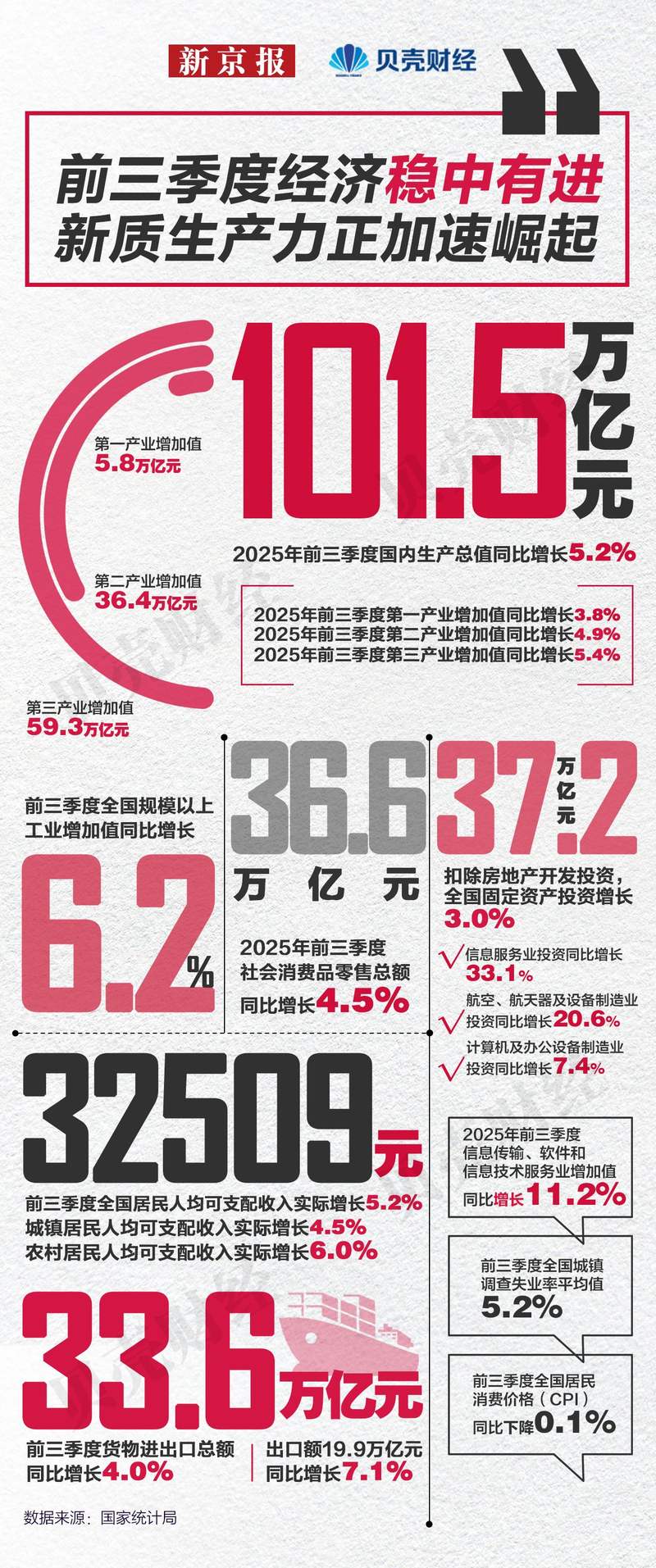
一图看懂|我国前三季度经济数据出炉 GDP同比增长5.2%
Xin Jing Bao· 2025-10-20 08:05
Economic Overview - The National Bureau of Statistics reported that the GDP for the first three quarters reached 10,150.36 billion yuan, reflecting a year-on-year growth of 5.2% at constant prices [1] - The industrial added value for large-scale enterprises increased by 6.2% year-on-year [1] Sector Performance - The equipment manufacturing sector saw an added value growth of 9.7%, while the high-tech manufacturing sector grew by 9.6%, both outpacing the overall industrial growth by 3.5 and 3.4 percentage points respectively [1] - In the high-tech industry, investments in information services, aerospace and equipment manufacturing, and computer and office equipment manufacturing grew by 33.1%, 20.6%, and 7.4% year-on-year respectively [1] Investment Trends - Total fixed asset investment (excluding rural households) amounted to 3,715.35 billion yuan, showing a year-on-year decline of 0.5% [1] - Excluding real estate development investment, fixed asset investment increased by 3.0% [1]
前三季度中国项目投资保持同比增长
Zhong Guo Xin Wen Wang· 2025-10-20 07:21
Core Insights - In the first three quarters, China's fixed asset investment (excluding rural households) decreased by 0.5% year-on-year, primarily impacted by real estate development investment [1] - Excluding real estate development, project investment still grew by 3.0% year-on-year [1] Investment Breakdown - Industrial investment in China increased by 6.4% year-on-year, contributing 2.1 percentage points to overall investment growth [1] - Mining investment grew by 3.7%, accelerating by 0.7 percentage points compared to January-August [1] - Manufacturing investment rose by 4.0%, contributing 1.0 percentage point to total investment growth [1] - Investment in electricity, heat, gas, and water production and supply surged by 15.3%, adding 1.1 percentage points to overall investment [1] Infrastructure and Equipment Investment - Infrastructure investment in China increased by 1.1% year-on-year, contributing 0.2 percentage points to total investment growth [1] - Private investment in infrastructure grew by 7.0%, accounting for 20.0% of total infrastructure investment, up by 1.1 percentage points from the previous year [1] - Equipment purchase investment maintained a growth rate of over 10% year-on-year, with a 14.0% increase in the first three quarters, representing 16.6% of total investment, up by 2.2 percentage points from last year [1] High-Tech Service Sector - Investment in China's high-tech service industry grew by 6.1% year-on-year, accounting for 5.3% of total service industry investment, an increase of 0.5 percentage points from the previous year [2] - Information service industry investment surged by 33.1% [2]