慢牛行情

Search documents
超九成创新高!66%的这类基金仍在回本
券商中国· 2025-09-23 02:02
Core Viewpoint - The article emphasizes the growing importance of "fixed income +" products as a hidden driver of positive market trends, particularly in the context of the current A-share market rally and the need for prudent asset allocation strategies [1][20]. Market Performance - The A-share market has shown a steady upward trend this year, with the Shanghai Composite Index surpassing 3,800 points in August and daily trading volumes exceeding 3 trillion yuan [2]. - Key sectors such as computing, chips, robotics, and solid-state batteries have attracted significant investor interest [2]. Investment Behavior - Investors are cautioned against the temptation of quick profits, which can lead to hasty decisions and poor asset allocation, resulting in losses during market fluctuations [3]. - As of the end of August, 65.58% of actively managed equity funds are still recovering from losses since the market peak in February 2021 [3]. Performance of "Fixed Income +" Products - "Fixed income +" products have outperformed traditional equity indices over the past five years, with the non-pure bond fund index yielding an annualized return of 2.78%, significantly higher than the -1.52% for the CSI 300 index [4]. - The volatility of the non-pure bond fund index over the past five and ten years was only 2.93% and 2.64%, respectively, compared to much higher volatility in equity indices [4]. Historical Performance of Mixed Bond Funds - The mixed bond fund index has consistently delivered positive returns, achieving positive performance in 18 out of 22 years from 2004 to 2025, with relatively small drawdowns during downturns [5]. Asset Allocation Logic - The article explains the asset allocation logic behind "fixed income +" products, highlighting the low volatility of bonds and the higher expected returns from equities, which can lead to significant losses if not managed properly [9]. - The negative correlation between stocks and bonds is noted, with less than 10% of periods experiencing simultaneous declines in both markets [10]. Selection of "Fixed Income +" Funds - Criteria for selecting "fixed income +" funds include a minimum scale of 3 billion yuan and performance metrics over various time frames, with several funds identified as top performers [11]. - Notable funds include博时稳健回报A, which focuses on high-grade credit bonds and employs various strategies to optimize returns while managing risks [11]. Fund Management and Team Expertise - The success of "fixed income +" products is attributed to the expertise of the management teams, with experienced fund managers leading the investment strategies [13]. -博时基金's strong performance is supported by a robust research team with extensive experience in fixed income investments [13]. Market Trends and Future Outlook - The article suggests that "fixed income +" products are becoming increasingly relevant in the current low-interest-rate environment, as traditional fixed income yields decline [21]. - The shift in asset allocation towards "fixed income +" products is expected to provide substantial capital inflows into the A-share market, potentially boosting major indices [22]. - As of August, over 1,640 "fixed income +" funds reported positive returns, with a median return exceeding 3%, indicating strong market performance [23].


【机构策略】本轮慢牛行情的根基并未动摇
Zheng Quan Shi Bao Wang· 2025-09-23 01:09
Market Overview - The A-share market experienced narrow fluctuations on Monday, with the Shanghai Composite Index showing slight movements while the Shenzhen Component and ChiNext Index saw initial gains followed by a decline and a late recovery [1][2] - The overall market sentiment remains optimistic, supported by the Federal Reserve's interest rate cuts and a strengthening yuan, which is expected to improve risk appetite [2][3] Sector Performance - Key sectors such as consumer electronics, semiconductors, computer equipment, and automotive parts performed well, while tourism, energy metals, automotive services, and fertilizers lagged behind [1] - The technology sector, particularly the Sci-Tech 50 Index, led the major indices, with strong performances in the consumer electronics and semiconductor chip sectors [3] Investment Trends - Foreign capital showed confidence in Chinese assets, with net purchases of domestic stocks and bonds in August, indicating a positive outlook for the market [1] - There is a gradual shift of household savings towards the capital market, creating a sustained source of incremental funds [1][2] Market Dynamics - The market is expected to maintain a steady upward trend amidst fluctuations, with a focus on structural optimization to seize investment opportunities [1] - The current market liquidity remains active, with daily trading volumes exceeding 2 trillion yuan, reflecting a robust market environment [2] Future Outlook - The market is anticipated to experience a slow bull trend, with the foundation for continued strength remaining intact despite short-term fluctuations [3] - The upcoming long holiday may lead to a stabilization in trading activity, but the overall sentiment remains positive with expectations of further market improvements [3]
A股四季度策略展望:慢牛进行时
Huajin Securities· 2025-09-22 11:11
Core Views - The A-share market is expected to continue a slow bull trend in the fourth quarter, with increased volatility, following a strong performance in the third quarter led by technology stocks [3][4] - The market is likely to experience a structural recovery in earnings and continued credit repair, supported by a resilient export environment and steady growth in manufacturing and infrastructure investment [3][4][19] - Key sectors to focus on include technology, cyclical industries, and consumer sectors, with a balanced style favoring both large and small-cap stocks [4][5] Market Trends - The third quarter saw a bull market with the ChiNext Index and STAR Market leading gains, driven by liquidity easing and improved risk appetite [10][14] - The fourth quarter is anticipated to maintain a low-level recovery in earnings, with potential inflows from foreign investment and new funds, although IPOs and sell-offs may increase [4][5] - The overall market valuation is currently neutral to high, with supportive policies likely to sustain risk appetite [4] Industry Allocation - Technology remains the main focus for investment in the fourth quarter, with significant opportunities in core assets and cyclical sectors [5] - Recommended sectors for attention include TMT (Technology, Media, Telecommunications), machinery, electric new energy, pharmaceuticals, military industry, non-ferrous metals, chemicals, and non-bank financials [5][19] - The market style is expected to be balanced, with large-cap and small-cap stocks performing well during periods of structural recovery in earnings and credit [5][54]
一图看懂历年国庆前后A股市场表现
天天基金网· 2025-09-22 09:06
Group 1 - The core viewpoint indicates that the A-share market shows a low probability of rising in the five trading days before the National Day holiday, but the last trading day before the holiday has a 70% probability of an increase, while the market tends to rise after the holiday [1][6] - Historical data from 2015 to 2024 shows that the Shanghai Composite Index has a 70% probability of rising on the first trading day after the holiday and a 60% probability of rising in the following five trading days [2][6] - The leading sectors in the A-share market before and after the National Day holiday exhibit significant rotation, covering various fields such as consumption, pharmaceuticals, and technology [6][7] Group 2 - The leading sectors for the five trading days before the holiday from 2020 to 2024 include Food & Beverage, Social Services, and Defense & Military, while the sectors leading after the holiday include Electronics, Automotive, and Pharmaceuticals [4][6] - The market is expected to maintain a volatile pattern before the holiday, influenced by factors such as the Federal Reserve's interest rate decisions and potential profit-taking by investors [6][7] - The financing trend typically shows a pattern of "contraction before the holiday and explosion after," indicating a shift in risk appetite post-holiday [7]

涨势遇冷资金却逆势布局,券商ETF680亿元资金“豪赌”的背后!
Sou Hu Cai Jing· 2025-09-22 08:57
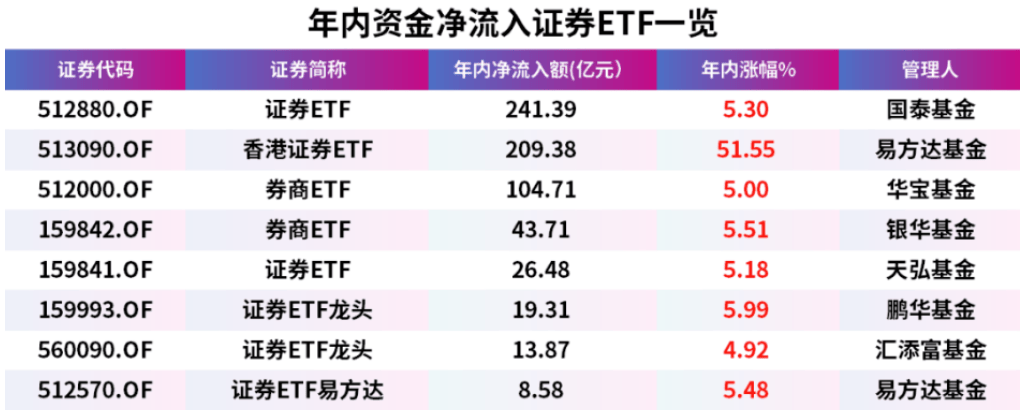
Group 1: Market Trends - The battery sector has seen significant capital inflow since September, with battery ETFs experiencing remarkable growth, such as the lithium battery ETF (561160) rising by 24.19% this month and 53.97% year-to-date [1] - In contrast, the brokerage sector has been in a continuous decline, with related ETFs dropping approximately 8% over the past 19 trading days since August 25 [1] - Despite the decline in the brokerage sector, there has been a unique phenomenon of increased buying, with 40 billion yuan flowing into securities-themed ETFs during this period [1] Group 2: Fund Inflows and Performance - Year-to-date, 68 billion yuan has been invested in securities ETFs, with notable inflows into the Guotai Securities ETF (512880) and the E Fund Hong Kong Securities ETF, attracting 24.139 billion yuan and 20.938 billion yuan respectively [3] - The performance of various ETFs shows that the Guotai Securities ETF has a year-to-date increase of 5.30%, while the Hong Kong Securities ETF has surged by 51.55% [3] Group 3: Brokerage Sector Outlook - The current market is characterized by a "slow bull" trend, where brokerage firms are expected to benefit first from increased trading volumes and improved performance in the third quarter [4] - The brokerage sector's performance is anticipated to improve due to rising trading activity and margin financing, with expectations for further growth in investment banking and public fund businesses [4] - The recent shift in household deposits, with a decrease of 600 billion yuan year-on-year in August, indicates a potential trend of funds moving into the stock market, as evidenced by a 165% increase in new stock accounts in August [7][8] Group 4: ETF Selection Strategy - Investors face a choice between broad-based securities indices and those focused on leading firms, with the latter showing higher returns, such as the CSI All Share Securities Company Index yielding 47.2% over the past year [9] - The performance of leading brokerage indices, such as the CSI Securities Leader Index, has outperformed broader indices, indicating a "Matthew effect" within the brokerage sector [9] Group 5: Market Conditions and Future Prospects - The current low-interest-rate environment has made the stock market an attractive option for deposits, contributing to a healthy outlook for brokerage firms [8][12] - The recent adjustments in the financial sector, along with increased trading activity and regulatory support for liquidity, provide a favorable environment for the brokerage sector [12]
慢牛,“慢”比“牛”难多了!
雪球· 2025-09-22 07:58
Group 1 - The article discusses the phenomenon of large sell orders in the stock market, which appear to be a deliberate action rather than typical large fund exits, possibly indicating regulatory intentions to stabilize the market [3][4][5] - It highlights the current market environment as a "man-made bull market," where regulatory attitudes are seen as the core driving force behind market trends [4][6] - The article outlines three key performance indicators (KPIs) for the regulatory body, including market stability, investment financing reform, and strengthening regulatory enforcement, with market stability being the primary focus [8][9][10] Group 2 - The article emphasizes that the current market conditions are not conducive to a slow bull market, as the macroeconomic environment does not support stable growth in corporate earnings [15][16] - It notes that the current bull market is primarily driven by liquidity rather than fundamental improvements in company performance, leading to potential volatility [17][18] - The discussion includes the risks associated with a market that relies solely on valuation increases without corresponding earnings growth, which could lead to sharp declines if expectations are not met [17][19] Group 3 - The article describes the regulatory approach as a technical challenge, where maintaining a balance between market inflows and outflows is crucial for sustaining a slow bull market [22][24] - It suggests that controlling the index, particularly the Shanghai Composite Index, is a strategy to manage market sentiment and prevent excessive volatility [22][23] - The article concludes that effective market management requires a nuanced understanding of market dynamics and the ability to respond to changing conditions, emphasizing the importance of regulatory experience [25][28]

回调超13%,银行是否跌到位?机构:绝对收益空间开始显现,险资、公募继续增配
Xin Lang Ji Jin· 2025-09-22 06:01
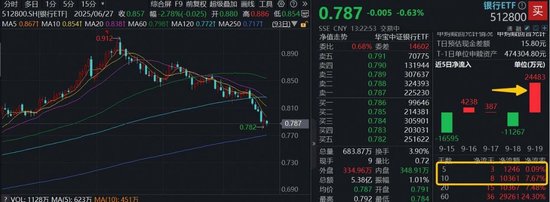
自7月11日高点以来,银行板块一路震荡向下,截至上周五(9月19日),百亿顶流银行ETF(512800) 跟踪的中证银行指数区间已累计下跌13.67%,表现居所有行业末位(中证全指二级)。尤其上周五当 日工商银行下穿半年线,被视为重要标志信号,引发市场对银行后续表现的讨论。 值得注意的是,同日百亿银行ETF(512800)却吸引资金大举增仓,彰显乐观信心。上交所数据显示, 银行ETF(512800)单日获资金净流入2.45亿元,近10日资金累计净流入10.37亿元。 从资产配置的角度而言,A股由单边上行向"慢牛"过渡,短期或仍难免颠簸。华宝证券表示,在产业趋 势及业绩增长前景支撑下成长风格弹性更大,周期风格更加稳健,建议风格适度均衡。 顺势而起,攻守兼备!银行ETF(512800)及其联接基金(A类:240019;C类:006697)被动跟踪中 证银行指数,成份股囊括A股42家上市银行,是跟踪银行板块整体行情的高效投资工具。 银行ETF(512800)基金规模稳居百亿阵营,年内日均成交额超6亿元,为A股10只银行类ETF中规模最 大、流动性最佳。 数据来源:沪深交易所等。 风险提示:银行ETF被动跟踪中证银行 ...
国内权益小幅调整,商品涨跌不一:宏观大类资产周报-20250921
Xiangcai Securities· 2025-09-21 09:33
Market Performance - Domestic equity market experienced a slight adjustment, with the Shanghai Composite Index down 1.30% and the Shenzhen Component Index up 1.14% from September 15 to September 19[2] - The ChiNext Index rose by 2.34% and the Sci-Tech 50 Index increased by 1.84% during the same period[2] - The A-share market is expected to face pressure around the 4000-point level, indicating a potential for technical adjustments[6] Monetary Policy and Funding - The funding environment is tightening marginally, with DR001 at 1.49% and DR007 at 1.53% as of September 19[3] - The 1-month SHIBOR rate is at 1.54% and the 3-month SHIBOR rate is at 1.56%[3] - The Federal Reserve's recent 25 basis points rate cut may open up space for China's central bank to implement monetary easing measures[3] Commodity Prices - Commodity prices showed mixed results, with the South China Gold Index down 0.8% while the South China Industrial Index and Energy Chemical Index rose by 0.96% and 1.42%, respectively[4] - COMEX gold futures settled at $3719 per ounce, influenced by a decline in the attractiveness of dollar assets and the Fed's rate cut[4] Currency Exchange Rates - The RMB appreciated slightly against the USD, with the exchange rate at 7.113 as of September 19[5] - The EUR to RMB exchange rate stood at 8.351 during the same period[5] Investment Recommendations - Short-term market fluctuations are anticipated, with a focus on low-positioned stocks for potential rebounds[6] - The bond market may see a slight decline in yields due to rate cut expectations, but long-term yield reduction potential remains limited[6] - Continued monitoring of domestic LPR quotes and government press releases is advised[6] Risk Factors - Potential escalation of US-China tariffs and geopolitical conflicts pose risks to market stability[7] - The possibility of the Fed's rate cuts falling short of expectations could impact market dynamics[7]
桂浩明:正确把握当前“慢牛”行情特点
Zheng Quan Shi Bao· 2025-09-20 15:19
桂浩明 去年"924"以来,A股市场形成了震荡上行的格局,截至目前已持续近一年。回眸行情爆发之初,恐怕 很少有人想到这波上涨能够维持这么久,当时更多观点认为这是基于政策刺激引发的超跌反弹,不具备 推动大盘进入牛市的条件。因此,当时一方面资金流入很快,但从操作层面而言则是以短线投机为主, 于是也就有了在去年10月初放巨量后大盘的大幅度下跌,以至于许多人感叹这轮牛市太短了。 但是,实际情况却是尽管A股在去年10月份有较明显下跌,几乎抹去了大盘涨幅的近一半,但到了去年 年底,又逐渐企稳回升了,上证综指推进到了3300点一线。从形态来看,似乎是进入到一个震荡市。今 年4月份,因为美国贸易战所导致的全球股市震荡,打破了这个局面。在各方面因素的推动下,A股短 暂下调后就展开了持续的上涨,并且在6月份以后行情的强度不断增加,直至8月底指数逼近3900点。 到这个时候,市场上的人们几乎都相信这是牛市来了,对行情高点的预期也越来越高。尽管如此,就 2025年前8个月的股市走势来说,虽然的确有牛市的模样,对于最具有标志性意义的上证综指而言,涨 幅也不过15%左右,这应该说是有点"慢牛"的样子,事实上此时的舆论中,很多也是谈到A股 ...
拒步美联储后尘!中国央行巧控掉期点,外资加仓,A股行情稳了
Sou Hu Cai Jing· 2025-09-20 08:50
Group 1 - The People's Bank of China (PBOC) has opted for a strategic adjustment of foreign exchange swap points instead of following the Federal Reserve's interest rate cut, effectively stabilizing the yuan and enhancing the attractiveness of Chinese assets to foreign investors [1][3][25] - The adjustment of foreign exchange swap points from 2.18% to 1.91% has reduced the cost for foreign capital entering China, promoting sustained foreign investment in the A-share market [5][7][20] - The current economic recovery in China allows for maintaining stable interest rates, which provides reassurance to the market and avoids potential negative impacts on savings habits [9][11] Group 2 - The reduction in foreign exchange swap points has made Chinese bonds more appealing, with one-year Chinese government bond yields at 3.58%, slightly lower than the U.S. yield of 3.61% [11][20] - The stock market benefits from the Fed's rate cut, as lower interest rates increase the present value of future earnings, theoretically boosting the valuation of the CSI 300 index by approximately 8.5% [13][15] - The current market sentiment is not overly exuberant, with trading volumes and turnover rates remaining within reasonable ranges, suggesting a controlled and gradual upward trend in the stock market [18][25][27]