
扩内需

Search documents
华泰证券:2026年宏观政策有望聚焦三大主线
Di Yi Cai Jing· 2025-12-03 01:04
Core Viewpoint - The macro policy has entered a critical window of "tuning - starting" with a GDP growth target expected to remain around 5% until 2026, emphasizing price factors and nominal growth [1] Group 1: Macro Policy Focus - The macro policy is expected to focus on three main lines: firstly, to emphasize "starting well," with a more proactive and timely macro policy [1] - Secondly, there will be a focus on "expanding domestic demand," shifting the consumption drive from goods to service consumption, with a need for stronger real estate policies and a recovery in infrastructure investment [1] - Thirdly, the technology focus will remain unchanged, accelerating the transition between old and new growth drivers [1] Group 2: Market Attention Areas - The strength and direction of policies aimed at stabilizing the real estate market, promoting consumption, and "reducing competition" will be key areas of market attention [1]

A股轮动频繁 医药商业板块表现强势
Qi Huo Ri Bao· 2025-12-02 14:57
Group 1: Market Performance - The A-share market experienced rapid rotation of hot themes, with the Shanghai Composite Index down 0.42%, the Shenzhen Component Index down 0.68%, and the ChiNext Index down 0.69% at the close [1] - The total market turnover reached 1,607.3 billion [1] Group 2: Sector Performance - The pharmaceutical commercial sector showed strong performance, ranking first in the increase of sector shares, with Haiwang Biological achieving a "five consecutive limit-up" and over 290,000 sealed orders remaining at the limit-up price [1] - The Fujian sector also performed well, with stocks like Jiarong Technology and Haixin Food hitting limit-up prices [1] - Energy metals and film industry sectors, which performed well previously, experienced adjustments [1] Group 3: Market Outlook - The market is expected to remain in a phase of frequent style switching in December, primarily characterized by structural trends [1] - Key areas for potential deployment include technological innovation, domestic demand expansion, anti-involution, and stabilizing the real estate sector, with industry meetings likely to catalyze thematic trends [1] - External uncertainties, particularly the potential impact of the upcoming Federal Reserve meeting on global market liquidity, are also highlighted [1] Group 4: Health Sector Insights - The China CDC reported that the flu positivity rate among emergency and outpatient cases is close to 45%, indicating a rapid increase in flu cases, with some provinces reaching high epidemic levels [2] - According to Everbright Securities, the demand for cold medicines in Q4 is expected to exceed market expectations due to the rising trend of flu cases [2] - The introduction of multi-pathogen detection products and convenient diagnostic tools is anticipated to support the performance of related pharmaceutical companies [2]


政策与产业会议成市场发展关键,500质量成长ETF(560500)调整蓄势
Sou Hu Cai Jing· 2025-12-02 02:55
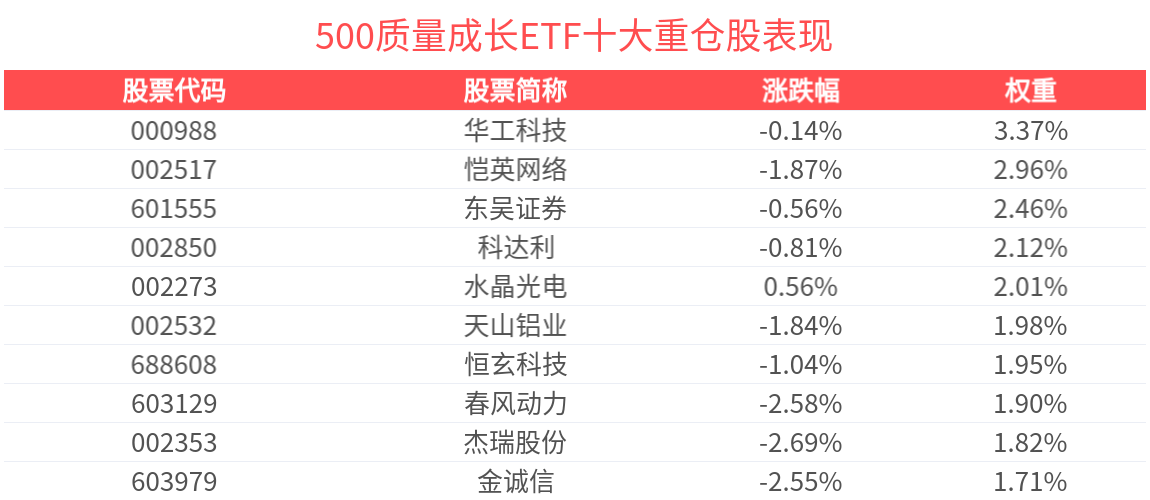
Group 1 - The core point of the news is that the CSI 500 Quality Growth Index has experienced a decline of 0.79% as of December 2, 2025, with Yifeng Pharmacy leading the gains among constituent stocks, while Shanghai Electric faced the largest losses [1] - The A-share market has shown increased volatility since November, with the Shanghai Composite Index, Shenzhen Component Index, and ChiNext Index declining by 1.67%, 2.95%, and 4.23% respectively during the month [1] - In terms of industry performance, sectors such as comprehensive, banking, and textile and apparel indices have shown positive growth, while previously high-performing sectors like computers, automobiles, and electronics have seen significant pullbacks [1] Group 2 - The CSI 500 Quality Growth ETF (560500) closely tracks the CSI 500 Quality Growth Index, selecting 100 companies with strong profitability, sustainable earnings, and robust cash flow from the CSI 500 Index [2] - As of November 28, 2025, the top ten weighted stocks in the CSI 500 Quality Growth Index include Huagong Technology, Kaiying Network, Dongwu Securities, and others, collectively accounting for 21.53% of the index [2] - The individual performance of the top ten stocks shows varied results, with Huagong Technology declining by 0.14% and Kaiying Network down by 1.87%, among others [3]

21评论丨供需两端改善 制造业内生修复动力增强
2 1 Shi Ji Jing Ji Bao Dao· 2025-12-01 22:40
Core Viewpoint - The November PMI data from the National Bureau of Statistics indicates a stabilization and recovery in the manufacturing sector, accumulation of momentum in the construction industry, and a short-term adjustment in the service sector, reflecting the resilience of the Chinese economy amid complex conditions and the effectiveness of previous growth stabilization policies [1] Group 1: Manufacturing Sector - The manufacturing PMI shows a slight recovery, with both the production index and new orders index rising, indicating positive signs of internal recovery [3] - High-tech manufacturing has remained in the expansion zone for ten consecutive months, and the recent improvement in high-energy-consuming industries is noteworthy [3] - The manufacturing production and business activity expectation index rose to 53.1%, indicating a high level of expansion and a gradual recovery in market confidence [3] - The PMI for small enterprises has seen a significant rebound, reaching a six-month high, reflecting the effectiveness of policies aimed at alleviating difficulties and supporting financing [3] Group 2: Demand Recovery - The recovery in demand is a key support for the improvement in PMI data, driven by positive changes in the external economic environment and the accumulation of domestic investment momentum [4] - Recent progress in China-U.S. trade negotiations has stabilized the external trade environment, leading to a notable increase in the new export orders index for November [4] - Domestic policies have shown positive signals for investment demand, with improvements in the construction business activity index and new orders index, particularly in infrastructure projects [4][5] Group 3: Price Indices and Profitability - Price indices have generally risen, indicating an optimization of supply-demand structure and a marginal improvement in the corporate profitability environment [5] - The increase in the purchasing price index and factory price index for manufacturing materials suggests a more balanced market supply-demand relationship [5] - The positive effects of capacity governance and structural optimization policies in key industries are beginning to alleviate excessive competition and pressure [5] Group 4: Structural Challenges - Despite positive signals, the PMI data reveals structural challenges and internal imbalances in the economic recovery process, with the service sector's business activity index falling below the critical point [6] - Sectors closely related to livelihood consumption, such as real estate and residential services, are experiencing weaker recovery in market demand [5] Group 5: Future Outlook - Future macro policies are expected to be more precise and coordinated, with continued support for manufacturing, especially small and high-tech enterprises [6] - Policies aimed at expanding domestic demand and promoting consumption are likely to intensify, focusing on integrating livelihood improvement with consumption promotion [6] - Fiscal spending is anticipated to shift further towards education, healthcare, and social security, enhancing residents' consumption capacity and willingness [6]
银河证券:年末风格轮动中关注防御性板块配置机会 同时聚焦明年景气方向的布局
Sou Hu Cai Jing· 2025-11-30 08:58
银河 证券表示,11月市场行情呈现出高低切换特征,资金从高估值成长股流向低估值周期股及红利资 产,防御板块吸引力上升。12月来看,市场仍处于风格频繁切换阶段,或以结构性行情为主。一方面, 作为年末最关键的政策窗口,重要政策会议在科技创新、扩内需、反内卷、稳地产等方面或将作出重点 部署。另一方面,一系列产业会议可能成为主题行情的重要 催化剂,关注即将召开的2025" 人工智能 +"产业生态大会、 脑机接口大会等。而外部环境依然存在不确定性,12月美联储议息会议表态对全球 市场流动性的潜在影响值得关注。 ...
1-10月工企利润数据点评:原材料价格仍是当前工业企业盈利能力的主要拖累
Bank of China Securities· 2025-11-27 07:58
Profit and Revenue Performance - From January to October, industrial enterprises achieved a total profit of CNY 59,502.9 billion, a year-on-year increase of 1.9%, with growth slowing by 1.3 percentage points compared to the previous three quarters[1] - In October alone, profits fell by 5.5% year-on-year, marking a significant decline of 27.1 percentage points from September[1] - Revenue for the same period grew by 1.8% year-on-year, with the revenue-to-asset ratio at CNY 74.5 per CNY 100 of assets, slightly down by CNY 0.2 from the previous quarter[1] Cost and Profitability Analysis - Industrial enterprises' operating costs increased by 2.0% year-on-year, with the growth rate narrowing by 0.6 percentage points compared to the previous three quarters[1] - The operating profit margin for industrial enterprises remained stable at 5.3% from January to October[1] - The Producer Price Index (PPI) and the PPI for production materials both showed negative growth, declining by 2.7% and 3.2% respectively, indicating continued pressure on profitability[2] Sector Contributions and Challenges - The mining sector's profit contribution to industrial enterprises was negative, with a year-on-year profit decline of 27.8%, impacting overall profit growth by 4.7 percentage points[10] - Real estate investment decreased by 14.7% year-on-year, further dragging down fixed asset investment growth by 3.0 percentage points, highlighting a significant demand shortfall[3] - The coal mining and washing industry had an import price index of 73.7 in October, indicating ongoing negative growth and contributing negatively to overall profit growth by 4.2 percentage points[24]
国家统计局:进一步扩内需、优结构、育新能 推动工业经济量质齐升、动能焕新
Di Yi Cai Jing· 2025-11-27 01:48
Group 1 - The core viewpoint emphasizes the need for industrial enterprises to adapt to a complex international environment and intertwined domestic structural contradictions while implementing policies to boost demand and optimize structure [1] - The focus is on promoting the quality and quantity of industrial economic growth and renewing momentum, which is essential for strengthening the foundation of the real economy [1]
专访交通银行杨立文:零售信贷业务的转型升级之道
21世纪经济报道· 2025-11-19 06:12
Core Viewpoint - The article emphasizes the importance of consumer spending as a key driver of economic growth, highlighting the proactive measures taken by the government and financial institutions like Bank of Communications to stimulate consumption through retail credit initiatives [4][5][6]. Group 1: Government Policies and Economic Context - The Chinese government has been actively promoting consumption and expanding domestic demand through various policies, including subsidies, tax incentives, and the issuance of consumption vouchers [5]. - Since 2014, consumption has consistently been one of the three main drivers of economic growth, with a projected retail sales total of 48.8 trillion yuan in 2024, reflecting a 3.5% increase from the previous year [4][5]. - The contribution rate of consumption to economic growth is expected to be 44.5%, underscoring its critical role in the national strategy for expanding domestic demand [4]. Group 2: Bank of Communications' Strategy - Bank of Communications is aligning its retail credit business with national strategies to enhance consumer spending and improve living standards, focusing on integrating supply and demand through institutional frameworks [6][11]. - The bank has launched the "Jiao Yin Hui Dai" personal loan brand, which combines consumer and business loans to meet diverse financial needs, emphasizing a one-stop service model [8][9]. - The bank's retail loan growth has outpaced the market, driven by a commitment to high-quality development and effective risk management [11][12]. Group 3: Digital Transformation and Innovation - The bank is leveraging digital technology to enhance its retail loan services, implementing an integrated credit approval process that simplifies customer interactions [13][14]. - Advanced technologies, including artificial intelligence, are being utilized to improve operational efficiency and risk management across the loan lifecycle [13][14]. - The bank aims to create a digital operating model that enhances customer experience and expands service coverage, particularly for new consumer segments [16][19]. Group 4: Risk Management and Talent Development - Bank of Communications is focusing on intelligent risk management, enhancing its fraud prevention systems and developing a dynamic monitoring and early warning system [20]. - The bank is committed to cultivating a workforce skilled in digital and data analysis to support its evolving business needs and improve frontline operational capabilities [19][20]. - The bank's risk management strategy includes a comprehensive collection and recovery system to maintain asset quality while expanding its loan portfolio [20].


华泰证券:关注情绪消费、国货崛起、AI+消费、银发经济等结构性机会
Xin Lang Cai Jing· 2025-11-18 00:13
Core Insights - The total retail sales in October increased by 2.9% year-on-year to 4.6 trillion yuan, slightly above the Wind consensus expectation of 2.7% [1] - The growth rate slowed down by 0.1 percentage points compared to September, primarily due to a deceleration in the sales of automobiles and home appliances [1] - Excluding automobiles, the retail sales of consumer goods grew by 4.0% [1] Group 1 - The holiday economic effect from the Mid-Autumn Festival and National Day, along with the early promotion period for "Double Eleven," contributed positively to sales [1] - Basic living goods showed a favorable sales trend, and the new high in gold prices boosted investment demand significantly [1] Group 2 - Looking ahead, the "14th Five-Year Plan" continues to emphasize expanding domestic demand and promoting consumption [1] - In the context of a moderate recovery in domestic demand, there may be a continued divergence in sales performance across different categories [1] - Structural opportunities are suggested to be focused on emotional consumption, the rise of domestic brands, AI+ consumption, and the silver economy [1]
10月宏观数据分析:10月经济数据继续走弱,核心通胀回升是亮点
Xi Nan Qi Huo· 2025-11-17 06:19
Report Industry Investment Rating No relevant content provided. Core Viewpoints of the Report - In October 2025, the macro - economic data continued to decline, and the recovery momentum needed to be strengthened. However, there were improvement signals in CPI and PPI, and the M1 growth rate remained high. The domestic economy's recovery was a long - term process, and the real estate market's transformation and adjustment also took time. The "Expand domestic demand, Anti - involution" policy would be an important long - term measure. The financial market was in a state of "weak reality, strong expectation", and the market sentiment was continuously improving. The macro - economy and asset prices in 2025 were expected to continue the upward repair trend [3][34]. Summary by Directory 1. Manufacturing PMI - In October, the manufacturing PMI was 49.0%, down 0.8 percentage points from the previous month, and the manufacturing prosperity declined. The PMI of large, medium, and small enterprises all decreased and were below the critical point. Among the 5 classification indexes, the supplier delivery time index was at the critical point, while the production, new orders, raw material inventory, and employment indexes were all below the critical point [4]. - The non - manufacturing business activity index in October was 50.1%, up 0.1 percentage points from the previous month, rising to the expansion range. The construction industry business activity index was 49.1%, down 0.2 percentage points, and the service industry business activity index was 50.2%, up 0.1 percentage points. The decline in manufacturing PMI indicated insufficient demand and weak economic recovery momentum [7]. 2. CPI and PPI - In October 2025, the national CPI rose 0.2% year - on - year and 0.2% month - on - month. Food prices decreased year - on - year, while non - food prices increased. Other than food and tobacco, six of the seven major categories of prices increased year - on - year, and one decreased [8][9]. - The national PPI decreased 2.1% year - on - year in October, with the decline narrowing by 0.2 percentage points, and turned from flat to a 0.1% increase month - on - month. The purchase price of industrial producers also showed similar trends. The "Anti - involution" policy had achieved some results, and the PPI was expected to turn positive in 2026 [11][12]. 3. Import and Export - In October 2025, China's exports decreased 1.1% year - on - year, imports increased 1.0% year - on - year, and the trade surplus was $900.7 billion. Exports to the US decreased, while exports to ASEAN increased. Despite the poor performance in October, exports were expected to remain strong in 2025, and the real risk for foreign trade was the potential decline in global demand [14][16]. 4. Credit and Money Supply - At the end of October 2025, the stock of social financing scale was 437.72 trillion yuan, a year - on - year increase of 8.5%. The increment of social financing scale in the first ten months was 30.9 trillion yuan, more than the same period last year. The overall credit in October was weak, indicating insufficient credit confidence and demand from residents and enterprises. Although the issuance of government bonds slowed down, the M1 growth rate remained high, and the macro - liquidity improved [18][22]. 5. Industrial Production, Consumption, and Investment - In October, the added value of large - scale industries increased 4.9% year - on - year and 0.17% month - on - month. The total retail sales of consumer goods increased 2.9% year - on - year. Consumption growth continued to decline, and the growth rates of automobile, catering, and real - estate - related consumption were weak. From January to October, the national fixed - asset investment (excluding rural households) decreased 1.7% year - on - year, and the growth rates of manufacturing, infrastructure, and real - estate development investment continued to decline [23][26]. 6. Real Estate Market - From January to October, the sales area and sales volume of new commercial housing decreased year - on - year, and the decline continued to expand in October. The new construction, construction, and completion of real estate were at a low level. The inventory of commercial housing decreased slightly. The real estate market was still in the adjustment stage, but it was expected to stop falling and stabilize in the first half of 2026 [27][33]. 7. Summary and Outlook - In general, the macro - economic performance in October was weak, but there were improvement signals in inflation indicators and M1. The "Expand domestic demand, Anti - involution" policy was crucial. The financial market was in a state of "weak reality, strong expectation", and the macro - economy and asset prices were expected to continue the upward repair trend in 2025. It was necessary to track policy implementation, observe price recovery, and wait for positive macro - economic signals [34][35].