新能源转型

Search documents
势如破竹确立新周期,行业景气将继续上行 | 投研报告
Sou Hu Cai Jing· 2025-11-28 02:04
Core Viewpoints - The report from China Galaxy highlights a positive outlook for cobalt prices due to the implementation of annual export quota management in the Democratic Republic of Congo (DRC), which dominates global cobalt supply [1][2] - The report anticipates a recovery in the non-ferrous metals industry starting in 2025, driven by macroeconomic improvements and supply chain disruptions, leading to a new upward cycle in metal prices and industry performance [1][2] - The gold market is expected to continue its bullish trend, supported by potential Federal Reserve rate cuts and increased global demand for gold as a safe-haven asset [1][2] Non-Ferrous Metals Industry - The industry is projected to stabilize in 2024, with a recovery in macroeconomic expectations following the Geneva Agreement between the US and China, leading to improved performance in 2025 [1][2] - The combination of US tariffs, China's countermeasures, and resource control policies from other countries will continue to disrupt supply chains, contributing to rising prices and profitability in the non-ferrous metals sector [1][2] Precious Metals - The report suggests that the gold bull market is likely to persist, driven by continued liquidity easing from the Federal Reserve and increasing purchases of gold by global central banks and private investors [1][2] - The acceleration of US debt growth and potential challenges to the Federal Reserve's independence may exacerbate credit issues, prompting a shift towards gold in asset allocation [1][2] Industrial Metals - The narrative surrounding copper supply remains positive, with ongoing production disruptions and limited new projects expected to maintain upward pressure on copper prices [2][3] - Demand for copper is expected to benefit from macroeconomic improvements and structural demand from sectors like renewable energy and data centers [2][3] Energy Metals - The DRC's new export quota management is anticipated to create upward price elasticity for cobalt, as global supply shortages become more apparent [2][3] - The demand for cobalt is expected to grow due to the high-end electric vehicle market and increased military and strategic reserve needs [2][3] Rare Metals - The strategic value of rare earth metals is increasing, with stable long-term demand and new applications emerging in robotics and low-altitude economies [3] - Domestic supply controls are expected to enhance the global monopoly position of China's rare earth industry, leading to improved profitability for rare earth enterprises [3] Investment Recommendations - The report recommends investing in companies such as Zhongjin Gold, Zijin Mining, Luoyang Molybdenum, Huayou Cobalt, and Northern Rare Earth, based on the anticipated upward trends in gold, copper, cobalt, and rare earth prices [3]
马斯克重返白宫,特朗普喊话50州,不能让中国在这一关键领域超车
Sou Hu Cai Jing· 2025-11-27 02:34
Core Insights - The U.S. faces three major pressures in the AI sector: power shortages, legislative confusion, and increasing global competition [1][3][5] Group 1: Energy and Infrastructure - By 2028, AI training is expected to consume around 5GW of power, equivalent to the simultaneous lighting of five million American homes [1] - Trump announced a plan to invest $92 billion to rebuild the U.S. energy and infrastructure system, emphasizing the need for sufficient power supply to maintain a competitive edge in technology [5] - Google plans to invest $25 billion in a new data center in Pennsylvania to address future energy demands [1] Group 2: Legislative Challenges - Over 260 AI-related bills have been proposed across the 50 states, with 22 already enacted, leading to a fragmented regulatory environment that complicates industry operations [1][3] - Trump advocates for a unified federal AI standard to prevent state-level regulations from stifling innovation, contrasting with China's more cohesive regulatory approach [3] Group 3: Key Players and Political Dynamics - Elon Musk is identified as a crucial figure for the success of Trump's AI initiatives, given his influence across multiple tech sectors [5][7] - The relationship between Trump and Musk is complex, with differing views on energy sources; Musk supports renewable energy while Trump favors fossil fuels [7][9] - Maintaining a non-hostile relationship with Musk is seen as essential for Trump, especially with upcoming elections and the need for political stability [9][11] Group 4: Future Implications - The dynamics between Trump and Musk will significantly impact the future trajectory of AI development in the U.S., with potential for collaboration or conflict based on their differing interests [12]



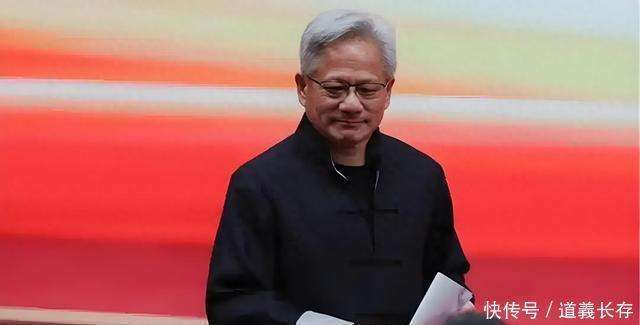
甘肃炭素龙头 入局杉杉集团重整
Mei Ri Jing Ji Xin Wen· 2025-11-26 14:59
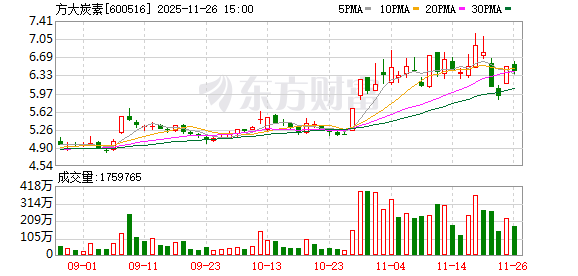
Core Viewpoint - The entry of Fangda Carbon into the restructuring of Shanshan Group presents new possibilities for the company, which is facing significant debt challenges amounting to 40 billion [2][3]. Group 1: Fangda Carbon's Involvement - Fangda Carbon announced its participation as an industrial synergy partner in the substantive merger restructuring of Shanshan Group and its wholly-owned subsidiary, Ningbo Pengze Trading Co., Ltd. [3][11]. - The company aims to strategically position itself in the lithium battery anode materials sector through this involvement [2][15]. - Following the announcement, Fangda Carbon's stock price surged to a closing price of 6.51 yuan, with a total market capitalization of 26.2 billion yuan [2]. Group 2: Shanshan Group's Assets - Shanshan Group and Ningbo Pengze collectively hold 526 million shares of Shanshan Co., accounting for 23.36% of its total share capital [6]. - The restructuring asset package includes 100% equity of Zhongjing Sihai Industrial Co., Ltd., which primarily holds a 3.64% stake in Huishang Bank and approximately 1.882 billion yuan in debt [7]. - Additional assets include a 50% partnership interest in Ningbo Xingtong Chuangfu Enterprise Management Partnership, real estate holdings, and accounts receivable valued at approximately 9.598 billion yuan [8][9]. Group 3: Financial Performance and Challenges - Fangda Carbon's revenue for 2024 is projected at 3.872 billion yuan, a year-on-year decline of 24.55%, with a net profit of only 186 million yuan, down 55.31% [16]. - The company has experienced a continuous decline in revenue and net profit for three consecutive years, with net profit declines exceeding 50% [16][21]. - The sales gross margin has decreased significantly, with the latest figure at 10.17%, down 19.02 percentage points from the previous year [18][19]. Group 4: Strategic Implications - The integration of Shanshan Co. is seen as a strategic opportunity for Fangda Carbon to achieve a dual-driven strategy of "carbon + new energy" [24]. - Shanshan Co. is recognized as a leading supplier of artificial graphite anode materials, with a strong growth trajectory in the lithium battery materials sector [22][23]. - Successful integration could significantly optimize Fangda Carbon's revenue structure, potentially contributing approximately 4.36 billion yuan to its revenue from Shanshan Co.'s operations [24][25].


西子洁能20251126
2025-11-26 14:15
Summary of XiZi Clean Energy Conference Call Company Overview - **Company**: XiZi Clean Energy - **Industry**: Clean Energy Equipment and Solutions Key Points Financial Performance - Revenue for the first three quarters of 2025 was 4.33 billion RMB, a slight decrease year-on-year due to delays in the Nigeria gas turbine project, impacting revenue by approximately 300 million RMB and gross profit by about 80 million RMB [3][3] - Net profit for the same period was 226 million RMB, with a non-recurring net profit of 180 million RMB, showing significant growth in non-recurring profit compared to the previous year [3][3] - Gross profit margin remained stable at around 19.33%, with a target to exceed 20% for the year [3][3] - Operating cash flow reached 348 million RMB, a year-on-year increase of 129% [4][4] Order Composition and Market Position - New orders totaled 4.054 billion RMB in the first three quarters, with significant contributions from: - Waste heat boilers: 1.2 billion RMB - Clean energy equipment: 1.426 billion RMB - Solutions: 1.94 billion RMB - Spare parts and services: 492 million RMB - Total backlog of orders reached 5.884 billion RMB, expected to exceed 6 billion RMB by year-end [2][5] - The company aims to capture 60-70% of the domestic market share in the gas-fired waste heat boiler sector [5][5] International Market Expansion - XiZi Clean Energy is actively expanding into overseas markets, particularly in Southeast Asia and countries along the Belt and Road Initiative, with overseas orders expected to reach approximately 1.4 billion RMB in 2024, accounting for 23-24% of total orders [2][6] - The company faced challenges during the pandemic but has seen a resurgence in overseas project opportunities since 2023 [6][6] North American Market Dynamics - The development of the North American computing power market has significantly increased equipment demand, with planned gas-fired power project capacity in the U.S. rising from 1.62 GW this year to 3 GW next year [8][8] - XiZi Clean Energy plans to collaborate with major companies like NE and GE, focusing on subcontracting due to increased tariffs from the U.S.-China trade war [9][9][10] - The company can cover 70-80% of the total cost of gas turbine waste heat boiler orders, with core pressure components making up 65-66% of total costs [11][11] Nuclear Power Business Development - Nuclear power has become a key growth area, with plans to achieve 300-500 million RMB in orders in 2026 through partnerships with major players like China National Nuclear Corporation and State Power Investment Corporation [15][16] - The company aims to enhance its supply chain capabilities and expand its market share in the nuclear sector, which has a market size of approximately 5 billion RMB [20][20] Energy Storage Initiatives - XiZi Clean Energy is focusing on molten salt energy storage applications, participating in multiple projects and planning to commercialize new storage technologies in 2026 [22][24] - The company has been involved in various molten salt storage projects since 2018, generating approximately 500 million RMB in new orders annually [22][22] Market Outlook and Strategy - The domestic market for new gas installations is expected to decline, with a cautious outlook for 2026, while overseas markets are projected to grow by over 20% [14][14] - The company is developing new KPIs for the upcoming year to clarify order guidance for 2026 [14][14] Competitive Landscape - In the domestic waste heat boiler market, key competitors include Huaguang Huaneng, Hailu Heavy Industry, and Huagi Energy [7][7] - Globally, Chinese manufacturers are gaining market share, with Chinese waste heat boiler products accounting for about 20% of the global market [7][7] Conclusion - XiZi Clean Energy is strategically positioned to leverage growth opportunities in both domestic and international markets, particularly in the clean energy and nuclear sectors, while navigating challenges posed by trade tariffs and market competition. The focus on innovative energy storage solutions and partnerships will be crucial for future growth.

福特陈晓波:以“场景造车”构筑“可城、可野、可玩”的差异化优势
Zhong Guo Qi Che Bao Wang· 2025-11-26 02:57
Core Insights - Ford China is launching a comprehensive transformation with a new global brand proposition and product lineup, including the debut of the Ford Mondeo and the Ford Mustang Mach-E at the Guangzhou International Auto Show [1][8] - The newly established Ford Sales and Service Company aims to integrate sales and service channels for a unified customer experience, reflecting Ford's commitment to a systematic reboot in the Chinese market [8][10] Product Strategy - The Ford Mustang Mach-E, as the first electric model in the Mustang family, is positioned as an all-terrain camping SUV, offering both pure electric and range-extended versions to meet diverse consumer needs [3][7] - The vehicle features unique configurations such as a one-button lift roof, a one-button bed function, and a 6.6kW external power supply, showcasing Ford's focus on understanding and addressing consumer demands [5][6] Consumer Engagement - Ford emphasizes the importance of differentiating its products by focusing on specific consumer needs rather than attempting to satisfy all market segments, aiming to provide a sense of reliability to customers [5][11] - The Mustang Mach-E offers a range of 650 km for the pure electric version and 1220 km for the range-extended version, enhancing its appeal for urban commuting and outdoor adventures [7] Technological Innovations - The vehicle includes an industry-first off-road navigation feature that provides real-time route adjustments and recommendations, enhancing the driving experience for outdoor enthusiasts [6] - The Mustang Mach-E is equipped with advanced off-road capabilities, including eight driving modes and a smart four-wheel drive system, ensuring performance across various terrains [6] Organizational Changes - The establishment of the Ford Sales and Service Company is part of a strategic upgrade, aiming to present a unified brand image and a complete product lineup to consumers in China [10][11] - The new company will streamline operations across sales, marketing, and after-sales services, enhancing overall efficiency and customer satisfaction [11]


从“技术导入”到“本土化创新” 东风本田欲融合股东优势重塑核心竞争力
Zhong Guo Jing Ying Bao· 2025-11-25 23:48
Core Viewpoint - The automotive market is experiencing a decline in fuel vehicle sales, but Dongfeng Honda aims to leverage its strengths in fuel and HEV vehicles while transitioning towards new energy vehicles [1][2]. Group 1: Company Strategy - Dongfeng Honda emphasizes the importance of maintaining its traditional fuel vehicle market while also pursuing new energy vehicle development, aiming for a dual approach [2][3]. - The company has a significant existing customer base in China, with over 8.6 million vehicles in operation, which supports its dealer network and after-sales revenue [2][4]. - Dongfeng Honda plans to enhance its product offerings by improving cost-effectiveness, configuration, and overall product strength in the face of increasing competition [3]. Group 2: Market Positioning - Despite the shrinking fuel vehicle market, Dongfeng Honda believes there are still substantial opportunities, as fuel vehicles could still represent around 30% of a 30 million annual sales market, equating to nearly 10 million units [2]. - The company aims to capitalize on its established reputation and customer loyalty, particularly in regions where fuel vehicles remain popular [2][4]. Group 3: Innovation and Development - Dongfeng Honda is focusing on local innovation by integrating the strengths of both Dongfeng and Honda, particularly in electric and intelligent vehicle technologies [5][6]. - The company is transitioning from a product-centered approach to a customer-centered one, actively seeking customer feedback to inform product development [5][6]. - Plans are in place to expand the local R&D team to enhance the development of electric and intelligent products tailored to Chinese market demands [6].
10月乘用车市场销量分析:新能源板块表现强势 转型步伐持续加速
Zhong Guo Zhi Liang Xin Wen Wang· 2025-11-25 08:05
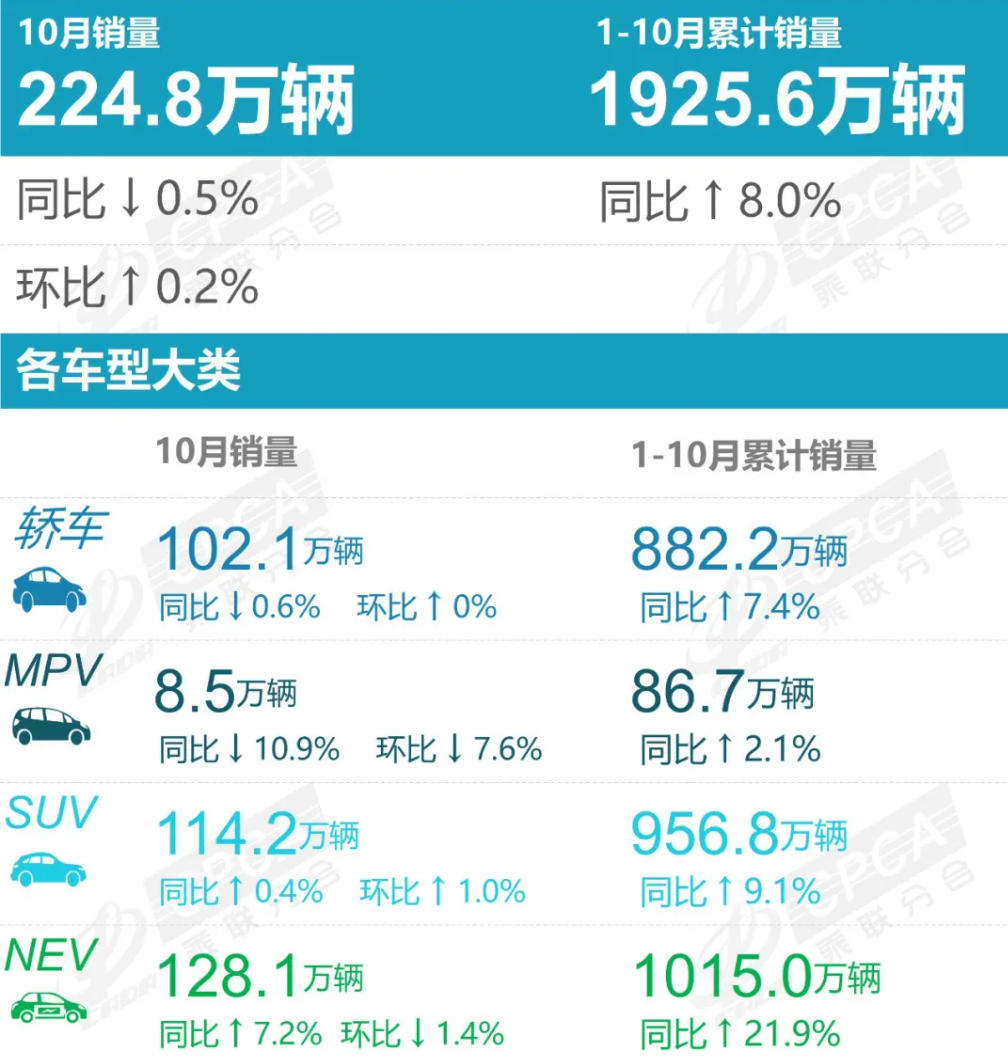
Core Insights - The domestic passenger car market experienced a retail sales volume of 2.248 million units in October 2025, reflecting a year-on-year decline of 0.5% but a month-on-month increase of 0.2% [1] - The market is undergoing a transformation, with strong performances from domestic brands and the new energy sector contrasting sharply with the pressures faced by joint venture brands [1][3] Market Performance - The SUV segment was the only category to achieve positive growth, with sales reaching 1.142 million units, up 0.4% year-on-year and 1.0% month-on-month [3] - New energy vehicle sales in October totaled 1.281 million units, showing a year-on-year increase of 7.2% despite a slight month-on-month decline of 1.4% [3] - The market share of domestic brands reached 68.7%, a year-on-year increase of 3 percentage points, with retail sales of 1.55 million units, up 4% year-on-year and 3% month-on-month [3][4] Brand Performance - Joint venture brands faced significant challenges, with retail sales of mainstream joint venture brands at 510,000 units, a year-on-year decline of 10% [4] - The luxury car market saw retail sales drop to 190,000 units, down 10% year-on-year and 23% month-on-month, with market share falling to 8.4% [4] - BYD led the sales ranking with 295,871 units sold, despite a year-on-year decline of 31.4%, marking the largest drop among the top ten manufacturers [5][4] Sales Rankings - Geely ranked second with 265,565 units sold, achieving a remarkable year-on-year increase of 36.8%, driven by the Geely Galaxy series [5][6] - Volkswagen ranked third with 136,002 units sold, but experienced a year-on-year decline of 3.9% [7] - Changan and Chery followed closely, with sales of 132,229 and 130,128 units respectively, both showing positive growth [7][6] New Energy Vehicle Market - BYD maintained its lead in the new energy vehicle market with a market share of 23.1%, despite a year-on-year decline of 31.4% [15] - Geely's new energy vehicle sales reached 164,256 units, with a year-on-year increase of 54.7%, narrowing the gap with BYD [15][17] - The new energy vehicle penetration rate surpassed 57%, indicating a deepening market acceptance [14][21] Future Outlook - The market is expected to see a release of consumer demand as tax incentives end, coupled with increased promotional efforts from manufacturers [21] - The ongoing trends of electrification and smart technology are anticipated to reshape the Chinese automotive market, with domestic and new energy brands likely to lead the next phase of industry transformation [21]


车展季·大咖说丨大通品牌全面焕新 宋海:未来将推四大车系22款新能源车型
Mei Ri Jing Ji Xin Wen· 2025-11-25 04:23
Core Viewpoint - SAIC Maxus is undergoing a significant brand renewal, focusing on a complete transition to new energy vehicles (NEVs) with plans to launch 22 new models across four vehicle series by 2025 [1][7] Group 1: Brand Renewal and Strategy - The brand renewal includes a new logo, vision, mission, values, and brand pillars, marking a milestone in SAIC Maxus's development [1] - The company aims to become the brand with the widest coverage of NEVs in the commercial vehicle sector [1] - SAIC Maxus has integrated its light commercial vehicle business under the OEM strategy, consolidating brands such as Maxus, Yuedong, and Iveco [3] Group 2: New Product Launches - At the 2025 Guangzhou Auto Show, SAIC Maxus unveiled the new "Zhonghui" logo and introduced the RoboVAN and RoboBUS, both part of its new energy light commercial vehicle series [4] - The RoboVAN is designed for 24/7 operation, capable of automatic order acceptance and optimal route planning, with plans for mass deployment next year [4] - Both models are built on the "Hongtu" super commercial electric architecture, which focuses on specialized technology solutions for commercial vehicles [4] Group 3: Strategic Partnerships - SAIC Maxus has entered a strategic partnership with CATL for autonomous battery swapping, integrating smart driving, fast charging, and battery swapping technologies [6] - CATL's battery swapping stations have been established at over 800 locations, supporting various commercial vehicle types [6] Group 4: Market Performance and Future Plans - The monthly order for the DANA product series has exceeded 3,000 units, with NEV sales accounting for 41% of SAIC Maxus's total sales [7] - The company plans to introduce a series of new energy vehicles, including light commercial vehicles, pickups, and MPVs, targeting global markets [7] - In October, SAIC Maxus reported sales of approximately 19,900 units, a year-on-year increase of 47.86%, with cumulative sales for the first ten months reaching 180,000 units, up 16.63% year-on-year [9]


威领股份筹划控制权变更,股票11月25日起停牌
Zhong Guo Ji Jin Bao· 2025-11-24 15:49
Core Viewpoint - Weiling Co., Ltd. is planning a change in control, leading to an emergency suspension of its stock starting November 25, 2025 [2][6]. Group 1: Control Change Announcement - Weiling Co., Ltd. announced that its controlling shareholder, Shanghai Lingyi New Materials Co., Ltd., and actual controller Huang Da are planning a significant matter that may lead to a change in the company's control [2][8]. - The stock will be suspended for no more than two trading days, with the resumption expected on November 27, 2025 [5][6]. - The company is in the early stages of planning and negotiation regarding the transfer of shares, which may result in the new shareholder becoming the largest shareholder of the company [8]. Group 2: Shareholding Changes - Shanghai Lingyi currently holds 31.52 million shares, accounting for 12.10% of the total share capital. After the planned transfer, its holding will drop below 5% [8]. - The shareholding of Shanghai Lingyi has been declining due to various factors, including dilution and active reduction, with a notable decrease from 23.93% to 17.54% between November 2022 and August 2024 [8][9]. Group 3: Financial Performance - Weiling Co., Ltd. has faced financial challenges, reporting losses in multiple years since 2021, with net losses of CNY 2.23 billion and CNY 3.08 billion for 2023 and 2024, respectively [10][13]. - In the first three quarters of 2025, the company achieved revenue of CNY 213 million, a year-on-year decrease of 53.88%, while the net loss was CNY 13.04 million, indicating a reduction in losses compared to previous periods [13]. - The company has attempted to diversify its operations by acquiring a 74.3% stake in Jiayu Mining for CNY 222 million, expanding into tungsten, tin, lead, and zinc mining [13].

一汽解放-中国一汽控股上市公司集体业绩说明会问答实录
Quan Jing Wang· 2025-11-24 07:45
Core Viewpoint - The company emphasizes its commitment to enhancing shareholder value and addressing stock price volatility through strategic initiatives in overseas market expansion and new energy vehicle transformation [2][3][6]. Group 1: Stock Price and Market Performance - The recent fluctuations in stock price are attributed to the cyclical nature of the industry and the company's ongoing transformation efforts, including a shift towards new energy vehicles and international market expansion [2][3]. - The company has established several overseas subsidiaries and acquired international assets to strengthen its global presence and product competitiveness [2][3]. - The company acknowledges the disparity between stock price and fundamental performance, attributing it to macroeconomic factors and market sentiment [6]. Group 2: Financial Performance and Shareholder Returns - Since its listing in 2020, the company has distributed approximately 6.29 billion yuan in dividends, demonstrating its commitment to returning value to shareholders [3]. - The company reported improved profitability in the third quarter, driven by increased sales volume and optimized product structure, alongside cost control measures [6]. Group 3: Business Strategy and Future Plans - The company is focused on enhancing its core business while also addressing underperforming segments, such as the bus division, by leveraging its strengths in commercial vehicle technology [4]. - The company has launched a comprehensive strategy for new energy vehicles, aiming to develop a full lifecycle solution for users and enhance its competitive edge in the market [6][10]. - The company is committed to reducing costs and improving efficiency across its entire value chain, with ongoing initiatives yielding positive results [7]. Group 4: Competitive Advantages - The company boasts a robust and complete R&D system, covering key components and technologies, which supports its competitive positioning in the market [10]. - The company has established a comprehensive marketing and service network, with nearly 1,000 dealers and over 1,800 service providers, ensuring efficient customer support [10]. - The company is actively pursuing international expansion, with plans to establish subsidiaries in multiple countries to support its global strategy [10].