
化工

Search documents
主动权益基金规模靠什么破百亿?
Guo Ji Jin Rong Bao· 2026-01-23 12:32
Core Insights - Growth stocks outperformed last year, leading to a significant increase in both performance and scale for several growth-oriented funds by the end of Q4 2025 [1][2] - The market trend has shifted from merely "star chasing" to focusing on "industry chain opportunities," with funds that strategically position themselves in high-growth sectors attracting substantial capital inflows [7] Fund Performance and Scale Growth - Several funds have transitioned from "mini funds" to larger scales, with notable examples including: - China Europe Cycle Selection increasing from 0.36 million to 15.75 million - Industrial Bank Quality Selection rising from 0.35 million to 17.91 million - Yongying Technology Selection reaching 154.68 million [1][2] - New funds entering the billion scale include: - Huatai PineBridge Xinxiang Tianli increasing from 62.65 million to 116.21 million - Huatai PineBridge Technology Innovation and Morgan Emerging Power also crossing the 100 million mark [2] Sector Focus and Investment Strategies - Funds that saw significant scale increases were heavily invested in high-demand sectors such as AI, commercial aerospace, and precious metals [1][4] - The investment strategies of these funds include: - Huatai PineBridge Xinxiang Tianli focusing on limited supply upstream resources and high-end manufacturing - Morgan Emerging Power maintaining positions in AI-related stocks while increasing exposure to lithium batteries and other sectors [4][5] - Funds like Yongying Technology Selection and Debon Xin Star Value continue to emphasize AI and related innovations, indicating a strong belief in the sector's growth potential [5][6] Market Dynamics and Fund Management - The surge in fund sizes is linked to the performance of their core holdings, creating a positive feedback loop where high sector demand drives fund inflows [8] - The shift in market dynamics reflects a growing preference for funds that can deliver stable returns and dividends, particularly in high-growth sectors [8] - Analysts suggest that the rapid increase in fund size may impact investment strategies, potentially leading to higher trading costs and challenges in maintaining flexibility [8]
策略周报:理性降温,景气度仍是避风港-20260118
HWABAO SECURITIES· 2026-01-18 14:33
Group 1 - The report emphasizes a rational cooling in the market, suggesting that the economic climate remains a safe haven for investors [1][3] - The bond market sentiment has improved due to recent central bank operations that injected liquidity, leading to a quick recovery in the 10-year government bond yield, which is expected to fluctuate around 1.85% [2][12] - The report highlights the importance of high coupon bond allocations, especially if government bond supply pressures ease in late January, presenting a potential mid-term buying opportunity [12][13] Group 2 - The stock market is experiencing a shift back to rationality, with regulatory measures aimed at preventing overheating risks, leading to adjustments in major indices like the CSI 300 [3][10] - The report suggests that after the market returns to rationality, it will benefit a slow bull market and attract funds back to high-growth sectors such as AI hardware, robotics, semiconductors, new energy, non-ferrous metals, and chemicals [3][13] - Short-term market indices may still be in a cooling phase, and it is recommended to wait for reduced selling pressure before making new investments [12][13] Group 3 - The report notes that the overseas markets are likely to continue a strong but volatile trend, although geopolitical risks in the Middle East have increased uncertainty [13] - Recent adjustments in financing margin ratios by the China Securities Regulatory Commission aim to lower leverage levels and protect investor rights, which may contribute to long-term market stability [9][10] - The report indicates that the A-share market has seen a significant increase in trading volume, with daily average turnover rising to 34,651 billion, marking a historical high [20]
博道基金张建胜:追求成长但不为高溢价“买单”
Zhong Guo Zheng Quan Bao· 2026-01-13 22:53
Core Viewpoint - The current market equates "investing in technology" with "buying AI," with popular sectors like optical modules seen as entry points into the AI trend. However, fund manager Zhang Jiansheng from Bodao Fund adopts a unique investment style that focuses on early-stage opportunities rather than chasing hot stocks, achieving significant returns through a diversified approach [1][2]. Investment Strategy - Zhang's investment framework emphasizes a "bottom-up, moderately diversified, and balanced growth" approach, with a strong focus on valuation and drawdown control. His cautious risk preference stems from his early career experiences during market volatility [2][3]. - He employs a "left-side trading" strategy, setting target market value ranges for companies and gradually selling once stock prices enter these pre-set areas, avoiding high premium purchases [2][3]. Market Insights - Zhang believes that leading companies with high market attention require deep industry knowledge to generate excess returns. He prefers to identify "left-side" targets with lower market attention and reasonable valuations, which helps manage downside risks [3][4]. - His portfolio is diversified across high-end manufacturing, TMT, and consumer sectors, with no single industry exceeding 25% of holdings, resulting in better drawdown control compared to other growth-style fund managers [3][4]. Portfolio Construction - Zhang's focus on valuation allows him to uncover opportunities in less popular market segments, such as his early 2024 positioning in the Hong Kong stock market and the innovative drug sector in 2025, where he aimed to capitalize on valuation recovery [4][5]. - He combines valuation assessments with industry trend analysis, as seen in his 2025 investments in semiconductor storage, where he identified low valuations alongside positive industry signals [5][6]. Future Market Outlook - Zhang maintains an optimistic view on the A-share market, supported by a significant decrease in risk premiums, ongoing regulatory support, and signs of corporate earnings recovery [6][7]. - He plans to focus on three main areas in 2026: AI applications, resource sectors benefiting from "re-industrialization" and "re-globalization," and valuation recovery opportunities in traditional industries like chemicals and consumer goods [6][7][8].
博道基金张建胜: 追求成长但不为高溢价“买单”
Zhong Guo Zheng Quan Bao· 2026-01-13 22:29
Core Viewpoint - The current market equates "investing in technology" with "buying AI," with many investors viewing optical modules as a ticket to the AI market. However, some fund managers, like Zhang Jiansheng from Baodao Fund, adopt a different approach by focusing on growth without chasing extreme hot stocks, achieving significant returns through early-stage investments in various sectors [1][2]. Investment Strategy - Zhang Jiansheng's investment framework emphasizes a "bottom-up, moderately diversified, and balanced growth" approach, with a strong focus on valuation and drawdown control. His cautious risk preference stems from early career experiences during market volatility [2]. - His investment style features distinct left-side trading characteristics, where he sets target market values for companies and gradually sells once stock prices reach predetermined levels, avoiding high premium purchases [2][3]. Market Insights - Zhang believes that leading companies with high market attention and expectations require deep industry knowledge to generate excess returns. He prefers to identify "left-side" targets with lower market attention and reasonable valuations, which helps manage downside risks [3][4]. - His portfolio construction strategy involves limiting single industry holdings to no more than 25%, maintaining a balanced allocation across high-end manufacturing, TMT, and consumer sectors, which aids in drawdown control [3][4]. Valuation Focus - Zhang's emphasis on valuation allows him to uncover opportunities in less popular market segments, such as his early 2024 positioning in the Hong Kong stock market and the 2025 focus on the innovative drug sector, where he aims to profit from valuation recovery [4][5]. - He recognizes that low valuations do not guarantee stock price increases; thus, identifying marginal changes in industry dynamics is crucial. His investment in semiconductor storage reflects a dual assessment of valuation and industry trends [5][6]. 2026 Market Outlook - Zhang maintains an optimistic view of the A-share market, supported by three key factors: a significant decrease in risk premiums, ongoing regulatory support for capital markets, and signs of corporate earnings recovery [6][7]. - In terms of investment focus for 2026, he highlights three areas: AI, particularly in storage and connectivity, resources and high-end manufacturing benefiting from "re-industrialization" and "re-globalization," and valuation recovery opportunities in traditional industries like chemicals and consumer sectors [6][7].
利好,多只,恢复大额申购
3 6 Ke· 2026-01-09 03:12
Core Viewpoint - The A-share market has rebounded to 4,000 points at the beginning of 2026, prompting several actively managed equity funds to reopen for large subscriptions, indicating a positive outlook for the market [1][2]. Fund Activity - Multiple fund companies, including Huaxia, China Europe, and Xinda Australia, have resumed large subscriptions for their actively managed equity funds, with notable performance among these funds [1][2]. - Huaxia Fund announced the removal of subscription limits for its Huaxia Large Cap Select Mixed Fund, which focuses on sectors like artificial intelligence and semiconductors, achieving a 19.19% annualized return, ranking first in its category [2]. - Xinda Australia Fund has also reopened large subscriptions for its Xinao Medical Health Mixed Fund, which has a one-year return of 69.09%, placing it in the top 10% of its category [2]. - New funds such as Guotai Haitong Zhaoyang Mixed Fund and Zhongyin Hong Kong Stock Connect Consumer Selected Mixed Fund have also opened for regular subscriptions shortly after their establishment [3]. Market Outlook - Analysts express optimism for the A-share market in 2026, driven by dual support from domestic and international liquidity, with a focus on sectors benefiting from rising commodity prices and emerging industries like AI [4][5]. - The market is expected to enter a phase of overall improvement and structural deepening, with global liquidity conditions and trends in AI as key drivers [4][5].
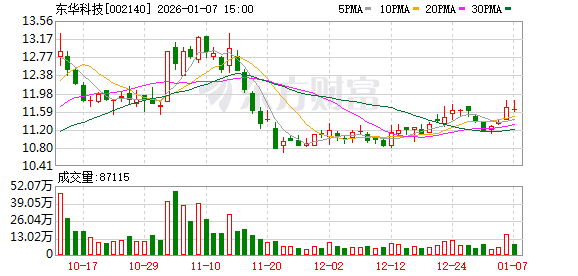
东华科技:公司核心技术相对集中在化工、环保等领域
Zheng Quan Ri Bao· 2026-01-07 11:17
Core Viewpoint - Donghua Technology is a comprehensive engineering company specializing in various fields including chemical, petrochemical, new materials, renewable energy, ecological environment, infrastructure, and biomedicine, providing a full range of services from R&D to project management [2] Company Overview - Donghua Technology holds top-level qualifications in engineering design and environmental engineering, with over 400 provincial and national awards for technological progress and quality engineering [2] - The company possesses more than 260 patents and proprietary technologies, including award-winning inventions such as a system and method for continuous production of battery-grade lithium carbonate and a process for converting coke oven gas into ethylene glycol synthesis gas [2] - Currently, the company is not involved in nuclear fusion business [2]


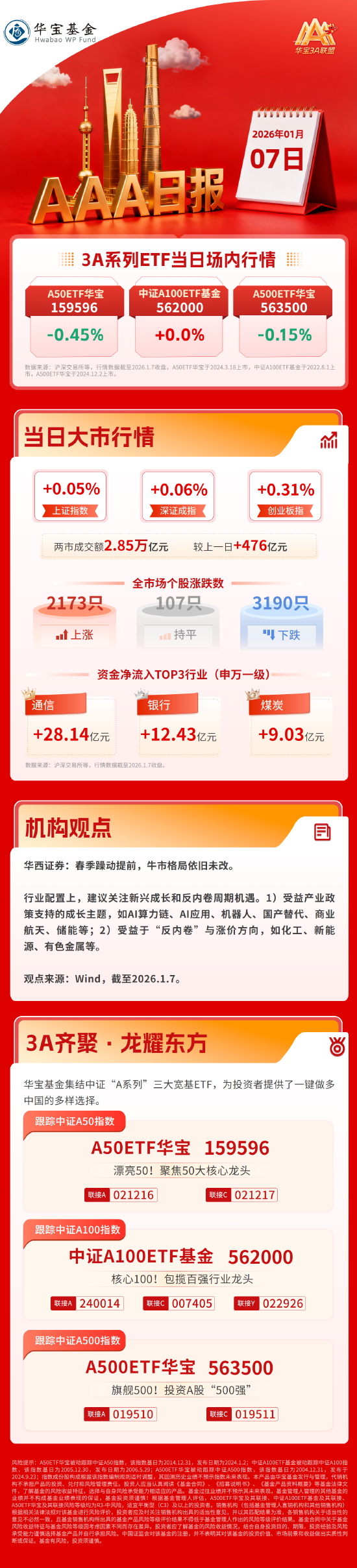
沪指14连阳!两市场成交额再超2.8万亿元 | 华宝3A日报(2026.1.7)
Xin Lang Cai Jing· 2026-01-07 09:30
Group 1 - The market showed a slight increase with the total trading volume reaching 2.85 trillion yuan, an increase of 476 billion yuan compared to the previous day [6][2] - The number of stocks that rose, remained flat, and fell in the market was 3190, 107, and 2173 respectively [6][2] - The top three sectors with net capital inflow were banking (+28.14 billion yuan), coal (+12.43 billion yuan), and telecommunications (+9.03 billion yuan) [6][2] Group 2 - Huaxi Securities suggests that the spring market rally has started early, maintaining a bullish outlook [2][6] - The report emphasizes focusing on emerging growth sectors and opportunities related to the "anti-involution" trend, including AI computing power chains, AI applications, robotics, domestic substitution, commercial aerospace, and energy storage [2][6] - The report also highlights sectors benefiting from price increases, such as chemicals, new energy, and non-ferrous metals [2][6] Group 3 - Huabao Fund has launched three major broad-based ETFs tracking the China A50, A100, and A500 indices, providing investors with diverse options for investing in China [2][6] - The A50 ETF focuses on the top 50 core leading companies, while the A100 ETF encompasses the top 100 industry leaders [2][6]
策略周报:跨年波动或有上升,不改高景气主线-20260104
HWABAO SECURITIES· 2026-01-04 13:16
Group 1 - The report indicates that post-New Year, the bond market sentiment is expected to ease, but a neutral approach is recommended due to low likelihood of interest rate cuts in the short term, suggesting a maintenance of a neutral duration strategy [2][12] - In the stock market, increased volatility is anticipated due to institutional rebalancing at year-end, but the focus on high prosperity sectors remains unchanged, with a positive outlook for the spring market in January-February [3][12] - Investment opportunities are highlighted in sectors with upward trends, specifically AI, semiconductors, new energy, non-ferrous metals, chemicals, and the ChiNext board, with a recommendation to patiently await the upcoming spring market [3][12] Group 2 - The report reviews significant events, including the announcement of a 625 billion yuan special bond to support consumer upgrades and the exemption of VAT on housing sold after two years of ownership, which may stimulate economic activity [9] - The report notes that the official manufacturing PMI for December rose to 50.1, indicating a return to expansion, with both production and demand showing significant recovery [9] - The bond market is described as experiencing weak fluctuations, with long-term bonds underperforming due to concerns over fiscal stimulus and stronger-than-expected PMI data [10]
超3800股上涨 商业航天、芯片概念爆发
2 1 Shi Ji Jing Ji Bao Dao· 2025-12-24 04:52
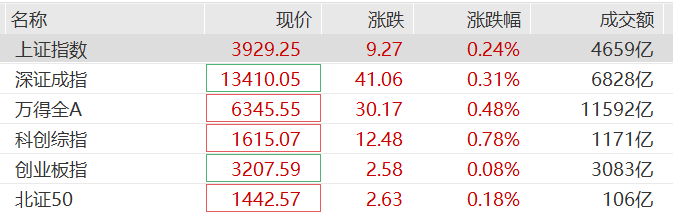
12月24日,A股市场早盘窄幅震荡,三大指数集体翻红。截至午盘,沪指涨0.24%,深成指涨0.31%,创 业板指涨0.08%。沪深两市半日成交额1.16万亿,较上个交易日缩量895亿。全市场超3800只个股上涨。 | 名称 | 现价 | 涨跌 | 涨跌幅 | 成交额 | | --- | --- | --- | --- | --- | | 上证指数 | 3929.25 | 9.27 | 0.24% | 4659亿 | | 深证成指 | 13410.05 | 41.06 | 0.31% | 6828亿 | | 万得全A | 6345.55 | 30.17 | 0.48% | 11592亿 | | 科创综指 | 1615.07 | 12.48 | 0.78% | 1171亿 | | 创业板指 | 3207.59 | 2.58 | 0.08% | 3083亿 | | 北证50 | 1442.57 | 2.63 | 0.18% | 106亿 | 从板块来看,商业航天概念持续走强,近20只成分股涨停,其中超捷股份20cm涨停,神剑股份5连板, 九鼎新材、合众思壮、再升科技涨停。消息面上,据证监会网上办事服务平台披露,近日 ...
宏观固收周报:A股高位震荡,债市窄幅波动-20251223
Shanghai Securities· 2025-12-23 13:17
Group 1: Industry Investment Rating - No information about the industry investment rating is provided in the report. Group 2: Core View - The A-share market is in a high-level oscillation, and the bond market has narrow fluctuations. The A-share market may continue to oscillate at a high level in the future. It is recommended to pay attention to investment opportunities in directions such as satellites, chemicals, new energy, photovoltaics, chips, computing power, and artificial intelligence. The bond market may continue to have narrow fluctuations, and the 10-year Treasury bond yield above 1.80% has allocation value. The gold price is expected to maintain a strong oscillation trend [3][12]. Group 3: Summary of Market Performance Stock Market - U.S. stock indices showed mixed performance, with the Nasdaq up 0.48%, the S&P 500 up 0.10%, and the Dow Jones Industrial Average down -0.67%. The Nasdaq China Technology Index fell -1.96%. The Hang Seng Index dropped -1.10% [3]. - Most A-share sectors declined, with the Wind All A Index down -0.15%. Among them, the CSI A100, CSI 300, and CSI 1000 decreased by -0.82%, -0.28%, and -0.56% respectively, while the CSI 2000 and Wind Micro-cap stocks increased by 0.30% and 3.12% respectively. In terms of sector style, Shanghai blue-chips rose while growth stocks fell, and Shenzhen blue-chips and growth stocks both declined. The North Exchange 50 Index decreased by -0.13%. In terms of industry performance, 20 out of 30 CITIC industries rose, with the leading sectors being commerce and retail and catering and tourism, with a weekly increase of more than 4.0%. ETFs related to tourism, satellites, aerospace, and chemicals also performed well, with a weekly increase of over 4.0% [4][5]. Bond Market - China's Treasury bond yields declined slightly. The 10-year Treasury bond futures contract rose 0.15% compared to December 12, 2025. The yield of the 10-year active Treasury bond decreased by 0.88 BP to 1.8308%. Yields of all maturity varieties decreased [6]. - U.S. Treasury bond yields mostly declined, and the yield curve became flatter. As of December 19, 2025, the 10-year U.S. Treasury bond yield decreased by -3 BP to 4.16%. Only the 6-month maturity yield increased, while the rest decreased [8][9]. Currency Market - The U.S. dollar strengthened, and the RMB appreciated against the U.S. dollar. The U.S. dollar index rose 0.32%. The U.S. dollar against the euro, pound, and yen changed by 0.25%, -0.07%, and 1.16% respectively. The U.S. dollar against the offshore and onshore RMB exchange rates decreased by 0.28% and 0.20% respectively [10]. Commodity Market - Gold and silver prices generally rose. London gold spot prices fell 0.22% to $4337.60 per ounce, while COMEX gold futures prices rose 1.19% to $4354.00 per ounce. Domestic gold prices rose, with Shanghai gold spot up 1.17% to 975.51 yuan per gram and futures up 1.10% to 977.88 yuan per gram. London silver spot prices rose 1.98% to $65.79 per ounce; COMEX silver futures prices rose 9.39% to $66.79 per ounce. Domestic silver prices showed term differentiation, with Shanghai silver spot up 3.08% to 15359 yuan per kilogram and futures down 4.40% to 14811 yuan per kilogram [11]. Group 4: Other Market Conditions - Capital prices showed mixed trends. As of December 19, 2025, R007 rose 0.73 BP to 1.5148%, and DR007 decreased 2.78 BP to 1.4413%, with the spread between the two widening. The central bank's open market operations had a net injection of 190 billion yuan [7].