多元配置

Search documents
假期访谈了十多位基民,发现这些新变化
天天基金网· 2025-10-06 05:12
Core Viewpoint - The public fund industry in China has reached a total scale of 36.25 trillion yuan, marking a significant increase and reflecting the growing demand for wealth management among investors [3][5][6]. Group 1: Market Overview - As of August 2025, the total net asset value of public funds in China has increased by 1.17 trillion yuan, a growth rate of 3.34% compared to the end of July [5]. - This is the 11th time since 2024 that the total scale of public funds has reached a historical high, and the fifth time this year [5][6]. - The number of public fund investors has exceeded 800 million, highlighting the industry's role in supporting the real economy and promoting financial stability [5][6]. Group 2: Investor Behavior Changes - Interviews with investors reveal a shift towards increased allocation in equity funds, preference for passive index products, and a focus on technology-themed funds [3][6]. - Investors are diversifying their portfolios, with many holding multiple types of funds, including money market funds, mixed funds, and passive index funds [9]. - There is a growing rationality in investment timing, with investors employing strategies like cost averaging and flexible trading, moving away from reliance on specific investment slogans or star investors [9][10]. Group 3: Investment Strategies - Investors are increasingly adopting a multi-faceted approach to fund selection, with some holding as many as 11 different funds [7][9]. - The trend of "from stocks to funds" is evident, as investors transition from direct stock investments to diversified fund portfolios, including broad-based and thematic ETFs [10].


假期访谈了十多位基民,发现这些新变化
Zhong Guo Zheng Quan Bao· 2025-10-05 12:15
Core Insights - The total scale of public funds in China reached 36.25 trillion yuan by the end of August 2025, marking the fifth historical high this year and the first time surpassing the 36 trillion yuan threshold [1][3][4] Fund Industry Overview - As of August 2025, there are 164 public fund management institutions in China, including 149 fund management companies and 15 asset management institutions with public qualifications [3] - The net asset value of public funds increased by 1.17 trillion yuan from the end of July, representing a growth rate of 3.34% [3] Investor Behavior Changes - Interviews with over ten investors during the National Day and Mid-Autumn Festival revealed a shift towards increased allocation in equity funds, preference for passive index products, and a focus on technology-themed funds [1][4] - The number of public fund investors has exceeded 800 million, highlighting the industry's role in serving the real economy and promoting financial stability [3] Investment Strategies - Investors are adopting a diversified investment approach, with many holding multiple types of funds, including money market funds, mixed funds, and passive index funds [6] - There is a trend towards more rational investment timing, with investors employing strategies like cost averaging and flexible trading, moving away from reliance on specific investment "celebrities" [6][7] Profile of Investors - The interviewed investors are primarily aged between 30 and 40, with diverse professional backgrounds and educational levels, all holding various fund positions [4] - Some investors have significant holdings, with amounts ranging from under 10,000 yuan to approximately 500,000 yuan [4]
百姓理财观变了!从“唯存款”到“新三金”
Zhong Guo Zheng Quan Bao· 2025-10-03 09:23
Group 1 - The core viewpoint of the articles highlights a significant shift in Chinese residents' investment behavior from traditional savings to diversified financial products, driven by changing wealth management perspectives and declining deposit interest rates [1][3][4] Group 2 - As of June 2025, the scale of the bank wealth management market reached 30.67 trillion yuan, marking a 2.38% increase from the beginning of the year and a 7.53% year-on-year growth [2] - The number of investors holding wealth management products reached 136 million by June 2025, reflecting an 8.37% increase since the start of the year [2] - Public fund assets reached a record high of 36.25 trillion yuan by the end of August 2025, marking the fifth consecutive record-breaking milestone this year [2] - The private fund sector also saw growth, with 137,922 funds in existence and a total scale of 20.73 trillion yuan as of August 2025 [2] Group 3 - The trend of "deposit migration" is ongoing, with non-bank institutions seeing an increase of 1.18 trillion yuan in deposits in August, indicating a continued shift of funds towards higher-yielding wealth management products [3] - The decline in deposit interest rates is providing long-term growth momentum for the wealth management market and the fund industry, as investors seek better returns [3] - The recent bullish trend in the A-share market, supported by policy measures and improved liquidity, has further enhanced the attractiveness of asset allocation in China [4] - Younger generations are increasingly adopting new investment concepts, focusing on "new three golds" (money market funds, short-term bond funds, and gold funds), reflecting a departure from traditional investment strategies [4]

汇丰全球投资展望|降息周期重启 多元配置应对多变环境
Sou Hu Cai Jing· 2025-09-22 09:48
Group 1: Federal Reserve Actions - The Federal Reserve announced a 25 basis point cut in the federal funds rate target range to 4.00%-4.25%, marking the first rate cut in nine months, aligning with market expectations [1] - HSBC anticipates two additional 25 basis point cuts in December and March, potentially lowering the target range to 3.50%-3.75% by the end of next year [1] - There is an increasing risk of multiple rate cuts if labor market data shows further weakness [1] Group 2: Investment Strategy - Emphasis on diversified asset allocation across asset classes, industries, and regions to enhance portfolio resilience in a changing environment [3] - The opportunity cost of holding cash assets may rise as the Fed's actions lower cash rates and bond yields, prompting a focus on high-quality bonds [4] - Preference for UK government bonds and investment-grade bonds in euros and pounds to hedge against downside risks, while maintaining a neutral view on US Treasuries [4] Group 3: Regional Market Outlook - The strategy maintains a diversified regional approach, favoring US, Asian, and UAE markets, with a positive outlook for Asian markets excluding China [5] - Singapore's defensive advantages and attractive dividends have made it stand out in Asia, while the UAE is seen as a market with structural growth potential [6] - The US market benefits from AI and economic growth, with second-quarter earnings exceeding expectations due to favorable conditions [6] Group 4: Sector Opportunities - The rapid application and commercialization of AI globally are enhancing productivity and creating new revenue streams, benefiting sectors like software, cloud services, and infrastructure [7] - The industrial sector is becoming a strategic focus due to ongoing trends in re-industrialization and the demand for digital infrastructure [7] - The financial sector is also showing growth potential, with banks being less affected by tariffs, making them an attractive investment opportunity [7]
达里奥:我76岁了,说一说我的理财法则 | 大家谈
高毅资产管理· 2025-09-12 07:03
Group 1 - The core viewpoint emphasizes that cash is a poor long-term investment, and investors should diversify their portfolios beyond real estate and cash deposits [2][5] - A balanced and diversified investment portfolio can mitigate significant market volatility, as different asset classes perform differently under varying market conditions [4][6] - Investors should avoid trying to time the market, as it is essentially a zero-sum game, and instead focus on maintaining a well-diversified portfolio [4][8] Group 2 - The discussion highlights the importance of understanding that asset returns consist of price changes and interest, and caution is advised when returns are primarily driven by price appreciation rather than interest [6][7] - It is suggested that investors should not solely focus on individual components of their portfolio but rather consider how these components work together to create a well-diversified investment strategy [4][8] - The concept of risk balancing is introduced, where combining non-correlated assets can significantly reduce overall portfolio risk while maintaining expected returns [9][10] Group 3 - The importance of rebalancing investment portfolios is emphasized, as it helps to maintain strategic asset allocation and avoid emotional decision-making [24][26] - The article discusses the role of gold as a non-yielding asset, suggesting it should be viewed as a form of currency that can effectively diversify risk [13][15] - The potential structural decline of the US dollar is addressed, linking it to the excessive growth of debt and the implications for monetary policy [16][18] Group 4 - The article mentions the limitations of stablecoins as a wealth storage tool, emphasizing their role in transactions rather than as an investment asset [17][19] - The discussion includes the importance of teaching financial literacy and the value of saving, particularly through the practice of gifting gold coins to younger generations [21][22] - The necessity of having a solid financial foundation before taking on higher investment risks is highlighted, advocating for a disciplined approach to investing [22][23]

中泰资管天团 | 唐军:资产配置需建立稳定分析框架,重视多元配置丰富回报流
中泰证券资管· 2025-09-11 11:33
Core Viewpoint - The article emphasizes the importance of a stable analytical framework and diversified asset allocation to avoid the pitfalls of chasing trends in investment, highlighting that there is no optimal solution in asset allocation [1][4]. Group 1: Asset Allocation Strategies - The performance of FOF funds has been strong this year, attributed to effective diversified allocation strategies [6]. - The manager, Tang Jun, adjusts the allocation between A-shares and Hong Kong stocks based on market conditions, demonstrating a responsive approach to market changes [1][6]. - Tang Jun actively participates in sectors like innovative pharmaceuticals and military ETFs, capitalizing on structural opportunities in a complex market environment [1][8]. Group 2: Professional Background and Insights - Tang Jun's career spans quantitative investment, fund evaluation, and macro research, providing a solid foundation for his current asset allocation work [3][4]. - His experience in quantitative research has enhanced his ability to identify various market factors, which is crucial for effective asset allocation [3][4]. - The "Zhongtai Clock" research incorporates policy analysis to better fit the domestic market, addressing the limitations of the previously used Merrill Lynch Clock [4]. Group 3: Dynamic Adjustment and Market Trends - Tang Jun believes that while macro trends provide guidance for asset allocation, the timing of price reflections can be uncertain, necessitating continuous monitoring and dynamic adjustments [6][8]. - The current allocation shows a shift towards A-shares over Hong Kong stocks, indicating a responsive strategy to market conditions [6][8]. Group 4: Avoiding Common Investment Mistakes - The article discusses the common mistake of "chasing trends," where investors buy high and sell low, and suggests establishing a stable analytical framework to counter this behavior [10][11]. - Diversification is recommended to enhance the return stream and provide confidence in maintaining the analytical framework during market fluctuations [11]. - Understanding "expectation differences" is crucial to avoid chasing trends, as short-term asset performance is often driven by the gap between fundamentals and market expectations [12].

超十家公募出手!FOF新品种扩容
Zheng Quan Shi Bao Wang· 2025-09-07 02:13
Core Insights - The ETF-FOF market is experiencing significant expansion after a three-year hiatus, with 12 institutions filing for 17 ETF-FOF products as of September 5, 2025, indicating a renewed interest in this investment vehicle [1][3][5] - The growth of ETF-FOF is attributed to a recovering market and the overall ETF scale surpassing 5 trillion yuan, which has prompted fund companies to enhance their asset allocation capabilities [1][5][6] Group 1: Market Dynamics - As of September 5, 2025, there are 17 ETF-FOF products filed by 12 institutions, with 16 expected to be launched within the year [3][5] - The ETF-FOF products are designed to allocate over 80% of their non-cash underlying assets to ETFs, marking a shift from traditional FOFs that primarily focused on actively managed funds [2][5] - The total number of domestic ETF products has exceeded 1,200, with a total scale of over 5 trillion yuan, providing a diverse range of low-cost and high-efficiency underlying assets for FOFs [5][6] Group 2: Product Development - Notable ETF-FOF products include the Xingzheng Global Yingfeng Multi-Asset Allocation Three-Month Holding and the Ping An Yingxuan 90-Day Holding, both of which have raised over 500 million yuan [2][3] - The first batch of ETF-FOF products was initiated in 2021, with early adopters like Huaxia and ICBC Credit Suisse leading the way [4][5] Group 3: Managerial Challenges - The rise of ETF-FOF necessitates enhanced asset allocation skills from fund managers, as the increasing complexity and variety of ETFs require a more sophisticated approach to investment [7][8] - Fund managers must possess strong macroeconomic analysis capabilities, market insight, and flexible adjustment skills to optimize the risk-return profile of their portfolios [7][8] - The potential for product homogeneity as the number of ETF-FOF products increases highlights the need for strategic innovation and differentiation in the competitive landscape [8]
险资LP“跑步”进入股权投资市场,上半年出资规模同比增46%
Sou Hu Cai Jing· 2025-09-05 01:18
Core Viewpoint - The establishment of Tianjin Jiayu Equity Investment Fund and Suzhou Kuanyu Equity Investment Fund has attracted market attention, with significant participation from insurance capital, indicating a trend of increased investment in the primary market by insurance funds since 2025 [1] Group 1: Investment Trends - Insurance capital's subscribed investment amount in equity investment reached 52.4 billion yuan in the first half of 2025, representing a year-on-year increase of 46% [1] - The general partners (GPs) in this round of insurance capital cooperation include not only state-owned enterprises but also several leading dollar funds and market-oriented venture capital institutions [1] Group 2: Market Dynamics - The acceleration of insurance capital entering the primary market is driven by policy relaxation and the pursuit of diversified allocation paths due to declining interest rates [1] - The continuous entry of long-term funds like insurance capital is expected to transform previously anticipated long-term capital in the primary market into actual investments, injecting more vitality into the market [1]
沪指10年新高!现在要卖吗?
天天基金网· 2025-08-22 11:17
Core Viewpoint - The market sentiment has shifted positively, with the Shanghai Composite Index reaching a 10-year high of 3,746 points in August, leading to discussions about a potential bull market [3]. Group 1: Market Performance - The Shanghai Composite Index was relatively stable in June but surged in July and August, breaking through significant resistance levels [3]. - The current market valuation, measured by rolling price-to-earnings (P/E) ratios, indicates that major indices like the CSI 300 and Hang Seng Index are at historical mid-levels, while the ChiNext Index is at a historical low [9]. Group 2: Investor Behavior - Experiments show that investors tend to exhibit risk-averse behavior when holding profitable stocks, often selling to secure gains, while showing risk-seeking behavior with losing stocks, hoping for recovery [6][8]. - The tendency to sell winning stocks while holding onto losing ones is likened to "pulling out flowers while watering weeds," highlighting a common behavioral bias among investors [14]. Group 3: Long-term Investment Strategy - Historical data indicates that despite the Shanghai Composite Index declining by 38% over 18 years, nearly 30% of stocks listed since 2007 have been profitable, with 185 stocks yielding over 50% returns [15]. - The importance of diversified investment strategies is emphasized, suggesting that spreading investments across various asset classes can mitigate risks and enhance resilience [15][16].

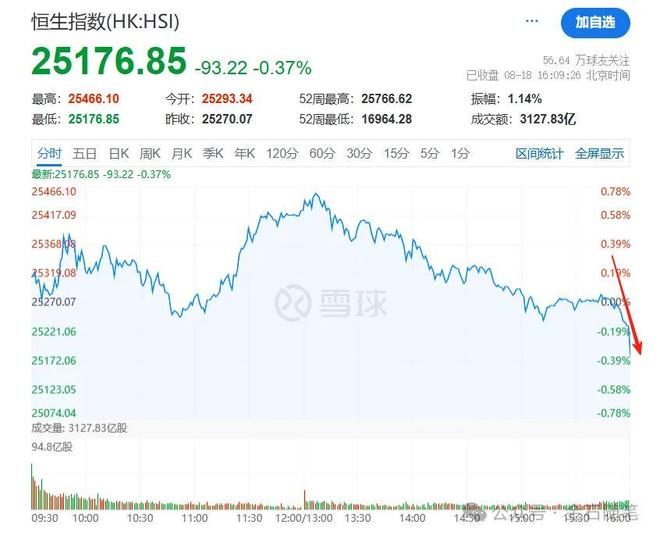
港股跳水,有股民心慌!西部策略:尚未过热,刘煜辉:港股还会创新高
Xin Lang Cai Jing· 2025-08-18 16:43
Core Viewpoint - The A-share market is experiencing significant gains, while the Hong Kong stock market is facing downward pressure due to capital inflow to A-shares and recent adjustments in the US stock market [1][3]. Group 1: Market Performance - A-shares reached a 10-year high with a trading volume of 2.8 trillion yuan, marking the third-highest in history, and the total market capitalization has reached 107 trillion yuan [8]. - The Hang Seng Index's earnings have been continuously revised downwards, with a projected growth rate of -1.2% for 2025, contrasting with the upward revisions in the US stock market [7]. Group 2: Investor Sentiment - There is a growing bullish sentiment among investors regarding A-shares, with predictions of breaking the 4000-point mark before the National Day holiday [7][11]. - Notable economists express differing views on asset valuations, indicating that while some sectors have room for growth, others may be nearing their peak [11]. Group 3: Liquidity and Market Dynamics - The tightening of Hong Kong dollar liquidity has led to a sharp rise in overnight Hibor rates, which may impact local real estate markets [5]. - The low AH premium at 125% is seen as an "invisible bottom," suggesting that below this level, dividend attractiveness diminishes [5].