
流动性驱动

Search documents
总量月报第2期:A股后续资金面怎么看?-20250905
Western Securities· 2025-09-05 11:03
Market Performance - In August, the Shanghai Composite Index rose by 7.97%, while the ChiNext Index increased by 24.13%[1] - Despite a weakening macroeconomic backdrop in July, liquidity and risk premiums were the primary drivers of the recent market rally[2] Liquidity and Economic Outlook - Liquidity is identified as the main driver of the recent market uptrend, with expectations for continued liquidity-driven performance in the stock market[3] - Since 2020, residents have accumulated 24 trillion yuan in excess savings, which could flow into the stock market if market conditions remain favorable[4] Domestic Policy Developments - The "anti-involution" policy continues to be implemented, with a focus on improving livelihoods and consumption policies[5] - Recent policies aim to expand consumer demand while ensuring high-quality economic development, with a strong emphasis on fiscal investment in human capital[6] Overseas Policy Impact - The U.S. "America First" investment policy is accelerating geopolitical fragmentation and localization, affecting global investment flows[7] - Trade fragmentation is encouraging companies to adjust supply chains, benefiting strategic and emerging technology sectors in allied countries[8] Fixed Income Market Dynamics - The current trend of deposit migration is linked to declining deposit rates and rising stock markets, which may slow down as equity market volatility increases[9] - The yield spread between 10-year government bonds and policy rates has returned to a "normal" range, potentially reducing the selling pressure on bonds[10] Investment Strategy - September is characterized as a "bullish option" period for A-shares, with limited downside risks and potential for significant upward movement driven by new capital inflows[11] - The correlation between A-share performance and the renminbi exchange rate is strong, with expectations for continued support from foreign capital allocation[12]
上交所调改科创50指数编制方案,寒武纪再度下挫
Nan Fang Du Shi Bao· 2025-09-04 09:06
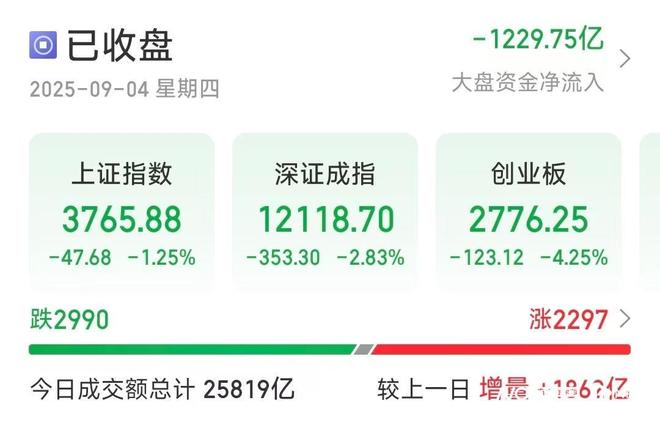
Group 1 - The Shanghai Stock Exchange and China Securities Index announced adjustments to the STAR 50 index samples, limiting individual sample weights to no more than 10%, impacting stocks like Cambricon which currently has a weight exceeding 15% [1][3] - As of September 4, the Shanghai Composite Index closed at 3765.88, down 1.25%, while the Shenzhen Component Index and the ChiNext Index fell by 2.83% and 4.25% respectively, indicating a broad market decline with nearly 3000 stocks dropping [1][3] - The adjustment to the STAR 50 index is set to take effect after the market closes on September 12, with the top five sample weights combined not exceeding 40%, which may lead to significant selling pressure on stocks like Cambricon [3] Group 2 - The consumer sectors such as dairy, retail, beauty, and tourism saw gains, with stocks like Lingnan Holdings and Guofang Group hitting the daily limit up, contrasting with the decline of Cambricon [3] - Financial analysts predict that the market may enter a phase of consolidation after rapid rotations, but the medium-term positive trend remains intact, driven by liquidity [3][4] - Current market liquidity is relatively abundant, with expectations of a potential interest rate cut by the Federal Reserve in September, which could improve the global liquidity environment and benefit the A-share market, particularly large-cap growth stocks [4]


银河证券:9月A股市场有望在流动性驱动下延续结构性行情
Zheng Quan Shi Bao Wang· 2025-09-04 00:25
Core Viewpoint - The A-share market is expected to continue a structural trend driven by liquidity, with a focus on fundamental clues and policy expectations [1] Group 1: Market Outlook - The current market liquidity is relatively abundant, with ongoing "residential deposit migration" [1] - The expectation of a Federal Reserve interest rate cut in September is high, which, if realized, will help improve the global liquidity environment [1] Group 2: Investment Opportunities - With the completion of the 2025 mid-year report disclosures, there are structural allocation opportunities based on performance clues [1] - Sectors showing high prosperity or improving performance should be prioritized for investment [1]

招商策略:短期震荡不改成长风格主线,大盘股更优
Sou Hu Cai Jing· 2025-09-03 14:32
Core Viewpoint - The current liquidity-driven environment remains the primary characteristic of the short-term stock market, with changes in market risk appetite dominating market rhythm [1] Group 1: Market Conditions - As September approaches, the Federal Reserve's interest rate cuts are expected to materialize, leading to a relatively high level of financing fund enthusiasm, although future inflows may slow down slightly [1] - With the potential for the Federal Reserve to restart interest rate cuts, the appreciation of the RMB, and the stabilization of domestic PPI, foreign capital may gradually shift towards inflows [1] Group 2: Historical Insights - Historical experience indicates that during the correction phase of a bull market, previously strong styles may experience larger pullbacks, but after a brief correction, the market quickly returns to the previous strong main style [1] Group 3: Market Style Outlook - Based on the analysis, it is believed that the market style in September may lean towards large-cap stocks, with growth styles expected to continue to outperform [1]
如何看待后市宏观叙事的变化?
Western Securities· 2025-09-03 12:01
Group 1: Market Trends - The A-share market has recently experienced an upward trend despite weak economic data, driven by liquidity and risk premium factors[1] - The M1-M2 growth rate differential has widened, indicating that liquid funds are flowing into financial markets[1] - The expectation of a Federal Reserve interest rate cut and the stabilization of the RMB are key macroeconomic narratives influencing market dynamics[1] Group 2: Fund Inflows - Public and private fund participation in the current market rally is higher compared to previous trends, with the margin trading balance exceeding 2 trillion yuan[2] - Equity fund issuance has rebounded, with 1.7 trillion yuan issued from June to August, a nearly 300% increase year-on-year[2] - The net inflow into ETFs has been modest, with a notable shift towards Hong Kong stocks[2] Group 3: Market Sentiment - The A-share sentiment index reached 77.6 as of August 28, up 10.6 percentage points from August 22, indicating a recovery in market sentiment but not yet at extreme levels[3] - Structural overheating is observed in certain sectors, particularly TMT, suggesting potential opportunities for style rebalancing[3] Group 4: Economic Indicators - July economic data showed a decline in retail sales growth to 3.7%, with fixed asset investment and industrial output growth also slowing[1] - The decline in household deposits by 1.1 trillion yuan in July, alongside a 2.14 trillion yuan increase in non-bank deposits, suggests a significant shift of funds into financial markets[1] Group 5: Risks - Risks include potential economic downturns, the possibility of the Fed not cutting rates, and the slow pace of household deposit migration[3] - Overheating speculative sentiment in the market could lead to regulatory risks[3]
瑞银:10月底或为A股行情分水岭,可关注两大投资主线
2 1 Shi Ji Jing Ji Bao Dao· 2025-09-03 01:48
Group 1 - The core viewpoint is that there is no need for excessive concern about the overheating risks in the technology sector in the short term, and there is optimism for growth stocks in the future [1][2] - The A-share market has experienced a strong rebound since July, primarily driven by liquidity, with average daily trading volume exceeding 2 trillion yuan in August [1][2] - The upcoming Politburo meeting at the end of October is expected to be a pivotal moment for the A-share market, with liquidity likely to continue driving growth until then [1][2] Group 2 - Investors are advised to focus on policy signals related to consumption, industry de-involution, and real estate from the Politburo meeting [2] - The Hong Kong stock market is currently in a correction phase, with the Hang Seng Index and Hang Seng Tech Index showing modest gains of 1.23% and 4.06% respectively in August [2] - A-share market has greater upside potential in the short term, especially if more retail investors enter the market [2] Group 3 - The technology and growth stock sectors are experiencing significant volatility and differentiation, making stock selection crucial for investors [3] - Investors should pay attention to the industry position of companies, particularly focusing on leading firms with strong scale effects in the technology sector [3] - Comparing potential leading companies in China with established leaders in the U.S. can help identify promising investment opportunities [3]
中央汇金,大举增持
Zheng Quan Shi Bao· 2025-09-01 00:36
Group 1 - Central Huijin Investment and its subsidiaries held stock ETFs worth 1.28 trillion yuan as of June 30, 2025, an increase of nearly 23% compared to the end of last year [1][2] - The number of stock ETFs held by Central Huijin increased to 1.58 times compared to the end of last year, with multiple broad-based ETFs receiving over 1 billion shares in increases [1][2] Group 2 - In the first half of 2025, the total revenue of listed companies in the market reached 35.01 trillion yuan, a year-on-year increase of 0.16% [2] - The net profit for the first half of 2025 was 3.00 trillion yuan, reflecting a year-on-year growth of 2.54%, with an increase of 4.76 percentage points compared to the previous year's total [2] Group 3 - BYD reported a net profit of 15.51 billion yuan for the first half of the year, representing a year-on-year growth of 13.79% [8] - Huawei's revenue for the first half of the year reached 427 billion yuan, a year-on-year increase of 3.94%, while net profit decreased by 32% to 37.1 billion yuan [9] - Tianqi Lithium Industries announced a net profit of 84.41 million yuan for the first half of the year, marking a return to profitability [10]
中央汇金,大举增持!
Sou Hu Cai Jing· 2025-09-01 00:31
Group 1 - Central Huijin Investment and its subsidiaries hold a total of 1.28 trillion yuan in stock ETFs as of June 30, 2025, representing an increase of nearly 23% compared to the end of last year [2][4] - The number of stock ETFs held by Central Huijin has increased to 1.58 times that of the end of last year, with multiple broad-based ETFs receiving over 1 billion shares in additional purchases [2][4] Group 2 - In the first half of 2025, the total operating revenue of listed companies in the market reached 35.01 trillion yuan, a year-on-year increase of 0.16% [4] - The net profit for the first half of the year was 3.00 trillion yuan, reflecting a year-on-year growth of 2.54%, with an increase of 4.76 percentage points compared to the previous year's overall growth rate [4] Group 3 - BYD reported a net profit of 15.51 billion yuan for the first half of the year, marking a year-on-year increase of 13.79% [9] - Huawei announced a revenue of 427 billion yuan for the first half of the year, a year-on-year growth of 3.94%, while net profit decreased by 32% to 37.1 billion yuan [10] - Tianshan Lithium Industry reported a net profit of 84.41 million yuan for the first half of the year, achieving a turnaround from losses [10]






中央汇金,大举增持!
证券时报· 2025-09-01 00:22
Core Viewpoint - The article highlights significant developments in the investment landscape, particularly focusing on the actions of central financial institutions and key companies in various sectors, including semiconductor, electric vehicles, and financial markets. Group 1: Central Financial Institutions - As of the end of June, the Central Huijin Investment Co. and its subsidiaries held stock ETFs worth 1.28 trillion yuan, an increase of nearly 23% compared to the end of last year [2][3] - The number of stock ETFs held by Central Huijin at the end of June is 1.58 times that of the end of last year, with several broad-based ETFs receiving over 10 billion shares in increases [3] Group 2: Semiconductor Industry - On August 30, the Ministry of Commerce spokesperson commented on the U.S. revoking the "validated end-user" authorization for three semiconductor companies in China, stating that this action would negatively impact the global semiconductor supply chain [5] Group 3: Company Earnings and Announcements - In the first half of 2025, the total revenue of listed companies reached 35.01 trillion yuan, a year-on-year increase of 0.16%, with a second-quarter revenue of 18.11 trillion yuan, up 0.43% year-on-year and 7.15% quarter-on-quarter [5] - Net profit for the first half of the year was 3.00 trillion yuan, reflecting a year-on-year growth of 2.54%, with an acceleration of 4.76 percentage points compared to the previous year's full-year growth [5] - BYD reported a net profit of 15.51 billion yuan for the first half of the year, a year-on-year increase of 13.79% [12] - Huawei announced a revenue of 427 billion yuan for the first half of the year, a year-on-year increase of 3.94%, while net profit decreased by 32% to 37.1 billion yuan [13] - Guizhou Moutai's controlling shareholder plans to increase its stake in the company by 3 to 3.3 billion yuan [11] Group 4: Regulatory and Market Developments - The new national standard for electric bicycles will be implemented, allowing a maximum weight of 55 kg for lithium battery models and increasing the weight limit for lead-acid battery models from 55 kg to 63 kg [5] - WeChat's "Coral Security" announced measures against accounts providing illegal stock recommendation services, indicating a crackdown on misleading financial information [6]




看好资金面与基本面双重驱动百亿级私募仓位重回八成以上
Shang Hai Zheng Quan Bao· 2025-08-24 15:36
Group 1 - The core viewpoint is that the market is experiencing a trend-driven upward phase, supported by both liquidity and fundamental factors, with a focus on companies representing economic transformation [4] - As of August 15, the stock private equity position index reached 74.86%, marking a continuous increase over two weeks, with 54.8% of private equity firms fully invested [2] - Billion-level private equity firms have shown significant buying activity, with their position index rising to 82.29%, the highest weekly increase this year, and 61.97% of these firms are fully invested [3] Group 2 - The optimistic market outlook is driving billion-level private equity firms to increase their positions, with expectations of a recovery in corporate performance and a stable domestic demand [4] - Two trends are expected to support the sustainability of market trends: a low-interest-rate environment encouraging risk appetite and a shift in household balance sheets towards equity investments [5][6] - Key sectors for private equity investment include technology, innovative pharmaceuticals, and new consumption, with a focus on companies benefiting from the "anti-involution" policy [7][8]