
货币政策宽松预期

Search documents
宝城期货国债期货早报(2025年11月19日)-20251119
Bao Cheng Qi Huo· 2025-11-19 01:16
Group 1: Report Industry Investment Rating - Not provided Group 2: Core Viewpoints of the Report - The short - term view of TL2512 is to oscillate, the medium - term view is to oscillate, and the intraday view is weak, with an overall view of oscillatory consolidation due to a decline in short - term interest rate cut expectations and the existence of long - term easing expectations [1]. - For financial futures in the bond index sector including TL, T, TF, and TS, the intraday view is weak, the medium - term view is to oscillate, and the reference view is oscillatory consolidation. The short - term trend is mainly oscillatory consolidation as the upward and downward momentum of Treasury bond futures is limited [5]. Group 3: Summary by Related Catalogs Variety Viewpoint Reference - Financial Futures Index Sector - For TL2512, the short - term is oscillatory, the medium - term is oscillatory, the intraday is weak, and the view is oscillatory consolidation. The core logic is that short - term interest rate cut expectations decline while long - term easing expectations still exist [1]. Main Variety Price Market Driving Logic - Financial Futures Index Sector - The varieties include TL, T, TF, and TS. The intraday view is weak, the medium - term view is oscillatory, and the reference view is oscillatory consolidation. Treasury bond futures oscillated and rebounded slightly in the previous two days this week due to factors like loose liquidity, reduced policy increments, stock market corrections, and geopolitical risk aversion. However, the upward and downward momentum is limited. Economic data shows insufficient domestic demand, so a long - term loose monetary environment is needed, but there is little need for policy intensification this year and a low possibility of short - term policy interest rate cuts [5].
债市做多情绪还在持续吗?:债券研究周报-20251110
Guohai Securities· 2025-11-10 11:31
Report Summary 1. Report Industry Investment Rating No industry investment rating information is provided in the report. 2. Core View of the Report From November 4th to November 10th, the bond market seller sentiment declined slightly, the buyer sentiment turned negative, the divergence of seller views decreased, the bond market lacked a main driving force, and the sentiment was cautious [4]. 3. Summary by Relevant Catalog 3.1 Seller Market Sentiment - **Seller Market Interest - Rate Bond Sentiment Index**: From November 4th to November 10th, the unweighted sentiment index was 0.48, a decrease of 0.06 compared to October 28th - November 3rd. Most institutions held a bullish view, with 15 bullish, 10 neutral, and 2 bearish. 56% of institutions were bullish, believing in monetary policy easing and a decline in investor risk - appetite; 37% were neutral, seeing a tug - of - war between factors and range - bound bond yields; 7% were bearish, citing economic improvement and stock market pressure on bonds [5][12]. - **Buyer Market Interest - Rate Bond Sentiment Index**: From November 4th to November 10th, the unweighted sentiment index was - 0.04, lower than the previous period. Institutions were neutral - bearish overall, with 3 bullish, 20 neutral, and 4 bearish. 11% of institutions were bullish, based on weak economic data expectations and reasonable bond value; 74% were neutral, concerned about policy uncertainties; 15% were bearish, due to expected economic improvement and supply pressure [6][13].
国债周报:债期延续修复行情-20251103
Guo Mao Qi Huo· 2025-11-03 06:37
1. Report Industry Investment Rating No relevant content provided. 2. Core Viewpoints of the Report - In the short - term, supported by risk - aversion sentiment, loose capital, and policy expectations, Treasury bond futures are expected to continue their strength, but attention should be paid to the subsequent progress of China - US game and the possible fluctuations caused by the release of important domestic economic data [8] - In the long - term, due to insufficient effective demand, deflation is likely to continue, and the fundamentals are still favorable for bond futures. With the synergy of monetary and fiscal policies and the low - interest - rate environment, the logic of a bond bull market is expected to continue [8] 3. Summary by Relevant Catalogs 3.1 Main Viewpoints - This week, the Treasury bond futures market showed an obvious repair, with relatively balanced increases in various maturity varieties. In the first half of the week, the repair of 3 - 7y Treasury bonds was more significant; in the second half, the repair of ultra - long - term yields was more prominent [4] - The Fed cut interest rates by 25 basis points as expected this week but released a cautious signal, leading to a significant cooling of the market's expectation of an interest - rate cut at the end of the year [4] - The China - US summit in Busan, South Korea reached a series of important consensuses in the economic and trade field, which was interpreted by the market as "good news exhausted", bringing a window period for bond repair and stock market adjustment [4] 3.2 Liquidity Tracking The report presents multiple charts related to liquidity, including open - market operations (volume and price), medium - term lending facilities (volume and price), capital prices (deposit - type pledged repurchase, SHIBOR, etc.), and the relationship between various interest rates and yields such as LPR, deposit reserve ratio, Treasury bond yields, and US Treasury bond yields [10][12][18] 3.3 Treasury Bond Futures Arbitrage Indicator Tracking - The report shows the basis, net basis, implied repo rate (IRR), and implied interest rate of Treasury bond futures for different maturities (2 - year, 5 - year, 10 - year, and 30 - year) [44][52][59][65]
宝城期货国债期货早报-20251022
Bao Cheng Qi Huo· 2025-10-22 01:22
Report Summary 1. Investment Rating - No investment rating for the industry is provided in the report. 2. Core View - The short - term view on TL2512 is that it will be in a state of shock, the medium - term view is also shock, and the intraday view is shock - biased upward. The overall view is shock. The core logic is that the short - term expectation of interest rate cuts has decreased, while the long - term expectation of monetary easing still exists [1]. - For TL, T, TF, and TS, the intraday view is shock - biased upward, the medium - term view is shock, and the overall reference view is shock. The core logic is that yesterday's Treasury bond futures were in shock consolidation. Macro data in September such as inflation and finance were still weak, and the lack of effective domestic demand persists. A loose monetary environment is needed to stabilize demand, so the long - term policy easing expectation provides strong support for Treasury bond futures. However, the short - term necessity for a comprehensive interest rate cut is not strong, and the short - term expectation of interest rate cuts is difficult to be fulfilled, so the upward momentum of Treasury bond futures is limited. In general, Treasury bond futures will maintain a bottom - shock consolidation in the short term [5]. 3. Summary by Relevant Content 3.1品种观点参考—金融期货股指板块 - For TL2512, short - term: shock; medium - term: shock; intraday: shock - biased upward; overall view: shock. Core logic: short - term interest rate cut expectation decreases, long - term easing expectation exists [1]. 3.2主要品种价格行情驱动逻辑—金融期货股指板块 - For TL, T, TF, and TS, intraday view: shock - biased upward; medium - term view: shock; overall reference view: shock. Core logic: yesterday's Treasury bond futures were in shock consolidation. September macro data showed weakness, and there is a lack of effective domestic demand. A loose monetary policy is needed in the long - term, providing support for Treasury bond futures. But the short - term necessity for an interest rate cut is not strong, and the short - term upward momentum is limited. Short - term Treasury bond futures will be in bottom - shock consolidation [5].
债市反弹的逻辑
SINOLINK SECURITIES· 2025-10-19 12:33
Group 1 - The bond market has recently shown signs of a mild rebound, driven by improved market sentiment due to trade tensions and a cooling equity market [2][7] - The rebound is attributed to three main factors: sufficient emotional clearance, stable funding conditions, and a return of easing expectations [5][18] - The "bond market micro trading thermometer" indicated a low reading of below the 30% percentile on October 10, suggesting that negative market sentiment has been largely priced in [3][10] Group 2 - Funding rates have remained stable, providing a "anchor point" for the bond market, which has historically limited the extent of bond yield increases during stable funding periods [4][11] - The cumulative increase in the 10-year government bond yield from July to September was at a historically high level during stable funding conditions, indicating a potential constraint on further increases [11][12] - Recent trade tensions have led to a mild recovery in expectations for monetary policy easing, as reflected in the decline of the one-year FR007 swap spread from +7bp to -3bp [5][18] Group 3 - The report anticipates a downward potential of around 10bp for the 10-year government bond yield, with a lower limit potentially testing 1.70% [5][18] - Despite the rebound, inflation lag and the trend of social financing rebound remain, indicating that the bond market opportunities should be approached with a rebound mindset [5][18] - The market's emotional structure is conducive to technical recovery, as the recent changes in sentiment and funding conditions create a favorable environment for bond market performance [3][4][10]
年内涨幅超30%!白银飙至14年新高!现在上车还来得及吗?
Sou Hu Cai Jing· 2025-09-30 02:12
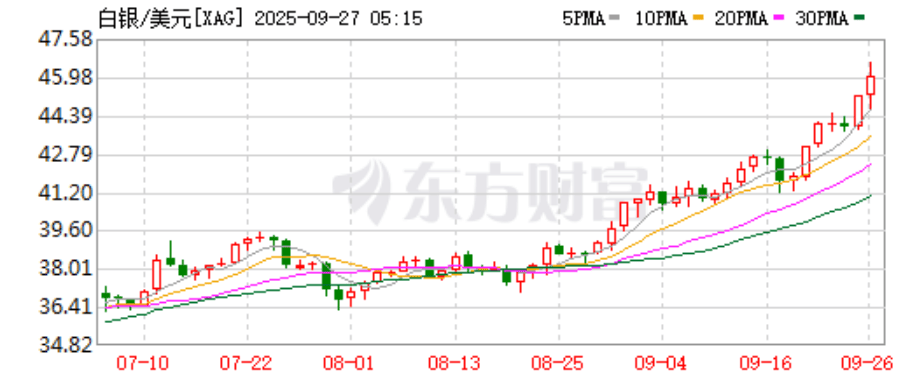
Core Viewpoint - The recent surge in silver prices, reaching a 14-year high, is primarily driven by expectations of continued interest rate cuts by the Federal Reserve, alongside strong industrial demand and a supply-demand imbalance in the silver market [3][5][7]. Group 1: Silver Price Performance - On September 26, international silver prices surpassed $46 per ounce, marking a 14-year high since 2010 [3]. - In 2024, the average silver price is projected to be $28.27 per ounce, compared to $23.35 per ounce in 2023 [3]. - Over the past six months, spot silver has seen a cumulative increase of over 30%, with a year-to-date rise of 59%, outperforming most commodities and gold, which rose by 43% [3][5]. Group 2: Economic Indicators and Federal Reserve Policy - Recent economic indicators show that U.S. non-farm payrolls increased by only 22,000 in August, significantly below the expected 75,000, with the unemployment rate rising to 4.3%, the highest in nearly four years [5]. - The non-farm employment data has been revised down by 911,000 over the past year, averaging a monthly shortfall of 76,000 jobs [5]. - These labor market weaknesses provide a strong basis for the Federal Reserve to consider further interest rate cuts, with expectations of a total reduction of 75 basis points this year and one cut next year [5][6]. Group 3: Supply and Demand Dynamics - Industrial demand for silver remains robust, driven by sectors such as photovoltaics, electric vehicles, and semiconductors, leading to a supply-demand gap [7]. - Global silver supply is expected to grow by 2% to 1.0306 billion ounces in 2025, while total demand is projected to decrease by 1% to 1.1483 billion ounces, resulting in a supply shortfall of 117.6 million ounces [7]. - The low inventory environment and persistent supply-demand imbalance amplify price volatility, with speculative inflows and fundamental support contributing to silver's stronger price resilience compared to gold [7]. Group 4: Future Outlook - The ongoing transition to green energy and the global digitalization process, combined with accommodative monetary policy expectations and geopolitical uncertainties, are likely to continue supporting silver prices [7]. - Silver is expected to maintain its medium to long-term investment value, with potential for further price increases [7].

领峰贵金属独家解析:黄金再再再创历史!金价还能涨多少?
Sou Hu Cai Jing· 2025-09-28 04:26
Group 1 - The article discusses the recent surge in gold prices, reaching $3750, driven by expectations of further monetary easing by the Federal Reserve and increased demand for safe-haven assets due to geopolitical risks [1] - It highlights the importance of monitoring key events such as speeches by Federal Reserve Chairman Jerome Powell and PCE data, which are expected to influence short-term gold price movements [5] - The long-term outlook for gold remains positive, supported by the onset of a global rate-cutting cycle and ongoing geopolitical uncertainties, suggesting a solid foundation for a bull market in gold [5] Group 2 - The company, Lingfeng Precious Metals, emphasizes its commitment to providing secure and transparent trading services, holding a top-tier trading license and adhering to strict regulations [1] - The MT4 trading system offered by Lingfeng is noted for its stability, efficiency, and user-friendliness, allowing investors to execute trades with millisecond order execution speeds [2] - Lingfeng's mobile app facilitates easy trading for investors, enabling them to capture opportunities in the gold market regardless of their location, thus simplifying the trading process for both experienced and novice investors [5]

金瞄3800银指45 三重动力驱动金银牛市
Jin Tou Wang· 2025-09-22 07:17
Market Overview - The US dollar index continued its rebound, reaching a daily high of 97.81 before closing up 0.33% at 97.67, marking three consecutive days of gains [1] - Spot gold surged by $50 from its low, closing up 1.12% at $3685.47 per ounce, achieving its fifth consecutive weekly gain [1] - Spot silver closed up 2.94% at $43.03 per ounce [1] Key News Summary - The US dollar index rose on Friday, with Federal Reserve Governor Milan suggesting continued rate cuts in the coming months, and Minneapolis Fed President Kashkari advocating for two more rate cuts this year, reinforcing expectations for monetary easing [2] - The US House Republican funding bill failed to pass in the Senate, increasing the risk of government shutdown and exacerbating market volatility due to partisan divisions [2] - The EU approved the 19th round of sanctions against Russia, while geopolitical tensions in the Middle East continued, with Trump planning discussions with Arab leaders regarding a ceasefire in Gaza and Israeli officials seeking to expand sovereignty in the West Bank [2] - Citigroup raised its three-month gold price target to $3800 per ounce, reflecting a long-term optimistic outlook for gold prices [2] Trading Strategy - Expectations of monetary policy easing, combined with political and geopolitical uncertainties, are providing upward momentum for gold and silver prices [3] - Technically, New York gold is supported around $3550 and may test the $3800 level, while silver, benefiting from both financial and industrial demand, could see upward movement towards $45 after breaking through $43 [3] - Overall, any pullbacks present buying opportunities, as gold and silver remain in a long-term bullish market trend [3]
趋势不改震荡上行,沪银突破前高打开空间
Jin Shi Shu Ju· 2025-09-22 05:29
Group 1 - Precious metals market rebounds strongly after a brief correction, with silver reaching a 14-year high and leading the gains in the gold and silver sector [1] - As of 11:00 AM, New York silver rose by 1.50% to $43.58 per ounce, while Shanghai silver surged by 3.07% to ¥10,243 per kilogram [1] - Gold also experienced upward movement, with New York gold futures increasing by 0.43% to $3,721.8 per ounce, and Shanghai gold rising by 1.25% to ¥840.16 per gram [1] Group 2 - Silver's price increase is driven by speculative sentiment and growing industrial demand in sectors such as photovoltaics, electric vehicles, and semiconductors, maintaining a supply-demand imbalance [1] - The gold-silver ratio in the domestic market is around 83, while the international market is approximately 85, indicating potential for silver price correction as it remains above the historical range of 60-80 [1] - Multiple factors, including speculative sentiment, industrial fundamentals, interest rate cuts, and geopolitical uncertainties, are expected to enhance silver's price elasticity compared to gold [1] Group 3 - The Federal Reserve's dovish stance, as indicated by officials, reinforces market expectations for continued monetary easing, supporting precious metal prices [2] - Geopolitical tensions in the Middle East are escalating, significantly boosting global market risk aversion and providing strong support for gold and silver prices [2] - The ongoing restructuring of military alliances in the region and the anticipated long-term conflicts are likely to sustain demand for gold and silver as traditional safe-haven assets [2] Group 4 - Overall, expectations of monetary policy easing, political and geopolitical uncertainties, along with bullish sentiment from institutions, are driving upward momentum in gold and silver prices [3] - Technically, key support for New York gold has risen to around $3,600, with potential to reach $3,800, while silver, benefiting from both financial and industrial demand, aims for a target of $45 after breaking through $43 [3] - Market corrections are viewed as opportunities for positioning, with gold and silver expected to remain in a long-term bullish trend [3]
UltimaMarkets 解读:多重因素驱动贵金属价格飙升,创历史新高
Sou Hu Cai Jing· 2025-09-02 10:31
Group 1: Market Performance - Precious metal prices surged significantly on Monday, with gold auction prices reaching a record high of $3,475 per troy ounce, and spot gold briefly surpassing the $3,500 mark, indicating strong upward momentum [1] - Silver prices also rose sharply, reaching a fourteen-year high, highlighting the overall strength in the precious metals market [1] Group 2: Catalysts for Price Increase - The primary catalyst for the recent rise in gold prices is market concerns regarding the independence of the Federal Reserve, triggered by actions from the U.S. government that are perceived as direct interference in monetary policy [2] - This political intervention has led to heightened risk aversion among investors, resulting in significant capital inflows into the gold market as a hedge against increasing political uncertainty [2] Group 3: Monetary Policy Influence - Clear expectations for monetary policy easing have also provided strong support for rising precious metal prices, with recent statements from the Federal Reserve Chairman signaling a more accommodative stance [3] - The market's expectation of a rate cut in the upcoming September policy meeting has risen to over 75%, which is expected to continue supporting precious metal prices [3] Group 4: Year-to-Date Performance - Year-to-date, gold prices have increased by over 30%, while silver has seen a rise of more than 40%, marking a historic bull market for precious metals [4] - Central banks' ongoing purchases of gold to diversify foreign exchange reserves and reduce reliance on the dollar have been a significant factor supporting gold prices [4] - Concerns over geopolitical uncertainty, rising inflation risks, and the potential health of the U.S. economy have further reinforced the safe-haven attributes and inflation-hedging value of precious metals [4]