
AI军备竞赛

Search documents
数据中心背后民怨沸腾,微软给马斯克上了一课
虎嗅APP· 2026-01-16 09:52
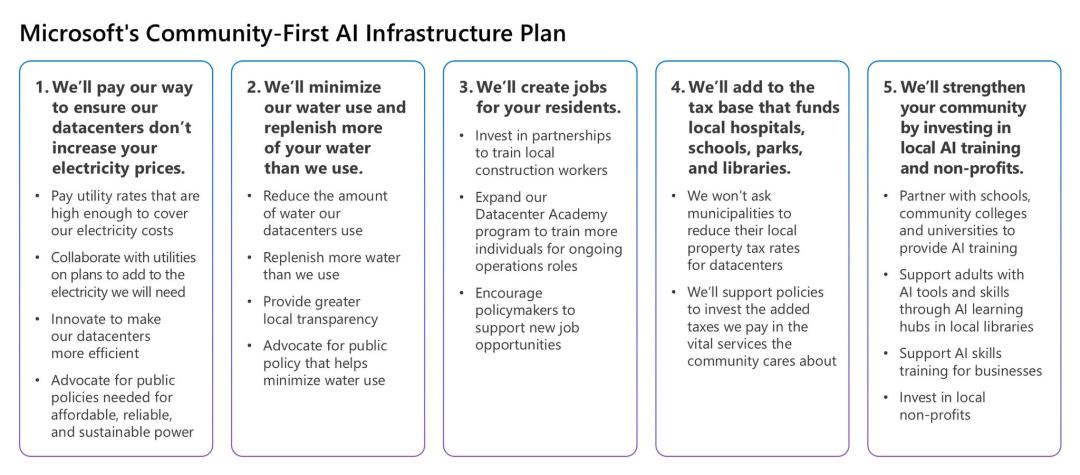
Core Viewpoint - The article discusses the growing tension between tech giants, particularly Microsoft, and local communities regarding the construction of data centers, emphasizing the need for responsible practices that benefit both technological advancement and community welfare [4][6][26]. Group 1: Microsoft's Community-Focused AI Infrastructure Plan - Microsoft President Brad Smith announced the "Community-First AI Infrastructure" plan, which includes five commitments: no electricity subsidies, reduced water usage, no tax breaks, job creation, and community feedback [5]. - The company aims to ensure that the benefits of AI infrastructure development outweigh the costs for local residents, promising not to raise local electricity prices and to cover additional electricity costs incurred by data centers [5][25]. - Microsoft has already implemented some of these commitments in Arizona, collaborating with local authorities to repair pipeline leaks and reduce freshwater loss [5][8]. Group 2: The Data Center Investment Surge - Major tech companies are engaged in an unprecedented data center investment race, with projected capital expenditures reaching $400 billion by 2025, primarily for AI infrastructure [8]. - The total capital expenditure for the five largest cloud service providers is expected to exceed $600 billion this year, marking a 36% increase from the previous year [8][9]. - Data centers' electricity consumption is projected to rise dramatically, with estimates suggesting that by 2026, consumption will exceed 250 terawatt-hours, and by 2030, it could reach 400-426 terawatt-hours, accounting for 6.7%-12% of the total U.S. electricity consumption [9][10]. Group 3: Community Challenges Amid Data Center Growth - Communities are facing significant challenges due to the rapid expansion of data centers, including rising electricity prices and water resource depletion [9][10]. - In areas with dense data center activity, wholesale electricity prices have surged by up to 267% over five years, with residential electricity costs projected to rise by 13% in 2025 [9][10]. - The water consumption for cooling data centers is also alarming, with estimates suggesting that by 2028, it could double to between 129 million and 258 million tons [10]. Group 4: Local Community Reactions - In Arizona, local residents have expressed strong opposition to data center projects due to concerns over water usage and environmental impact, leading to the rejection of certain proposals [13]. - The disparity between resource consumption by data centers and the lack of basic utilities for nearby communities, such as the Navajo reservation, highlights the inequities created by tech investments [12]. Group 5: Other Tech Giants' Practices - Other tech companies like Google and Meta are also facing scrutiny for their resource consumption, with Google using approximately 24.2 million tons of water globally in 2023, 95% of which was for data centers [21]. - Critics argue that the water compensation strategies employed by these companies are insufficient and that transparency regarding water usage is lacking [22]. Group 6: The Need for a New Social Contract - The article emphasizes the necessity for a new social contract between tech companies and communities, where the costs of resource consumption are shared more equitably, and local benefits are prioritized [26]. - Microsoft's commitments serve as a potential model for other tech giants, suggesting that responsible practices can lead to a more sustainable relationship with local communities [28].


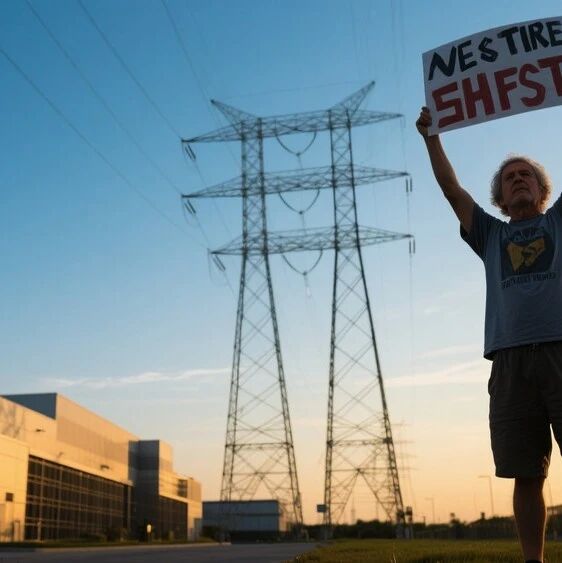
数据中心背后民怨沸腾,微软给马斯克上了一课
3 6 Ke· 2026-01-16 01:45
Core Viewpoint - Microsoft has introduced a "Community-First AI Infrastructure" plan, committing to responsible data center development that prioritizes community benefits over costs, aiming for a win-win between technological innovation and local employment [1][3][23]. Group 1: Microsoft's Commitments - Microsoft will not seek electricity subsidies or tax breaks, ensuring that local residents do not bear the costs of increased electricity prices due to data centers [2][23]. - The company promises to minimize water usage and replenish more water than it consumes, investing in local water systems [2][23]. - Microsoft aims to create job opportunities for local residents and enhance the tax base to support local services like hospitals and schools [2][23]. Group 2: Industry Context - The competition among major tech companies for data center investments is unprecedented, with projected capital expenditures reaching $400 billion by 2025, primarily for AI infrastructure [4][5]. - Data centers are expected to consume approximately 250 terawatt-hours (TWh) of electricity by 2026, increasing to 400-426 TWh by 2030, which will account for 6.7-12% of the total electricity consumption in the U.S. [5][7]. - The rapid growth in data center electricity consumption poses significant challenges to the U.S. energy system, with a projected total electricity consumption of 183 TWh by 2024 [4][5]. Group 3: Community Concerns - Local communities are increasingly concerned about the rising electricity prices and water resource depletion caused by data centers, with reports indicating a 267% increase in wholesale electricity prices in data center-heavy regions over five years [7][9]. - The disparity in resource consumption is stark, as communities near data centers face resource shortages while tech companies consume vast amounts of electricity and water [11][12]. - Employment opportunities created by data centers are often limited, with a typical facility requiring only 50 to 100 full-time employees after construction [8][12]. Group 4: Broader Implications - The current situation highlights the need for a new social contract between tech companies and communities, where the costs of resource consumption are shared more equitably [24][25]. - Microsoft’s commitments could serve as a model for other tech giants, emphasizing the importance of corporate responsibility in resource management and community engagement [23][25]. - The ongoing resistance from communities against data center projects indicates a growing demand for transparency and accountability from tech companies regarding their environmental and social impacts [22][25].



Anthropic拟融资百亿美元,估值或飙升至3500亿美元
Sou Hu Cai Jing· 2026-01-12 02:20
Group 1 - Anthropic is in talks for a new funding round of up to $10 billion, potentially led by Singapore's GIC and Coatue Management, which could raise its valuation to $350 billion, nearly double its previous valuation of $183 billion four months ago [2] - The funding aims to expand Anthropic's computing power and accelerate technology development, independent of the $15 billion investment previously committed by Microsoft and Nvidia [2] - This potential financing indicates a new phase of "capital oligopoly" in the global AI arms race, raising the entry barriers for top model manufacturers to the $100 billion level [2] Group 2 - The doubling of Anthropic's valuation reflects market confidence in the Claude series models, particularly in programming and reasoning capabilities, and highlights the exponential growth in funding required for training next-generation models [2] - The AI industry is experiencing a "Matthew effect," with capital increasingly betting on leading players to secure future operating system-level entry points [3] - Analysts warn that such high valuations may overextend future commercialization expectations, with Anthropic needing to demonstrate scalable revenue by 2026 that matches its valuation [3]

台积电1月15日法说会 有望报佳音 法人预期Q1淡季不淡
Jing Ji Ri Bao· 2026-01-10 23:15
Core Viewpoint - TSMC is expected to hold a corporate briefing on January 15, where its 2026 outlook and capital expenditure plans will be significant indicators for the tech industry [1] Group 1: Financial Performance - TSMC's revenue for December exceeded expectations, contributing to a total revenue of NT$38,090.5 billion for 2025, marking a year-on-year increase of 31.6% and setting a historical high [2] - The revenue for the fourth quarter reached NT$10,460.8 billion, a quarter-on-quarter increase of 5.7% and a year-on-year increase of 20.5%, achieving a new single-quarter record [1] Group 2: Market Demand and Pricing - Analysts predict that TSMC's advanced process technology will remain in high demand, with major clients pre-booking capacity, leading to potential price increases of 3% to 10% for advanced processes starting in 2026 [2] - Despite the proposed price increases, clients are still eager to secure advanced process capacity, indicating ongoing strong demand in the AI sector [2] Group 3: Capital Expenditure - TSMC's capital expenditure for 2026 is projected to remain at historically high levels, potentially reaching between US$42 billion and US$45 billion [2] - The company aims to ensure that revenue growth outpaces capital expenditure growth, demonstrating a commitment to financial discipline [2]

Ed Yardeni 2026展望:美国不衰退,标普7700,美债收益率超4%,金价6000美元
美股IPO· 2025-12-28 16:03
Core Viewpoint - The current economic landscape is characterized as the "Roaring 2020s," with resilience and AI productivity expected to drive the S&P 500 to 7,700 points by the end of 2026 and potentially challenge 10,000 points by the end of the decade. The investment focus is shifting from AI producers to the 493 companies that benefit from cost reduction and efficiency improvements [1][3][4]. Economic Outlook - The economy has shown resilience over the past four years, with expectations of a 2% inflation rate as productivity increases lower unit labor costs. This stability may prevent the Federal Reserve from raising interest rates, keeping bond yields above 4% [6][11][14]. - The S&P 500 is projected to reach 7,700 points by the end of 2026, based on an estimated earnings per share (EPS) of $350 multiplied by a price-to-earnings (P/E) ratio of 22. By the end of the decade, the index could reach 10,000 points, with gold also expected to hit $10,000 per ounce [3][16]. AI Market Dynamics - The competitive landscape in the AI sector is shifting from a monopoly of tech giants to a more competitive environment, referred to as an "arms race." This change is narrowing the competitive advantages of major tech companies, leading to a focus on AI users who can leverage technology to enhance productivity and profit margins [3][9][10]. Market Performance - The S&P 500 has experienced a strong performance, with an average increase of 16.5% this year, surpassing the historical average of 12%. Analysts remain optimistic about corporate earnings, with expectations for continued growth in the coming years [8][27][28]. - The earnings outlook for the S&P 500 is positive, with analysts projecting EPS of approximately $312 for the current year and $357 for the next, indicating a bullish sentiment for 2026 and 2027 [28][29]. Sector Analysis - Key sectors expected to benefit from AI advancements include healthcare, finance, and industrials, as these industries are poised to leverage AI technology to improve productivity significantly [34]. - Precious metals, particularly gold and silver, are anticipated to perform well, with gold potentially reaching $10,000 per ounce by the end of the decade. Silver's industrial applications may provide it with a stronger fundamental outlook compared to gold [16][36].

GPT-5.2来了!全球AI大模型竞赛加速,国内算力配套产业链有望受益
Jin Rong Jie· 2025-12-15 00:40
Core Insights - OpenAI officially released the GPT-5.2 series model on December 11, showcasing significant advancements in reasoning, professional knowledge work, financial modeling, and productivity tools like PPT/Excel, surpassing previous generations and leading in multiple reasoning benchmark tests against Google's Gemini 3 [1] - The global AI arms race is intensifying, with OpenAI being pressured by competitors like Google and Anthropic, prompting accelerated development of large models [1] - The recent approval of NVIDIA's H200 chip for export to China, which has nearly six times the performance of the previous H20 chip, is expected to alleviate the domestic high-end computing power shortage and accelerate AI computing infrastructure development in China [1] Industry Implications - The breakthroughs in large model speed and stability will drive increased demand for AI training and inference computing power, impacting the global supply chain for core hardware components such as servers, specialized chips, optical modules, advanced packaging, high-speed interconnects, high-bandwidth storage, liquid cooling, and copper cables [1] - Despite the easing of restrictions on the H200 chip, the U.S. strategy to maintain long-term control over core computing power in China remains unchanged, emphasizing the urgency for domestic self-sufficiency in computing power [2] - The acceleration of AI computing infrastructure in China is expected to benefit various segments related to computing power, including server manufacturing, high-bandwidth memory (HBM), optical modules, PCBs, copper cables, and liquid cooling, highlighting potential investment opportunities in leading companies within these sectors [2]

超长端性价比提升,期货价格大幅下跌
Nan Hua Qi Huo· 2025-12-04 11:58
Group 1: Report Industry Investment Rating - No investment rating information provided Group 2: Core Viewpoints of the Report - The main reason for the recent weakness in the bond market is that the central bank's open - market operations and external expectation management since November have been overall prudent and did not match the market's high expectations. The concerns about policy tone adjustment and “short - term tightening and long - term easing” are more of an emotional interpretation. [1][3] - The bond market is currently facing potential pressures from inflation improvement and the mismatch between supply and demand of ultra - long - term bonds. [8] - Suggestions for responding to the market situation include staying on the sidelines in the near term and paying attention to short - term opportunities and long - term opportunities to steepen the yield curve. [8][9] Group 3: Summary by Relevant Catalogs Reasons for the Decline - **Monetary Policy Factor**: The market's expectations for monetary policy were not met. After the central bank restarted treasury bond trading in late October, the follow - up policy guidance and actual open - market operations were restrained. The third - quarter monetary policy implementation report in mid - November did not echo the over - heated policy expectations. Near the end of the year, discussions about policy setting and the description of “short - term tightening and long - term easing” in the media also affected the bond market. [1][2][3] - **Institutional Behavior Factor**: Concerns about public fund redemption rules and banks selling old bonds are institutional behavior disturbances. The suspension of five - year large - denomination certificates of deposit by large banks and the adjustment of medium - and long - term time deposits by small and medium - sized banks led to a decline in the duration of the liability side and weakened the demand of the allocation disk. The central bank's investigation into banks' selling of old bonds also affected the market. [6] - **Potential Risk Factor**: The bond market is facing inflation pressure from statistical improvement and the strong performance of commodities, as well as the problem of the increasing mismatch between supply and demand of ultra - long - term government bonds. [8] Response Measures - **Stay on the Sidelines**: Pay attention to the tone of the year - end meetings and the central bank's statements to observe the bottom of the recent decline. Wait for the central bank's supportive statements to avoid the potential systemic risk of concentrated redemptions caused by the over - decline of ultra - long - term bonds. [8] - **Focus on Opportunities**: Focus on short - term opportunities and long - term opportunities to steepen the yield curve. Short - and medium - term varieties have higher anti - decline attributes and allocation value. [9]
12月全球十大富豪:第二名换人了
3 6 Ke· 2025-12-02 09:57
Core Insights - The latest Forbes Billionaires list reveals significant changes among the world's wealthiest individuals, particularly in the tech sector, driven by stock price fluctuations and advancements in AI technology [1][2][3]. Group 1: Wealth Changes Among Billionaires - Larry Page, co-founder of Google, has risen to the second position on the Forbes list with a net worth of $262 billion, an increase of $30 billion from November 1 due to a 14% rise in Alphabet's stock price [1][3]. - Sergey Brin, also a co-founder of Google, saw his wealth increase by $27 billion to approximately $242 billion, moving him up to the fifth position [1]. - Warren Buffett's Berkshire Hathaway disclosed nearly $5 billion in Alphabet shares, leading to a $9 billion increase in his wealth, bringing it to about $152 billion and elevating him to the tenth position [2][30]. Group 2: Notable Losers - Larry Ellison, founder of Oracle, experienced a significant loss, with his wealth decreasing by $67 billion to $253 billion due to a 23% drop in Oracle's stock price [3][11]. - Jensen Huang of Nvidia saw his wealth decrease by $22 billion to $154 billion, although he maintained the eighth position [3][23]. - Elon Musk, despite a $15 billion decrease in wealth due to a 6% drop in Tesla's stock price, remains the richest person in the world with an estimated net worth of $483 billion [3][8]. Group 3: Overall Billionaire Rankings - As of December 1, 2025, the total wealth of the top ten billionaires is $2.4 trillion, unchanged from the previous month [4]. - The top ten billionaires are predominantly from the United States, with Bernard Arnault from France being the only exception [33]. - All ten individuals on the list are male, with each having a net worth of at least $152 billion [34].

抄底时刻已到!投行韦德布什:科技股抛售实为买入良机,AI军备竞赛将推动年底反弹
Zhi Tong Cai Jing· 2025-11-14 13:57
Core Viewpoint - The recent sell-off in technology stocks is viewed as a buying opportunity, despite the challenges faced by major players like Tesla, Microsoft, Palantir, and Nvidia due to risk aversion among investors [1][2] Group 1: Market Sentiment - Analysts from Wedbush Securities, led by Daniel Ives, noted that the tech sector experienced a difficult trading day, raising concerns about the sustainability of the tech bull market [1] - The sell-off was exacerbated by fears surrounding the "AI bubble" and concerns over Nvidia's revenue being impacted in China, alongside discussions about the implications of OpenAI being "too big to fail" [1] Group 2: Earnings and Growth Projections - The third quarter earnings season revealed strong cloud business performance from Microsoft, Amazon, and Alphabet, indicating robust growth potential [1] - Analysts project that capital expenditures from tech giants could increase significantly, from approximately $380 billion this year to between $550 billion and $600 billion by 2026, driven by the ongoing AI revolution [1] Group 3: Future Outlook - The ongoing AI arms race is expected to drive growth, with tech giants' spending remaining strong through 2026, as evidenced by Cisco's optimistic quarterly results [2] - Nvidia's upcoming earnings report is anticipated to serve as a critical validation point for the AI revolution and act as a positive catalyst for tech stocks through the end of the year [2]



微软第一座“AI超级工厂”投入运营:将两座数据中心连接,构建分布式网络
Hua Er Jie Jian Wen· 2025-11-13 00:29
Core Insights - Microsoft is launching a new chapter in its AI infrastructure by creating a distributed "AI super factory" that connects large data centers across different states, aiming to accelerate AI model training at an unprecedented scale and speed [1][2] - The company plans to double its data center footprint in the next two years to meet the surging demand for computing power, highlighting its core position in the AI infrastructure sector [1][2] Group 1: AI Super Factory Concept - The "AI super factory" concept integrates geographically dispersed data centers into a virtual single supercomputer, differing from traditional data center designs [3] - This distributed network will connect multiple sites, consolidating tens of thousands of advanced GPUs, exabyte-scale storage, and millions of CPU cores to support future AI model training with trillions of parameters [3][4] Group 2: New Data Center Design and Technology - The new "Fairwater" series data centers are specifically designed for AI workloads, with the Atlanta facility covering 85 acres and over 1 million square feet [4] - Key features include high-density architecture, advanced chip systems with NVIDIA's GB200 NVL72, efficient liquid cooling systems, and high-speed internal connectivity [4][5] Group 3: AI WAN and Power Distribution Strategy - Microsoft has deployed 120,000 miles of dedicated fiber optic cables to create an AI WAN, allowing data to be transmitted at near-light speed without congestion [6] - The decision to build across states rather than centralizing power is driven by land and electricity supply considerations, ensuring that no single grid is overburdened [6] Group 4: Competitive Landscape - Microsoft is not alone in this race; competitors like Amazon, Meta Platforms, and Oracle are also making significant investments in data center infrastructure [7] - By connecting data centers into a unified distributed system, Microsoft is preparing to meet the substantial demands of top AI companies [7]