HALO资产

Search documents
全市场都在战火里面找 HALO
远川投资评论· 2026-03-05 07:05
Core Viewpoint - The article discusses the emerging investment trend towards HALO assets, which are characterized by heavy assets and low obsolescence, as a response to the rapid advancements in AI and geopolitical tensions affecting supply chains and resource prices [1][2][4]. Group 1: HALO Assets - HALO stands for Heavy Assets and Low Obsolescence, indicating a shift in investment focus towards physical assets that are less likely to be disrupted by AI [1]. - High demand for stable physical assets such as utilities, transportation infrastructure, and long-cycle industrial capacity is highlighted as a key investment opportunity [1][2]. - Goldman Sachs' report indicates that the valuation gap between light asset and heavy asset portfolios is narrowing, with heavy assets experiencing valuation increases [4][7]. Group 2: Market Dynamics - The article notes a significant change in market sentiment, where traditional investment strategies favoring light assets are being challenged by the realities of supply chain disruptions and geopolitical conflicts [3][4]. - The capital expenditure race driven by major tech companies for AI infrastructure is compared to historical investments in telecommunications and railroads, indicating a substantial shift in capital flow towards heavy assets [10][13]. - The ongoing geopolitical tensions, particularly in the Middle East, are causing spikes in resource prices, further validating the investment thesis for HALO assets [13][15]. Group 3: China’s Role - The article emphasizes China's position as a leading manufacturer of physical assets, suggesting that its capabilities should not be undervalued in the context of global supply chain reconfiguration [16]. - The demand for Chinese manufacturing and materials is expected to rise as countries face challenges in rebuilding local supply chains, reinforcing the value of heavy assets [16][17]. - The article posits that the current global economic landscape favors real, productive assets over financial capital, with China being a central player in this transition [16][17]. Group 4: Investment Strategies - The article suggests that institutional investors are increasingly recognizing the importance of physical assets, with a notable shift in portfolio allocations towards sectors like metals and traditional energy [20][21]. - The narrative around supply chain management is evolving from "Just-in-Time" to "Just-in-Case," reflecting a strategic pivot towards securing raw materials and local production capabilities [21]. - The uncertainty in the market is prompting a reevaluation of investment strategies, advocating for a balanced approach that includes maintaining reserves and being prepared for volatility [21].


铁路公路行业点评:寻找时代的HALO资产,唱响铁路公路资产的时代奏鸣曲
Shenwan Hongyuan Securities· 2026-03-02 07:01
Investment Rating - The report rates the transportation industry as "Overweight," indicating that the industry is expected to outperform the overall market [8]. Core Insights - The report highlights the "HALO asset" characteristics of railway and highway assets, which are defined as heavy assets with low elimination risk, high barriers to entry, and stable cash flows. These assets are seen as typical network-type transportation assets with strong "HALO asset" attributes [2]. - The report notes an improvement in the transportation sector's performance during the Spring Festival period, with a total of 6.937 billion inter-regional passenger movements from February 2 to February 28, 2026, representing a year-on-year increase of 5.88%. Specifically, highway passenger transport increased by 5.62%, non-commercial vehicle travel on highways and national/provincial roads rose by 5.76%, and railway passenger volume grew by 7.43% [2]. - The report discusses the decline in long-term bond rates and risk premiums, driven by heightened market risk aversion due to geopolitical tensions. This shift has increased the marginal allocation value of high-dividend assets [2]. Summary by Sections Investment Analysis Recommendations - The report suggests that two main investment themes in the highway sector are expected to persist throughout the year: traditional high-dividend investments and potential market capitalization management catalysts. Recommended stocks include Anhui Expressway, Shandong Expressway, Zhejiang Hu-Hang-Yong Expressway, Ninghu Expressway, and China Merchants Expressway. Stocks to watch include Sichuan Chengyu, Dongguan Holdings, Guangdong Expressway, Shenzhen Expressway, and Gansu Expressway [2]. - For the railway sector, the report recommends focusing on Beijing-Shanghai High-Speed Railway and Daqin Railway, while keeping an eye on Guangzhou-Shenzhen Railway and Guanghui Logistics [2]. Key Company Valuations - The report provides a valuation table for key companies in the transportation sector, including: - Daqin Railway: Closing price of 5.10 RMB, market cap of 102.8 billion RMB, with projected EPS of 0.41 RMB for 2026 and a PE ratio of 12 for 2026 [3]. - Beijing-Shanghai High-Speed Railway: Closing price of 4.95 RMB, market cap of 242.2 billion RMB, with projected EPS of 0.32 RMB for 2026 and a PE ratio of 15 for 2026 [3]. - Shandong Expressway: Closing price of 9.74 RMB, market cap of 47.1 billion RMB, with projected EPS of 0.75 RMB for 2026 and a PE ratio of 13 for 2026 [3].




铁路公路行业点评:寻找时代的“HALO资产”,唱响铁路公路资产的时代奏鸣曲
Shenwan Hongyuan Securities· 2026-03-02 05:50
Investment Rating - The report rates the railway and highway industry as "Overweight," indicating a positive outlook for the sector compared to the overall market performance [2]. Core Insights - The "HALO asset" characteristics of railway and highway assets are prominent, marking the opening of a mid-to-long-term strategic allocation window. These assets are defined as heavy assets with low elimination risk, high barriers (approval, replication, CAPEX scale), and stable cash flows [2]. - The Spring Festival transportation peak shows a low-to-high trend, with improvements in the railway and highway sectors. From February 2 to February 28, 2026, the total inter-regional passenger flow reached 6.937 billion trips, a year-on-year increase of 5.88%. Specifically, highway passenger transport volume was 855 million trips (up 5.62%), non-commercial vehicle trips on highways and national/provincial roads totaled 5.613 billion trips (up 5.76%), and railway passenger volume was 378 million trips (up 7.43%) [2]. - The beta long-term bond rates and risk premiums are declining. Due to heightened market risk aversion stemming from geopolitical tensions, capital is shifting from risk assets to safe assets, leading to a decrease in long-term bond rates and market risk premiums. This environment enhances the marginal allocation value of high-dividend assets [2]. Summary by Sections Investment Analysis Recommendations - The report suggests that the highway sector has two main investment lines for the year: traditional high-dividend investments and potential market capitalization management catalysts. Recommended stocks include Anhui Expressway, Shandong Expressway, Zhejiang Hu-Hang-Yong Expressway, Ninghu Expressway, and China Merchants Expressway. Stocks to watch include Sichuan Chengyu, Dongguan Holdings, Guangdong Expressway, Shenzhen Expressway, and Gansu Expressway. For railways, the overall passenger and freight volume is stable with growth, recommending Beijing-Shanghai High-Speed Railway and Daqin Railway, while watching Guangzhou-Shenzhen Railway and Guanghui Logistics [2]. Valuation Table of Key Companies in Transportation Industry - The report includes a valuation table for key companies in the transportation sector, detailing their stock prices, market capitalizations, and earnings per share (EPS) forecasts for 2024 to 2027. For instance, Daqin Railway has a market cap of 102.8 billion RMB with an EPS forecast of 0.48 RMB for 2024, while Beijing-Shanghai High-Speed Railway has a market cap of 242.2 billion RMB with an EPS forecast of 0.26 RMB for 2024 [3].
0301狙击龙虎榜
2026-03-01 17:21
Summary of Key Points from Conference Call Records Industry Overview - The market showed resilience despite initial declines, with a strong recovery in sentiment observed in the afternoon. The overall market performance was positive, influenced by the dynamics of AI hardware and pricing trends in various sectors [1][1]. - The geopolitical situation is expected to impact market conditions, particularly in resource sectors, but the long-term outlook remains optimistic [1][1]. Company Insights Yunnan Zhiye - Yunnan Zhiye is a key player in the production of phosphor aluminum, essential for 800G/1.6T optical modules. The global supply-demand gap is projected to reach 70%, with supply concentrated among US and Japanese companies [4][1]. - The company is positioned favorably in the domestic market, covering major optical module and chip manufacturers, and is expected to benefit from the transition to CPO technology [4][1]. Zhongman Petroleum - Zhongman Petroleum is a leading private oil and gas exploration company with a comprehensive industry chain from equipment manufacturing to exploration and development. The company has proven and assessed oil reserves of approximately 147 million tons (about 1.07 billion barrels) [5][1]. - Unlike state-owned enterprises, Zhongman Petroleum exhibits greater earnings elasticity, with profit increases significantly higher during price surges. The company’s operations in Kazakhstan are insulated from risks associated with the Strait of Hormuz [5][1]. Hangzhou Steel - Hangzhou Steel is transforming its operations by leveraging scarce industrial land in urban areas, having established over 5,500 machine frames and hosting more than 26,000 servers [6][1]. - The company is extending its business model beyond just renting out machine cabinets to manufacturing computing equipment, with plans for a 300,000 square meter computing equipment industrial park [6][1]. - The integration of land, power, and customer relationships creates a high barrier to replication, positioning the company for potential valuation restructuring amid the HALO asset wave [6][1]. Market Trends - The market is currently focused on price increases and AI-related trends, which are seen as key drivers of future growth [1][1]. - The demand for electrical and electronic equipment is surging due to the expansion of AI data centers, leading to longer delivery times for critical components like power transformers [1][1]. Stock Performance - Notable stock movements include Zhongman Petroleum (+0.33%), Hangzhou Steel (+9.96%), and Yunnan Mingye (+8.72%) [7][1]. Additional Insights - The ongoing discussions around "HALO" assets highlight the intersection of pricing power and AI demand, particularly in sectors experiencing explosive growth due to technological advancements [1][1].
国泰君安期货·君研海外:境外权益(港美股)周度策略报告-20260301
Guo Tai Jun An Qi Huo· 2026-03-01 09:04
1. Report Industry Investment Rating - No information provided in the content 2. Core Viewpoints of the Report - This week, the escalation of the Middle - East situation and AI panic trading dragged down the US stocks, with the three major indices falling and significant sectoral differentiation. The market has partially priced in the escalation of the Middle - East situation in advance, and defensive assets such as gold, military, energy, and utilities are better than elastic assets. The AI panic trading is hard to end, and the market is chasing "HALO" assets [7]. - The trading trend of technology contraction (upstream hardware > mid - stream cloud computing > downstream application software) has been the main trading line in the US stocks since last November. The AI panic trading has affected various industries, including traditional industries and network security stocks [11]. - After about 80% of the US stock earnings reports have been disclosed, the geopolitical situation may become the dominant factor in the short - term. The 200 - day moving average may be a short - term effective support for the Nasdaq [12]. - In the short - term, it is recommended to maintain a relatively defensive stance (military and energy) due to potential variables in the Middle - East situation and the crowded and fragile market structure of US stocks. In the long - term, US stock investment should return to fundamental endogenous factors, and hardware and "HALO" assets are favored [13]. - After the holiday, Chinese - funded stocks had a good start, with prominent sectoral differentiation. The trading line is mainly around the "escalation of the Middle - East situation" and "AI panic trading". A - shares outperformed Hong Kong stocks this week, and it is recommended to maintain a balanced allocation of defensive sectors in the short - term and keep a balanced allocation of technology and physical cycles in Chinese - funded stocks [14]. 3. Summary According to Relevant Catalogs US Stocks - **Overall Market Performance**: This week, the "escalation of the Middle - East situation" and "AI panic trading" dragged down the US stocks, with the three major indices falling and sectoral differentiation. Defensive assets such as utilities, materials, and energy led the gains, and the "HALO" trading became the main trading line [3][7]. - **AI Panic Trading**: The AI panic trading is hard to end in the short - term. It has spread from software to industries such as real - estate agencies, wealth management, and insurance agencies in the equity market. In the credit market, the high - yield spread of US technology stocks has significantly increased. Since last November, the trading trend of technology contraction has been the main line, and various AI - related events have continuously affected the market [9][11]. - **Earnings Reports and Geopolitical Impact**: About 80% of the US stock earnings reports have been disclosed. Referring to the experience of the past three years, the 200 - day moving average may be a short - term effective support for the Nasdaq. In the short - term, the geopolitical situation may be the dominant factor [12]. - **Investment Strategy**: In the short - term, maintain a relatively defensive stance (military and energy) due to potential variables in the Middle - East situation and the fragile market structure. In the long - term, US stock investment should return to fundamental endogenous factors, and hardware and "HALO" assets are favored [13]. Chinese - Funded Stocks - **Market Performance**: After the holiday, Chinese - funded stocks had a good start, with prominent sectoral differentiation. The trading line is mainly around the "escalation of the Middle - East situation" (leading sectors: non - ferrous metals, petroleum and petrochemicals, and military) and "AI panic trading" (leading sectors: upstream hardware of AI and North American power export chain). A - shares outperformed Hong Kong stocks this week [14]. - **Investment Strategy**: In the short - term, maintain a balanced allocation of defensive sectors (energy, military, non - ferrous metals, etc.) due to potential geopolitical variables. Keep a balanced allocation of technology and physical cycles in Chinese - funded stocks, with the technology contraction (upstream infrastructure (domestic and foreign demand chains) > mid - stream cloud computing > downstream application software) [14].
华尔街忽然转向!大摩、高盛力荐HALO资产
Ge Long Hui A P P· 2026-02-28 04:05
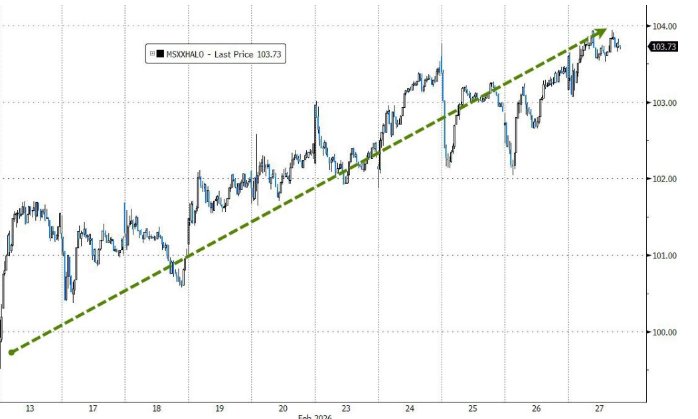
Group 1 - The core viewpoint of the articles highlights the emergence of HALO (Heavy Assets, Low Obsolescence) assets as a new investment focus due to the disruptions caused by AI, prompting investors to reassess risks [1] - Morgan Stanley introduced the HALO trading concept, creating a HALO basket (MSXXHALO) that includes seven structural pillars: materials, utilities, railroads, pipelines, waste management, defense, and signal towers, aimed at mitigating risks associated with technological obsolescence [1] - Goldman Sachs corroborated this trend, indicating that the market is undergoing a "scarcity repricing" under the pressures of rising interest rates, geopolitical fragmentation, and increased AI capital expenditures, with tangible production capacity becoming a scarce resource [1] Group 2 - In the A-share market, HALO assets have been identified, with the electricity sector experiencing a strong rise driven by the HALO trading logic and increased electricity demand from AI [2] - Core materials such as rare earths and minor metals have also become focal points for investment, driven by supply-demand dynamics and AI-related demand [2] - Overall, A-share HALO assets are concentrated in electricity, metals, and utilities, exhibiting a "stronger gets stronger" structural characteristic, reflecting a global revaluation trend of HALO assets, although some leading stocks in the A-share market may face higher valuation risks due to excessive market enthusiasm [2]


高盛:投资者终于开始重视传统“资本密集型”企业
智通财经网· 2026-02-28 03:27
Core Viewpoint - Investors are re-evaluating capital-intensive assets in the "old world," with a shift from data centers to a broader range of physical economy supply chains, driven by the AI era's demand for "hard assets" [1][4]. Group 1: Investment Trends - Goldman Sachs reports that capital is flowing towards "hard assets" such as power grids, pipelines, utilities, transportation infrastructure, and critical industrial capacity, which are difficult to replicate and have high physical barriers [1][4]. - Since late February, a basket of HALO stocks has been on the rise, supported by changes in U.S. tariff policies that may lower actual tariff rates by approximately 100 basis points [3]. - The market is increasingly favoring traditional capital-intensive companies, extending this trend to supply chain and broader economic sectors [3][5]. Group 2: Characteristics of HALO Assets - Goldman Sachs defines optimal HALO assets as those with high reconstruction costs, deep regulatory barriers, and long construction cycles, making them hard to disrupt or replace [5]. - The focus areas for these assets include power grids, pipelines, utilities, transportation infrastructure, critical machinery, and long-cycle industrial capacity [5]. Group 3: Impact on Soft Assets - While hard assets are gaining popularity, soft assets such as software, media, consulting, and certain financial sectors are under pressure, with significant declines in software and IT service stocks observed in February [6]. - Concerns about AI disrupting these sectors and enabling low-cost competitors are leading to a fundamental reassessment of their business models [6]. - However, not all software companies are equally affected, and those demonstrating a history of delivering high-quality AI outcomes may still be viable investments [6].
HALO资产横空出世!近20亿抢筹电网设备ETF(159326),规模突破200亿,高盛大幅上调全球AI用电预期至220%
Ge Long Hui A P P· 2026-02-26 02:33
Group 1 - The electric grid and power sectors are experiencing an upward trend, with the electric grid equipment ETF (159326) rising by 2.55% and attracting a net subscription of 197 million shares, estimated at 387 million yuan, with a net inflow of 1.98 billion yuan over the past five days [1] - Goldman Sachs has raised its forecast for global data center electricity demand growth from 175% to 220% by 2030, indicating a "super cycle" in infrastructure reliability driven by AI investments [1] - The U.S. government is set to convene major tech companies on March 4 to sign a commitment regarding the electricity cost burden of high-energy data centers, with former President Trump urging large tech firms to build their own power plants [1] Group 2 - The electric grid equipment ETF (159326) has a weight of 66.28% in ultra-high voltage, 55% in smart grid, and 14% in controllable nuclear fusion, with key stocks including State Grid NARI, TBEA, and Sifang Electric [2] - The green electricity ETF (562550) focuses on the entire chain of power transition, with core stocks like Yangtze Power and Three Gorges Energy [2] - The public utility ETF (159301) emphasizes high dividends and stable growth, covering hydropower, nuclear power, thermal power, and renewable energy, with major stocks including Yangtze Power, China Nuclear Power, and Three Gorges Energy [2]
再聊一次牛市的几条主线
表舅是养基大户· 2026-02-25 13:35
Group 1 - The A-share market continues to show positive momentum, with the median increase of stock ETFs at approximately 0.7% and individual stocks at 0.6%, indicating a strong profit effect as trading volume approaches 2.5 trillion yuan, an increase of over 200 billion yuan from the previous day [4] - The A-share index has reached a new high, closing near 6900 points, surpassing the previous peak on January 23, marking a significant recovery since the lows [6] - Key supporting factors for the stock market include the recovery from pandemic effects, unprecedented attention from authorities towards the stock market, the rise of leading industries, and an historically low interest rate environment [8][9] Group 2 - The recovery from pandemic effects is evident, with the offshore RMB exchange rate reaching 6.86, a three-year high, and tourist numbers and spending during the recent Spring Festival recovering to 151% and 135% of 2019 levels, respectively [11][13] - The trend of leading industries gaining market share is highlighted by the significant decline in German automotive exports to China, which dropped by one-third compared to 2022, indicating a shift in global manufacturing dynamics [23][25] - The low interest rate environment has led to a substantial increase in insurance capital investment in stocks and funds, with a year-on-year growth of 38.9%, reflecting the urgency for capital to seek opportunities in the stock market [27][28] Group 3 - The market strategy for the upcoming year emphasizes embracing quality equity investments, maintaining a balanced asset allocation, and focusing on opportunities outside of the US and technology sectors [32] - The importance of managing short-term volatility and focusing on overall portfolio performance rather than individual asset fluctuations is stressed [34] - The ongoing AI revolution is reshaping investment priorities, with a focus on maintaining core competencies in the workforce to ensure stable cash flow, suggesting a shift in investment management strategies [34] Group 4 - The recent surge in physical assets, termed "HALO" assets, is driven by global capital seeking sectors less affected by AI, leading to significant gains in related markets [35][37] - The South Korean stock market has surpassed the total market capitalization of major European economies, driven by the performance of its semiconductor giants, indicating a strong position in the AI era [40][41]