美元指数

Search documents
分歧加剧!美指跌破关口 26年降息路径成关键博弈点
Jin Tou Wang· 2026-01-12 14:27
Core Viewpoint - The ICE US Dollar Index has entered a downward trend, breaking key support levels and ending a previous streak of gains, indicating short-term pressure on the dollar [1] Group 1: Federal Reserve and Monetary Policy - The recent Federal Reserve meeting saw a significant number of dissenting votes, highlighting deep internal divisions among committee members regarding interest rate policy [1] - There are two opposing factions within the dissenting group: one advocating for maintaining rates to prevent sticky inflation, while the other supports larger rate cuts to address weak employment [1] - The divergence in opinions among committee members has led to decreased predictability in policy, undermining market confidence in the dollar [1] Group 2: Global Central Bank Policies - Central bank policies among major economies are increasingly diverging, exerting continuous pressure on the dollar [1] - The Federal Reserve has initiated a rate-cutting cycle, but the pace of future cuts remains uncertain; the European Central Bank has paused cuts, while the Bank of Japan is gradually increasing rates [1] - This lack of coordinated policy among central banks disrupts the previous supportive environment for the dollar, making it difficult for the currency to rely on a single easing cycle for sustained support [1] Group 3: Economic Indicators and Market Reactions - The U.S. economy is experiencing a "growth and employment temperature gap," with GDP growth expectations being raised while non-farm employment data remains weak [1] - The Federal Reserve is adopting a "wait-and-see" approach, planning to pause rate cuts in the short term, which further amplifies market volatility due to policy uncertainty [1] - Following the dollar's decline, non-U.S. currencies have strengthened, gold prices have surged, and U.S. Treasury yields have slightly decreased, indicating a shift towards safe-haven assets [2] Group 4: Future Outlook and Risks - In the short term, the dollar index needs to be monitored closely for key moving average support levels, with potential for further declines if these are breached [2] - The long-term outlook for the dollar index will hinge on the pace of Federal Reserve rate cuts and the policy direction of the new chairperson, with predictions suggesting a "steady then weak" trend for the year [2] - There are three major risk variables to watch: potential inflation resurgence, geopolitical conflicts, and financial market turbulence, which could alter the rate-cutting path and lead to significant adjustments in the dollar index and global market volatility [2]
汇率高频追踪20260112
Zhong Xin Qi Huo· 2026-01-12 06:58
Report Summary 1. Report Industry Investment Rating - Not provided in the content 2. Core Viewpoints - The market's recent focus is on the December non - farm payroll data and the tariff ruling result. The December non - farm payroll data did not cause significant market impact. The unemployment rate dropped to 4.375% in December, exceeding market expectations and well below the previous value of 4.6%, temporarily avoiding the trigger of the Sahm Rule. However, the non - farm employment added in December was 50k, lower than expected and the previous two months' data was revised down by a total of 76k. The labor market demand remains weak. The tariff - related de - dollarization and pre - emptive interest rate cut logic may reverse if the tariff bill is invalidated, but the impact is expected to be short - term. The Federal Reserve's threshold for a January interest rate cut is high, and if the labor market maintains the current "low - speed balance", the short - term monetary easing path may not be supported [2][3] 3. Summary by Related Indicators Exchange Rate - related Indicators - The US dollar index rebounded slightly following the US - Germany interest rate spread. The US Citigroup Economic Surprise Index has recovered. The difference in the US - Europe Citigroup Economic Surprise Index has also increased [2][5][7] - The difference in long - term inflation expectations between the US and Europe has further declined, and the US long - term inflation expectation is oscillating at a low level [9][12] - The US short - term interest rate expectation is significantly changing, and the difference in short - term interest rate expectations between the US and Europe is rising [14][16] - The euro swap basis shows that the US dollar cross - border liquidity pressure is limited [18] Position and Market Sentiment Indicators - The CFTC net position shows that the US dollar maintains a net short position exposure. The VIX index reflects market volatility [21][20] Bond Spread Indicators - Based on the 30 - 10Y spread (in reverse order) and the 10Y swap spread, concerns about US Treasury deficits and the US dollar trend show a slight narrowing of the spreads [23] Commodity - related Indicators - The US dollar index and copper price show that the copper price has risen significantly, and the US dollar index and crude oil price show that the crude oil price has rebounded [27]
管涛:众口一词的人民币升值“真相”|立方大家谈
Sou Hu Cai Jing· 2026-01-11 14:53
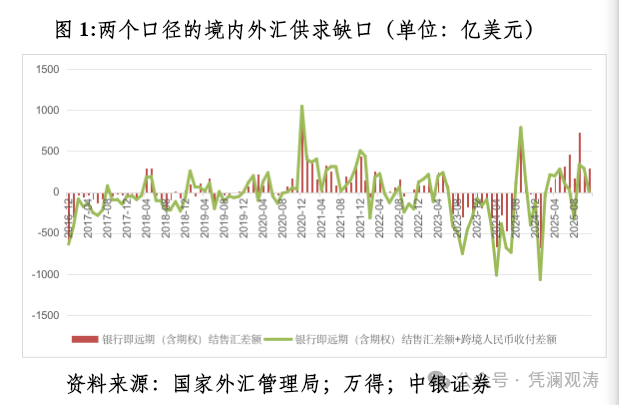
Core Viewpoint - The article discusses the recent strengthening of the RMB against the USD, highlighting that the narrative around RMB appreciation lacks substantial data and theoretical support, despite claims from foreign investment banks about its structural undervaluation and potential asset revaluation in China [1][2][4]. Exchange Rate Trends - From July 2023 to February 2025, the RMB faced overall pressure, with a notable shift to a surplus in bank foreign exchange settlements starting March 2025, accumulating a surplus of $273.3 billion by November 2025 [2][4]. - In November 2025, the bank's foreign exchange settlement surplus was $29.7 billion, a modest increase from the previous month, indicating a lack of strong market consensus on RMB appreciation [2][4]. Market Behavior - The improvement in the foreign exchange situation is attributed more to a decrease in the motivation to purchase foreign currency rather than an increase in the willingness to settle foreign exchange [4]. - The average settlement rate for foreign currency receipts increased to 54.6% from July 2023 to February 2025, while the payment rate decreased to 58.8%, suggesting a natural hedging against exchange rate risks rather than a bullish sentiment towards RMB [4]. Real Effective Exchange Rate (REER) - The RMB's real effective exchange rate (REER) has depreciated by 16.7% since March 2022, contrasting with the appreciation of other major currencies, indicating a complex relationship between REER and nominal exchange rates [7][11]. - Despite the depreciation of the REER, it does not necessarily imply that the RMB is undervalued or will appreciate, as historical data shows inconsistent relationships between REER movements and nominal exchange rates [7][18]. Trade Balance and Economic Indicators - China has maintained a significant trade surplus, while Japan has faced trade deficits since 2021, yet China's overall current account surplus remains within international warning limits [12][15]. - The article emphasizes that while a trade surplus may suggest RMB undervaluation, domestic economic conditions, such as low inflation and nominal growth rates, could indicate overvaluation [15][23]. Impact on Corporate Earnings - Analysis of A-share listed companies from 2015 to 2022 shows that a higher percentage of non-financial firms reported net exchange gains during depreciation years compared to appreciation years, suggesting that RMB appreciation may not necessarily benefit corporate earnings [21][23]. - The shift from net external debt to net external assets for Chinese firms raises concerns that significant RMB appreciation could lead to net exchange losses, adversely affecting corporate profitability [23].

管涛:众口一词的人民币升值“真相”︱汇海观涛
Di Yi Cai Jing· 2026-01-11 12:53
Group 1 - The article discusses the recent strengthening of the RMB against the USD, which has been characterized by a reversal of the previous trend of depreciation over the past three years, particularly since November 2024 [1] - Foreign investment banks have suggested that the RMB is structurally undervalued, predicting that RMB appreciation will be a high-confidence trade in 2026, while domestic voices echo that RMB revaluation will lead to a reassessment of Chinese assets [1][2] - However, the article argues that these significant judgments lack data, facts, or theoretical support, indicating skepticism about the sustainability of the RMB's appreciation [1] Group 2 - From July 2023 to February 2025, the RMB exchange rate faced overall pressure, with a notable shift to a surplus in bank foreign exchange settlements starting in March 2025, accumulating a surplus of $273.3 billion by November [2] - In November, the bank's foreign exchange settlement surplus was $29.7 billion, which was significantly lower than the surpluses recorded in September and October [2] - The article highlights that the improvement in the foreign exchange situation is not due to an increase in market settlement willingness but rather a decrease in the motivation to purchase foreign currency [4] Group 3 - The RMB broke the 7 mark in December 2025, with the domestic trading price showing a consistent strength against the central parity and offshore RMB rates [5] - The article compares the current situation to December 2020, when the RMB was also appreciating, noting that the average transaction volume in the interbank market decreased by 14.3% in December 2025 compared to the previous month [5] - The article emphasizes that the relationship between the actual effective exchange rate (REER) and the nominal exchange rate is complex, with REER depreciation not necessarily indicating that the nominal exchange rate is undervalued [7] Group 4 - The article notes that while China has a growing trade surplus, it also faces deficits in service trade and investment income, leading to a mixed picture in the current account balance [12] - In contrast, Japan has a trade deficit but benefits from significant investment income, resulting in a stronger current account position compared to China [12] - The article suggests that the equilibrium exchange rate is influenced by both external and internal factors, with the RMB potentially being undervalued due to trade surpluses but overvalued due to domestic economic conditions [14] Group 5 - The article discusses the complexities of the relationship between exchange rates and asset prices, arguing that a strong RMB does not automatically lead to a revaluation of Chinese assets [18] - Historical data shows that during years of RMB appreciation, a lower percentage of non-financial companies reported net exchange gains compared to years of depreciation [20] - The shift from net external debt to net external assets for Chinese companies may lead to net exchange losses if the RMB appreciates significantly, impacting corporate profitability [23]
2025年12月美国就业数据分析:1月降息预期打消
CMS· 2026-01-10 07:19
证券研究报告 | 宏观点评报告 2026 年 1 月 10 日 1 月降息预期打消 —2025 年 12 月美国就业数据分析 频率:每月 事件:2026 年 1 月 9 日,美国劳工统计局(BLS)发布:2025 年 12 月非农 就业人数新增 5 万人,前值 6.4 万人;失业率录得 4.4%,前值 4.6%。 点评报告 相关报告 1、《PPI 超预期回升——2025 年 12 月通胀数据点评》2026- 01-09 2、《预计 2025 年 5%收官—— 宏观经济预测报告(2025 年 12 月)》2026-01-06 3、《从"安全资产"到"地缘 安全资产"———宏观与大类 资产周报》2026-01-05 张静静 S1090522050003 zhangjingjing@cmschina.com.cn 张岸天 S1090522070002 zhangantian@cmschina.com.cn 敬请阅读末页的重要说明 宏观点评报告 图 1:时薪增速环比偏强(%) 0.0 1.0 2.0 3.0 4.0 5.0 6.0 7.0 8.0 9.0 -1.5 -1.0 -0.5 0.0 0.5 1.0 1.5 ...
美元指数收涨0.28%
Sou Hu Cai Jing· 2026-01-09 23:11
每日经济新闻 每经AI快讯,1月10日纽约尾盘,美元指数涨0.28%报99.14,非美货币多数下跌,欧元兑美元跌0.22%报 1.1634,英镑兑美元跌0.28%报1.3404,澳元兑美元跌0.17%报0.6688,美元兑日元涨0.68%报157.9365, 美元兑加元涨0.34%报1.3914,美元兑瑞郎涨0.31%报0.8013。 ...
美元指数非农日涨0.2%,本周累涨超0.7%
Jin Rong Jie· 2026-01-09 20:40
本文源自:金融界AI电报 周五纽约尾盘,ICE美元指数涨0.20%,报99.127点,北京时间21:30发布美国非农就业报告后跳水至 98.896点刷新日低,随后反抽至99.264点刷新日高,整体持续上涨,本周累计上涨0.72%,整体交投区 间为98.161-99.264点。彭博美元指数涨0.20%,报1211.64点,本周累计上涨0.60%,整体交投区间为 1201.41-1213.00点。 ...
美股期货短线拉升,现货黄金短线拉升
Mei Ri Jing Ji Xin Wen· 2026-01-09 15:03
Core Viewpoint - After the release of U.S. non-farm data, U.S. stock futures experienced a short-term surge, indicating positive market sentiment [1] Group 1: Stock Market Reaction - Nasdaq futures rose by 0.43% during the day [1] - S&P 500 index futures increased by 0.33% [1] - Dow Jones futures saw a gain of 0.28% [1] Group 2: Other Financial Instruments - U.S. Treasury bonds declined in value [1] - The U.S. dollar index experienced a short-term drop [1] - Spot gold prices surged, reaching $4,490 per ounce, with a daily increase of 0.30% [1]
ATFX汇评:非农就业报告来袭 新增就业预期6万人
Xin Lang Cai Jing· 2026-01-09 11:03
Core Viewpoint - The upcoming U.S. non-farm payroll report for December is significant as it is the first complete month unaffected by the government shutdown, with expectations for stable employment figures [1][9]. Employment Data - The expected change in non-farm employment for December is around 60,000, with a previous value of 64,000, indicating a stable outlook [1][9]. - The unemployment rate for December is anticipated to be 4.5%, slightly down from the previous 4.6%, reflecting a stable labor market [1][9]. Market Expectations - The stability in employment expectations is attributed to the absence of government shutdowns in December, unlike the previous months [1][9]. - The ADP employment data, which serves as a precursor to the non-farm payroll report, showed a positive shift from a previous value of -29,000 to a current value of 41,000, suggesting a potential positive trend in the upcoming non-farm report [3][9]. Dollar Index Analysis - The dollar index is showing signs of a potential breakout from its current mid-term consolidation range, having started a rebound since December 24 [6][12]. - The established trading range for the dollar index is between 96.34 and 100.23, with the latest upward movement facing resistance near the 100-point mark [7][12].