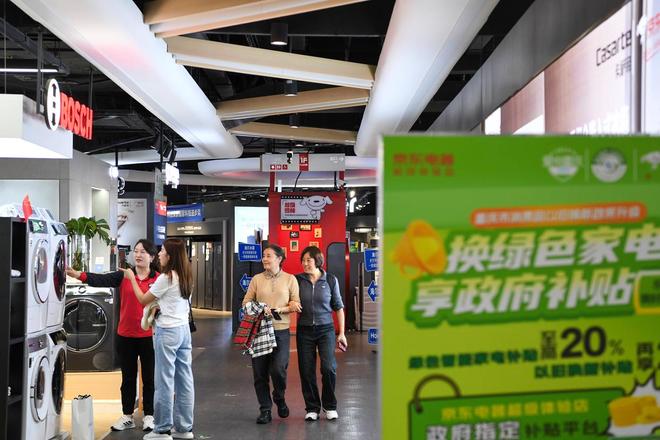
扩内需

Search documents
合百集团:公司产业覆盖零售业及农产品流通两大主业
Zheng Quan Ri Bao Zhi Sheng· 2025-10-21 11:38
Core Viewpoint - Company focuses on enhancing regional consumption vitality and releasing local consumption potential by aligning with national policies to promote consumption and expand domestic demand [1] Group 1: Company Overview - Company is a leading comprehensive commercial circulation enterprise in Anhui Province, covering two main industries: retail and agricultural product circulation [1] - Retail sector includes various sub-sectors such as department stores, home appliances, supermarket chains, e-commerce, and wholesale trade [1] Group 2: Strategic Focus - Company is deepening the layout of first stores and first launches while exploring innovative consumption scenarios based on regional consumption characteristics [1] - The strategy aims to actively contribute to enhancing regional consumption vitality and unlocking local consumption potential [1]

核心CPI温和上涨,消费向好积极信号|新京报快评
Xin Jing Bao· 2025-10-20 11:05
Core Insights - The article highlights the effectiveness of proactive fiscal policies in stimulating consumer demand in China, with a focus on the recent economic data released by the National Bureau of Statistics [2][3]. Economic Data Summary - In the first three quarters of this year, China's Consumer Price Index (CPI) slightly decreased by 0.1% year-on-year, while the core CPI, excluding food and energy, increased by 0.6%, with a notable rise of 1.0% in September, marking the first return to a 1% increase in nearly 19 months [2]. - Final consumption expenditure contributed 53.5% to economic growth, an increase of 9.0 percentage points compared to the previous year, reinforcing its role as a key driver of economic growth [2]. Policy Measures - The "Special Action Plan to Boost Consumption" was introduced in March, outlining 30 key tasks across eight areas, including actions to increase residents' income and enhance service consumption [3]. - The government allocated 300 billion yuan in special long-term bonds to support consumption, particularly through trade-in programs, which have led to double-digit growth in retail sales of household appliances and related goods [3]. Retail Performance - Retail sales of household appliances and audio-visual equipment increased by 4.4% year-on-year in the first three quarters, with a significant jump of 20.5% in September, marking a 17.1 percentage point acceleration from August [4]. - The automotive market is also showing signs of recovery, with over 8.3 million trade-in applications for vehicles submitted by September 10, averaging more than 30,000 applications per day [4]. Financial Policies - The central bank has implemented personal consumption loan interest subsidies and support for service industry loans, effectively reducing credit costs for residents and businesses, thereby stimulating consumption potential [4]. - There is a notable shift in consumer spending from goods to services, with service retail sales growing by 5.2% year-on-year in the first three quarters, outpacing goods retail sales [4]. Future Considerations - There is a need to solidify the foundation for consumer recovery, focusing on improving residents' income and optimizing income distribution to enhance consumption levels [5]. - Improving consumer expectations is crucial, as it significantly influences consumption decisions, and a coordinated policy framework is essential for maximizing the effectiveness of measures aimed at expanding domestic demand and promoting consumption [5].

A股这一板块,逆势加仓
Zheng Quan Shi Bao· 2025-10-17 08:58
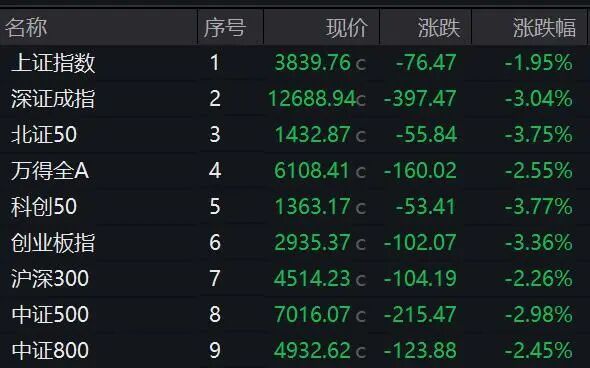
Market Overview - The financing net purchase in A-shares exceeded 14.4 billion yuan for the week, with the financing balance reaching a historical high of 2.44 trillion yuan [1][3] - The A-share market experienced adjustments due to external market volatility, with the Shanghai Composite Index failing to break through 3,900 points and the Shenzhen Component Index falling below 13,000 points [1][3] Index Performance - The Shanghai Composite Index closed at 3,839.76, down 76.47 points or 1.95% [2] - The Shenzhen Component Index closed at 12,688.94, down 397.47 points or 3.04% [2] - The ChiNext Index fell to 2,935.37, down 102.07 points or 3.36% [2] - The Hong Kong Hang Seng Index dropped 2.48% for the week, with a cumulative decline of 3.97% [2] Sector Analysis - The non-ferrous metals sector saw a net purchase of over 7.6 billion yuan, while the power equipment sector received over 2.7 billion yuan in net purchases [3] - The banking sector experienced a net outflow of over 1.3 billion yuan, while the food and beverage, home appliances, electronics, and automotive sectors also faced net outflows exceeding 1 billion yuan [3] - The banking sector was the only one to see a net inflow exceeding 12.3 billion yuan, with transportation and steel sectors also receiving significant inflows [3] Investment Trends - The banking sector's dividend yield median is 4.01%, with several banks exceeding 6% [6] - All bank stocks have a dynamic price-to-earnings ratio below 10, indicating a favorable long-term investment opportunity [6] - The coal sector has shown strength due to the onset of the heating season, with coal stocks experiencing significant price increases [4][8] Future Outlook - The "14th Five-Year Plan" is expected to drive sector rotation in the A-share market, with a focus on digital technology, space economy, and healthcare [3] - The coal industry is projected to maintain a balanced supply and demand, with potential price improvements expected due to seasonal demand [8]

绝味食品:一根鸭脖,“链”动万家灯火
Shang Hai Zheng Quan Bao· 2025-10-16 19:01
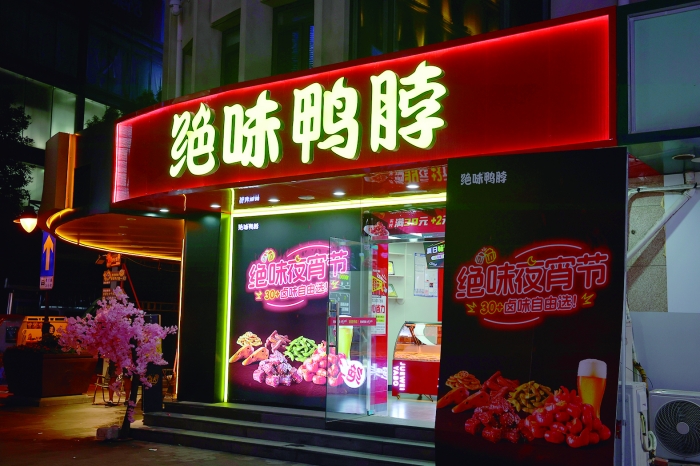
Core Insights - The article highlights the growth and strategic transformation of Juewei Foods, a leading player in China's marinated food industry, emphasizing its extensive network of stores and efficient supply chain management [2][3][5]. Group 1: Business Model and Operations - Juewei Foods has established a nationwide network of over ten thousand stores, enabling fresh food delivery directly to consumers, which is a core competency that has contributed to its growth as a "marinated food giant" [2]. - The company operates a modern supply chain that connects franchisees with standardized operations and brand support, creating a stable chain from centralized production to local sales [3]. - As of mid-2025, Juewei's franchise committee system has linked over 3,000 franchisees, providing a community-based economic model that attracts many small investors and entrepreneurs [4]. Group 2: Strategic Focus and Market Trends - Juewei Foods is shifting its strategy from "broad expansion" to "deep exploration" of the marinated food sector, focusing on understanding consumer needs and preferences in a competitive market [5]. - The company has invested 24.7 million yuan in R&D during the reporting period, a 9.44% increase year-on-year, to enhance its product offerings and improve customer engagement [6]. Group 3: Social Responsibility and Investor Relations - Juewei Foods emphasizes social responsibility by establishing long-term partnerships with suppliers, stabilizing raw material prices, and contributing to rural revitalization efforts [7]. - Since its listing, the company has distributed a total of 2.364 billion yuan in cash dividends to investors, demonstrating its commitment to sharing growth benefits [7]. Group 4: Consumer Experience and Innovation - The company aims to provide consumers with a seamless shopping experience through a membership-centric model that integrates online and offline channels [8]. - Juewei Foods is committed to exploring new consumption trends and enhancing its service model to resonate with regional economic development [8].

9月份核心CPI同比涨幅近19个月以来首次回到1%——部分领域市场供求关系逐步改善
Jing Ji Ri Bao· 2025-10-15 22:11
Core Insights - The consumer price index (CPI) showed a slight increase in September, with a month-on-month rise of 0.1%, marking a shift from the previous month where it was flat. The core CPI, excluding food and energy, rose by 1% year-on-year, the highest increase in 19 months, indicating a recovery in consumer prices [1][2][3] CPI Analysis - The year-on-year CPI decreased by 0.3%, but the decline was less severe than the previous month, narrowing by 0.1 percentage points. The drop was primarily due to the "carryover effect" from previous price changes, with food prices falling by 4.4% [2][3] - Food prices saw a month-on-month increase of 0.7%, driven by seasonal rises in fresh vegetables, eggs, fruits, lamb, and beef, while pork and aquatic product prices decreased due to sufficient supply [1][2] PPI Insights - The producer price index (PPI) remained flat month-on-month for two consecutive months, with a year-on-year decline of 2.3%, which is a reduction of 0.6 percentage points from the previous month. This decline is attributed to a low comparison base from the previous year and the positive effects of macroeconomic policies [3][4] - Certain industries, such as coal processing and black metal smelting, have shown price stabilization, with some experiencing price increases for two consecutive months [3][4] Market Dynamics - The ongoing construction of a unified national market has contributed to a narrowing of year-on-year price declines in various sectors. Improved market competition and capacity management have led to better price stability in industries like coal and photovoltaic equipment [4] - The upgrading of industrial structures and the release of consumer potential have driven price increases in specific sectors, such as aircraft manufacturing and specialized electronic materials, reflecting a shift towards higher-quality and upgraded consumption [4]
中国经济再现回暖信号 宏观政策发力持续转向扩内需
Di Yi Cai Jing· 2025-10-15 16:32
Group 1 - The continuous improvement of macro policies and financial support for the real economy has led to increased business activity and positive price changes in some industries, indicating a recovery in personal consumption and investment demand [1][6] - In September, the Consumer Price Index (CPI) and Producer Price Index (PPI) both showed a narrowing decline year-on-year, with the core CPI rising by 1%, marking the first return to this level in 19 months [2][4] - The PPI's year-on-year decline narrowed to 2.3%, with several industries showing positive price changes due to improved supply-demand structures and effective macro policies [4][5] Group 2 - The financial data released by the central bank indicates that the growth rates of broad money (M2) and social financing remain high, creating a favorable monetary environment for economic recovery [1][6] - As of the end of September, M2 balance reached 335.38 trillion yuan, with an 8.4% year-on-year growth, supported by proactive fiscal policies and moderately loose monetary policies [6][7] - The analysis suggests that the current economic challenge is not merely a lack of total demand but a structural imbalance, with excessive investment and insufficient consumption [7]
财经聚焦 | 核心CPI重回1% 9月物价数据透出哪些信号?
Xin Hua She· 2025-10-15 14:02
Group 1: Core CPI and Price Trends - The core CPI increased by 1% year-on-year in September, marking the first return to this level in 19 months and the fifth consecutive month of growth [1] - The overall CPI rose by 0.1% month-on-month, with food prices contributing significantly to this increase, particularly fresh vegetables, eggs, and meat [1] - Seasonal factors and holiday demand have driven up prices in certain categories, such as vegetables, which saw a price increase from 2.58 yuan/kg in August to 3.32 yuan/kg in September [1] Group 2: PPI and Market Dynamics - The Producer Price Index (PPI) decreased by 2.3% year-on-year in September, but the decline was less severe than in previous months, indicating a positive trend [3] - The reduction in PPI decline is attributed to improved macroeconomic policies and the ongoing development of a unified national market [3] - Certain industries, such as coal processing and black metal smelting, have shown signs of price stabilization, with coal processing prices rising by 3.8% month-on-month [3] Group 3: New Economic Drivers and Consumption Upgrades - Emerging industries are thriving, with new consumption patterns and business models contributing to positive price changes [4] - The manufacturing sector is experiencing a shift towards high-end, intelligent, and green development, leading to increased market demand and price growth in specific sectors, such as aircraft manufacturing [4] - Consumer demand is transitioning from quantity to quality, with significant price increases in sectors like arts and crafts, sports equipment, and nutritional foods [5]
核心CPI重回1%,9月物价数据透出哪些信号?
Xin Hua She· 2025-10-15 13:31
Group 1 - The core CPI has returned to 1%, marking the first increase in nearly 19 months, indicating a stable price environment supported by policies aimed at expanding domestic demand and promoting consumption [1] - In September, the CPI increased by 0.1% month-on-month, with food prices rising by 0.7%, contributing approximately 0.13 percentage points to the CPI increase [1] - Seasonal price increases were observed in fresh vegetables, eggs, fruits, lamb, and beef due to weather impacts and holiday demand [1] Group 2 - The PPI decreased by 2.3% year-on-year in September, with the decline narrowing by 0.6 percentage points compared to the previous month, reflecting the effectiveness of macroeconomic policies and the progress of a unified national market [3] - Improvements in supply and demand structures have led to price stabilization in certain industries, with coal processing prices rising by 3.8% and black metal smelting prices increasing by 0.2% [3] Group 3 - Emerging industries are thriving, with new consumption patterns and models driving positive price changes in related sectors [4] - The manufacturing sector is experiencing upgrades, with aircraft manufacturing prices increasing by 1.4% and electronic materials prices rising by 1.2% year-on-year [5] Group 4 - Consumer demand is shifting from quantity expansion to quality enhancement, with significant price increases in high-quality goods such as arts and crafts (14.7%) and sports equipment (4%) [6] - Policies aimed at boosting consumption are expected to further support the development of certain consumer goods and manufacturing sectors, improving market supply-demand relationships [6]
毛戈平、老铺黄金均涨超9%,消费板块投资机会来了?
Sou Hu Cai Jing· 2025-10-15 12:42
Core Viewpoint - The Hong Kong consumer sector has rebounded strongly due to market style switching and favorable policies, with various sub-sectors such as luxury goods, aviation, education, and new consumption showing active performance [2][3] Group 1: Market Performance - The consumer sector saw significant gains, with notable stocks like Guoquan (02517.HK) rising by 11.86%, Mao Ge Ping (01318.HK) by 9.71%, and China Eastern Airlines (00670.HK) by 9.27% [2] - Other strong performers included China Southern Airlines (01055.HK) up 7.98%, and Mijue Group (02097.HK) up 6.58% [2] Group 2: Policy Impact - The surge in the consumer sector was directly triggered by favorable policies announced during a meeting on October 14, emphasizing the need for effective counter-cyclical adjustments and resource utilization to boost domestic demand [3][4] - Ongoing policies such as "trade-in" programs and consumer loan subsidies have effectively activated market vitality [4] Group 3: Investment Insights - Analysts from Zhongyuan Securities noted that the food and beverage manufacturing sector has maintained high investment growth levels, significantly outpacing social investment growth [5] - The report highlighted production trends, indicating a contraction in the output of certain alcoholic beverages while cold fresh meat and edible oil production continued to grow [5] - Price trends showed increases in various food items, suggesting mild inflation in upstream sectors [5] Group 4: Future Consumption Trends - Guojin Securities indicated that Q4 is expected to see a convergence of style and policy in domestic consumption, with opportunities emerging for new consumption growth stocks [6] - The report suggested that the upcoming Double Eleven shopping festival will be a critical indicator for observing market trends [6][7]

避险情绪升温,机构仍看好中长期行情,港股红利ETF博时(513690)小幅上涨
Xin Lang Cai Jing· 2025-10-15 05:36
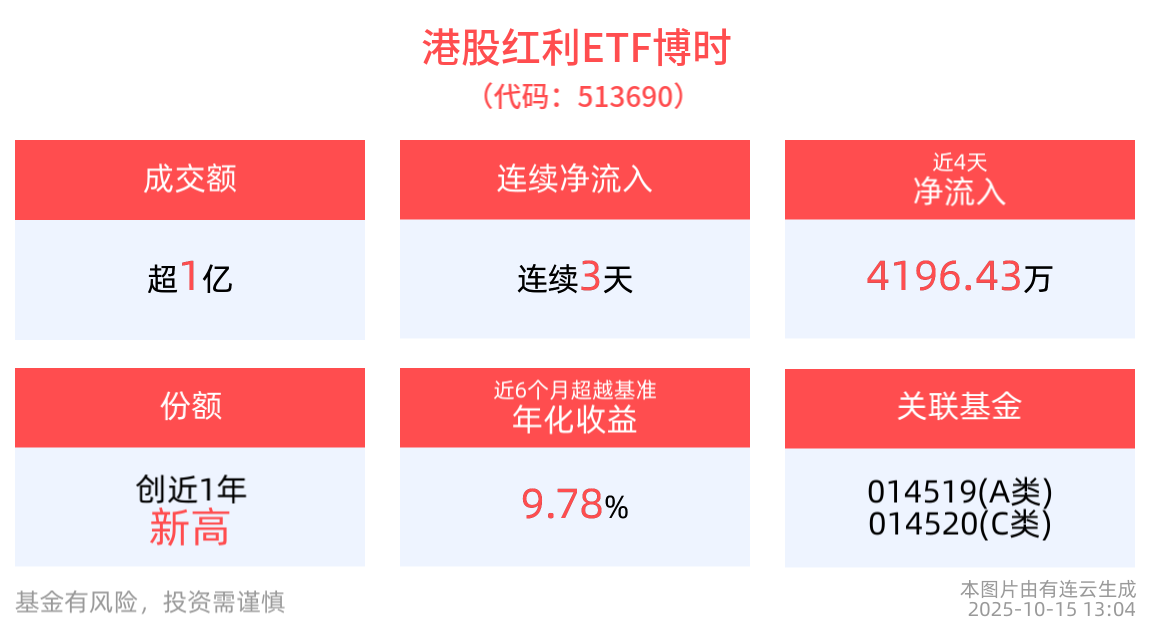
Market Performance - The Hang Seng High Dividend Yield Index increased by 0.30% as of October 15, 2025, with notable gains from Wan Zhou International (up 2.72%) and China Ping An (up 2.64%) [3] - The Hong Kong Dividend ETF (博时, 513690) rose by 0.19%, reaching a latest price of 1.08 CNY, with a cumulative increase of 1.13% over the past week [3] - The CSI Dividend Index experienced a slight decline of 0.01%, with mixed performance among constituent stocks [5] - The Large Cap Growth ETF (159203) decreased by 0.39%, with a latest price of 1.29 CNY, but showed a cumulative increase of 2.54% over the past month [5] Liquidity and Trading Volume - The Hong Kong Dividend ETF had a turnover of 2.01% and a transaction volume of 1.09 billion CNY, with an average daily transaction volume of 2.66 billion CNY over the past week [3] - The Large Cap Growth ETF recorded a turnover of 4.49% and a transaction volume of 679,800 CNY, with an average daily transaction volume of 802.88 million CNY over the past year [7] Economic Insights - A recent meeting emphasized the need to expand domestic demand and strengthen the domestic circulation to create new growth points [8] - The upcoming important meeting in late October is a critical time for the 14th Five-Year Plan, focusing on self-sufficiency and expanding domestic consumption [9] Market Sentiment and Trading Logic - On Monday, the market opened lower but closed higher, driven by optimistic expectations regarding trade negotiations, contrasting with the more cautious sentiment observed on Tuesday [10][11] - The trading logic on Tuesday reflected a recognition of the complexities and potential duration of current trade conflicts, suggesting a more cautious approach to investment strategies [11] Fund Performance and Composition - The Hong Kong Dividend ETF (博时, 513690) has a latest scale of 5.362 billion CNY and a record high of 5.008 billion shares [13][14] - The ETF closely tracks the Hang Seng High Dividend Yield Index, which includes high dividend-paying stocks, with the top ten stocks accounting for 28.98% of the index [15] - The Large Cap Growth ETF tracks the National Large Cap Growth Index, with its top ten stocks representing 48.85% of the index [16]