
滞胀

Search documents
三大“催化剂”引爆!黄金本轮牛市天高海阔
Jin Shi Shu Ju· 2025-09-05 08:21
Group 1 - The core viewpoint of the article highlights that gold has experienced a remarkable year, with futures surpassing $3600 per ounce for the first time, reflecting a 36% increase year-to-date, significantly outperforming the S&P 500's 10% return [2] - Three main catalysts are identified for the recent surge in gold prices, all related to investors seeking safe-haven assets [2] Group 2 - The first catalyst is the uncertainty surrounding Trump's tariffs, which could impose up to 39% tariffs on gold bars imported from Switzerland, a major gold producer. This has led to market speculation about the potential tax implications for U.S. citizens purchasing gold bars as a hedge against inflation [3] - The second catalyst is geopolitical tensions, particularly between the U.S. and Russia, which may escalate if peace negotiations fail, potentially increasing the risk premium on gold as a safe-haven asset [4] - The third catalyst is growing concerns about the strength of the U.S. economy, with signs of weakness in the job market and inflation indicators raising fears of stagflation, which could further support gold as a long-term safe-haven investment [5][6] Group 3 - Analysts predict that gold prices could reach $4000 by mid-next year, with potential for $5000 if concerns about the independence of the Federal Reserve escalate, leading to significant capital inflows into gold [6]
93%衰退风险!瑞银预警:美国经济已滑入疲软区域
Zhi Tong Cai Jing· 2025-09-04 07:24
Group 1 - UBS warns that the risk of a U.S. economic recession is as high as 93% based on "hard data" from May to July 2025, describing the current situation as "stable but high-risk" [1] - UBS does not formally predict a recession but expects weak economic growth in 2025, with a potential recovery in 2026 [1][3] - The yield curve inversion, currently at 23%, is a significant danger signal indicating pressure in the bond market, having persisted for several months and significantly higher than early 2025 levels [1] Group 2 - Analysts are increasingly seeing signs of an economic slowdown in 2025, aligning with UBS's warnings, indicating a "broad but not deep" stagnation rather than a sharp decline [2] - Key economic indicators such as employment and production have not shown a collapse below trend levels, which typically precedes a recession [2] - UBS conveys that the U.S. economy is experiencing slow growth or mild contraction rather than a sudden collapse, raising concerns about potential stagflation [2] Group 3 - Despite a 93% recession risk indicator, UBS has not officially predicted a recession, instead projecting a weak economic growth in 2025 and improvement in 2026 [3] - The overall probability of recession in July was assessed at 52%, up from 37% in January, a level historically associated with recessions [3] - Other experts, including Moody's Mark Zandi, warn that the U.S. is on the edge of recession, citing weak employment data and downward revisions similar to past recessions [3]

永赢基金刘庭宇:黄金有望重启上升行情 黄金股或持续跑赢金价
Zhi Tong Cai Jing· 2025-09-04 05:42
Group 1 - The current investment environment for gold stocks is favorable, with a potential continuation of the trend where gold stocks outperform gold itself. Valuations for gold stocks are considered reasonable, with room for recovery [1][3] - Since May, gold prices have been in a consolidation phase, absorbing negative impacts from recent U.S. economic data and trade tensions. As these negatives fade, the potential for interest rate cuts opens up, which could lead to an upward trend in gold prices [1] - The market has shown a 70% probability for a rate cut in September, although some Federal Reserve officials have maintained a hawkish stance, indicating that inflation must be fully addressed before any cuts are made. The upcoming speech by Powell at the Jackson Hole meeting is seen as a critical indicator for the September rate decision [1] Group 2 - Gold stocks have significantly outperformed gold prices since May, driven by a strong sentiment in the A-share market and the growth potential of gold mining companies, including increased production and profit growth from rising gold prices [2] - The performance forecasts for several gold mining companies in the first half of the year have been impressive, indicating that their growth has led to excess returns beyond gold price movements. This trend of gold stocks outperforming gold is expected to continue [3]
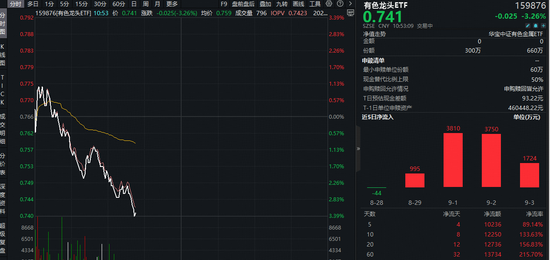
全球宽松+反内卷助攻,机构预测金价或超3730美元!有色龙头ETF(159876)近4日吸金1.03亿元,规模屡创新高
Xin Lang Ji Jin· 2025-09-04 03:10
Core Viewpoint - The recent performance of the non-ferrous metals sector shows a mixed trend, with significant inflows into the leading non-ferrous metals ETF, indicating investor interest despite market fluctuations [1][3]. Group 1: ETF Performance and Market Trends - The non-ferrous metals ETF (159876) experienced a decline of 3.26% amid market consolidation, but has seen a net inflow of 103 million yuan over the past four days, reaching a new high of 223 million yuan as of September 3 [1]. - The performance of constituent stocks is varied, with lithium industry leaders like Shengxin Lithium Energy and Tianqi Lithium rising over 2%, while copper industry leaders such as Baiyin Nonferrous and Luoyang Molybdenum fell over 8% [1]. Group 2: Economic and Market Drivers - Economic recovery expectations have not fully materialized for cyclical products, with future pricing likely driven by manufacturing demand for non-ferrous metals [3]. - Central bank gold purchases and geopolitical factors are contributing to a complex balance of bullish and bearish influences on gold prices, with predictions suggesting gold prices may exceed $3,730 by year-end [3][4]. Group 3: Company Earnings and Profitability - Among the 60 constituent stocks of the China Nonferrous Metals Index, 55 reported profits in the first half of the year, with a notable 91% profitability rate [4]. - Companies like Northern Rare Earth and Guocheng Mining reported staggering net profit growths of 1,951% and 1,111%, respectively, highlighting strong performance in the sector [4][6]. Group 4: Future Outlook - Analysts suggest that the combination of potential interest rate cuts by the Federal Reserve and domestic policies aimed at optimizing production factors will support metal price increases and improve market expectations [4][7]. - The non-ferrous metals sector is positioned for valuation recovery, with industrial metal valuations currently at low levels, indicating potential for upward adjustment [4][7].


中信证券:预测年底金价有望超过3730美元/盎司
Zheng Quan Shi Bao Wang· 2025-09-04 00:37
Core Viewpoint - Since the end of April, gold has been in a volatile market influenced by tariffs, U.S. fiscal policies, geopolitical factors, and central bank gold purchases, but changes in these factors may initiate an upward trend for gold prices [1] Group 1: Market Influences - Tariff expectations are likely to stabilize for the time being, while the impact of stagflation may just be beginning to manifest [1] - The likelihood of a significant decrease in geopolitical risks within the year is low [1] - The Federal Reserve may initiate an early curve rate cut [1] Group 2: Central Bank Actions - The trend of global central banks purchasing gold remains stable [1] Group 3: Price Predictions - Under a neutral assumption, the model predicts that gold prices could exceed $3,730 per ounce by the end of the year [1]

中信证券:预测年底金价有望超过3730美元
Mei Ri Jing Ji Xin Wen· 2025-09-04 00:37
Core Viewpoint - Since the end of April, gold has been in a volatile market, influenced by factors such as tariff impacts, U.S. fiscal policies, geopolitical tensions, and central bank gold purchases, creating a complex balance of bullish and bearish forces. However, changes in these factors may initiate an upward trend for gold prices [1] Group 1: Factors Influencing Gold Prices - Tariff expectations are likely to stabilize for the time being, while the effects of stagflation may just be beginning to manifest [1] - The likelihood of a significant decrease in geopolitical risks within the year is low [1] - The Federal Reserve may initiate early interest rate cuts [1] - The trend of global central banks purchasing gold remains stable [1] Group 2: Price Predictions - Under a neutral assumption, the model predicts that gold prices could exceed $3,730 per ounce by the end of the year [1]
BBMarkets蓝莓外汇:黄金再度爆发,背后原因是什么?
Sou Hu Cai Jing· 2025-09-03 08:06
Group 1 - Gold prices have gained significant attention, with spot gold surpassing $3,500 per ounce, reaching a high of $3,539.88, and closing at $3,533.40, reflecting an increase of over 1% [1] - Year-to-date, gold has risen by 34.5%, outperforming most other assets [1] - The recent rise in gold prices is attributed to poor U.S. economic performance, trade tensions, and global risk factors [1] Group 2 - The U.S. manufacturing sector has contracted for six consecutive months, with the ISM manufacturing PMI rising from 48.0 to 48.7 in August, still below the neutral level of 50, indicating ongoing contraction [2] - Manufacturing accounts for approximately 10.2% of the U.S. economy, and its decline is impacting employment, investment, and consumption [2] - High tariff policies are identified as a major factor, with average tariff levels reaching a century high, increasing costs for imported components and disrupting production plans for various sectors [2] Group 3 - The Federal Reserve's policy is expected to significantly influence gold prices, with a potential 25 basis point rate cut anticipated on September 17, totaling around 57 basis points for the year [4] - Non-farm payroll data will be a critical reference point, as weak data could elevate rate cut expectations [4] - Manufacturing data shows new orders rising to 51.4, but the production index has dropped to 47.8, indicating ongoing employment pressures and supply chain bottlenecks [4] Group 4 - The gold market is entering a seasonally active period, with SPDR Gold Trust holdings rising to 977.68 tons, the highest since August 2022, and silver prices reaching a 14-year high [6] - Despite a slightly stronger dollar, the overall trend remains weak, supporting gold prices [6] - Global factors, including European inflation nearing central bank targets, political instability in Japan, and fiscal issues in the UK, alongside U.S. economic slowdown and inflation pressures, are driving investors towards gold as a safe-haven asset [6]
美国制造业崩盘式萎缩,关税风暴下“避险之王”刷新历史高点
Sou Hu Cai Jing· 2025-09-03 03:40
Group 1: Gold Market Dynamics - Gold prices surged over 1% on September 2, reaching a historic high of $3539.88 per ounce, closing at $3533.40 per ounce, reflecting a 34.5% increase year-to-date, significantly outperforming other assets [1] - The rise in gold prices is attributed to the weak U.S. economy, trade policy uncertainties, and global geopolitical risks, with investors seeking safe-haven assets amid these challenges [1][4] - The demand for gold is further supported by central bank purchases and diversification away from the U.S. dollar, reinforcing its status as a reliable hedge against economic instability [6][10] Group 2: U.S. Manufacturing Sector - The U.S. manufacturing sector has been in decline for six consecutive months, with the August PMI slightly improving to 48.7 but still below the neutral level of 50, indicating ongoing contraction [3] - High tariff policies implemented by the Trump administration have led to increased costs for manufacturers, negatively impacting profit margins and employment in the sector [3][5] - Factory construction spending fell by 6.7% year-over-year in July, signaling a cooling investment sentiment within the manufacturing industry [3] Group 3: Economic Indicators and Market Reactions - The market anticipates a 90% probability of a 25 basis point rate cut by the Federal Reserve on September 17, with potential discussions for a 50 basis point cut if upcoming non-farm payroll data is weak [7][11] - The uncertainty surrounding tariffs has led to significant declines in stock markets, with the Dow Jones Industrial Average dropping 0.55% and the S&P 500 down 0.69% at the start of September [5] - Rising U.S. debt levels, now at $37.18 trillion, and concerns over fiscal deficits are contributing to increased yields in the bond market, further driving investors towards gold [5][6] Group 4: Global Economic Context - Global factors, including inflation concerns in the Eurozone and political instability in Japan and the UK, are contributing to a complex risk environment that supports gold's appeal as a safe-haven asset [10] - The interplay of stagnant economic growth and inflationary pressures, described as "stagflation," enhances gold's role as a hedge [10] - The upcoming release of U.S. economic data, including factory orders and job openings, will be critical in shaping market expectations and gold prices [11]
黄金今日行情走势要点分析(2025.9.3)
Sou Hu Cai Jing· 2025-09-03 01:03
Group 1: Fundamental Analysis - The U.S. manufacturing sector continues to shrink, with the August PMI at 48.7, indicating a contraction for six consecutive months, which raises recession risks [2] - The high tariff policies of the Trump administration have led to increased costs for imported components, with the average tariff rate reaching a century high, negatively impacting the business environment [2] - The recent court ruling questioning the legality of most tariff measures has heightened market concerns about deteriorating trade relations and reduced tariff revenue, leading to declines in major U.S. stock indices [2] Group 2: Market Reactions - The low manufacturing performance has intensified recession fears, prompting investors to shift towards safe-haven assets like gold [2] - The market anticipates a 90% probability of a 25 basis point rate cut by the Federal Reserve on September 17, with expectations of a total cut of 57 basis points for the year [3] - The global largest gold ETF, SPDR Gold Trust, has seen its holdings rise to 977.68 tons, the highest since August 2022, indicating strong demand for gold [3] Group 3: Technical Analysis - Gold prices have shown a strong bullish trend, achieving six consecutive days of gains, with the 5-day moving average acting as a crucial support level around 3480 [7] - Key support levels for gold are identified at 3500, 3480, and the 3470-3466 range, while resistance levels are noted at 3558, 3570, 3582, and 3606 [8][9] - The current market structure indicates a strong bullish sentiment, with no clear signs of a corrective phase, suggesting a continued focus on long positions [7]

英国财政“黑洞”吓坏市场!30年期国债惨遭抛售 英镑创6月17日以来最大单日跌幅
智通财经网· 2025-09-02 09:21
Group 1 - The UK 30-year government bond yield has risen to its highest level since 1998, reaching 5.69%, amid growing concerns over the sustainability of public finances [1] - The British pound has depreciated over 1%, marking its largest single-day decline since June 17, with the exchange rate against the US dollar falling to 1.33 and against the euro to 86.98 pence [1] - The UK government forecasts that fiscal spending will account for 60% of GDP, up from 53% during the pandemic, while revenue is expected to slightly decrease to below 40% of GDP, leading to a projected national debt of 274% of GDP by 2073 [1] Group 2 - Analysts express that the UK's fiscal situation remains precarious, with expectations of higher risk premiums for the pound as the autumn budget approaches [2] - The UK Chancellor, Reeves, faces immense pressure to address a projected £50 billion fiscal deficit, with expectations of potential tax increases despite warnings that this could further suppress economic growth [2] - Opposition parties argue that increasing taxes would worsen the situation, advocating for spending cuts instead [2] Group 3 - Economists warn that Reeves' tax and spending policies could lead the UK towards a debt crisis similar to the 1970s, potentially necessitating assistance from the International Monetary Fund (IMF) [3] - The retail sector is also raising alarms about rising taxes and administrative burdens pushing the UK into a "stagflation" era, with food price inflation expected to remain around 5% next year [3] - The former director of the National Institute of Economic and Social Research (NIESR) indicates that the current economic conditions could lead to a collapse, drawing parallels to the 1976 IMF intervention [3] Group 4 - A former member of the Bank of England's Monetary Policy Committee highlights that the current situation resembles the 1970s, suggesting that Reeves' fiscal policies could lead to a crisis similar to the 1976 Healey crisis [4] - The increase in public spending, borrowing, and taxes is seen as a driver of both demand-pull and cost-push inflation, raising concerns about potential economic collapse if policies do not change [4]