
高性能计算

Search documents
高性能计算群星闪耀时
雷峰网· 2025-08-18 11:37
Core Viewpoint - The article emphasizes the critical role of high-performance computing (HPC) in the development and optimization of large language models (LLMs), highlighting the synergy between hardware and software in achieving efficient model training and inference [2][4][19]. Group 1: HPC's Role in LLM Development - HPC has become essential for LLMs, with a significant increase in researchers from HPC backgrounds contributing to system software optimization [2][4]. - The evolution of HPC in China has gone through three main stages, from self-developed computers to the current era of supercomputers built with self-developed processors [4][5]. - Tsinghua University's HPC research institute has played a pioneering role in China's HPC development, focusing on software optimization for large-scale cluster systems [5][11]. Group 2: Key Figures in HPC and AI - Zheng Weimin is recognized as a pioneer in China's HPC and storage fields, contributing significantly to the development of scalable storage solutions and cloud computing platforms [5][13]. - The article discusses the transition of Tsinghua's HPC research focus from traditional computing to storage optimization, driven by the increasing importance of data handling in AI applications [12][13]. - Key researchers like Chen Wenguang and Zhai Jidong have shifted their focus to AI systems software, contributing to the development of frameworks for optimizing large models [29][31]. Group 3: Innovations in Model Training and Inference - The article details the development of the "Eight Trigrams Furnace" system for training large models, which significantly improved the efficiency of training processes [37][39]. - Innovations such as FastMoE and SmartMoE frameworks have emerged to optimize the training of mixture of experts (MoE) models, showcasing the ongoing advancements in model training techniques [41][42]. - The Mooncake and KTransformers systems have been developed to enhance inference efficiency for large models, utilizing shared storage to reduce computational costs [55][57].



2025 CCF全国高性能计算学术大会精彩启幕
Huan Qiu Wang Zi Xun· 2025-08-18 03:28
Core Insights - The "2025 CCF National High-Performance Computing Academic Conference" emphasizes China's leading position and strategic importance in the global high-performance computing (HPC) field [1][4] - The conference features discussions on autonomous innovation in computing power, green and efficient development, and deep integration of intelligent computing [1][4] - A total of 43 thematic forums were held, marking a record high for the event, showcasing a diverse range of topics including AI, big data, cloud computing, and quantum computing [4][5] Industry Developments - Key reports presented at the conference highlighted the strategic value of HPC in various sectors, from deep space exploration to AI applications [1][2] - The conference encouraged young scholars to participate, aiming to broaden their innovative research boundaries and promote collaboration between academia and industry [3] - Notable advancements in HPC applications were showcased in fields such as chemical simulation, nuclear engineering, climate prediction, and aerospace materials [2][3] Technological Innovations - Reports discussed the importance of selecting cost-effective computing resources to enhance computational efficiency and reduce time and costs [2] - Various teams presented breakthroughs in large-scale virtual molecular screening, high-fidelity simulations for nuclear reactors, and AI-enabled earth system modeling [3] - The conference served as a platform for sharing insights on the integration of HPC with emerging technologies, fostering a collaborative environment for innovation [4][5]
澜起科技重磅发布全新第六代津逮®性能核CPU
半导体行业观察· 2025-08-15 01:19
Core Viewpoint - The launch of the sixth-generation Jindai® performance core CPU (C6P) by Lanke Technology is driven by the dual demands of digital transformation and data security, aiming to provide powerful computing capabilities for data centers, artificial intelligence, cloud computing, and critical industry infrastructure [1][11]. Group 1: Product Features - C6P features an advanced architecture design, supporting up to 86 high-performance cores and 172 threads, with a maximum L3 cache capacity of 336 MB, catering to high-density computing scenarios [3]. - The product supports single and dual-socket deployments, utilizing four UPI interconnect channels with a maximum speed of 24 GT/s for efficient multi-processor collaboration [3]. - The memory subsystem employs an 8-channel DDR5 architecture, supporting up to 6400 MT/s for RDIMM or 8000 MT/s for MRDIMM, significantly enhancing memory bandwidth and scalability for AI training and big data analysis [3]. Group 2: Connectivity and Compatibility - C6P offers 88 PCIe® 5.0 lanes and is compatible with CXL® 2.0 protocol, providing excellent connection bandwidth for GPUs, FPGAs, and other accelerators [5]. - The CPU uses the same packaging and pin design as Intel Xeon® 6 processors, fully supporting the X86 instruction set, allowing seamless migration of existing applications without modification, thus reducing system upgrade costs and complexity [7]. Group 3: Security Enhancements - The security performance of C6P has been comprehensively upgraded, integrating data protection and trusted computing acceleration features, supporting data encryption and decryption algorithms, and establishing a robust security barrier at the chip level [9]. - This security framework effectively defends against data breaches and malicious tampering, providing high-standard privacy protection and compliance solutions for critical industries such as finance, government, and healthcare [9]. Group 4: Strategic Vision - The release of C6P signifies a dual breakthrough in high-performance computing and security needs, maintaining the familiar X86 development ecosystem while offering high cost-performance options through security modules and customized performance tuning [11]. - Lanke Technology is actively building an open collaborative Jindai® ecosystem, participating in mainstream open-source operating system communities and achieving broad compatibility certification with major cloud service providers, database vendors, and core hardware suppliers [11].


海外龙头及国产代工最新业绩总结,关注旺季下的涨价、扩产、复苏
Tianfeng Securities· 2025-08-12 04:13
Investment Rating - Industry Rating: Outperform the Market (maintained rating) [8] Core Insights - The semiconductor industry continues to show optimistic growth trends driven by AI and high-performance computing, with strong demand for HBM, AI chips, and edge AI hardware [2][19] - The storage market is expected to see sustained price increases in the second half of the year, with strong demand for HBM and DDR5, while DDR4 supply remains tight [2][19] - Foundry services are optimistic, with expectations of price increases and capacity expansion, particularly for companies like Huahong and SMIC [2][19] Summary by Sections 1. Overseas Leaders and Domestic Foundry Performance - AI and high-performance computing remain core growth drivers, with strong demand for HBM and AI chips [2] - NAND Flash market is expected to see price increases due to production cuts and strong AI demand [2][19] - Foundry sector shows optimism with price increases and capacity expansion, particularly for Huahong and SMIC [2][19] 2. Wafer Manufacturing - SMIC's Q2 capacity utilization was 92.5%, with a revenue of $2.209 billion, expected to grow by 5%-7% in Q3 [3][20] - Huahong's Q2 revenue was $566.1 million, with a capacity utilization of 108.3% and a strong demand for power devices [3][20] - TSMC's revenue in July reached NT$323.166 billion, with strong AI chip demand and advanced process capacity remaining tight [3][20] 3. IDM and Advanced Logic Chips - Intel's Q2 revenue was $12.9 billion, with a net loss of $2.92 billion, while Qualcomm's Q3 net profit was $2.666 billion, driven by automotive and IoT business [4][30] - AMD's Q2 net profit surged to $872 million, with strong client segment performance, while MediaTek's Q2 revenue was NT$150.336 billion [4][30] 4. Storage Chips - Samsung's Q2 storage revenue was 21.2 trillion KRW, with HBM3E sales increasing to over 80% of total HBM sales [5][50] - SK Hynix's Q2 revenue was 22.232 trillion KRW, with a net profit of 6.996 trillion KRW, driven by strong NAND and DRAM demand [5][56] 5. Analog Chips - Texas Instruments reported Q2 revenue of $4.45 billion, with a net profit of $1.3 billion, driven by stable industrial and automotive demand [5][18] 6. IP Licensing and Design Services - Arm's FY2026 Q1 revenue was $1.053 billion, driven by demand from AI and data centers [5][18] 7. Overall Industry Outlook - The global semiconductor market is expected to maintain optimistic growth in 2025, driven by AI and domestic substitution efforts [6][19] - The storage sector is projected to see significant price increases in Q3 2025, with strong quarterly performance from leading companies [6][19]

工业富联(601138.SH)发布半年度业绩,归母净利润121.13亿元,同比增长38.61%
智通财经网· 2025-08-10 08:03
Group 1 - The company reported a revenue of 360.76 billion yuan for the first half of 2025, representing a year-on-year growth of 35.58% [1] - The net profit attributable to shareholders reached 12.113 billion yuan, an increase of 38.61% year-on-year, with a basic earnings per share of 0.61 yuan [1] - The company's core business demonstrated strong growth momentum, with both order scale and value increasing significantly [1] Group 2 - In the cloud computing sector, the product structure continued to optimize, with the proportion of AI servers steadily increasing [1] - Overall server revenue grew by over 50% in the second quarter, while revenue from cloud service provider servers increased by over 150% year-on-year, and AI server revenue rose by over 60% [1] - The GB200 series products achieved mass production with improving yield rates and increasing shipment volumes [1] Group 3 - In the precision components business, the shipment volume increased by 17% year-on-year, benefiting from the hot sales of specific models [2] - The high-end smartphone market trend is expected to continue, with GenAI and foldable devices providing new growth momentum for the industry [2] - Revenue from 800G high-speed switches nearly tripled compared to the entire year of 2024, indicating strong demand in the market [2] Group 4 - The company strengthened its market share among core customer groups through deepened cooperation and optimized product structure [2] - The company is expanding its global production capacity and integrating industry chain resources to enhance its delivery capabilities [2] - The company is reinforcing its competitiveness in the global high-performance computing and AI infrastructure sectors [2]

UCIe 3.0来了:Chiplet互连速度翻倍
半导体行业观察· 2025-08-09 02:17
Core Viewpoint - The demand for Chiplet architecture is increasing due to advancements in cloud computing, high-performance computing (HPC), and artificial intelligence (AI), alongside rising technical challenges and costs in semiconductor design and manufacturing [1][3]. Group 1: UCIe Alliance and Standards - The Universal Chiplet Interconnect Express (UCIe) Alliance was established in 2022 by major semiconductor companies and cloud service providers to create standardized interconnect specifications for Chiplets, enhancing flexibility, efficiency, and customization [1]. - UCIe 3.0 was recently launched, featuring enhancements in power efficiency and management while maintaining backward compatibility, and it supports data rates of 48 GT/s and 64 GT/s, doubling the bandwidth of the previous UCIe 2.0 [3][5]. Group 2: Performance and Applications - The performance improvements in UCIe 3.0 are particularly aimed at meeting the "insatiable demand for high bandwidth" in rapidly expanding fields such as AI, HPC, and data analytics, where interconnect boundary lengths are limited [3][5]. - The new data rates apply to both UCIe-S (2D standard packaging) and UCIe-A (2.5D advanced packaging) designs, addressing the need for higher throughput within constrained interconnect boundaries [5][9]. Group 3: Technical Specifications - UCIe 3.0 introduces new data rates of 48 GT/s and 64 GT/s, with specific characteristics for UCIe-S and UCIe-A, including bandwidth density and power efficiency targets [9]. - The standard maintains backward compatibility to ensure seamless integration with existing systems and infrastructure, allowing for a smooth transition for system designers and developers [7][9]. Group 4: Broader Implications - The Chiplet architecture is becoming ubiquitous across various sectors, including mobile devices, PCs, and automotive applications, with UCIe expected to cover a complete computing continuum from handheld devices to data centers [10]. - UCIe 3.0 also includes improvements such as runtime recalibration for low-power link tuning and more flexible Session Initiation Protocol (SIP) topologies, enhancing its applicability in new interconnect scenarios [10].



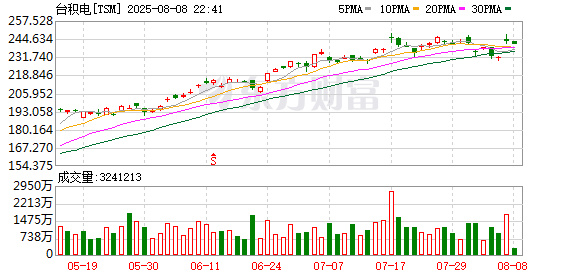
台积电泄密风波引关注 全球2纳米工艺规模量产在即
Zhong Guo Jing Ying Bao· 2025-08-08 14:41
Group 1: TSMC's 2nm Process Leak Incident - TSMC announced a leak of confidential information related to its 2nm chip process, resulting in the dismissal of involved employees and the initiation of legal proceedings [2] - TSMC's 2nm process is expected to enter mass production in the second half of this year, with the A20 chip for the iPhone 18 series being one of its first applications [2] - TSMC's 2nm process has achieved a yield rate exceeding 80%, which is sufficient for mass production and revenue generation [2][3] Group 2: Competitive Landscape - TSMC holds a significant market share of approximately 67.6%, while Samsung has about 7.7%, highlighting the competitive gap [3] - Samsung plans to start mass production of its 2nm process in the first half of 2026, despite initial yield rates being lower than TSMC's [3][5] - Intel aims to disrupt the market with its 18A process, which is equivalent to 1.8nm, but faces challenges with yield rates and production timelines [6][7] Group 3: Market Outlook and Applications - The global market for 2nm and similar processes is projected to exceed $50 billion by 2025, with an annual growth rate of over 20% [5] - The introduction of 2nm technology is expected to benefit downstream applications, particularly in consumer electronics, AI, and IoT [8][9] - Companies like Apple and NVIDIA are anticipated to leverage 2nm chips for enhanced performance in their next-generation products [8][9]
CCF HPC China 2025即将举行
Huan Qiu Wang Zi Xun· 2025-08-07 06:50
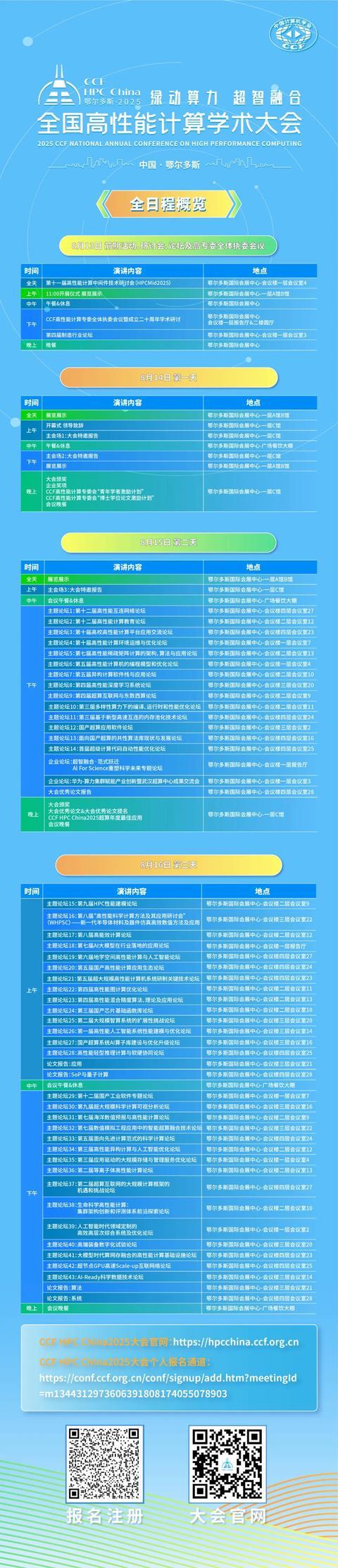
Core Insights - The 21st CCF National High-Performance Computing Academic Conference (CCF HPC China 2025) will be held from August 13-16 at the Ordos International Convention and Exhibition Center, focusing on the theme "Green Computing, Super Intelligence Integration" [1] - The conference aims to create a platform for high-performance computing exchange, featuring academic discussions, results showcases, and ecosystem connections [1] Group 1: Academic and Industry Highlights - The conference will gather over 20 invited guests, 40 high-quality thematic forums, and more than 500 speakers, including Turing Award winners and academicians, focusing on breakthroughs in high-performance computing across various fields [2] - Nearly 100 leading global companies in the computing power sector will exhibit, showcasing technologies across the entire chain, including chips and supercomputing centers, with Huawei and Sugon presenting case studies [2] - The WEC 2025 computing power industry panorama will be released, covering dozens of sub-field ecological maps and providing free access for participants to connect and collaborate across the industry chain [2] Group 2: Conference Schedule and Structure - The conference spans four days, with a detailed schedule to help participants plan their attendance effectively [2] - Various thematic forums will be held, covering topics such as high-performance computing education, application exchanges, and optimization techniques [6][8] - The event will also feature awards for outstanding papers and applications, promoting recognition within the high-performance computing community [6][8] Group 3: Exhibition Information - Over 60 companies will participate in the exhibition, located in the AB halls of the Ordos International Convention and Exhibition Center, accessible with conference credentials [11] - Participants can register for free to access the exhibition area, highlighting the event's focus on industry engagement and collaboration [11]
2025年全球纯晶圆代工营收预计同比增长17%,受AI与高性能计算芯片驱动
Counterpoint Research· 2025-08-07 01:03
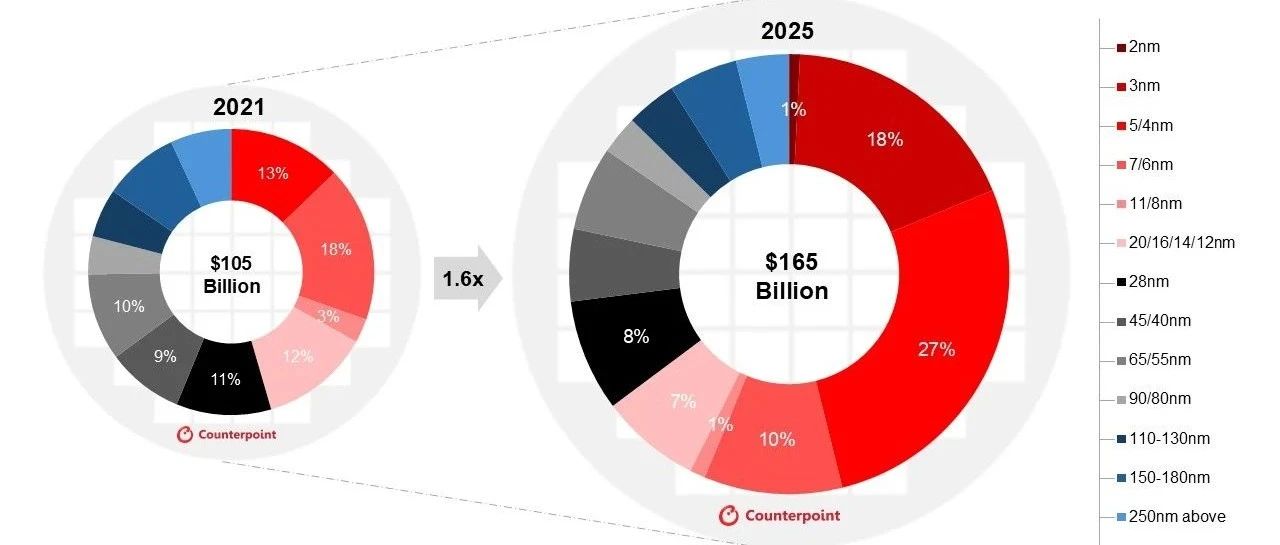
Core Viewpoint - The global pure foundry industry is projected to achieve a revenue of $165 billion by 2025, reflecting a 17% year-on-year growth and a compound annual growth rate (CAGR) of 12% from 2021 to 2025, driven by advanced nodes like 3nm and 5/4nm [4][8]. Industry Summary - The revenue from the global pure foundry market is expected to reach a historical high of $165 billion in 2025, compared to $105 billion in 2021, indicating a strong growth trajectory [8]. - Advanced process nodes (7nm and below) are anticipated to contribute over 56% of total revenue by 2025, fueled by demand for AI smartphones, high-performance computing (HPC), and server chips [8]. - The introduction of the 2nm process is expected to further tilt the revenue structure towards advanced nodes, with projections indicating that it will contribute over 10% of revenue by 2027 [8][9]. Node-Specific Insights - The 3nm node is expected to see a revenue increase of over 600% by 2025, reaching approximately $30 billion, while the 5/4nm nodes are projected to exceed $40 billion in revenue [4]. - The 20-12nm node range is expected to remain stable, contributing about 7% of total revenue, reflecting a transition of some chips from mature nodes to intermediate nodes [7]. - The 28nm node is highlighted as a standout among mature nodes, with an expected CAGR of 5%, despite the overall revenue share of mature nodes declining from 54% in 2021 to 36% in 2025 [9]. Competitive Landscape - TSMC is expected to be the largest beneficiary in the advanced node sector, followed by Samsung and Intel, while UMC, GlobalFoundries, and SMIC will continue to benefit from stable market demand, albeit at a slower growth rate [9]. - Innovations in front-end process technologies, such as High-NA EUV, and advancements in back-end packaging technologies are creating diverse opportunities for foundries [9].
AMD20250806
2025-08-06 14:45
Summary of AMD Conference Call Company Overview - **Company**: AMD (Advanced Micro Devices) - **Quarter**: Q2 2025 - **Revenue**: $7.7 billion, a record high, up 32% year-over-year [2][3][22] Key Points Financial Performance - **Revenue Growth**: Achieved a record revenue of $7.7 billion, driven by strong sales in EPYC processors and data center business [2][3][22] - **Gross Margin**: Reported a gross margin of 54%, marking the sixth consecutive quarter of year-over-year gross margin expansion [3][22] - **Free Cash Flow**: Generated over $1 billion in free cash flow [3] - **Operating Income**: $897 million, representing 12% of revenue [22] Data Center Business - **Revenue**: Data center revenue grew 14% year-over-year to $3.2 billion, despite a $155 million operating loss due to MI308 export restrictions [2][5][23] - **AI Business**: The data center AI segment faced challenges due to export restrictions, but MI300 and MI325 series products showed good progress with new contracts signed [10][4] - **EPYC Demand**: Strong demand for EPYC processors, particularly in cloud computing and enterprise workloads [5][23] Client and Gaming Segments - **Client Revenue**: Client segment revenue reached $2.5 billion, up 67% year-over-year, driven by record desktop CPU sales [17][25] - **Gaming Revenue**: Gaming segment revenue increased 73% to $1.1 billion, supported by strong demand for custom chips for next-gen consoles and new GPU launches [19][24] Future Outlook - **Q3 2025 Revenue Guidance**: Expected revenue of approximately $8.7 billion, a year-over-year increase of about 28% [4][29] - **Product Development**: Actively developing the next-generation MI400 series GPUs, expected to deliver up to 40 petaflops of AI computing power [4][13] - **Helios Platform**: Introduction of Helios, a full-stack AI platform expected to provide a tenfold performance leap for advanced models [14] Market Dynamics - **Telecom Sector**: KDDI and Nokia are deploying EPYC processors for 5G networks, enhancing AMD's presence in the telecom industry [6] - **Embedded Business**: Revenue declined 4% to $824 million, but demand is gradually recovering [20][26] Strategic Initiatives - **Acquisitions**: Completed the acquisition of ZT Systems and announced the divestiture of ZT manufacturing business [27][47] - **Cash Management**: Generated $1.5 billion in cash from operations, with a total cash and short-term investments of $5.9 billion [28] Regulatory Challenges - **Export Licenses**: Working with the U.S. Department of Commerce to secure MI308 export licenses to China, with ongoing reviews impacting revenue guidance [16][31] Competitive Position - **High-Performance Computing**: AMD powers over one-third of the world's fastest supercomputers, showcasing its performance and efficiency advantages [9][10] AI and Software Developments - **Rockem Software**: Significant improvements in performance and usability, with the latest version showing over threefold increases in inference and training performance [11][12] Additional Insights - **Market Share**: Positive outlook on server CPU market share growth, particularly in traditional enterprise servers [44] - **Customer Engagement**: Strong interest from customers in MI400 and Helios platforms, indicating a robust pipeline for future growth [38][42] This summary encapsulates the key insights and developments from AMD's recent conference call, highlighting the company's strong financial performance, strategic initiatives, and future outlook in the competitive landscape.