
高水平对外开放

Search documents
【权威访谈】扎实推动经济高质量发展
Yang Shi Wang· 2025-11-16 12:07
Core Viewpoint - The "14th Five-Year Plan" emphasizes promoting high-quality development as the central theme for economic and social development during this period [1][3]. Group 1: High-Level Opening Up - The plan outlines a series of important deployments to expand high-level opening up, aiming to create a new situation of win-win cooperation [3]. - It emphasizes the necessity of open cooperation and mutual benefit as an inevitable requirement for Chinese-style modernization [3]. Group 2: Agricultural and Rural Modernization - The plan highlights the importance of accelerating agricultural and rural modernization, promoting comprehensive rural revitalization, and ensuring urban-rural integration [5]. - It stresses the need to consolidate and expand the achievements of poverty alleviation and to push for rural areas to meet modern living conditions [5]. - The goal is to build a strong agricultural nation and ensure sustainable and healthy economic development as a key focus for the current and future economic construction [5].


上海打开高水平对外开放新天地(活力中国调研行)
Ren Min Ri Bao· 2025-11-15 21:51
Core Insights - Shanghai is positioning itself as a global hub for trade and investment, emphasizing its role in international economic integration and reform [3][4][8] Group 1: Economic Performance and Trade - The Yangshan Port automated terminal efficiently handles hundreds of containers every minute, showcasing Shanghai's strong global resource allocation capabilities [2] - In the first three quarters of this year, automobile exports from the Waigaoqiao Port area increased by 14.2%, with new energy vehicles accounting for over 60% of exports [5] - The Shanghai International Commodity Fair has established a year-round trading platform, with over 6000 brands from more than 120 countries, achieving a transaction volume exceeding 30 billion yuan last year [4] Group 2: Foreign Investment and Corporate Presence - Shanghai is home to 80,000 foreign enterprises, attracting over 10% of the country's actual foreign investment, contributing approximately one-third of the city's tax revenue and one-fourth of its GDP [4] - Standard Chartered Bank views China as a key development focus, actively participating in various financial projects in Shanghai, including being the first foreign bank approved for participation in China's government bond futures trading [4] Group 3: Innovation and Technology - Companies like Qianlong Technology are adapting their products for international markets, benefiting from Shanghai's comprehensive industrial chain that allows for rapid product iteration [5] - Schneider Electric's factory in Putuo District serves as both a production and incubation base, launching global solutions from Shanghai [6] Group 4: Regulatory Environment and Policy Initiatives - The Shanghai Data Exchange has established a cross-border data trading rule system, with transaction volumes exceeding 3 billion yuan in the first half of this year [7] - The government is implementing significant reforms to enhance the business environment, including a new international business cooperation zone aimed at facilitating trade and investment [7][8]
前三季度出口增速全省第一 解锁济源外贸背后的服务密码
He Nan Ri Bao· 2025-11-14 23:32
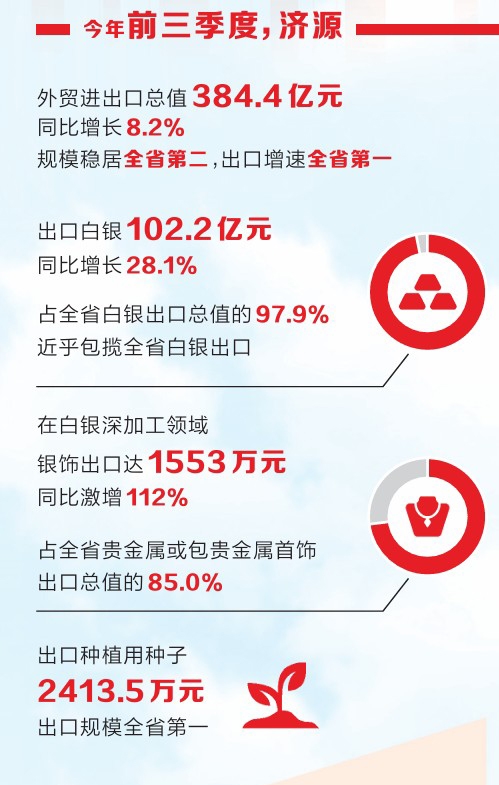
Group 1 - The total import and export value of Jiyuan in the first three quarters reached 38.44 billion yuan, a year-on-year increase of 8.2%, ranking second in the province, with the highest export growth rate in the province [2] - Jiyuan exported silver worth 10.22 billion yuan, a year-on-year increase of 28.1%, accounting for 97.9% of the province's total silver exports [2] - The export of silver jewelry reached 15.53 million yuan, a significant increase of 112% year-on-year, representing 85.0% of the province's total exports of precious metal or semi-precious metal jewelry [2] Group 2 - Jiyuan's export of planting seeds amounted to 2.4135 million yuan, ranking first in the province, with Qingyin Seed Industry becoming a key player in "Jiyuan Good Seeds" [2] - Jiyuan Sunshine Food Co., Ltd. received official registration approval from the EU, achieving a breakthrough in rabbit meat exports to the EU, with an additional export value of 2.51 million yuan this year [2] Group 3 - The impressive foreign trade performance is attributed to Jiyuan's focus on characteristic development and optimized industrial layout, along with the Jiyuan Customs' precise support for local advantageous industries [3] - Jiyuan Customs has implemented customized services for key agricultural industries, reducing average customs clearance time by over 30% and resolving over 20 export-related issues for agricultural enterprises this year [3] - For the silver industry, Jiyuan Customs has tailored solutions to enhance customs efficiency, helping enterprises transition from raw silver to high-end jewelry for international markets [3] Group 4 - The 20th Central Committee of the Communist Party of China emphasized expanding high-level opening-up and creating a new situation of win-win cooperation, which Jiyuan Customs aims to implement by optimizing regulatory services and supporting more "Jiyuan-made" products to enter the global market [4]
“中国在科技领域取得的进步令人印象深刻”——访泰国副总理波汶萨
Ren Min Wang· 2025-11-14 14:45
Core Points - The Thai Deputy Prime Minister, Prawit Wongsuwan, emphasized the long-standing friendship between Thailand and China, highlighting the recent state visit of Thai King Vajiralongkorn to China as a significant event in bilateral relations [1] - The relationship is deeply rooted in cultural ties, with many Thai citizens having Chinese ancestry, which strengthens the sentiment of "Thailand and China as one family" [1] - China is a crucial trade partner for Thailand, with an increasing number of Thai consumers choosing high-quality Chinese products [1] - There is significant potential for cooperation in technology sectors such as biotechnology, artificial intelligence, and communication technology between Thailand and China [1] Youth and Education - The youth of both countries are seen as the future of Thailand-China relations, with increased exchanges fostering closer ties [2] - Thai students are increasingly choosing to study in China, reflecting deepening educational cooperation [2] - Prawit Wongsuwan praised China's commitment to high-level openness and modernization, which serves as a model for Thailand [2] Multilateralism and Future Cooperation - Prawit Wongsuwan advocated for multilateralism in international relations, opposing unilateralism and protectionism [2] - The year marks the 50th anniversary of diplomatic relations between Thailand and China, presenting an opportunity to strengthen bilateral ties [2]
欧洲和拉美多国人士积极评价中国未来五年发展新蓝图
Yang Shi Xin Wen Ke Hu Duan· 2025-11-14 13:05
近日,德国、意大利、巴西、波兰、匈牙利、塞尔维亚、黑山、保加利亚、阿尔巴尼亚、希腊等欧洲和拉美国家政要、专家学者和意见领袖在接受总台采访 中,积极评价四中全会为中国未来五年发展擘画宏伟蓝图,为全球发展注入更多确定性,期待中国与世界各国共享发展新机遇。 波兰前副总理雅努什·皮耶霍钦斯基在接受专访时指出,过去十年,中国取得的绿色发展成就举世瞩目,已成为全球可再生能源生产与绿色技术创新的领导 者。他强调,绿色经济是国际合作的桥梁,中波双方要在合作基础上共同构建开放包容的绿色发展体系,携手打造"绿色丝绸之路",推动中国—中东欧国家 间在新能源、环保技术和清洁工业等领域的深度合作。 △波兰前副总理雅努什·皮耶霍钦斯基 △德国前国会议员扎克林·纳斯蒂奇 德国前国会议员扎克林·纳斯蒂奇指出,近年来中国取得的成功不仅为全球南方国家提供了发展范例,也为德国增强经济活力提供了有益经验。她认为,德 国各党派应着眼中国发展的有益经验,聚焦数字经济、人工智能等关键领域,弥补当前发展短板。 △保加利亚国会议员、复兴党主席科斯塔丁·科斯塔迪诺夫 保加利亚国会议员、复兴党主席科斯塔丁·科斯塔迪诺夫表示,鉴于中国在"十四五"期间取得的成就,有 ...

以开放促发展 以合作谋共赢 从第八届进博会看中国对外开放新实践
Jin Rong Shi Bao· 2025-11-14 02:03
对外开放是中国的基本国策。长期以来,中国坚持开放合作、互利共赢,为全球经济增长作出了重要贡 献。 正是因为进博会坚持平等互利原则,因此对众多展客商都具有强大的吸引力。 "本届进博会共组建43个交易团和700多个交易分团。"吴政平介绍说,进博会期间,重要采购商选品会 开展农食、消费品和医疗领域对接1300轮次;贸易投资对接会吸引超过5000家企业和园区,达成合作意 向超300项;集中签约活动达成合作意向近600项。 党的二十届四中全会审议通过的《中共中央关于制定国民经济和社会发展第十五个五年规划的建议》提 出,扩大高水平对外开放,开创合作共赢新局面。稳步扩大制度型开放,维护多边贸易体制,拓展国际 循环,以开放促改革促发展,与世界各国共享机遇、共同发展。积极扩大自主开放。推动贸易创新发 展。拓展双向投资合作空间。高质量共建"一带一路"。 第八届中国国际进口博览会(以下简称"进博会")是党的二十届四中全会胜利召开后举办的首场重要经 济外交活动。《金融时报》记者在11月10日召开的进博会闭幕新闻通气会上了解到,本届进博会成交活 跃,按一年计意向成交额达834.9亿美元,比上届增长4.4%,创历史新高。 "与此同时,第 ...
推动大宗商品跨境电商迈向全球资源配置枢纽
Qi Huo Ri Bao Wang· 2025-11-14 01:17
Core Insights - The recent proposal from the Central Committee emphasizes support for the development of new business models such as cross-border e-commerce, injecting new momentum into the transformation and upgrading of bulk commodity cross-border e-commerce [2] - The development path for bulk commodity cross-border e-commerce during the 14th Five-Year Plan period needs to align with the dual goals of "high-quality development" and "high-level security" [2] Policy Positioning - Bulk commodities are essential for industrial production, and their cross-border circulation efficiency directly impacts the stability of the industrial chain and national economic security [3] - The proposal marks a shift in the role of bulk commodity cross-border e-commerce from a digital supplement to traditional trade to a "strategic infrastructure" within the national trade promotion system [3] Theoretical Foundations - The integration of "factor market-oriented allocation reform" and "high-level opening-up" is crucial for this transition [4] - Cross-border e-commerce platforms can leverage digital technologies like blockchain and smart contracts to overcome traditional trade barriers, enhancing the efficiency of global resource matching [4] Industry Integration - The proposal links the cultivation of emerging industries with the promotion of cross-border e-commerce, supporting innovation in product categories and value chain elevation [5] - The emphasis on "internal and external trade integration" aims to unify quality certification, logistics fulfillment, and credit evaluation systems, enhancing the global competitiveness of Chinese bulk commodity enterprises [5] Global Value Chain Reconstruction - The core competitiveness of bulk commodity cross-border e-commerce will shift from relying on "traffic dividends" to a "data-driven efficiency revolution" during the 14th Five-Year Plan period [8] - The integration of technologies such as blockchain, artificial intelligence, and digital twins will address traditional trade pain points, enhancing decision-making and operational efficiency [8][9] Conclusion - The development logic of bulk commodity cross-border e-commerce has evolved beyond traditional trade, deeply integrating with national modernization strategies, the dual circulation model, and digital China initiatives [10] - The elevation of policy positioning, deepening industry integration, and reconstruction of the global value chain will collectively drive the industry from a "scale-oriented" to a "value-oriented" approach, ultimately becoming a strategic pillar for ensuring supply chain security and enhancing global resource allocation capabilities [10]

中金 | 深度布局“十五五”:软件和电信服务
中金点睛· 2025-11-14 00:18
Core Viewpoint - The article emphasizes the strategic importance of technological self-reliance and innovation in China's modernization process, as outlined in the "14th Five-Year Plan" [2][3]. Group 1: Technological Self-Reliance and Innovation - The "14th Five-Year Plan" prioritizes technological self-reliance, establishing a comprehensive framework for enhancing the national innovation system and integrating technological and industrial innovation [2][3]. - The focus on foundational software as a key area highlights both the risks from external supply chain controls and the strategic opportunities for improvement in usability and functionality [3]. - The plan encourages enterprises to take a leading role in innovation, promoting collaboration between research institutions and industry to enhance the efficiency of resource allocation and innovation outcomes [4]. Group 2: Talent Development and Education - The "14th Five-Year Plan" proposes a mechanism for integrated development of education, technology, and talent, focusing on key talent groups such as strategic scientists and engineers [5]. - Reforms aimed at breaking down barriers to talent mobility are expected to stimulate innovation and creativity across various sectors [5]. Group 3: Future Industries and Infrastructure - The plan outlines a forward-looking approach to future industries, identifying key areas such as quantum technology, biomanufacturing, and 6G as focal points for development [6][7]. - New infrastructure construction is deemed essential for supporting future industries, with a focus on building a robust digital economy framework [7][8]. Group 4: Institutional Reforms - The "14th Five-Year Plan" emphasizes institutional reforms to eliminate barriers to high-quality development, particularly in finance and taxation, which are expected to create new market demands [8][9]. - The financial sector is set to undergo significant changes, including upgrades to trading systems and enhanced risk monitoring capabilities [8]. Group 5: Global Cooperation and Market Expansion - The plan advocates for high-level openness and cooperation, particularly in technology export and global collaboration, creating opportunities for domestic companies to expand internationally [10]. - The focus on digital infrastructure development in countries along the "Belt and Road" initiative aligns with China's strengths in digital technology, facilitating market entry for Chinese firms [10].

中金 | 深度布局“十五五”:消费篇
中金点睛· 2025-11-14 00:18
Core Viewpoint - The article emphasizes the importance of the consumption sector in China's economic development, highlighting the goal of significantly increasing the resident consumption rate and enhancing domestic demand as a primary driver of economic growth during the "14th Five-Year Plan" period [2][3]. Group 1: Importance of the Consumption Sector - The "Suggestions" state that a strong domestic market is the strategic foundation for Chinese modernization, advocating for the expansion of domestic demand and the promotion of consumption [3]. - China's resident consumption rate is currently at 40%, which is lower than that of developed countries like the US (over 60%) and Japan (over 50%), indicating significant room for improvement [3][5]. Group 2: Institutional Improvements and Market Environment - The article discusses the need to eliminate barriers to the establishment of a unified national market, addressing issues such as unfair competition and inconsistent quality standards [5]. - The implementation of policies to enhance consumer rights and improve the market environment is expected to boost consumer experience and expand the consumption market [5][6]. Group 3: Investment in People - The "Suggestions" highlight the importance of promoting high-quality employment, improving income distribution, and enhancing social security systems to support consumer demand [6]. - Various initiatives aimed at increasing consumer capacity and willingness, such as childcare subsidies and consumption vouchers, are anticipated to positively impact consumer spending [6][8]. Group 4: Investment in Goods and Services - The article notes the need for increased investment in consumer-related infrastructure and services to improve consumer experience [15]. - The current service consumption rate in China is about 46%, which is lower than in the US (69%), UK (62%), and Japan (56%), suggesting potential for growth in service consumption as GDP rises [15][16]. Group 5: International Trade and Market Expansion - The "Suggestions" advocate for expanding international trade and investment cooperation, which could enhance the scale of the consumption market and facilitate the internationalization of high-quality domestic brands [18][19]. - The increase in inbound tourism, with 26.94 million foreign visitors in 2024 (up 96% year-on-year), reflects the potential for expanding the domestic consumption market through greater openness [18][19].

陆慷会见美中关系全国委员会负责人
Zheng Quan Shi Bao Wang· 2025-11-13 12:30
Core Points - The Chinese government, represented by Vice Minister of the International Liaison Department Lu Kang, emphasizes the commitment to high-level opening up and invites countries, including the United States, to share in China's development opportunities [1] Group 1 - Lu Kang conveyed the spirit of the 20th Central Committee's Fourth Plenary Session, highlighting China's intention to continue expanding its openness to the outside world [1] - The meeting included an exchange of views on issues related to China-U.S. relations, indicating ongoing diplomatic engagement [1]