AI硬件

Search documents
上证早知道|证监会,最新公布;成品油价,年内第九次下调;机构密集调研科技成长板块
Shang Hai Zheng Quan Bao· 2025-10-28 00:50
Group 1 - The China Securities Regulatory Commission (CSRC) has announced measures to enhance the protection of small and medium investors in the capital market, focusing on key issues of concern and proposing 23 specific measures across eight areas [4][5] - The National Development and Reform Commission has reduced domestic gasoline and diesel prices for the ninth time this year, with gasoline prices decreasing by 265 yuan per ton and diesel prices by 255 yuan per ton, effective from October 27 [5] - Recent data shows that institutional investors have been actively researching the technology growth sector, including sub-sectors such as semiconductors, computer software, and hardware [6][8] Group 2 - The People's Bank of China (PBOC) has expressed a cautious stance towards the development of stablecoins and plans to continue cracking down on domestic virtual currency operations while monitoring the development of overseas stablecoins [4] - The recent third-quarter reports from various companies in the power generation sector indicate a recovery in profitability driven by a decrease in thermal coal prices and increased electricity demand during peak summer [6] - The A-share market has shown strong performance, with major indices approaching the 4000-point mark, driven by a resurgence in AI hardware and strong performances from financial and cyclical sectors [7][8] Group 3 - Several companies have reported significant growth in their third-quarter earnings, including Tongfu Microelectronics with a revenue of 7.078 billion yuan, up 17.94% year-on-year, and a net profit of 448 million yuan, up 95.08% [10] - Allwinner Technology reported a revenue of 824 million yuan for the third quarter, a year-on-year increase of 32.28%, with a net profit of 117 million yuan, up 267.36% [10] - Gaode Infrared reported a substantial increase in revenue to 1.134 billion yuan, up 71.07%, and a net profit of 401 million yuan, up 1143.72% for the third quarter [11]
ETF收评 | A股盘中站上3999点!AI硬件涨势不止,5G通信ETF、5GETF涨5%
Ge Long Hui· 2025-10-27 08:51
Core Points - The three major A-share indices collectively rose today, with the Shanghai Composite Index increasing by 1.18%, reaching a peak of 3999.07 points, close to the 4000-point mark [1] - The Shenzhen Component Index rose by 1.51%, and the ChiNext Index increased by 1.98%, while the North Stock 50 Index fell by 0.2% [1] - The total trading volume in the Shanghai and Shenzhen markets was 23.566 billion yuan, an increase of 3.65 billion yuan compared to the previous day [1] - Over 3300 stocks in the market experienced gains, with notable increases in sectors such as storage chips, small metals, controllable nuclear fusion, steel, and computing hardware [1] - Conversely, sectors such as wind power equipment, gaming, Hainan Free Trade Zone, Shenzhen, and cultural media saw declines [1] ETF Performance - The AI communication sector continued its upward trend, with the Huaxia 5G Communication ETF and the Yinhua 5G ETF both rising by 5% [1] - The Bosera 5G 50 ETF and the Guotai 5G Communication ETF increased by 4.88% and 4.86%, respectively [1] - The storage chip sector saw a comprehensive rally, with the Huatai Bairui China-Korea Semiconductor ETF, Huaxia Semiconductor Materials ETF, and Guotai Semiconductor Equipment ETF rising by 4.58%, 3.99%, and 3.99% respectively [1] - The Nikkei 225 ETF from Huazhang Fund rose by 3.77%, as Japanese stocks reached a historical high above 50,000 points [1] Sector Declines - The gaming sector experienced significant declines, with the Gaming ETF and Huatai Bairui Gaming ETF falling by 1.77% and 1.57%, respectively [1] - Gold weakened, leading to a 0.4% drop in gold ETFs and gold fund ETFs [1]
ETF午评 | A股放量逼近4000点!AI硬件领涨,通信ETF、5G通信ETF涨4%
Ge Long Hui· 2025-10-27 04:00
Market Performance - The three major A-share indices collectively rose in the morning session, with the Shanghai Composite Index increasing by 1.04% to 3991.35 points, continuing to reach a nearly ten-year high and approaching the 4000-point mark [1] - The Shenzhen Component Index rose by 1.26%, and the ChiNext Index increased by 1.54%, while the North China 50 Index saw a slight increase of 0.05% [1] - The total trading volume in the Shanghai and Shenzhen markets reached 15,760 billion yuan, an increase of 3,367 billion yuan compared to the previous day [1] - Over 3,700 stocks in the market experienced gains [1] Sector Performance - The steel, small metals, pork, controllable nuclear fusion, Fujian, and storage chip sectors led the gains [1] - Conversely, the wind power equipment, gaming, Shenzhen, and state-owned cloud sectors saw declines [1] ETF Performance - The AI hardware sector continued to surge, with the Guotai Fund Communication ETF and the Huaxia Fund 5G Communication ETF rising by 4.39% and 4%, respectively [1] - The semiconductor sector also performed well, with the Huatai-PineBridge Fund Korea-China Semiconductor ETF, Guotai Fund Semiconductor Equipment ETF, and Huaxia Fund Semiconductor Materials ETF increasing by 4.3%, 2.97%, and 2.96%, respectively [1] - The gaming sector faced declines, with the gaming ETF dropping by 1.63% [1] - The S&P Oil and Gas ETF fell by 0.6%, and gold prices continued to retreat, with the Gold Fund ETF and Shanghai Gold ETF both decreasing by 0.4% [1] International Market - Japanese stocks rose in the morning session, surpassing 50,000 points, marking a historical high, with the Industrial and Commercial Bank of China Fund Nikkei ETF increasing by 3.34% [1]
政策东风劲吹工业母机 创世纪前三季净利激增72.56% 破局高端化
Zheng Quan Shi Bao Wang· 2025-10-27 03:45
Core Viewpoint - The latest Q3 2025 report from Genesis (300083.SZ) shows strong growth, with revenue reaching 3.826 billion yuan, a year-on-year increase of 16.80%, and net profit attributable to shareholders at 348 million yuan, up 72.56% year-on-year, indicating a significant improvement in the company's core business profitability [1] Group 1: Financial Performance - In the first three quarters of 2025, the company achieved a revenue of 3.826 billion yuan, representing a 16.80% year-on-year growth [1] - The net profit attributable to shareholders was 348 million yuan, reflecting a substantial year-on-year increase of 72.56% [1] - The company's gross profit margin reached 25.33%, with the non-recurring net profit at 341 million yuan, showing a remarkable increase of 106.81% year-on-year [1] Group 2: Industry Context - China is the world's largest machine tool producer and consumer, but still faces challenges in high-end sectors, with a domestic market share of only 6% for high-end CNC machine tools in 2024 [2] - The machine tool industry in China has begun to recover since 2020, with metal cutting machine tool production expected to rise from 450,000 units in 2020 to 695,000 units in 2024, indicating a growth trend [2] Group 3: R&D and Innovation - The company increased its R&D investment to 103 million yuan in the first three quarters of 2025, a year-on-year growth of 41.25% [3] - As of June 30, 2025, the company held 744 valid patents related to its main business, establishing a technological barrier in core component R&D [3] Group 4: Market Opportunities - The global consumer electronics market is projected to grow from 864.73 billion USD in 2025 to 1,467.94 billion USD by 2032, with a CAGR of 7.85% [4] - The company has established four large self-owned industrial bases in key regions and has seen nearly 90% year-on-year growth in overseas revenue, reaching 162 million yuan in the first half of 2025 [4] Group 5: Future Growth Areas - The company is actively exploring new growth areas such as robotics and AI hardware, leveraging a dual-engine strategy of "technology upgrades + scenario customization" [5] - In the new energy sector, the company offers comprehensive solutions for the electric vehicle supply chain, addressing specific processing needs with a combination of various machine tools [6] - The company is also focusing on the liquid cooling market, which is expected to exceed 8 billion USD by 2025, by providing precision machining solutions for key components [6]

与大盘共振,AI硬件或王者归来!下周关注几件大事
Mei Ri Jing Ji Xin Wen· 2025-10-26 11:08
Market Overview - The A-share market experienced a significant rebound this week, with the Shanghai Composite Index achieving four consecutive days of gains and breaking previous highs [1][3] - The technology sector, particularly the STAR 50 Index and the ChiNext Index, saw impressive performance, both rising over 7% [1][2] - The market sentiment has notably improved, transitioning from a previous period of stagnation to a bullish trend [1][3] Key Indices Performance - The Shanghai Composite Index and the Shanghai 50 Index reached new highs, indicating strong leadership in the market [3] - The recent upward movement is expected to continue, although at a slower pace compared to the rapid increases seen in July and August [4][5] Upcoming Events and Market Influences - Key events to watch include the conclusion of US-China trade talks in Malaysia on October 27 and the APEC meeting in South Korea from October 31 to November 1, which may impact market sentiment depending on outcomes [6] - The upcoming earnings reports from major AI companies in the US, such as Microsoft and Amazon, will provide clarity on the performance of A-share AI stocks [6][7] - The Federal Reserve's interest rate decision on October 30 is anticipated to influence market conditions, especially given recent lower-than-expected inflation data in the US [7] Sector Focus - The technology sector, particularly AI-related stocks, is expected to remain a focal point, with emphasis on AI computing power and semiconductor chips [9][10] - The storage sector is entering a price increase cycle, with some products experiencing halted quotations, indicating strong demand [10] - The humanoid robotics sector is gaining traction, with significant orders expected from companies like JD Logistics and Tesla, which may drive market interest [11] Military Electronics Sector - The military electronics sector is showing promise, with a reported 51.1% year-on-year increase in revenue for 64 companies in the first half of the year [12] - The sector is expected to benefit from the acceleration of previously delayed orders and the upcoming "14th Five-Year Plan" initiatives [12] Conclusion - The recent highs in the Shanghai Composite and Shanghai 50 indices suggest a high probability of continued market upward movement, albeit at a reduced pace [12] - Investment focus should be on sectors with clear opportunities, particularly in technology and military electronics, while monitoring the performance of AI hardware and related applications [12]
科技股,全线爆发!
Shang Hai Zheng Quan Bao· 2025-10-24 04:50
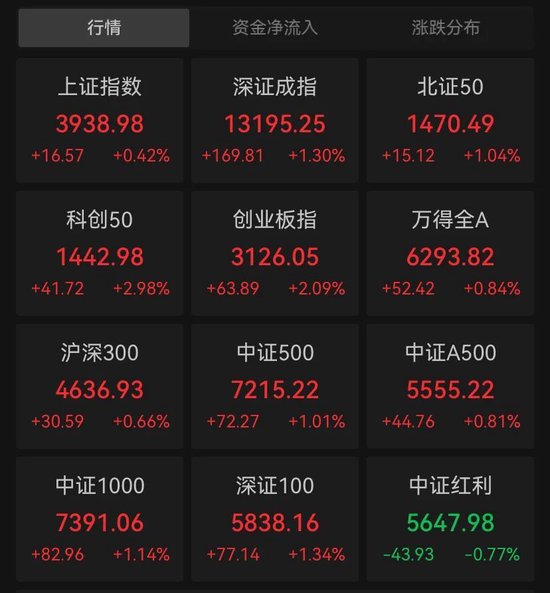
Market Performance - A-shares experienced a strong rally, with the Shanghai Composite Index breaking previous highs and reaching a new high for the year at 3938.98 points, up 0.42% [1] - The Shenzhen Component Index rose by 1.3% to 13195.25 points, while the ChiNext Index increased by 2.09% to 3126.05 points [1] - The total trading volume in the Shanghai and Shenzhen markets reached 1.23 trillion yuan, indicating a significant increase in trading activity [1] Sector Performance - The technology growth sector showed strong performance across the board, with notable activity in storage chips, computing hardware, quantum technology, and commercial aerospace [2][3] - Shengyi Electronics saw a 20% limit-up increase, while stocks like Zhongji Xuchuang and Xiangnong Chip Innovation reached new highs [2][3] - The storage chip sector experienced a collective surge, with multiple stocks in the computing hardware segment also showing significant gains [3] Company Highlights - Shengyi Electronics reported third-quarter earnings that exceeded expectations, with projected revenue between 6.6138 billion yuan and 7.0338 billion yuan, representing a year-on-year increase of 108% to 121% [5] - The company's net profit attributable to shareholders is expected to be between 1.074 billion yuan and 1.154 billion yuan, reflecting a year-on-year increase of 476% to 519% [5] Industry Trends - The storage market is experiencing a price surge due to supply constraints and rising production costs, particularly in NAND and DRAM segments [6][7] - The sentiment among storage manufacturers is leaning towards controlling inventory and holding back sales, which may lead to continued price increases in storage products [7] - Quantum technology remains a vibrant sector, with companies like Dahua Intelligent and Geer Software achieving consecutive gains, driven by advancements in quantum computing and communication technologies [10]


夸克AI眼镜已开启预售,正深度联动阿里巴巴大商业体系 | 巴伦精选
Tai Mei Ti A P P· 2025-10-24 04:28
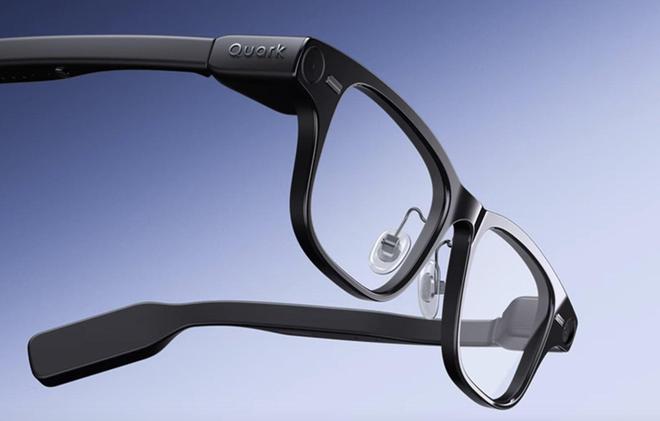
Core Insights - Alibaba's Quark AI Glasses S1, a significant entry into the AI hardware market, has begun pre-sales and is expected to officially launch in December [2][5] - The glasses quickly became the second best-selling smart glasses brand on Tmall during the Double 11 shopping festival, only behind Xreal [2] - The pricing strategy shows a significant discount for 88VIP members, with the lowest price at 3329 yuan compared to 3999 yuan for non-members, indicating a strong integration with Alibaba's ecosystem [2][5] Product Features - Quark AI Glasses S1 integrates advanced AI capabilities, featuring a built-in AI assistant based on Alibaba's latest Qwen closed-source model, focusing on daily AI Q&A, tools, and services related to travel, shopping, and payments [5][6] - The glasses are equipped with dual flagship chips, Qualcomm AR1 and Hengxuan BES2800, and utilize a dual optical display system that adjusts to user comfort and visual habits [5][6] - A unique design allows for a seamless integration of prescription lenses, enhancing optical performance and stability compared to traditional methods [6] Battery and Design - The glasses feature a dual battery and replaceable design, allowing users to swap batteries without downtime, ensuring all-day usage [6] - The minimalist design makes the glasses lightweight and visually similar to regular eyewear, with a balanced weight distribution for comfort [6] - To address low-light photography challenges, Alibaba has developed a SuperRaw night mode for high-quality images in dark environments, along with dual stabilization technology for smooth video recording [6]

那些昙花一现的AI硬件做错了什么?Nest创始人指出根本原因
Huan Qiu Wang· 2025-10-24 03:42
Core Insights - Recent high-profile AI hardware products have failed, prompting deep reflection within the industry, with the fundamental issue being that they are built on hype rather than functionality [1][3] Group 1: Critique of Current AI Hardware - The current AI hardware has three major failures: Humane's AI Pin lacks integration of core smartphone functions and has user-unfriendly operation; Rabbit's R1 was launched without a clear use case; and the new Friend necklace device fails to answer the question of its utility [3] - The focus on packaging, industrial design, and marketing has led to a significant disconnect from actual user needs [3] Group 2: Comparison with Successful Products - The success of the original iPhone was attributed to addressing daily user pain points, such as cumbersome keyboards and poor mobile browsing experiences, aligning with Larry Page's "toothbrush test" which emphasizes solving high-frequency user needs [3] - None of the current AI hardware products have passed this "toothbrush test" [3] Group 3: Future of AI Technology - Despite a cooling market, there is a belief that the future of AI technology is still tied to hardware, with a notable investment of $6.4 billion by OpenAI into Jony Ive's startup seen as a potential turning point for AI integration into daily life [3] - The key to success lies in shifting focus to the smartphone sector, where hardware must meet daily needs more effectively [3] Group 4: Challenges Ahead - Two major challenges are highlighted: the urgent need for high-end software talent in Ive's team and the necessity to navigate the realities of using Google's Android system [3] - While Ive's Apple background may pose competitive challenges with OpenAI and Google, leveraging the open-source nature of Android could provide the fastest path to return on investment [3] Group 5: Conclusion on AI Integration - Manufacturing AI smartphones is deemed the most challenging task in the tech industry since 2007, with the assertion that for AI to truly integrate into billions of lives, it must be compatible with the existing world [4] - OpenAI is urged to develop the next generation of smartphone iterations rather than spending months on products that do not complement or compete with existing smartphones [4]

AH股齐跌,创业板跌超1%,农业银行15连阳再创新高,AI硬件股调整,恒科指跌超1%,国债跌,商品涨
Hua Er Jie Jian Wen· 2025-10-23 01:53
Market Overview - A-shares experienced a decline with all three major indices falling, the ChiNext index dropping over 1% [1] - The Hang Seng Index also fell, with the Hang Seng Tech Index down 1.28% [2][3] - Domestic commodity futures showed strength, with fuel oil rising nearly 3% [4][5] A-shares Performance - As of the report, the Shanghai Composite Index decreased by 0.46% to 3895.79, the Shenzhen Component Index fell by 1.00% to 12867.09, and the ChiNext Index dropped by 1.11% to 3025.44 [1][14] - The banking sector showed resilience, with Agricultural Bank of China hitting a historical high and several other banks like Postal Savings Bank and Qingdao Bank also rising [8][9] Hong Kong Market - The Hang Seng Index was down 0.41% to 25677.26, while the Hang Seng Tech Index fell by 1.28% [2][3] - New consumption concept stocks in Hong Kong continued to weaken, with Pop Mart dropping over 6% [10] Commodity Market - Domestic commodity futures mostly rose, with notable increases in fuel oil (up 2.86%) and asphalt (up 2.37%) [5][17] - Other commodities like coking coal, soybean meal, and lithium carbonate also saw gains exceeding 1% [4][5] Banking Sector - The banking sector maintained strong performance, with multiple banks reporting gains, including Postal Savings Bank (up 3.14%) and Qingdao Bank (up 1.74%) [9][8] - Agricultural Bank of China continued its upward trend, marking 15 consecutive days of gains [8] Coal Sector - The coal sector remained strong, with stocks like Daya Energy and Zhengzhou Coal Electricity hitting the daily limit up [11] - Notable gains included Shaanxi Black Cat (up 10.12%) and Yunmei Energy (up 10.06%) [11] Shenzhen Local Stocks - Shenzhen local stocks opened strong, with several companies like Jian Kexuan and Guangtian Group hitting the daily limit up [12][13] - The Shenzhen government announced a plan to enhance the quality of listed companies, aiming for a total market value exceeding 20 trillion yuan by 2027 [13]

重回3900点!A股三大指数集体收涨
Sou Hu Cai Jing· 2025-10-21 08:25
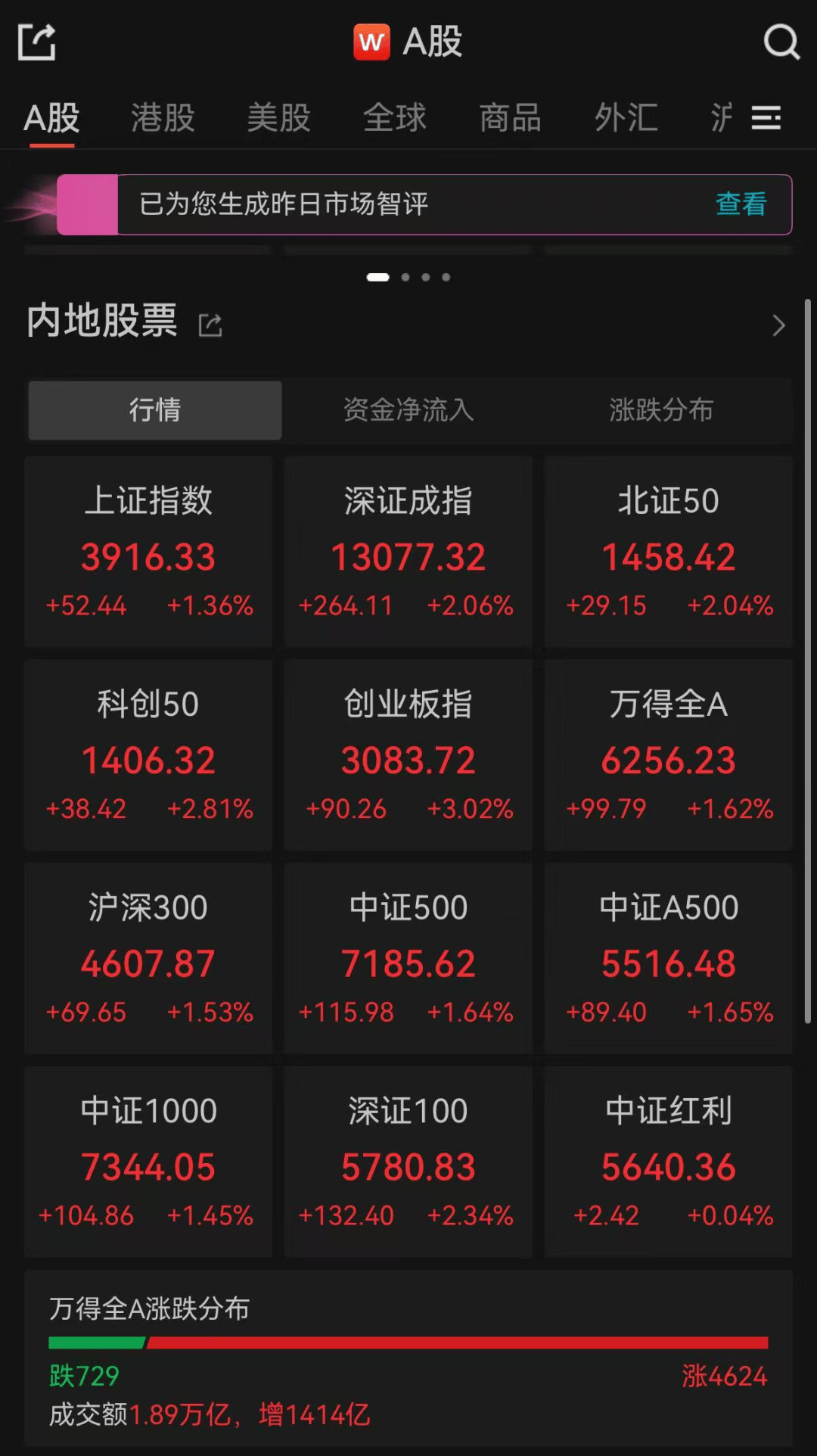
Market Overview - On the 21st, all three major A-share indices closed higher, with the Shanghai Composite Index rising by 1.36% to 3916.33 points, the Shenzhen Component Index increasing by 2.06%, and the ChiNext Index up by 3.02% [1] - The total trading volume for A-shares reached 1.89 trillion yuan, with over 4600 stocks rising across the market [1] Sector Performance - The CPO, HBM, and consumer electronics sectors saw significant gains, while the electrolyte, coal, and civil aviation sectors experienced declines [4] - The fruit supply chain concept had notable performance, with companies like Luxshare Precision hitting the daily limit, and others such as Wingtech Technology and Huanxu Electronics also reaching their limits [4] - AI hardware led the gains, with Yuanjie Technology hitting a historical high, and companies like Zhongji Xuchuang and Xinyisheng seeing increases of over 10% [4] Detailed Sector Tracking - Communication equipment rose by 4.81%, energy equipment by 4.39%, and heavy machinery by 3.15% [5] - Real estate stocks strengthened, with Guangming Real Estate and Shenzhen Zhenye A hitting the daily limit, and Yunnan Chengdu Investment rising over 5% [6] - Brokerage stocks also saw gains, with Ruida Futures and Tianfeng Securities hitting the daily limit, and Changjiang Securities increasing by over 5% [6] Declines - Coal stocks generally fell, with China Coal Energy and Yanzhou Coal Mining dropping over 2% [7] - Civil aviation stocks retreated, with China Southern Airlines and China National Aviation falling by 2% [7]