
扩内需

Search documents
扩内需政策料协同发力PPI有望继续呈现改善态势
Zhong Guo Zheng Quan Bao· 2025-09-11 00:40
Group 1 - In August, China's Commodity Price Index (CBPI) rose for the fourth consecutive month, indicating a positive trend in various price indicators due to policies aimed at expanding domestic demand [1][2] - The Manufacturing Purchasing Managers' Index (PMI) for major raw material purchase prices and factory prices increased to 53.3% and 49.1%, respectively, marking a three-month upward trend [2] - The CBPI reached 111.7 points in August, with a month-on-month increase of 0.3% and a year-on-year increase of 1.2%, reflecting ongoing expansion in enterprise production and operations [2] Group 2 - The implementation of policies to address "involution" in competition is expected to improve market competition order and alleviate supply-demand conflicts, supporting a positive price cycle [3] - Key sectors such as photovoltaic, automotive, steel, and cement are seeing improvements in supply-demand dynamics due to the enforcement of "involution" policies [4] - The steel industry reported a total profit of 59.2 billion yuan in the first half of the year, a year-on-year increase of 63.26%, indicating a positive trend in profitability [4] Group 3 - There are signs of improvement in the Producer Price Index (PPI), but the transmission mechanism to the Consumer Price Index (CPI) remains weak, limiting the impact on consumer prices [5] - The effectiveness of stimulating internal demand is crucial for achieving a virtuous cycle of improved corporate profitability and enhanced economic momentum [5] - The National Development and Reform Commission plans to implement policies to expand domestic demand, including a trade-in program for consumer goods and support for digital consumption [6]
以扩内需和产能治理带动价格修复
2 1 Shi Ji Jing Ji Bao Dao· 2025-09-11 00:09
Group 1: Price Data Overview - The August price data from the National Bureau of Statistics shows significant structural differentiation, with a slight year-on-year decline in CPI, but positive signals regarding economic transformation and structural optimization are evident [1][4] - CPI decreased by 0.4% year-on-year, primarily due to last year's high base and lower seasonal food prices, with food prices dropping by 4.3% year-on-year [1][2] - The decline in food prices reflects the strengthening of domestic agricultural supply capabilities, indicating support from the supply side rather than a contraction in demand [1] Group 2: Core CPI and Consumer Demand - The core CPI, excluding food and energy prices, rose by 0.9% year-on-year, marking the fourth consecutive month of growth, indicating a steady recovery in domestic consumption demand [2] - Service consumption, particularly in healthcare, education, and tourism, has shown significant price increases, contributing to the core CPI's rise [2] - Upgraded consumption remains robust, with notable price increases in gold and platinum jewelry, as well as household appliances, reflecting a growing pursuit of high-quality living among consumers [2] Group 3: Industrial Price Trends - Industrial prices are showing positive changes, with PPI stabilizing after eight months of decline, and the year-on-year decline narrowing by 0.7 percentage points [3] - The structural improvement in industrial prices indicates a marginal improvement in supply-demand relationships within certain industries, alongside ongoing optimization of industrial structure and growth of new drivers [3] - Key industry capacity governance measures are yielding results, leading to price increases in traditional raw material sectors like coal and steel, while new drivers are enhancing prices in high-tech and green industries [3] Group 4: Policy Implications and Future Outlook - Current price data reflects a significant structural characteristic of "supply optimization in traditional sectors and demand expansion in emerging sectors," highlighting the accelerated transition of China's economic drivers [4] - Macro policies need to remain precise and patient, ensuring stable supply and prices for essential goods while enhancing the internal driving force through improved consumption environments and high-quality supply [4] - Continued support for consumption and the construction of a unified national market are expected to promote steady recovery in consumer demand and stabilize low CPI levels, while industrial price recovery is anticipated to continue [4]
国内核心CPI同比涨幅连续第4个月扩大
Qi Huo Ri Bao Wang· 2025-09-11 00:04
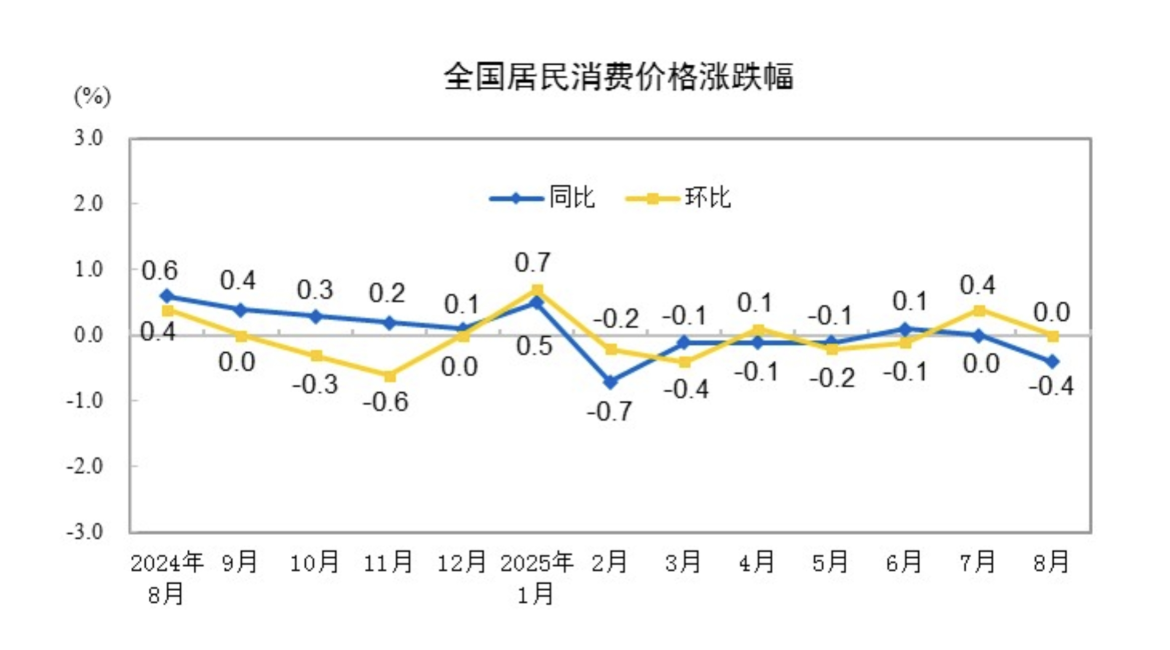
Group 1 - The Consumer Price Index (CPI) remained flat month-on-month in August, with a year-on-year decline of 0.4%, while the core CPI, excluding food and energy, rose by 0.9%, marking the fourth consecutive month of expansion [1] - The Producer Price Index (PPI) showed a month-on-month stabilization after a 0.2% decline last month, with a year-on-year decrease of 2.9% [1] - The decline in food, tobacco, and alcohol prices by 2.5% year-on-year contributed approximately 0.72 percentage points to the CPI decrease, indicating weak food consumption and sufficient supply of agricultural products [1] Group 2 - The narrowing of the PPI year-on-year decline by 0.7 percentage points compared to the previous month is attributed to effective domestic demand expansion and consumption promotion policies [2] - The optimization of market competition order has led to a reduction in the year-on-year price decline in related industries, with ongoing efforts in capacity governance and the establishment of a unified national market [2] - The growth of new economic drivers and increased demand for upgraded consumption have positively impacted the prices in certain industries [2] Group 3 - The expectation for the future PPI indicates that the low base effect will continue to influence short-term trends, but external uncertainties may affect the sustainability of PPI recovery [2] - The overall focus of future policies may be on achieving stable price increases, improving corporate profitability, and enhancing economic momentum through effective domestic price transmission mechanisms [2]
21评论丨以扩内需和产能治理带动价格修复
2 1 Shi Ji Jing Ji Bao Dao· 2025-09-10 22:49
Group 1 - The August price data from the National Bureau of Statistics shows significant structural differentiation, with a slight year-on-year decline in CPI, but positive signals regarding economic transformation and structural optimization are evident [1][4] - The CPI decreased by 0.4% year-on-year, primarily due to a high base from the previous year and lower seasonal food prices, with food prices dropping by 4.3% year-on-year [1][2] - Non-food prices are showing a continuous recovery, with the core CPI (excluding food and energy) rising by 0.9% year-on-year, indicating a steady recovery in domestic consumption demand [2][3] Group 2 - Industrial prices are showing positive changes, with PPI turning stable after eight months of decline, and the year-on-year decline narrowing by 0.7 percentage points, signaling improved industrial economic stability [3][4] - The structural improvement in industrial prices reflects better supply-demand relationships in certain sectors and ongoing optimization of industrial structure, with traditional industries like coal and steel seeing price increases [3][4] - The ongoing expansion of new demand in emerging sectors is driving price increases in high-tech and green industries, indicating a shift towards higher value-added products [3][4]
国内核心CPI同比涨幅连续第4个月扩大 市场竞争秩序持续优化 部分行业供需关系改善
Qi Huo Ri Bao Wang· 2025-09-10 19:37
王鹏认为,PPI同比跌幅收窄,既有政策调整、需求韧性等的支撑,也有2024年同期低基数的影响。随 着扩内需、"反内卷"等政策持续落地,相关行业供需格局出现改善,部分行业原材料采购和产品销售价 格有所上涨。 银河期货首席宏观分析师王鹏在接受期货日报记者采访时表示,8月,食品烟酒类价格同比下降2.5%, 影响CPI下降约0.72个百分点。农副产品价格走弱,一方面与近期食品消费较弱、农产品供给技术提升 和居民饮食结构变化有关;另一方面也与农产品基本面有关,从库存消费比看,农副产品整体供应充 足,这是价格上行动力有限的原因之一。 对此,格林大华期货首席专家王骏认为,农产品贸易商和供应企业后期需要加大卖出保值力度,对冲企 业风险敞口。另外,部分生鲜商品正处在收获季节,可根据产量预估情况和新季商品质量进行相应保值 操作。 国家统计局城市司首席统计师董莉娟分析称,随着扩内需、促消费政策持续显效,8月PPI同比下降 2.9%,降幅比上月收窄0.7个百分点,为今年3月以来首次收窄。我国加紧实施更加积极有为的宏观政 策,一些行业价格呈现积极变化。一是国内市场竞争秩序持续优化,带动相关行业价格同比降幅收窄。 全国统一大市场建设纵深 ...
核心CPI涨幅连续4个月扩大 “反内卷”推动行业价格改善
Di Yi Cai Jing· 2025-09-10 13:36
Group 1: CPI and PPI Overview - In August, the Consumer Price Index (CPI) decreased by 0.4% year-on-year, while the Producer Price Index (PPI) showed signs of improvement, remaining flat month-on-month after a decline in July [1][4] - The core CPI, excluding food and energy prices, increased by 0.9% year-on-year, marking the fourth consecutive month of growth [4][12] - The PPI year-on-year decline narrowed to 2.9%, a reduction of 0.7 percentage points compared to July, marking the first contraction since March [6][10] Group 2: Factors Influencing CPI and PPI - The decline in CPI was primarily influenced by a high base from the previous year and lower food prices, which fell by 4.3% year-on-year, with significant drops in pork, fresh vegetables, and eggs [12][13] - The PPI's month-on-month stability was attributed to improved supply-demand relationships and the impact of international commodity prices, particularly in the energy and raw materials sectors [5][9] - The government's proactive macroeconomic policies and the ongoing construction of a unified national market have contributed to a narrowing of the year-on-year decline in PPI [9][10] Group 3: Industry and Market Dynamics - The industrial sector is experiencing a positive shift, with prices in coal processing, black metal smelting, and photovoltaic equipment manufacturing showing reduced year-on-year declines [9][10] - The Ministry of Industry and Information Technology emphasized the importance of industry governance to combat irrational competition, which has shown initial success [11] - Analysts predict that the PPI's year-on-year decline may further narrow to around -2.3% in September, with expectations of a gradual recovery in the fourth quarter [10][14]

扩内需等政策效果初步显现 8月份PMI三大指数均有所回升
Zhong Guo Chan Ye Jing Ji Xin Xi Wang· 2025-09-08 01:23
Group 1: Manufacturing Sector - In August, the manufacturing PMI rose to 49.4%, indicating an improvement in economic conditions compared to July [2][3] - The production index reached 50.8%, up 0.3 percentage points from July, marking an acceleration in manufacturing production [2] - The new orders index increased to 49.5%, reflecting a slight recovery in demand [2] - High-tech manufacturing and equipment manufacturing PMIs were 51.9% and 50.5%, respectively, showing continued strength in these sectors [3] - The prices of major raw materials and factory output prices rose to 53.3% and 49.1%, respectively, indicating an overall improvement in market price levels [2][3] Group 2: Non-Manufacturing Sector - The non-manufacturing business activity index was 50.3%, a 0.2 percentage point increase from July, indicating continued expansion [5] - The service sector's business activity index reached 50.5%, the highest point of the year, reflecting a significant recovery [5] - The construction sector's business activity index fell to 49.1%, down 1.5 percentage points from July, due to adverse weather conditions [6] Group 3: Market Expectations - The production and business activity expectations index was 53.7%, up 1.1 percentage points from July, suggesting increased confidence among manufacturing firms [4] - The business activity expectations index for the service sector was 57.0%, indicating optimism about future market developments [5]
“双贴息”促消费,“四两”如何拨“千斤”
Sou Hu Cai Jing· 2025-09-07 22:52
Group 1 - The "double subsidy" policy for personal consumption loans and service industry loans aims to stimulate consumer spending and enhance economic growth [1][2] - The policy is expected to reduce interest expenses significantly for consumers and businesses, with examples showing potential savings of up to 2,000 yuan for a 200,000 yuan loan and 10,000 yuan for a 1,000,000 yuan loan [1] - The policy covers a wide range of consumption areas, including essential needs like childcare and healthcare, as well as discretionary spending like education and tourism [1][2] Group 2 - Data from the People's Bank of China indicates that by the end of 2024, the balance of consumer loans (excluding mortgages) is projected to reach 21.01 trillion yuan, reflecting a year-on-year growth of 6.2% [2] - Empirical studies show that the introduction of consumer finance products can increase borrowing consumers' spending by 16% to 30%, while merchant sales can rise by approximately 40% [2] - There is a notable supply-demand gap in consumer credit services, with the demand rate exceeding actual participation by 5.3 percentage points in 2021 [2] Group 3 - The "national subsidy" program for replacing old consumer goods has stimulated over 2.9 trillion yuan in consumption and benefited around 400 million people [3] - Innovative products and services, such as cultural souvenirs and drone delivery systems, are emerging to meet new consumer demands and enhance shopping experiences [3][4] - Understanding consumer psychology and preferences is crucial for creating demand and driving consumption, emphasizing the importance of innovation [4][5] Group 4 - The government and market collaboration is essential for effectively boosting consumption, with a focus on leveraging policy benefits and fostering innovation among businesses [5]
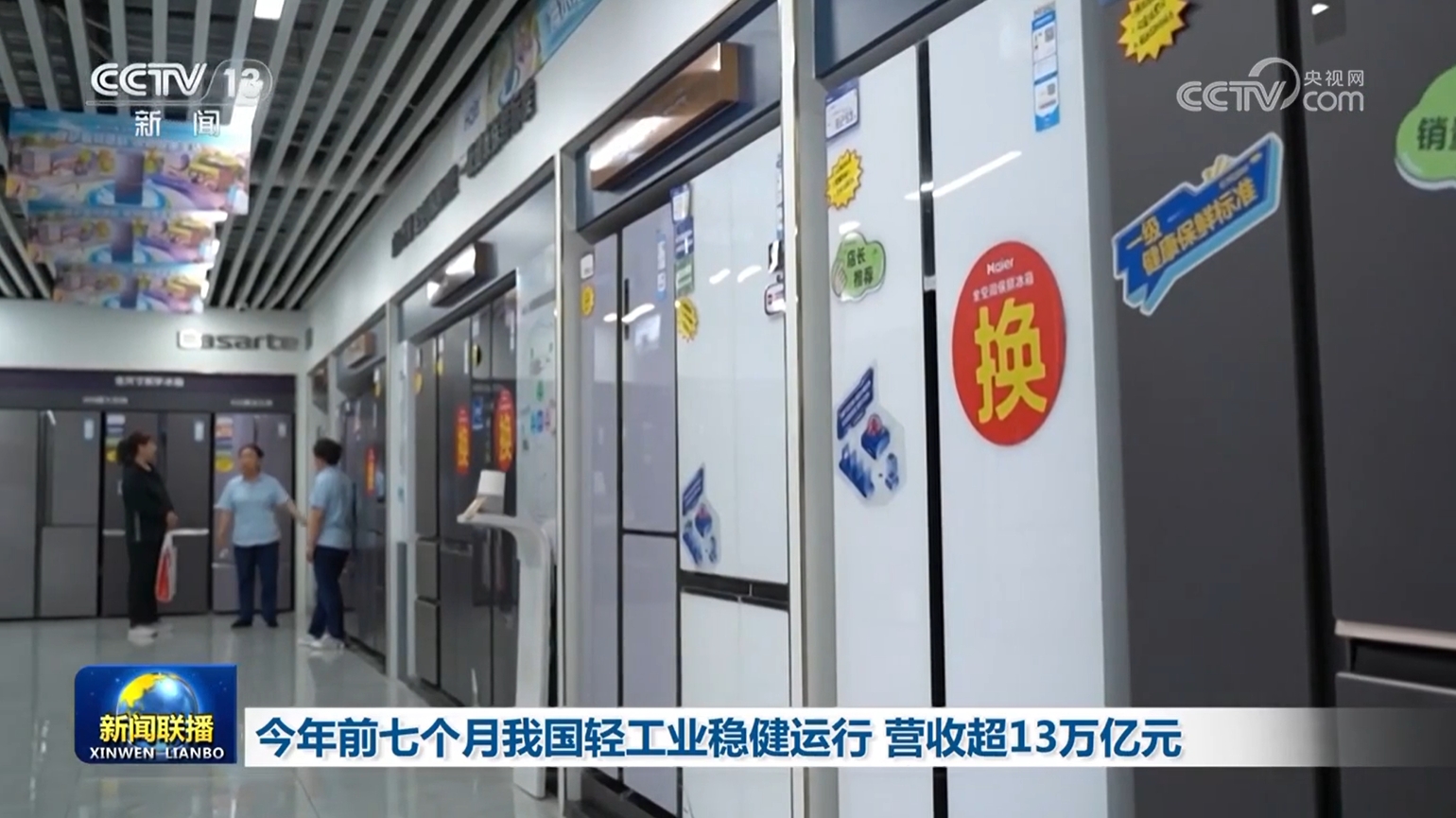
今年前七个月我国轻工业稳健运行 营收超13万亿元
Yang Shi Wang· 2025-09-06 12:00
Core Insights - The light industry in China has shown robust performance in the first seven months of the year, supported by policies aimed at expanding domestic demand and promoting consumption [1][3][4] Group 1: Production and Revenue - The added value of the light industry increased by 6.7% year-on-year, with total operating revenue reaching 13.2 trillion yuan and profits amounting to 760.11 billion yuan [1] - Retail sales of 11 categories of light industry products totaled 4.9 trillion yuan, reflecting a year-on-year growth of 11.4%, accounting for 17.4% of total retail sales of consumer goods [3] Group 2: Investment Growth - Investment in major sectors of the light industry maintained a double-digit growth rate, surpassing the national fixed asset investment and manufacturing investment growth rates [4] Group 3: Export Performance - Light industry exports reached 535.75 billion USD, representing 25.1% of the national total exports, with a year-on-year growth of 1.1%; 11 out of 21 major categories of products experienced growth [6]
航空公路物流网络持续织密 “货畅其流”见证经济蓬勃活力
Yang Shi Wang· 2025-09-06 02:44
Group 1: Air Cargo Industry - In the first eight months of this year, over 150 new international air cargo routes have been established in China, with 15 routes opened in August alone [1][4] - The new routes primarily connect to Asia and Europe, with 76 and 55 routes respectively, and 14 routes to North America [4] - The cargo transported mainly consists of cross-border e-commerce goods, high-end manufacturing products, high value-added goods, and electronic products [4] Group 2: Road Logistics Market - The China Road Logistics Freight Index for August was reported at 105.1 points, showing a slight month-on-month increase of 0.01% and a year-on-year increase of 0.8% [7][10] - The index for full truckload freight, which is mainly driven by bulk commodities and regional transport, reached 105.6 points, reflecting a month-on-month increase of 0.01% and a year-on-year increase of 1% [10] - The road logistics market remains active, supported by stable economic growth and robust production and consumption [12] Group 3: Future Outlook - As September progresses, weather-related factors are expected to diminish, and a series of policies aimed at stabilizing growth and promoting consumption will likely enhance market activity [14] - The logistics market is anticipated to remain active, with the freight index expected to continue its slight upward trend [14]
