消费电子

Search documents
研究所晨会观点精萃-20251112
Dong Hai Qi Huo· 2025-11-12 01:43
General Investment Ratings - The report does not explicitly provide an overall industry investment rating. However, for different asset classes, it offers specific short - term investment suggestions: - For stocks and bonds, short - term cautious long positions are recommended; for commodities, different sectors have different suggestions, including cautious long, cautious short, and cautious observation [3]. Core Views - Overseas, the US labor market shows signs of deterioration, the dollar index is falling, but the potential end of the long - term shutdown boosts global risk appetite. Domestically, China's economic growth has slowed in October, but inflation data has recovered, and the central bank's policies have increased liquidity and boosted domestic risk appetite. The short - term macro - upward driving force has strengthened, and the market focuses on domestic incremental stimulus policies and economic growth [3][4]. Summary by Categories Macro - finance - **Market Conditions**: Overseas, the ADP predicts a decline in US private - sector jobs, the dollar index is falling, and the potential end of the shutdown boosts global risk appetite. Domestically, China's manufacturing and export data in October are weak, but inflation data has recovered, and the central bank's policies have increased liquidity [3]. - **Investment Suggestions**: Stocks and bonds are expected to rebound in the short - term, with cautious long positions. For commodities, black metals are in short - term shock, with cautious observation; non - ferrous metals, precious metals, and some other sectors are in short - term shock and rebound, with cautious long positions; energy and chemical sectors are in short - term shock, with cautious observation [3]. Stocks - **Market Conditions**: Affected by sectors such as artificial intelligence, consumer electronics, and insurance, the domestic stock market has declined slightly. China's economic growth has slowed, but inflation data has recovered, and policies have boosted risk appetite [4]. - **Investment Suggestions**: Stocks are expected to rebound in the short - term, with cautious long positions [4]. Precious Metals - **Market Conditions**: The precious metals market rose on Tuesday night. The expectation of the US government ending the shutdown and potential Fed rate cuts has boosted prices. Spot gold has reached a high since October 23 [4]. - **Investment Suggestions**: Precious metals are in short - term shock and rebound, with a long - term upward trend. Short - term cautious long positions are recommended, and long - term buying on dips is advised [4]. Black Metals - **Steel**: Spot prices were flat on Tuesday, and futures prices continued to fluctuate. The change in coking coal supply expectations and the decline in coking coal prices have led to a weakening of the steel market. Demand is weak, and supply has decreased. The short - term market may continue to weaken, but the decline below 3000 points for rebar is limited [7]. - **Iron Ore**: Futures and spot prices weakened slightly on Tuesday. Steel mills' losses have accelerated production cuts, and iron ore demand may further decline. Supply has decreased, but port inventories have increased. The short - term price is expected to fluctuate within a range [7]. - **Silicon Manganese/Silicon Iron**: Spot prices were flat on Tuesday, and futures prices weakened slightly. Steel production has declined, reducing ferroalloy demand. Manganese ore prices are firm, and supply has decreased slightly. The prices of silicon manganese and silicon iron are expected to continue to fluctuate within a range [8]. Non - ferrous Metals and New Energy - **Copper**: There are differences within the Fed on interest rate cuts. US copper inventories are at a high level, and there is a risk of the Panama copper mine restarting. Domestic de - stocking is less than expected, but the shutdown of an Indonesian copper mine supports prices. The short - term price is expected to fluctuate at a high level [9]. - **Aluminum**: On Tuesday, Shanghai aluminum declined slightly. The market is worried about future supply shortages, but domestic de - stocking is difficult. The short - term price is expected to be strong, but there may be a significant correction later [10]. - **Tin**: The supply of tin is still tight, and the demand is weak. Tin ingot inventories have increased. The short - to - medium - term price is expected to be supported at the bottom but pressured at the top, with high - level fluctuations [11]. - **Lithium Carbonate**: The price of the lithium carbonate futures contract rose on Tuesday. The market has digested negative news, and the demand logic is dominant. The price is expected to be strong with fluctuations, but supply - side disturbances and hedging pressure need attention [12]. - **Industrial Silicon**: The price of the industrial silicon futures contract declined on Tuesday. Supply and demand are both weak, and the price is expected to fluctuate. Buying on dips is recommended [12]. - **Polysilicon**: The price of the polysilicon futures contract declined on Tuesday. There is a game between strong policy expectations and weak reality. The price is expected to fluctuate in a high - level range, and buying on dips is recommended [13][14]. Energy and Chemicals - **Crude Oil**: The weakness of the crude oil market is offset by the high premium of refined oil products. Supply concerns and technical buying support the price. The short - term price is expected to continue to fluctuate [15]. - **Asphalt**: Asphalt has rebounded slightly following crude oil, but the rebound space is limited. There is pressure on inventory accumulation, and supply pressure is increasing. Attention should be paid to the cost fluctuations of crude oil [15]. - **PX**: PX has weakened slightly. PTA's high - level operation provides some demand support. The PXN spread has rebounded slightly, and PX is still in a tight supply situation. Attention should be paid to cost changes [16]. - **PTA**: The expectation of inventory accumulation from November to December has decreased, but the actual production cut is not highly confirmed, and there is still a risk of inventory accumulation later [16]. - **Ethylene Glycol**: Ethylene glycol has declined again and is still under pressure. Port inventories have increased significantly, and there is pressure on inventory accumulation in mid - to - late November [16]. - **Short - fiber**: Short - fiber has declined slightly following the polyester sector, and there is still pressure in the later period. The follow - up upward space may be limited [17]. - **Methanol**: The methanol market has weakened. There is pressure on inventory accumulation, and the price is expected to decline with fluctuations, but the decline rate may slow down [17][18]. - **PP**: The price of polypropylene is expected to continue to decline. Demand improvement is limited, and supply is increasing. Cost support is insufficient [18]. - **LLDPE**: The price of polyethylene is expected to continue to be under pressure. Supply pressure is increasing, demand is weakening, and cost support is insufficient [19]. - **Urea**: The urea market is stable with a slight decline. Supply is expected to increase, and demand is differentiated. The short - term market is expected to continue to weaken slightly [19]. Agricultural Products - **US Soybeans**: The CBOT soybean price has declined. The market is optimistic about Sino - US soybean trade relations. Attention should be paid to USDA reports. If the USDA lowers the yield per unit, the US soybean's ending inventory will shrink, strengthening the cost - repair logic [20]. - **Soybean and Rapeseed Meal**: The supply of soybean meal is loose, and the basis is weak. With the improvement of Sino - US agricultural trade relations, the cost of imported soybeans has increased, and the risk of future shortages has decreased. Rapeseed meal generally follows the soybean meal market [20]. - **Oils**: Palm oil has entered the production - reduction cycle, and the market is weak and stable. The supply - demand situation of soybean oil is still unbalanced, and the price is stable within a range. Rapeseed oil inventories are decreasing, and the basis is strengthening [22]. - **Corn**: The futures price has risen continuously, driving up the price in the Northeast production area. Inventories are low, and the price is expected to be stable with a slight increase [22]. - **Pigs**: The planned slaughter volume of large - scale farms in November has decreased, and the supply pressure has eased. Demand has increased with the cooling weather. The pork price is expected to be weak and stable, and the futures price may be supported [22].
昀冢科技前三季亏损1.46亿元,毛利率骤降拖累业绩
Xi Niu Cai Jing· 2025-11-12 01:01
Core Insights - Yunzuka Technology reported a total revenue of 400 million yuan for the first three quarters of 2025, a year-on-year decline of 3.46%, with a net loss of 146 million yuan, further widening compared to the same period last year [2][3] - In Q3 alone, the company achieved a revenue of 154 million yuan, marking a year-on-year increase of 33.43%, while the net loss for the quarter was 45.9 million yuan, a reduction compared to the previous year's loss [2][3] Financial Performance - The gross margin for the first three quarters was only 3.57%, a significant drop of 77.95% year-on-year, and the net margin was -39.22%, down 87.62% year-on-year, indicating challenges in cost control and product value addition [4] - For the first half of 2025, the company reported a revenue of 246 million yuan, a year-on-year decrease of 17.66%, with a net loss of 99.9 million yuan, a substantial increase of 262.76% compared to the same period last year [3][4] Business Challenges - The decline in revenue and the widening loss were primarily attributed to the delayed release schedule of new consumer electronics, leading to a year-on-year decrease in orders, as well as adjustments in marketing strategies and customer order optimization [4] - Yunzuka Technology, which specializes in the development and production of camera optical modules and precision electronic components, is facing direct impacts from the slowdown in the global smartphone market, which affects its main clients such as Huawei, Xiaomi, OPPO, and VIVO [4] Strategic Initiatives - In response to the pressures from traditional business, Yunzuka Technology is actively exploring new business areas, including electronic ceramics and automotive electronics [4]



ETF午评 | 港股汽车涨幅居前,港股汽车ETF、港股汽车ETF基金涨超2%
Ge Long Hui· 2025-11-11 11:50
Market Overview - The three major A-share indices collectively adjusted today, with the Shanghai Composite Index down 0.38%, the Shenzhen Component Index down 0.52%, and the ChiNext Index down 0.74% [1] - The total trading volume in the Shanghai, Shenzhen, and Beijing markets was 12,680 billion yuan, a decrease of 1,864 billion yuan compared to the previous day [1] - Over 2,900 stocks in the market experienced an increase [1] Sector Performance - The sectors with the highest gains included cultivated diamonds, photovoltaic equipment, battery chemicals, gas, pharmaceutical commerce, and non-ferrous metals [1] - The sectors with the largest declines included coal mining and processing, insurance, liquor, AI corpus, computing power hardware, and securities [1] ETF Performance - In the ETF market, Hong Kong automotive ETFs showed strong performance, with gains of 2.38%, 2.35%, and 2.26% for Guangfa Fund, ICBC Credit Suisse Fund, and Huatai-PineBridge Fund respectively [1] - The new energy sector also performed well, with Penghua Fund's Science and Technology New Energy ETF rising by 1.94% [1] - Gold prices continued to rise, with Tianhong Fund's Shanghai Gold ETF increasing by 1.86% [1] - The coal sector saw significant declines, with the coal ETF down 2.56% [1] - The AI hardware sector weakened, with both the communication ETF and communication equipment ETF falling by 2% [1] - Consumer electronics concept stocks weakened, with the consumer electronics ETF down 1.63% [1]
高开低走,延续弱势,落袋为安还是小跌小买?
Ge Long Hui· 2025-11-11 11:37
Group 1 - The three major indices in the market experienced a collective decline, with the Shanghai Composite Index down 0.03%, the Shenzhen Component Index down 0.59%, and the ChiNext Index down 2.13% [1] - Over 2800 stocks in the two markets fell, with a total trading volume of 1.44 trillion [1] Group 2 - The fluorochemical sector opened high and maintained a strong position, with an increase of 3.6% at midday, including stocks like Dongyue Silicon Material and Tianji Shares hitting the daily limit [3] - The lithium battery sector showed repeated activity, with multiple stocks, including Tianji Shares, reaching the daily limit [3] - The phosphate chemical concept continued to be strong, with Chengxing Shares achieving three consecutive limit-ups [3] - The consumer sector saw a significant surge, particularly in duty-free and food and beverage segments, with companies like China Duty Free Group and Huifa Food hitting the daily limit [3] - The computing hardware concept stocks collectively weakened, with companies like Xinyi Sheng and Shenghong Technology experiencing significant declines [3] - The humanoid robot concept faced a sharp drop, with Zhejiang Rongtai hitting the daily limit down [3] - NAND flash memory contract prices were raised significantly by SanDisk, with an increase of up to 50%, and the company saw a more than 15% rise in stock price due to strong sales in data center storage chips [3] - Leading polysilicon companies are planning to form a consortium with a total investment potentially between 20 billion to 30 billion [3]

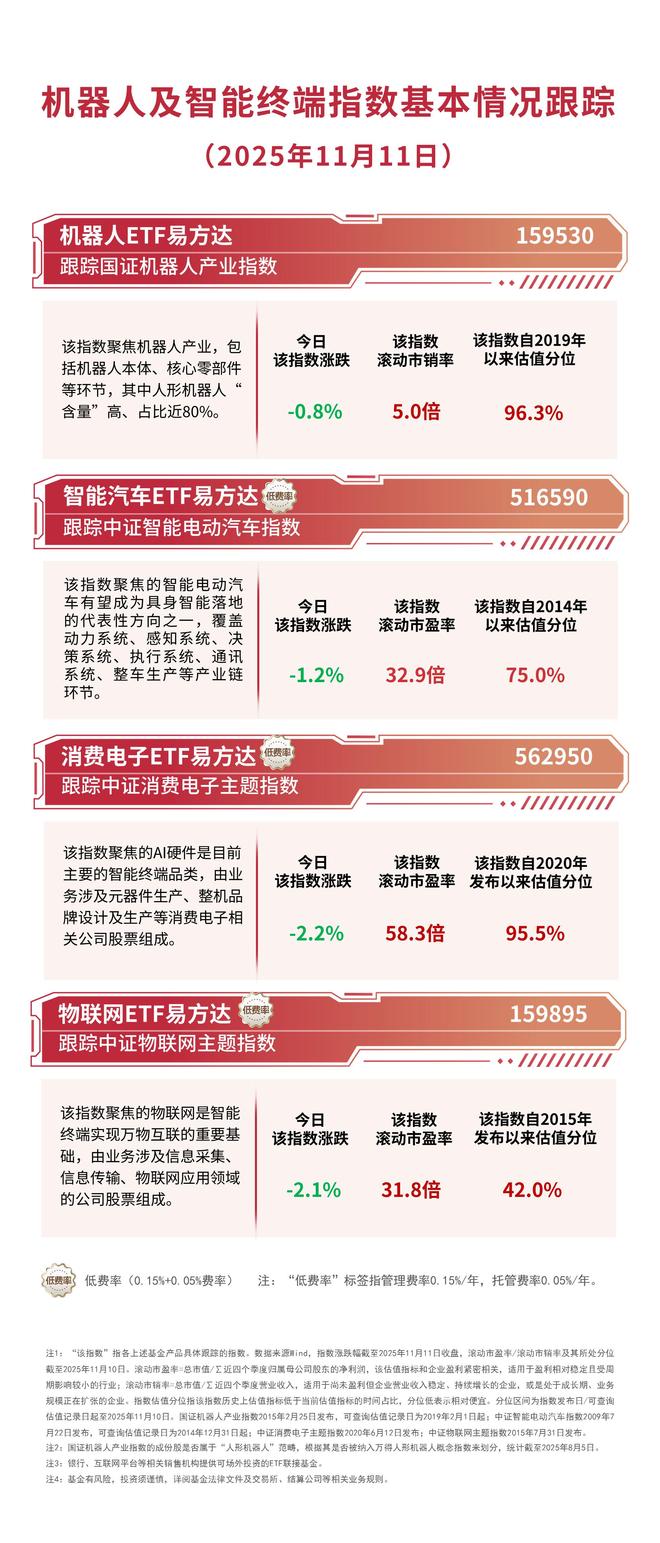
特斯拉筹备扩建机器人超级工厂,机器人ETF易方达(159530)助力布局产业链龙头
Mei Ri Jing Ji Xin Wen· 2025-11-11 10:27
Market Performance - The National Robot Industry Index decreased by 0.8%, the China Securities Intelligent Electric Vehicle Index fell by 1.2%, the China Securities Internet of Things Theme Index dropped by 2.1%, and the China Securities Consumer Electronics Theme Index declined by 2.2% [1] Tesla's Expansion Plans - Tesla is preparing to expand its Texas Gigafactory by building a dedicated facility for the mass production of its humanoid robot, Optimus [1] - Currently, Tesla has established a pilot production line in Fremont, California, for assembling some Optimus prototypes, but the majority of the production capacity for the Optimus project is planned to be located at the Texas Gigafactory [1] - The company aims to achieve an annual production capacity of 10 million units for the Optimus robot [1]


祥源新材(300980):IXPE产销亮眼,积极拓展人形机器人新市场
NORTHEAST SECURITIES· 2025-11-11 09:16
Investment Rating - The report maintains a "Buy" rating for the company, indicating a positive outlook for the stock's performance in the near term [5]. Core Insights - The company reported a strong financial performance for the first three quarters of 2025, achieving a revenue of 440 million yuan, a year-on-year increase of 32.3%, and a net profit attributable to shareholders of 40.65 million yuan, up 94% year-on-year [1]. - The company has entered into a collaboration with Tongji University to expand into new markets for humanoid robots, acquiring exclusive rights to four invention patents, which will enhance its technological capabilities and market applications [2]. - The establishment of production bases in Southeast Asia (Vietnam and Thailand) has provided tariff advantages and improved operational efficiency, contributing to a 13.1 percentage point increase in overseas revenue share [3]. Financial Summary - The company is projected to achieve net profits of 72 million yuan, 124 million yuan, and 184 million yuan for the years 2025, 2026, and 2027, respectively, with corresponding price-to-earnings ratios of 61X, 35X, and 24X [3][4]. - Revenue is expected to grow significantly, with forecasts of 605 million yuan in 2025, 784 million yuan in 2026, and 952 million yuan in 2027, reflecting growth rates of 27.2%, 29.5%, and 21.4% respectively [4][11]. - The company's gross margin is projected to improve from 29.3% in 2024 to 36.3% in 2027, indicating enhanced profitability [11].
收评:沪指跌0.39%险守4000点 光伏板块逆市走强
Xin Hua Cai Jing· 2025-11-11 07:33
Market Overview - The market experienced fluctuations with the three major indices opening high but closing lower, with the Shanghai Composite Index barely holding above 4000 points, closing at 4002.76, down 0.39% [1] - The Shenzhen Component Index closed at 13289.03, down 1.03%, and the ChiNext Index closed at 3134.32, down 1.40% [1] - Total trading volume in the Shanghai and Shenzhen markets was 199.36 billion, a decrease of 18.09 billion from the previous day [1] Sector Performance - The photovoltaic equipment, chemical raw materials, non-metallic materials, food and beverage, and pharmaceutical commercial sectors saw the highest gains [1] - Conversely, the insurance, energy metals, aerospace, electronic components, and software development sectors experienced the largest declines [1] Stock Highlights - The consumer sector was notably active, with food and beverage stocks leading the gains; companies like Huanlejia and San Yuan shares hit the daily limit [2] - The photovoltaic concept stocks surged, with multiple stocks such as GCL-Poly Energy and TBEA hitting the daily limit [2] - Nearly 2800 stocks rose, with over 80 stocks reaching the daily limit [3] Institutional Insights - According to Jifeng Investment Advisors, the market's overall trend remains upward, with a focus on sectors like semiconductors, consumer electronics, AI, and low-altitude economy for medium-term investment opportunities [4] - Furong Fund noted that while the technology sector is experiencing frequent rotations, the core narrative around AI remains intact, suggesting potential in AI-related investments [4] Automotive Industry Update - The China Association of Automobile Manufacturers reported that in October, the sales of new energy vehicles (NEVs) exceeded 50% of total new car sales for the first time, reaching 51.6% [5] - From January to October, NEV production and sales reached 13.015 million and 12.943 million respectively, with year-on-year growth of 33.1% and 32.7% [5] - NEV exports for the same period totaled 2.014 million, marking a significant year-on-year increase of 90.4% [5]
崇达技术跌2.01%,成交额2.24亿元,主力资金净流出3317.97万元
Xin Lang Zheng Quan· 2025-11-11 05:42
Group 1 - The core viewpoint of the news is that 崇达技术 (Chongda Technology) has experienced a decline in stock price and significant net outflow of funds, despite a year-to-date increase in stock price [1][2] - As of November 11, the stock price of 崇达技术 was 13.14 yuan per share, with a market capitalization of 16.001 billion yuan and a trading volume of 224 million yuan [1] - The company has seen a year-to-date stock price increase of 30.36%, but has faced declines of 4.37% over the last five trading days, 3.38% over the last 20 days, and 6.28% over the last 60 days [1] Group 2 - 崇达技术's main business involves the design, research and development, production, and sales of printed circuit boards (PCBs), with revenue composition being 82.83% from PCBs, 10.52% from waste materials and others, and 6.64% from IC substrates [1][2] - For the period from January to September 2025, 崇达技术 reported a revenue of 5.593 billion yuan, representing a year-on-year growth of 22.27%, and a net profit attributable to shareholders of 314 million yuan, reflecting a year-on-year increase of 19.58% [2] - The company has distributed a total of 2.112 billion yuan in dividends since its A-share listing, with 665 million yuan distributed over the last three years [3] Group 3 - As of October 31, 崇达技术 had 71,200 shareholders, an increase of 0.99% from the previous period, with an average of 10,916 circulating shares per shareholder, a decrease of 0.98% [2] - The second-largest circulating shareholder is Hong Kong Central Clearing Limited, holding 36.2069 million shares, which increased by 29.2455 million shares compared to the previous period [3] - The company is classified under the electronic components industry, specifically in the printed circuit board sector, and is associated with concepts such as consumer electronics, flexible electronics, AIPC concept, robotics, and sensors [2]

麦捷科技跌2.07%,成交额1.94亿元,主力资金净流出1661.56万元
Xin Lang Zheng Quan· 2025-11-11 05:35
Core Viewpoint - 麦捷科技's stock has experienced fluctuations, with a recent decline of 2.07% and a total market capitalization of 10.82 billion yuan, reflecting mixed investor sentiment and market activity [1]. Financial Performance - For the period from January to September 2025, 麦捷科技 reported a revenue of 2.903 billion yuan, representing a year-on-year growth of 21.71%, while the net profit attributable to shareholders was 245 million yuan, showing a modest increase of 1.53% [2]. - Cumulatively, 麦捷科技 has distributed a total of 444 million yuan in dividends since its A-share listing, with 292 million yuan distributed over the past three years [3]. Shareholder Information - As of October 31, 2025, 麦捷科技 had 47,000 shareholders, a decrease of 7.30% from the previous period, with an average of 17,659 circulating shares per shareholder, which is an increase of 7.88% [2]. - The top ten circulating shareholders include significant entities such as Hong Kong Central Clearing Limited, which increased its holdings by 627,400 shares to 10.6698 million shares [3].

产能“极度紧张”,客户“紧急加单”,台积电毛利率有望“显著提升”
美股IPO· 2025-11-11 04:48
Core Viewpoint - The demand for next-generation chips from AI giants like Nvidia is pushing TSMC's N3 advanced process capacity to its limits, leading to a significant supply shortage that is expected to enhance TSMC's profit margins, potentially pushing gross margins above 60% by 2026 [1][3][9] Group 1: Capacity Constraints - TSMC's N3 advanced process capacity is nearing its maximum, with Morgan Stanley predicting a significant capacity shortfall even with efforts to optimize existing lines [1][3] - Nvidia's CEO Jensen Huang has personally requested increased chip supply from TSMC, highlighting the urgency of the situation [3] - Despite Nvidia's request to expand N3 capacity to 160,000 wafers per month, TSMC's actual capacity may only reach 140,000 to 145,000 wafers per month by the end of 2026, indicating a persistent supply-demand imbalance [3][4] Group 2: Production Strategies - TSMC is not planning to build new N3 fabs but will prioritize existing facilities for next-generation processes, with capacity increases mainly coming from line conversions at the Tainan Fab 18 [4][6] - The conversion of N4 lines to N3 may face challenges if Nvidia is allowed to ship GPUs to the Chinese market, potentially slowing down the conversion process [5] - TSMC is also utilizing cross-factory collaboration to maximize output, leveraging idle capacity from its Fab 14 to handle some backend processes for N3 [6] Group 3: Customer Demand - Major tech companies are scrambling to secure production capacity, with a diverse lineup of clients including Nvidia, Broadcom, Amazon, Meta, Apple, Qualcomm, and MediaTek [7] - The demand from cryptocurrency miners is expected to remain largely unmet in 2026 due to the pre-booking of capacity by major clients [7] Group 4: Profitability Outlook - The scarcity of capacity is translating directly into TSMC's profitability, with clients willing to pay premiums of 50% to 100% for expedited orders [8][9] - Morgan Stanley predicts that if the trend of urgent orders continues, TSMC's gross margin could reach the low to mid-60% range in the first half of 2026, exceeding current market expectations [9]