
人民币升值

Search documents
离岸人民币兑美元升破7.0大关!对普通人有哪些影响?一文读懂
Sou Hu Cai Jing· 2025-12-26 02:12
离岸人民币兑美元汇率一举升破7.0关口,创下2024年9月以来新高。这一变化不仅刷屏财经圈,更与每个普通人的钱包息息相关。人民币为何大幅升值?未 来走势如何?普通人该如何应对?一文说清! 美元走弱成主因 美联储降息预期升温,美元指数跌破100,带动非美货币普遍升值。市场对2026年美联储继续降息的押注,进一步削弱美元吸引力。 中国经济韧性支撑 出口超预期增长、贸易顺差扩大至1万亿美元,叠加资本市场对国际资本的吸引力增强,为人民币提供基本面支撑。 年末结汇潮推波助澜 外贸企业年底集中将美元收入兑换成人民币,短期需求激增加速汇率上行。 1. 换汇成本大降,留学生家庭迎来利好 2. 美元存款"倒亏钱",理财需谨慎 留学、旅游更省钱:当前换10万美元比6月节省约1.7万元,赴美留学、旅游开支显著降低。 海淘党狂喜:进口商品价格下降,电子产品、奢侈品性价比提升。 杭州张凯年初存8400美元,到期后人民币计价反亏1033元;购买美国国债的收益也被汇率波动吞噬。 建议:持有美元资产者可考虑分批换回人民币,或配置黄金、A股等对冲风险。 人民币购买力提升,核心城市房产、黄金等抗通胀资产可能吸引更多资金流入。 注意:央行强调"房 ...

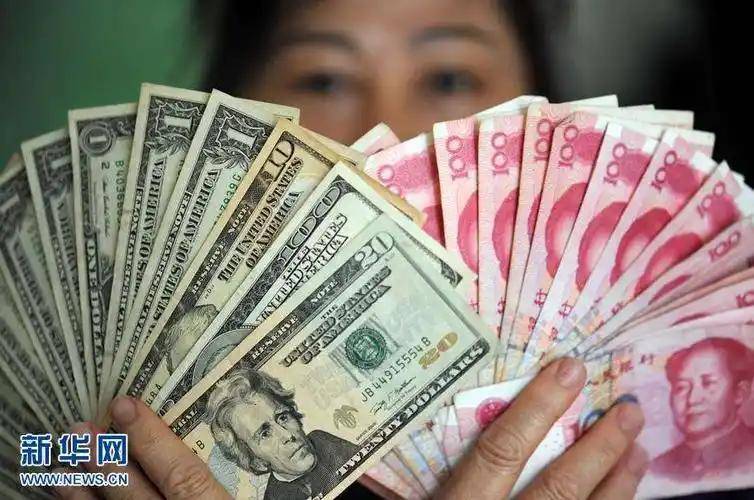
人民币升值,只是开始
2025-12-26 02:12
Summary of Key Points from the Conference Call Industry Overview - The discussion revolves around the **Chinese Yuan (RMB)** and its appreciation against the US Dollar and other currencies, highlighting macroeconomic factors and seasonal trends affecting the currency's value [1][3][6]. Core Insights and Arguments - **RMB Appreciation**: Since August, the RMB has appreciated by **2.3%**, with the US Dollar's weakness contributing **1.6%** and active appreciation from China contributing **0.7%**. This indicates that both external and internal factors are driving the RMB's rise [1][3]. - **End-of-Year Trends**: Historically, the end of the year is a period when the RMB tends to appreciate due to increased demand for currency exchange as companies prepare for the new fiscal year. This seasonal trend has been observed in previous years, except for 2024 [4][5]. - **Long-term Outlook**: The current appreciation is not merely a short-term seasonal effect but may signal the beginning of a long-term trend. Factors such as improvements in the Chinese macroeconomy and ongoing global monetary easing, particularly in the US, are expected to support the RMB's strength [6][8]. - **Impact on Exports**: The rise in the RMB is not expected to significantly hinder Chinese exports. The trade surplus with major partners does not rely on currency depreciation or deflation, but rather on internal competition among Chinese firms [7]. - **Future Drivers**: In the coming year, several factors could influence the RMB's trajectory, including improvements in the Chinese economy, the breaking of capital outflow cycles, continued US monetary easing, and rising commodity prices. However, potential global economic changes or domestic policy adjustments could also impact this trend [8]. Additional Important Content - **Labor Productivity and Exchange Rate**: There is a historical correlation between labor productivity growth and nominal effective exchange rates. China's labor productivity has outpaced global averages over the past 20 years, but recent internal competition and investment issues have suppressed this relationship. A potential recovery in productivity by 2025 could help restore the nominal effective exchange rate to reasonable levels [2][9].
和讯投顾周翔:这个暗线在走强
Sou Hu Cai Jing· 2025-12-26 02:09
周五不要期待八连阳了,需要关注两个重要事项。 除此之外,锂电、光伏等反内卷方向也不容忽视。尽管目前这些领域并不被市场看好,但在商业航天板 块出现分歧的时候,这些超跌的板块可能会迎来短线的折腾机会,投资者可以适当关注。 总之,市场在周五可能会出现一些变化,投资者需要保持谨慎,合理调整投资策略,抓住潜在的投资机 会。 首先,不要被指数缩量的情况所误导。今天市场没有外资参与,成交量受到一定影响。如果按照平时北 向资金每天2000亿以上的量能来估算,今天的真实成交量应该可以达到2万亿以上。由此可见,今天的 市场势头依然强劲。然而,目前市场对盘面冲击4000点上方新高的预期过于一致,这种一致性很容易被 量化交易或AI语料捕捉并进行反向操作,尤其是在尾盘阶段,投资者需要格外警惕。 其次,有一个明牌方向正变得越来越强劲,那就是人民币升值带来的利好。人民币升值对造纸业有直接 的积极影响,同时也会利好跨境电商、能源金属、多元金融等多个相关分支领域。即使投资者没有参与 商业航天板块的博弈,也没有关系。汇率升值这一方向仍会反复被市场炒作,存在不少机会。 ...
【机构策略】A股市场短期或将延续震荡上行趋势
Zheng Quan Shi Bao Wang· 2025-12-26 01:36
Group 1 - The A-share market remains active, with major indices continuing to rise, driven by the commercial aerospace sector [1] - The recent upward trend in the A-share market is attributed to three main factors: expectations of overseas liquidity easing, continuous appreciation of the RMB, and anticipation of a spring market rally [1] - The offshore RMB exchange rate against the US dollar has broken the important 7.0 level for the first time since September 2024, positively impacting the Chinese stock market [2] Group 2 - Technical analysis indicates that the Shanghai Composite Index has stabilized above the five-day moving average, suggesting a bullish short-term outlook [2] - The performance of various sectors shows strength in aerospace, robotics, and wind power equipment, while precious metals and automotive sectors lag behind [2] - The market is expected to consolidate around the 4000-point level, influenced by macroeconomic data, overseas liquidity changes, and policy developments [2]
期指:情绪积极,震荡偏强
Guo Tai Jun An Qi Huo· 2025-12-26 01:34
1. Report's Investment Rating for the Industry - No information about the report's investment rating for the industry is provided. 2. Core View of the Report - On December 25, 2025, all four major index futures contracts for the current month rose. The overall sentiment is positive, with the market expected to be volatile but on an upward trend [1]. 3. Summary by Relevant Catalogs 3.1 Index Futures Data Tracking - **Price and Change**: The closing prices of CSI 300, SSE 50, CSI 500, and CSI 1000 all increased, with gains of 0.18%, 0.25%, 0.80%, and 0.97% respectively. The corresponding index futures contracts also showed varying degrees of increase [1]. - **Trading Volume and Open Interest**: The total trading volume of index futures decreased, indicating a cooling of investors' trading enthusiasm. Specifically, the total trading volume of IF, IH, IC, and IM decreased by 11,854, 7,004, 12,456, and 14,596 lots respectively. In terms of open interest, IF and IC decreased by 563 and 3,891 lots respectively, IH increased by 197 lots, and IM decreased by 3,977 lots [1][2]. - **Basis**: The basis data for different index futures contracts are presented, showing the differences between the futures prices and the spot prices [1]. 3.2 Top 20 Member Positions in Index Futures - The data shows the changes in long and short positions of the top 20 members in different index futures contracts. For example, in the IF2601 contract, long positions decreased by 1,522 lots, and short positions decreased by 2,499 lots [5]. 3.3 Trend Strength - The trend strength of IF and IH is 1, and that of IC and IM is also 1, indicating a relatively neutral - to - slightly bullish trend [6]. 3.4 Important Drivers - The offshore RMB against the US dollar broke through the 7.0 mark during intraday trading for the first time since September 2024. Most views believe that the RMB against the US dollar has the basis for continued appreciation in 2026 [6]. - From January to November this year, 25,800 urban old residential areas were newly started for renovation across the country, and 22 regions and the Xinjiang Production and Construction Corps have completed their annual renovation plans [6]. 3.5 Market Conditions - The Politburo held a meeting to study and deploy the work of improving Party conduct, building a clean government, and combating corruption in 2026 [7]. - The A - share market continued to rise, with the Shanghai Composite Index recording seven consecutive positive days. The trading volume reached 1.94 trillion yuan, slightly higher than the previous day. Some sectors such as commercial aerospace and paper - making performed strongly, while others like Hainan Free Trade Zone and precious metals weakened [7].
铜冠金源期货商品日报-20251226
Tong Guan Jin Yuan Qi Huo· 2025-12-26 01:29
1. Report Industry Investment Rating No relevant content provided in the report. 2. Core Viewpoints of the Report - Overseas, European and American financial markets were closed for holidays, while in the early morning of Thursday, the accelerating upward trend of metals continued. Japan plans to launch a record - high budget of 122 trillion yen in the new fiscal year, a 6.3% year - on - year increase. The Bank of Japan may continue to raise interest rates if the economy meets expectations. Domestically, the Ministry of Commerce will promote year - end consumption and supply guarantee, and the RMB has accelerated its appreciation at the end of the year. The A - share market has further risen [2][3]. - The performance of precious metals has diverged. Gold prices are oscillating at a high level, silver is rising, platinum prices have fluctuated sharply and then risen, and palladium prices have dropped significantly. It is expected that the precious metal market will experience increased volatility in the short term [4]. - The price of copper continues to rise due to the resonance of macro and fundamental factors. The price of aluminum is oscillating at a high level driven by the long - position atmosphere. The price of zinc is oscillating with inventory reduction providing support. The upward trend of lead prices has slowed down. The price of tin is oscillating at a high level. The price of industrial silicon is oscillating strongly. The prices of steel products are oscillating and adjusting in a situation of weak supply and demand. The price of iron ore is oscillating downward. The prices of coking coal and coke are oscillating and adjusting. The prices of soybean meal and rapeseed meal are oscillating. The price of palm oil is oscillating with a weakening rebound [4][6][8][9][11][12][13][15][16][17][18][20]. 3. Summary by Related Catalogs 3.1 Main Variety Views 3.1.1 Macro - Overseas: European and American financial markets were closed for holidays on Christmas. The Japanese government continues to expand its budget, with a planned 122 trillion yen budget in the new fiscal year, a 6.3% year - on - year increase, mainly driven by social security and defense expenditures. The Bank of Japan Governor Ueda Kazuo said that wage growth is pushing inflation steadily towards 2%, and if the economy meets expectations, the interest - rate hike path will continue [2]. - Domestic: The Ministry of Commerce will promote year - end consumption and supply guarantee. The RMB has accelerated its appreciation at the end of the year, with the offshore and onshore exchange rates breaking through 7.0 and 7.01 respectively, reaching the highest level since the end of September last year. The A - share market has further risen, with the Shanghai Composite Index reaching nearly 3960 points, and growth stocks such as the STAR Market and CSI 2000 performing better. Sectors such as commercial aerospace, large aircraft, and satellites led the gains [3]. 3.1.2 Precious Metals - The prices of precious metals have diverged. Gold prices are oscillating at a high level, silver has continued to rise, with Shanghai silver rising more than 5% at night and breaking through 18,000 yuan to a record high. Platinum prices have fluctuated sharply and then risen, while palladium prices have dropped significantly. The Guangzhou Futures Exchange has adjusted the minimum opening order quantity and trading limits for platinum and palladium futures contracts. The Sino - US rare - earth magnet export issue has received a positive response. It is expected that the precious - metal market will experience increased volatility in the short term [4]. 3.1.3 Copper - The main contract of Shanghai copper accelerated its upward movement on Thursday, while London copper was closed due to the holiday. The domestic spot market for electrolytic copper had light trading, with domestic trade copper at a discount of 330 yuan/ton. The LME inventory remained at 157,000 tons, and the COMEX inventory remained at 479,000 tons. Macroscopically, the stability of the FOMC voting committee may lead to Powell's early resignation, and Trump may advocate for a dovish Fed chair. The Bank of Japan may further raise interest rates in 2026. Industrially, the union of a copper mine in Chile may go on strike. It is expected that copper prices will remain strong at a high level in the short term [6][7]. 3.1.4 Aluminum - The main contract of Shanghai aluminum closed at 22,305 yuan/ton on Thursday, up 0.67%. The LME was closed, and the spot price decreased. The inventory of electrolytic aluminum ingots increased by 217,000 tons, and the inventory of aluminum rods increased by 15,000 tons. The continuous new high of copper prices provides impetus for aluminum prices, but the fundamental driving force is weak, and aluminum prices are oscillating at a high level [8]. 3.1.5 Zinc - The main contract of Shanghai zinc oscillated narrowly on Thursday. The spot market had light trading, and the inventory decreased to 114,700 tons, providing support for zinc prices. However, with the opening of the zinc - ore import window and the approaching of the downstream consumption off - season, it is difficult to provide upward driving force. It is expected that Shanghai zinc will oscillate mainly [9][10]. 3.1.6 Lead - The main contract of Shanghai lead oscillated strongly on Thursday. The spot market had light trading, and the inventory decreased to 17,900 tons, remaining at a low level within the year. The supply of primary and secondary lead refineries has increased, but it has not been reflected in the inventory. The lead price's upward trend has slowed down, and attention should be paid to the pressure near the previous high [11]. 3.1.7 Tin - The main contract of Shanghai tin oscillated strongly during the day and declined slightly at night on Thursday. The US has ended the chip trade investigation against China, and no additional tariffs will be imposed on Chinese chips in the next 18 months. The market lacks external - market guidance, and the downstream consumption has a negative feedback. It is expected that the inventory will continue to accumulate this week, and the tin price has a large risk of high - level adjustment [12]. 3.1.8 Industrial Silicon - Industrial silicon oscillated narrowly on Thursday. The spot price in the East China region was basically stable, and the social inventory decreased to 553,000 tons last week. The supply side is converging, and the demand side has different situations in each link. The industrial - silicon spot market has stabilized due to the rebound of futures prices. It is expected that the futures price will continue to oscillate strongly in the short term [13][14]. 3.1.9 Steel Products (Screw and Coil) - Steel futures oscillated on Thursday. The spot trading volume was 82,500 tons. The supply of five major steel products decreased by 0.1% week - on - week, the total inventory decreased by 2.8% week - on - week, and the consumption of building materials decreased by 3.2% week - on - week, while that of plates increased by 1.4% week - on - week. The overall supply and demand are weak, and it is expected that steel prices will oscillate weakly [15]. 3.1.10 Iron Ore - Iron - ore futures oscillated and adjusted on Thursday. The port - spot trading volume was 1.34 million tons. The supply is still at a high level, and the port inventory is accumulating. The demand of steel mills is weakening, and the terminal demand is in the off - season. It is expected that the futures price will be under pressure and oscillate [16]. 3.1.11 Coking Coal and Coke (Double - Coking) - Coking - coal and coke futures oscillated and adjusted on Thursday. The production of coking coal has decreased due to annual maintenance, and the downstream acceptance is not strong. The profit of coke enterprises has shrunk, and the procurement of raw coal is cautious. It is expected that the double - coking market will oscillate weakly in the short term [17]. 3.1.12 Soybean Meal and Rapeseed Meal (Bean and Rapeseed Meal) - On Thursday, the 05 - contract of soybean meal closed up 0.77% at 2,760 yuan/ton, and the 05 - contract of rapeseed meal closed up 0.04% at 2,352 yuan/ton. CBOT soybeans were closed for the holiday. Argentine farmers' soybean sales are accelerating. The weather in the Brazilian soybean - producing area is good, while the weather in the Argentine soybean - producing area may turn dry. It is expected that the domestic soybean - meal futures will oscillate in the short term [18][19]. 3.1.13 Palm Oil - On Thursday, the 05 - contract of palm oil closed up 0.31% at 8,542 yuan/ton. According to the ITS data, Malaysia's palm - oil exports from December 1 - 25 increased by 1.6% compared with the same period last month. The RMB exchange rate is strengthening. The export demand for palm oil is slightly increasing, and the short - position reduction of palm oil has a weakening rebound. It is expected that palm oil will oscillate in the short term [20]. 3.2 Metal Main Variety Trading Data - The report provides the closing data of major futures markets on December 25, including the closing price, change, change percentage, total trading volume, total open interest, and price unit of contracts such as SHFE copper, LME copper, SHFE aluminum, etc. [21] 3.3 Industrial Data Perspective - The report presents the industrial data of various metals on December 25 and 24, including the price, inventory, and other data of copper, nickel, zinc, lead, aluminum, alumina, tin, precious metals, steel products, iron ore, coking coal, coke, lithium carbonate, industrial silicon, soybean meal, etc. [22][25][27]
财信证券晨会纪要-20251226
Caixin Securities· 2025-12-26 00:22
Group 1: Market Strategy and Economic Insights - The market sentiment is positive, with the major indices experiencing an increase in trading volume [7][10] - The offshore RMB has surpassed the 7.0 mark against the USD for the first time since 2024, which is expected to enhance purchasing power and lower costs for imports [15][16] - The People's Bank of China continues to implement a moderately loose monetary policy to support economic stability and growth [26] Group 2: Industry Dynamics - The Chinese liquor industry is transitioning from extensive expansion to high-quality, sustainable development, focusing on five major trends including specialization and digital integration [29] - The 2025 China Petroleum and Chemical Industry Association Technology Awards recognized 165 achievements, highlighting advancements in energy materials and green technologies [31][32] - A record was set in superconducting magnetic levitation technology, achieving a speed of 700 km/h, marking a significant advancement in high-speed transportation [34] Group 3: Company Updates - Anjiu Foods has added Henan Anzhai as a co-implementing entity for its expansion project, aiming to enhance operational efficiency and market reach [40][41] - TianShun Wind Power's German offshore base has made significant progress with the successful testing of heavy plate rolling machines, crucial for producing large wind power foundation components [43][44] - Aier Eye Hospital has approved the acquisition of partial equity in 39 institutions to strengthen its market position and expand its chain system across the country [45]
华泰证券:人民币升值有利于相关资产价格重估
Di Yi Cai Jing· 2025-12-26 00:08
(文章来源:第一财经) 华泰证券指出,现阶段人民币升值(纠正低估)有望推升外资对人民币资产的关注度和风险偏好,和资 金流入形成"正循环",有利于放松金融条件。近期跨境资本流入部分受益于市场回升带动的证券投资净 流入。虽然年底资金流向和风险偏好指标有季节性回落,但随着人民币升值动能进一步强化,人民币资 产、包括在岸和离岸人民币资产估值均将继续受到提振。我们维持2026年底美元兑人民币汇率6.82的预 测——这一预测意味着,中国明年美元计价名义GDP增速可能达到8.5-9%,相应的盈利增长预测也将大 幅提升。这一名义增长表现或将促使海外资金重新审视目前偏低的中国资产相对配置份额。 ...

老张的8400美元存一年 算算账反而“亏”了一笔
Sou Hu Cai Jing· 2025-12-25 23:36
Core Viewpoint - The appreciation of the Renminbi (RMB) against the US dollar has led to negative returns on US dollar deposits, impacting individuals' investment decisions and costs for families with students studying abroad [4][5][6]. Exchange Rate Trends - The offshore RMB has appreciated against the US dollar, surpassing the 7 mark for the first time in nearly 15 months, with a maximum rate of 6.9941 [4]. - As of December 31, 2024, the offshore RMB exchange rate was 7.3338, reflecting a year-on-year increase of 4.63% [4]. Impact on Investments - The significant appreciation of the RMB has resulted in negative returns for US dollar deposits. For instance, an individual who deposited 8,400 USD at a 2.8% interest rate earned 254.8 USD, but the RMB equivalent decreased by 1,071 RMB compared to the beginning of the year [5]. - Another individual holding US Treasury bonds with a 5% yield saw their returns diminish when converted to RMB, yielding only 6,710 RMB, which is slightly above the return from a one-year RMB fixed deposit [5]. Cost Implications for Families - The appreciation of the RMB has reduced the cost of studying abroad for families. For example, a family preparing to pay tuition found that the exchange rate had improved, saving them over 17,000 RMB compared to earlier in the year [6]. Economic Factors Influencing Exchange Rates - The continuous appreciation of the RMB is attributed to several factors, including an expanding trade surplus, increased demand for RMB due to export companies needing to settle accounts, and a weakening US dollar index, which has declined by 9.74% this year [7]. - The euro, pound, and Australian dollar have all appreciated against the US dollar, indicating a broader trend of dollar depreciation [7]. Future Outlook - Experts suggest that the current period is a favorable time for currency exchange for families with immediate needs, although the long-term outlook for the RMB will depend on economic fundamentals and monetary policies from central banks, including the Federal Reserve [7].
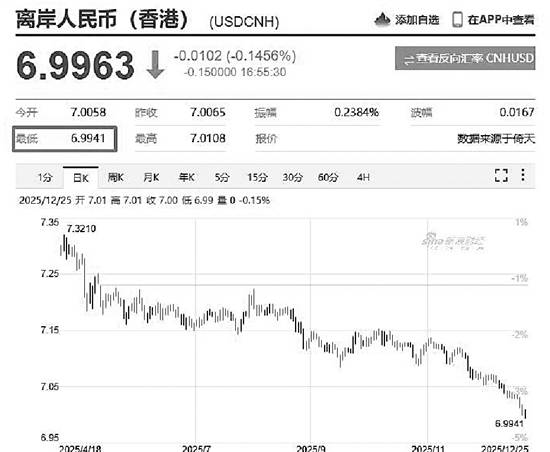
华泰证券:重申2026年底美元兑人民币汇率6.82、且2026年美元计价中国名义GDP增长8.5-9%的预测
Xin Lang Cai Jing· 2025-12-25 23:32
华泰证券研报指出,12月25日,离岸人民币兑美元汇率盘中突破7.00的重要关口,在岸人民币也升破 7.01。目前,跨过7的象征性点位后,我们仍看好人民币升值的潜力和动力。基本面层面,人民币汇率 极具竞争力、且相对价格优势与日俱增——年化4-5个百分点的升值不影响中国出口行业的总体优势。 结汇高峰这一催化剂之外,我们关注2026年"开门红"和中美经贸关系进一步缓和的潜在利好。对市场环 境的影响而言,现阶段人民币升值(纠正低估)有望推升外资对人民币资产的关注度和风险偏好,和资 金流入形成"正循环",推升资产估值和银行间流动性,反而有利于放松金融条件。我们重申2026年底美 元兑人民币汇率6.82、且2026年美元计价中国名义GDP增长8.5-9%的预测。 ...