
成本控制

Search documents
萨莉亚火爆!日媒:日本餐饮用“低价经验”走红中国
Hua Er Jie Jian Wen· 2025-10-26 10:41
Core Viewpoint - The contrasting public reception of pre-made meals in China, highlighted by the success of Japanese brand Salia and the controversy surrounding Chinese brand Xibei, emphasizes the importance of transparency in business practices [2][9]. Group 1: Market Dynamics - The success of Salia reflects a broader trend of Japanese restaurants expanding internationally, leveraging a mature low-cost operational system developed in a competitive domestic market [3][4]. - Japanese dining brands are gaining positive reviews in China due to their balance of quality and price, appealing to consumers' desire for value [4]. Group 2: Salia's Business Model - Salia's impressive cost-effectiveness stems from a deep-rooted philosophy of cost control and operational efficiency, initiated by its founder, Masahiko Shogaki [5][11]. - The company plans to open over 50 new stores annually in China, aiming to double its total number of locations to 1,000 by 2035, supported by a new factory investment of approximately $30 million [7][11]. Group 3: Value Proposition - Salia's business model is built on transparent value exchange, where consumers receive stable, hygienic, and affordable meals in return for their money, contrasting with other brands that mislead consumers about the nature of their products [2][9]. - The company's approach to pricing is innovative, as it actively reduces prices due to supply chain efficiencies, exemplified by a significant price drop for a bottle of wine from 124 RMB to 63 RMB [11]. Group 4: Operational Efficiency - Salia employs meticulous operational strategies, such as a strict 10-minute service time for all orders and a unique method of serving food to maximize efficiency [11]. - The company adopts a long-term perspective on profitability, preparing for initial losses in new stores to build customer loyalty and ensure sustainable growth [11].
温氏股份(300498)25年三季报点评:生猪价格低迷拖累利润表现 肉鸡板块经营小幅改善
Xin Lang Cai Jing· 2025-10-26 08:33
Core Insights - The company reported a decline in revenue and net profit for Q1 to Q3 of 2025, with revenue at 75.788 billion yuan and net profit at 5.256 billion yuan, reflecting a year-on-year change of -0.03% and -18.29% respectively [1] - In Q3 2025, the company achieved revenue of 25.937 billion yuan and net profit of 1.781 billion yuan, showing a significant year-on-year decline of -9.76% and -65.02% [1] - The decline in performance is attributed to a decrease in the average selling price of pigs during the peak season, despite an increase in the number of pigs sold [1] Revenue and Profit Analysis - For Q1 to Q3 2025, the company sold 27.668 million pigs, a year-on-year increase of 28.32%, while Q3 sales reached 9.736 million pigs, up 35.45% year-on-year [1] - The weighted average selling price for pigs was 14.57 yuan/kg for Q1 to Q3 and 13.86 yuan/kg for Q3, reflecting a year-on-year decrease of -12.79% and -28.84% respectively [1] - The average selling price of pigs decreased monthly from July to September, contributing to the overall decline in performance [1] Cost and Efficiency - The company has been improving operational efficiency, with the comprehensive cost of pig farming remaining stable at 12.2 to 12.4 yuan/kg in August [1] - Despite low pig prices, the company managed to achieve profitability in its pig farming business during Q3 2025 [2] - The average cost of chicken production was maintained at a low level, with the total cost for broilers at 11.6 yuan per jin in August [2] Chicken Business Performance - The company sold 950 million chickens from Q1 to Q3 2025, a year-on-year increase of 8.90%, while Q3 sales were 350 million chickens, up 8.44% year-on-year [2] - The weighted average selling price for chickens was 11.22 yuan/kg for Q1 to Q3 and 11.91 yuan/kg for Q3, with year-on-year decreases of -15.22% and -9.37% respectively [2] - The chicken business showed signs of recovery in Q3, with monthly average prices increasing from July to September [2] Profitability Metrics - The gross margin for Q1 to Q3 2025 was 12.82%, down by 3.51 percentage points year-on-year, primarily due to the decline in pig prices [2] - The expense ratio for the same period was 6.15%, showing an improvement of -1.28 percentage points year-on-year, driven by effective cost control measures [2] Investment Outlook - The company has adjusted its profit forecast, expecting net profits of 7.787 billion yuan, 11.622 billion yuan, and 13.884 billion yuan for 2025 to 2027, reflecting a year-on-year change of -15.6%, +49.2%, and +19.5% respectively [3] - The company maintains a solid leading position in the breeding industry with good long-term growth potential, sustaining a "buy" rating [3]

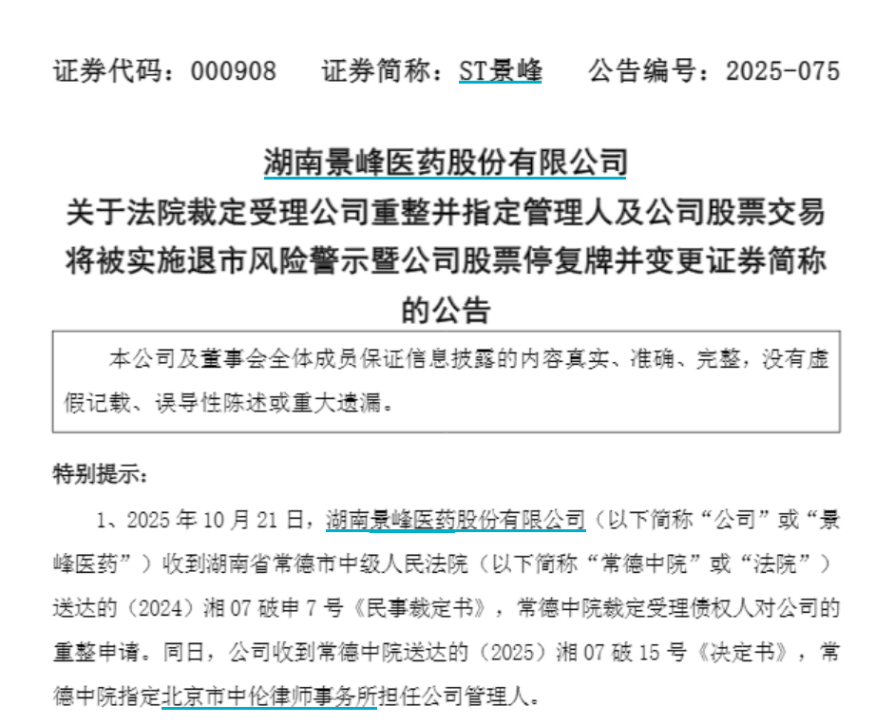
宇树科技上市在即,ST景峰却陷退市危机!
Sou Hu Cai Jing· 2025-10-25 10:58
Group 1 - The capital market is experiencing a stark contrast, with ST Jingfeng facing delisting risks while Yushu Technology is successfully advancing towards an IPO [1][3] - ST Jingfeng, a cardiovascular drug company listed in 2014, is now on the brink of restructuring, with negative net assets and overdue bonds as key issues [3] - In contrast, Yushu Technology, a robotics company, is showing strong performance, with its concept stocks averaging a 71.37% increase this year, and some stocks like Zhejiang Rongtai and Wolong Electric Drive seeing increases of 316.38% and 240.73% respectively [3] Group 2 - Retail investors often fall into the "valuation supremacy" trap, focusing excessively on price-to-earnings ratios without considering market dynamics [5] - The example of the 2025 new energy storage sector illustrates how retail investors missed significant gains by fixating on perceived overvaluation, while leading stocks surged from 20 to 120 [5] - Understanding the cost structure is crucial for investment success, as demonstrated by Warren Buffett's low-cost acquisition of Coca-Cola shares [6][7] Group 3 - Institutional investors focus on ensuring cost safety before considering profit potential, contrasting with retail investors who often prioritize potential gains [7] - The behavior of institutional investors can be identified through their active trading patterns in narrow price ranges, as seen in the case of Sifang Technology [9] - Concept stocks like Chuan Da Zhisheng show that even speculative trading requires a foundation of cost support, while stocks lacking institutional backing may only experience temporary rebounds [11][13] Group 4 - The challenges faced by ST Jingfeng were indicated by early warning signs such as negative net assets and overdue bonds, while Yushu Technology's strong performance is supported by industry growth and financing data [5][11] - The market rewards those who delve into data analysis, emphasizing the importance of data as a guiding tool in investment decisions [11]

【洽洽食品(002557.SZ)】积极推新,关注成本走势——2025年三季报点评(叶倩瑜/董博文)
光大证券研究· 2025-10-25 00:04
Core Viewpoint - The company reported a decline in revenue and net profit for the first three quarters of 2025, indicating challenges in maintaining growth and profitability [3]. Group 1: Financial Performance - For Q1-Q3 2025, the company achieved revenue of 4.501 billion yuan, a year-on-year decrease of 5.38%, and a net profit of 168 million yuan, down 73.17% year-on-year [3]. - In Q3 2025 alone, revenue was 1.749 billion yuan, a decrease of 5.91% year-on-year, with a net profit of 79 million yuan, down 72.58% year-on-year [3]. Group 2: Product Performance and Market Strategy - The "All Nuts" series performed well during the Mid-Autumn Festival and National Day, contributing positively to the nut category's revenue, while the sunflower seed category faced pressure due to inventory control measures [4]. - New products, particularly konjac products, showed promising trial sales in Southeast Asia, with plans to expand flavors and enhance the product matrix [4]. Group 3: Cost and Profitability Challenges - The gross margin for Q1-Q3 2025 was 21.94%, with Q3 at 24.52%, reflecting a year-on-year decrease of 8.59 percentage points due to rising raw material costs and promotional activities [5]. - The net profit margin for Q1-Q3 2025 was 3.73%, with Q3 at 4.54%, indicating a significant year-on-year decline of 11.03 percentage points, influenced by reduced revenue scale, increased raw material costs, and higher promotional expenses [5]. Group 4: Future Outlook - The company is optimistic about the performance of new products and expects improvements in terminal sales, with a slight decrease in sunflower seed costs potentially alleviating some cost pressures [6].


苏泊尔(002032):25Q3营收小幅下滑,静待需求回暖
HTSC· 2025-10-24 11:33
Investment Rating - The investment rating for the company is maintained as "Buy" with a target price of 60.27 RMB [6][4]. Core Views - The company reported a slight decline in revenue for Q3 2025, with revenue at 5.42 billion RMB, down 2.3% year-on-year and 4.8% quarter-on-quarter. The net profit attributable to the parent company was 426 million RMB, down 13.4% year-on-year and 3.8% quarter-on-quarter. The decline in revenue is attributed to pressure on domestic sales due to tightening national subsidy policies and expected slowdown in foreign sales due to uncertainties in tariff policies. The decrease in net profit is mainly due to increased marketing expenses, with the sales expense ratio rising by 1.5 percentage points [1][2][3]. Summary by Sections Revenue and Profitability - For the first three quarters of 2025, the company achieved revenue of 16.897 billion RMB, an increase of 2.3% year-on-year, while the net profit attributable to the parent company was 1.366 billion RMB, down 4.7% year-on-year. The company expects revenue pressure to ease as production capacity in Vietnam ramps up and promotional seasons approach [1][4]. Sales Performance - The kitchen small appliance industry saw total retail sales of 13 billion RMB in Q3 2025, up 6.9% year-on-year, but the total sales volume decreased by 7.5% year-on-year. The company, being a leader in the kitchen small appliance sector, is expected to face pressure on domestic sales due to the tightening of national subsidy policies. Additionally, foreign sales are anticipated to slow down due to cautious ordering patterns from clients amid tariff uncertainties [2][3]. Cost Management - The company's gross margin remained stable at 23.9% in Q3 2025, showing a slight increase of 0.6 percentage points quarter-on-quarter. The increase in sales expense ratio to 10.4% is attributed to enhanced marketing efforts aimed at product structure optimization and member engagement. The net profit margin for Q3 2025 was 7.9%, down 1.0 percentage points year-on-year, primarily due to the rise in sales expense ratio [3][4]. Earnings Forecast and Valuation - The earnings forecast has been slightly adjusted downward due to pressures on domestic and foreign sales. The expected net profit attributable to the parent company for 2025-2027 is projected to be 2.193 billion RMB, 2.298 billion RMB, and 2.388 billion RMB respectively. The corresponding EPS is expected to be 2.74 RMB, 2.87 RMB, and 2.98 RMB. The target price is set at 60.27 RMB, based on a 21x PE for 2026 [4][10].

万华化学:第三季度营收净利同比实现增长
Zheng Quan Shi Bao Wang· 2025-10-24 10:17
Core Insights - Wanhua Chemical reported a decline in profitability due to falling sales prices of its main products, with a year-on-year decrease in revenue and net profit for the first three quarters of 2025 [1] Financial Performance - For the first three quarters of 2025, Wanhua Chemical achieved operating revenue of 144.23 billion yuan, a decrease of 2.29% year-on-year; net profit attributable to shareholders was 9.16 billion yuan, down 17.45% year-on-year; and net profit excluding non-recurring items was 9.10 billion yuan, down 16.72% year-on-year [1] - In Q3 2025, the company reported operating revenue of 53.32 billion yuan, an increase of 5.52% year-on-year; net profit was 3.03 billion yuan, up 3.96% year-on-year, indicating a better quarterly performance compared to the overall first three quarters [1] Business Segments - The three core product lines of the company maintained stable production and sales, with the polyurethane segment generating sales revenue of 55.14 billion yuan, producing 4.54 million tons and selling 4.58 million tons; the petrochemical segment and trading generated sales revenue of 59.32 billion yuan, producing 4.78 million tons and selling 4.60 million tons; the fine chemicals and new materials segment generated sales revenue of 23.81 billion yuan, producing 1.89 million tons and selling 1.84 million tons, all maintaining industry-leading levels [1] Price Trends - The price trends for different products showed divergence, with the average market price for pure MDI at 18,300 yuan/ton, while the average price for polymer MDI was 15,200 yuan/ton, and TDI was 14,700 yuan/ton. The average price for soft foam polyether was 8,000 yuan/ton, benefiting from stable demand in the automotive and home industries [2] - The petrochemical product prices generally declined year-on-year, with significant drops in prices for key products such as propylene, normal butanol, and MTBE, which fell by 6.83%, 20.57%, and 19.87% respectively [2] Cost and Margin Analysis - On the cost side, the prices of major raw materials generally decreased year-on-year, which partially offset the pressure from falling product prices. The average price of pure benzene was 5,905 yuan/ton, down 30.05% year-on-year; the average price of 5,000 kcal thermal coal was 597 yuan/ton, down 20.61% year-on-year; and the average price of propane and butane also saw declines [2] - Despite the decrease in raw material costs, the company's gross margin fell by 1.94 percentage points year-on-year due to the impact of declining product prices [2] Cash Flow and Shareholder Activity - The net cash flow from operating activities for the first three quarters was 17.02 billion yuan, down 11.83% year-on-year; the net cash flow from investing activities was -24.92 billion yuan; and the net cash flow from financing activities was 18.69 billion yuan, showing a year-on-year decrease [3] - Major shareholder Synthesia International reduced its stake in Wanhua Chemical by selling a total of 16.47 million shares, representing 0.53% of the company's total shares, bringing its ownership down from 5.53% to 5.00% [3]

洽洽食品(002557):积极推新,关注成本走势:——洽洽食品(002557.SZ)2025年三季报点评
EBSCN· 2025-10-24 08:02
Investment Rating - The report maintains a "Buy" rating for the company [4][6]. Core Views - The company reported a revenue of 4.501 billion yuan for the first three quarters of 2025, a year-on-year decrease of 5.38%, and a net profit attributable to the parent company of 168 million yuan, down 73.17% year-on-year [1]. - The company is actively launching new products and focusing on cost trends, with a notable performance in the nut category during the Mid-Autumn Festival and National Day periods [2]. - The increase in raw material costs has pressured profits, with gross margins decreasing significantly [3]. Summary by Sections Financial Performance - For Q3 2025, the company achieved a revenue of 1.749 billion yuan, a decrease of 5.91% year-on-year, and a net profit of 79 million yuan, down 72.58% year-on-year [1]. - The gross margin for Q1-Q3 2025 was 21.94%, while for Q3 it was 24.52%, reflecting a year-on-year decline of 8.59 percentage points [3]. Product and Market Development - The nut product line showed positive sales momentum, while the sunflower seed category faced pressure due to inventory control measures [2]. - New products, including the "All Nuts" series and konjac products, are being introduced to expand the product matrix and enhance market presence [2]. Cost and Expense Analysis - The company faced increased costs due to rising raw material prices and promotional activities, leading to a decline in net profit margins [3]. - The sales expense ratio for Q1-Q3 2025 was 11.33%, reflecting increased investment in market expenses during the new product rollout phase [3]. Profit Forecast and Valuation - The profit forecast for 2025-2027 has been revised downwards, with expected net profits of 390 million yuan, 634 million yuan, and 738 million yuan respectively [4]. - The current stock price corresponds to a price-to-earnings ratio of 28x for 2025, 17x for 2026, and 15x for 2027 [4].
成本控制见效,纽曼矿业(NEM.US)三季度盈利超预期
智通财经网· 2025-10-23 23:17
Core Insights - The global largest gold mining company, Newmont Corporation, reported quarterly earnings that exceeded expectations due to effective cost control amidst soaring precious metal prices [1][2] - The company's Q3 revenue reached $5.52 billion, a year-on-year increase of 19.7%, surpassing market forecasts [1] - Despite better-than-expected adjusted earnings and revenue, the company could not fully capitalize on record gold prices due to lower production levels [1] Financial Performance - Q3 earnings per share reached $1.71, exceeding analysts' average expectations by $0.29 [1] - The average realized gold price in Q3 rose from $2,518 per ounce in the same period last year to $3,539 per ounce [1] - Total sustaining costs for gold decreased by 2.8% to $1,566 per ounce [2] Production Challenges - Gold production fell by 15% year-on-year from 1.67 million ounces to 1.42 million ounces, primarily due to declining ore grades and maintenance plans at the Penasquito mine in Mexico and the Lihir mine in Papua New Guinea [1] - The completion of open-pit mining at Ahafo South's Subika also impacted production levels [1] Strategic Initiatives - The outgoing CEO, Tom Palmer, has focused on controlling expenditures following a $15 billion acquisition of Newcrest Mining, expanding the portfolio to approximately 20 mines [2] - Newmont has indicated plans to align closer to the cost structure of its lowest-cost peers, which may lead to significant layoffs [2] - The company expects to realize the full benefits of cost-saving measures, which will be reflected in the 2026 guidance [2] Market Performance - Newmont's stock price has increased by approximately 140% this year, nearing the average level of its peers in the industry [2]

World Kinect(WKC) - 2025 Q3 - Earnings Call Transcript
2025-10-23 22:00
Financial Data and Key Metrics Changes - In Q3 2025, consolidated volume was 4.3 billion gallons, down 4% year over year, and gross profit declined 7% to $250 million [11][19] - Operating expenses were $181 million, down 7% year over year, reflecting effective cost management [17][21] - Interest expense increased to $26 million, up approximately 8% year over year [18] Business Line Data and Key Metrics Changes - Aviation volume was 1.8 billion gallons, down 4% year over year, but gross profit increased by 11% to $143 million due to strong performance in Europe and government sales [11][12] - Land volumes declined 8% year over year, with gross profit at $81 million, down 20% due to unfavorable market conditions [13][14] - Marine volumes increased 3% year over year, but gross profit decreased 32% due to lower profit contributions and market volatility [15][16] Market Data and Key Metrics Changes - The aviation segment showed resilience with growth in government and business aviation activities, while the marine segment faced challenges from low bunker prices and volatility [6][16] - The land segment is focusing on core profitable activities after exiting non-core businesses in Brazil and the UK [15][20] Company Strategy and Development Direction - The company is sharpening its focus on core businesses and has announced leadership changes to enhance strategic direction [4][9] - The acquisition of Universal Trip Support Services is expected to enhance service offerings and drive growth in the aviation segment [12][19] - The company aims to improve financial returns and earnings predictability through portfolio reshaping and operational efficiencies [7][15] Management's Comments on Operating Environment and Future Outlook - Management expressed confidence in the leadership team and their ability to navigate market cycles and uncertainties [5][9] - The company anticipates continued growth in aviation gross profit supported by the recent acquisition and strong performance in Europe [12][19] - Management acknowledged challenges in the land segment but is focused on strategies to improve profitability [30][31] Other Important Information - The company generated $116 million in operating cash flow and $102 million in free cash flow in Q3 2025, maintaining a strong liquidity profile [19][22] - The adjusted effective tax rate for Q3 was 27%, with expectations for Q4 to remain consistent [18][19] Q&A Session Summary Question: What is needed to turn around unfavorable market conditions in the land segment? - Management is exploring strategies to manage delivery costs and evaluating long-term viability of certain markets [27][28][30] Question: How will the earnings accretion from the latest acquisition flow in the first year? - The contribution is expected to be ratable over the first 12 months, with additional synergies realized in the following two years [31][32] Question: How is the company balancing divestitures and potential M&A opportunities? - The company is actively looking at opportunities while focusing on restructuring and integrating the recent acquisition [33][34] Question: What other areas are being targeted for cost efficiencies? - The company is implementing a global finance transformation initiative aimed at generating long-term cost benefits [36][37]

恒源煤电20251023
2025-10-23 15:20
Summary of Hengyuan Coal Power's Conference Call Company Overview - **Company**: Hengyuan Coal Power - **Industry**: Coal Mining and Power Generation Key Financial Performance - **Q3 2025 Revenue**: Reached 1.4 billion yuan, a 17% increase quarter-on-quarter [2][3] - **Net Profit**: Turned profitable with a net profit of 29 million yuan, compared to a loss of over 100 million yuan in Q2 [2][3] - **Operating Cash Flow**: Positive cash flow of 400 million yuan in Q3, contrasting with negative cash flow in previous quarters [2][3] - **Coal Production**: - Raw coal production: 2.4785 million tons, a 3.2% increase from Q2 [3] - Commodity coal production: 1.966 million tons, a 9.4% increase from Q2 [3] - Premium coal sales: 554,000 tons, a 4% decrease year-on-year [5] Pricing and Cost Analysis - **Average Selling Price**: - Overall average price: 640.32 yuan/ton, a slight increase of 0.8% from Q2 [2][3] - Premium coal price: 1,036.14 yuan/ton, a decrease of 150.06 yuan from Q2 [2][3] - **Cost Control**: - Commodity coal total cost: 670.9 yuan/ton, a 6.2% decrease year-on-year [2][3] - Unit production costs reduced due to increased production and cost control measures, although fixed costs rose due to high investments in smart systems [2][8][9] Market Dynamics - **Market Opportunities**: Capitalized on rising prices of thermal coal and coke, optimizing product structure to enhance sales [4][10] - **Sales Target**: Expected to meet the annual commodity coal sales target of 7.5 million tons [4][12] - **External Factors**: Profitability impacted by external factors such as tax policy changes and market conditions [15] Future Outlook - **Q4 2025 Projections**: Anticipated average price increase of 150 yuan to 1,550 yuan/ton for coking coal, which is expected to positively impact profits [14] - **Cost Management Goals**: Plans to maintain cost control measures despite potential increases in fixed and additional costs due to prior investments [9] Additional Insights - **Production Stability**: No signs of overproduction among coal enterprises in Anhui province, with stable operations reported [16][18] - **Regulatory Environment**: Increased safety regulations have had a minor impact on production [17] - **Investment Returns**: Increased investment returns attributed to the Phase II project of previous investments [23] This summary encapsulates the key points from Hengyuan Coal Power's conference call, highlighting financial performance, market dynamics, and future outlook.
