
新发展格局

Search documents
苹果CEO库克等“大咖”热议这一话题→
Jin Rong Shi Bao· 2025-10-21 05:07
楼继伟:探索安全与效率并重的增长模式 中国上半年GDP增速在全球居于前列,高技术产业投资保持较高增速,同时通过多元化产能与市场布局 积极破局,成功对冲了单一市场依赖风险。 楼继伟表示,更重要的是,面对全球保护主义暗流涌动,产业链的碎片化割裂、阵营化对抗倾向,中国 以更开放的姿态坚定拥抱全球化;也未固守传统发展路径,而是主动构建新发展格局,探索安全与效率 并重的增长模式。 近日,在全球财富管理论坛·2025上海苏河湾大会上,全球财富管理论坛理事长、中国财政部原部长楼 继伟,第十三届全国政协常委、经济委员会主任尚福林,亚洲基础设施投资银行行长、董事会主席金立 群,苹果公司首席执行官蒂姆·库克等"大咖",对人工智能等话题展开了探讨。 金立群:AI将带来显著生产率提升 金立群表示,生成式AI将会定义我们如今这个时代的生活,AI能带来显著的生产率提升。 金立群提到,麦肯锡估计,生成式AI在16个行业63个用例中,每年可创造2.6万亿至4.4万亿美元的经济 价值。"通过人工智能驱动的感知、推理和控制能力,机器人正从刚性工具转变为能在动态现实环境中 安全、高效、运行的自主适应系统。"他表示。 库克:企业如果不部署AI,就会 ...
首席点评:构建新发展格局
Shen Yin Wan Guo Qi Huo· 2025-10-21 02:47
1. Report Industry Investment Rating - There is no specific industry investment rating provided in the report. 2. Core Viewpoints of the Report - The futures market capital in China reached a new high of about 2.02 trillion yuan on October 9, 2025, a 24% increase from the end of 2024 [1]. - The stock index is entering a direction - selection phase. The domestic liquidity environment is expected to remain loose, and external funds may flow in. The market style may shift to value in the fourth quarter [2][10]. - Precious metals are strong in the long - term, but there may be adjustments after rapid increases. Copper prices may be supported in the long run due to supply - demand changes [3][18][19]. - The central bank is expected to implement a moderately loose monetary policy in the fourth quarter, and there may be reserve requirement ratio cuts, interest rate cuts, and treasury bond trading operations [11][12]. - The prices of various commodities are affected by factors such as supply - demand relationships, geopolitical situations, and policy changes, and their trends vary [2][3][13][14] 3. Summary by Relevant Catalogs 3.1 Main News International News - The US and Australia signed an agreement on rare earths and critical minerals, planning to invest over $3 billion in related projects in the next 6 months, and the Pentagon will invest in a gallium processing plant in Western Australia [5]. Domestic News - China's LPR for October remained unchanged, with the 1 - year and 5 - year varieties at 3% and 3.5% respectively, and the central bank may implement a moderately loose monetary policy [6][11]. Industry News - The monthly average price futures of linear low - density polyethylene, polyvinyl chloride, and polypropylene will be listed on October 28, 21:00, and will be included in the tradable scope for qualified overseas investors [7]. 3.2 Foreign Market Daily Returns - The S&P 500, European STOXX 50, and FTSE China A50 futures all rose, while ICE Brent crude oil fell. Other commodities also showed different price changes [9]. 3.3 Morning Comments on Major Varieties Financial - Stock index: After a high - level shock in September, it will enter a direction - selection phase. The domestic liquidity environment is expected to be loose, and the market style may shift to value in the fourth quarter [2][10]. - Treasury bonds: They generally fell. The central bank may implement a moderately loose monetary policy in the fourth quarter, which will support treasury bond futures prices [11][12]. Energy and Chemical - Crude oil: SC fell at night. The decline is due to geopolitical stability and the end of the demand peak. The reaction of OPEC in November is crucial [13]. - Methanol: It fell at night. The operating rate of domestic coal - to - olefin plants decreased, and the inventory of coastal methanol increased [14]. - Rubber: After continuous declines, it is expected to fluctuate and adjust in the short term, and the supply pressure may gradually appear [15]. - Polyolefins: The futures continued to be weak, and the price was affected by crude oil and inventory digestion [16]. - Glass and soda ash: Both futures continued to be weak, and they are in the process of inventory digestion [17]. Metals - Precious metals: Gold and silver continued to be strong, but the upward trend at high levels slowed down. There may be adjustments after rapid increases [3][18]. - Copper: The price rose at night. The supply of concentrates is tight, and the Indonesian mine accident may lead to a supply - demand gap [19]. - Zinc: The price rose at night. The processing fee of zinc concentrates increased, and the domestic zinc price may be weaker than the foreign one [20]. - Lithium carbonate: The supply and demand both increased, and the inventory decreased. The price is expected to be volatile in the short term [21]. Black Metals - Coking coal and coke: The night - session trend was weak. The high iron - water production supports the demand, but there is a risk of blast furnace production cuts [22][23]. - Iron ore: The price was weak, but the demand is supported by strong steel production. The global iron ore shipment decreased, and the port inventory decreased rapidly [24]. - Steel: The price was stable and improving. The supply pressure is increasing, and the market supply - demand contradiction is not significant [25]. Agricultural Products - Protein meal: The price of soybean and rapeseed meal rose at night. The US soybean crushing data exceeded expectations, but the domestic supply is sufficient [26]. - Oils and fats: The price of rapeseed and palm oil fell at night, while soybean oil rose. The export of Malaysian palm oil increased, but the market is affected by the Sino - US trade situation [27]. - Sugar: The price of Zhengzhou sugar rose at the end of the night session. The global sugar market is in a stocking phase, and the domestic sugar price is expected to fluctuate [28]. - Cotton: The price of Zhengzhou cotton fluctuated. The US cotton picking is progressing, and the domestic cotton price lacks upward momentum [29][30]. Shipping Index - Container shipping to Europe: EC fluctuated. The SCFIS European line rebounded after 13 weeks of decline. The market is in a game for the year - end peak season, and it is expected to continue wide - range fluctuations in the short term [31].
新华社社评:在接续奋斗中谱写中国式现代化新篇章
Xin Hua She· 2025-10-20 04:47
征程万里风正劲,重任千钧再扬帆。在全党全国各族人民的团结奋斗中,"十四五"规划即将圆满收官。 10月20日至23日,中国共产党第二十届中央委员会第四次全体会议在北京召开。这一万众期待、举世瞩 目的历史性盛会,将准确把握"十五五"时期党和国家事业发展所处历史方位,深入分析我国发展环境面 临的深刻复杂变化,对未来五年发展作出顶层设计和战略擘画。这是乘势而上、接续推进中国式现代化 建设的又一次总动员、总部署,体现了以习近平同志为核心的党中央团结带领全党全国各族人民续写经 济快速发展和社会长期稳定两大奇迹新篇章、奋力开创中国式现代化新局面的历史主动,必将对党和国 家事业发展产生重大而深远的影响。 办好中国的事情,关键在党。推动"十五五"时期经济社会高质量发展,坚持党的全面领导是根本保证。 习近平总书记深刻指出:"能不能驾驭好世界第二大经济体,能不能保持经济社会持续健康发展,从根 本上讲取决于党在经济社会发展中的领导核心作用发挥得好不好。"只有坚决维护党中央权威和集中统 一领导,把党的领导贯穿经济社会发展各方面全过程,才能充分发挥党总揽全局、协调各方的领导核心 作用,形成推动经济社会发展的强大合力。打铁必须自身硬。要坚 ...
郑学工:前三季度国民经济运行保持总体平稳
Guo Jia Tong Ji Ju· 2025-10-20 02:17
Economic Overview - In the first three quarters, China's GDP reached 10,150.36 billion yuan, with a year-on-year growth of 5.2% [2] - The contribution rates to economic growth from the primary, secondary, and tertiary industries were 4.7%, 34.6%, and 60.7% respectively [2] Industry Performance - Agricultural production showed stability with a year-on-year increase of 4.0%, contributing 0.3 percentage points to economic growth [3] - Industrial production increased by 6.1% year-on-year, contributing 1.8 percentage points to economic growth, with manufacturing growing by 6.5% [3] - The service sector also performed well, with significant growth in information transmission, software, and IT services, which grew by 11.2% [3] Domestic Demand and Trade - Final consumption expenditure contributed 53.5% to economic growth, adding 2.8 percentage points to GDP [5] - Investment in key areas showed rapid growth, with capital formation contributing 17.5% to economic growth [5] - Net exports maintained stable growth, contributing 29.0% to economic growth [5] Market Dynamics - The digital economy showed significant support, with revenue from information transmission and IT services growing by 12.1% [6] - The manufacturing sector is accelerating its transformation, with high-tech manufacturing increasing by 9.6% [7] - Modern service industries are also improving, with high-tech service sector revenue growing by 9.4% [7]
前三季度经济运行稳中有进 高质量发展取得积极成效
Guo Jia Tong Ji Ju· 2025-10-20 02:01
(2025年10月20日) 国家统计局 前三季度,在以习近平同志为核心的党中央坚强领导下,各地区各部门认真贯彻落实党中央、国务院决策部署,坚持稳中求进工作总基调,完整准确全面贯 彻新发展理念,加快构建新发展格局,认真实施更加积极有为的宏观政策,积极做强国内大循环,促进国内国际双循环,扎实推动高质量发展,国民经济顶 住压力延续稳中有进发展态势,生产供给平稳增长,就业物价总体稳定,新动能稳步成长,民生保障有力有效,经济运行展现出强大韧性和活力。 初步核算,前三季度国内生产总值1015036亿元,按不变价格计算,同比增长5.2%。分产业看,第一产业增加值58061亿元,同比增长3.8%;第二产业增加 值364020亿元,增长4.9%;第三产业增加值592955亿元,增长5.4%。分季度看,一季度国内生产总值同比增长5.4%,二季度增长5.2%,三季度增长4.8%。 从环比看,三季度国内生产总值增长1.1%。 一、农业生产形势较好,畜牧业平稳增长 前三季度,全国固定资产投资(不含农户)371535亿元,同比下降0.5%;扣除房地产开发投资,全国固定资产投资增长3.0%。分领域看,基础设施投资同 比增长1.1%,制造业 ...


作出战略擘画,凝聚磅礴力量,四中全会开幕吸引世界目光
Huan Qiu Wang· 2025-10-19 23:32
Group 1 - The 20th Central Committee's Fourth Plenary Session of the Communist Party of China is taking place from October 20 to 23, focusing on the formulation of the 15th Five-Year Plan, which is crucial for China's economic direction and goals [1][2] - The 15th Five-Year Plan is expected to emphasize high-quality development, technological independence, and expanding domestic demand, addressing regional disparities and enhancing social welfare [5][6] - The global community is closely watching the outcomes of the Fourth Plenary Session, as the new Five-Year Plan is anticipated to shape future global markets and reflect China's ability to manage social governance effectively [1][2][4] Group 2 - The 15th Five-Year Plan is part of a broader strategy that includes the 14th and 16th plans, aiming for modernization by 2035, with a target of achieving a per capita GDP comparable to that of moderately developed countries [2][4] - The plan will be finalized and approved by the National People's Congress in March 2024, following discussions and endorsements from various regional and departmental stakeholders [2][3] - China's unique approach to Five-Year Plans not only guides domestic industrial policy but also has significant global implications, particularly in high-tech sectors [3][5] Group 3 - The upcoming Five-Year Plan is seen as a critical period for technological innovation and industrial upgrading, with a focus on new productivity in areas like AI, semiconductors, and green technologies [5][6][7] - The plan is expected to reinforce China's commitment to carbon emission reduction and energy efficiency, aligning with global sustainability goals [5][6] - The emphasis on a new development and security framework indicates a strategic approach to balancing economic growth with national security in an increasingly uncertain global environment [7][8]
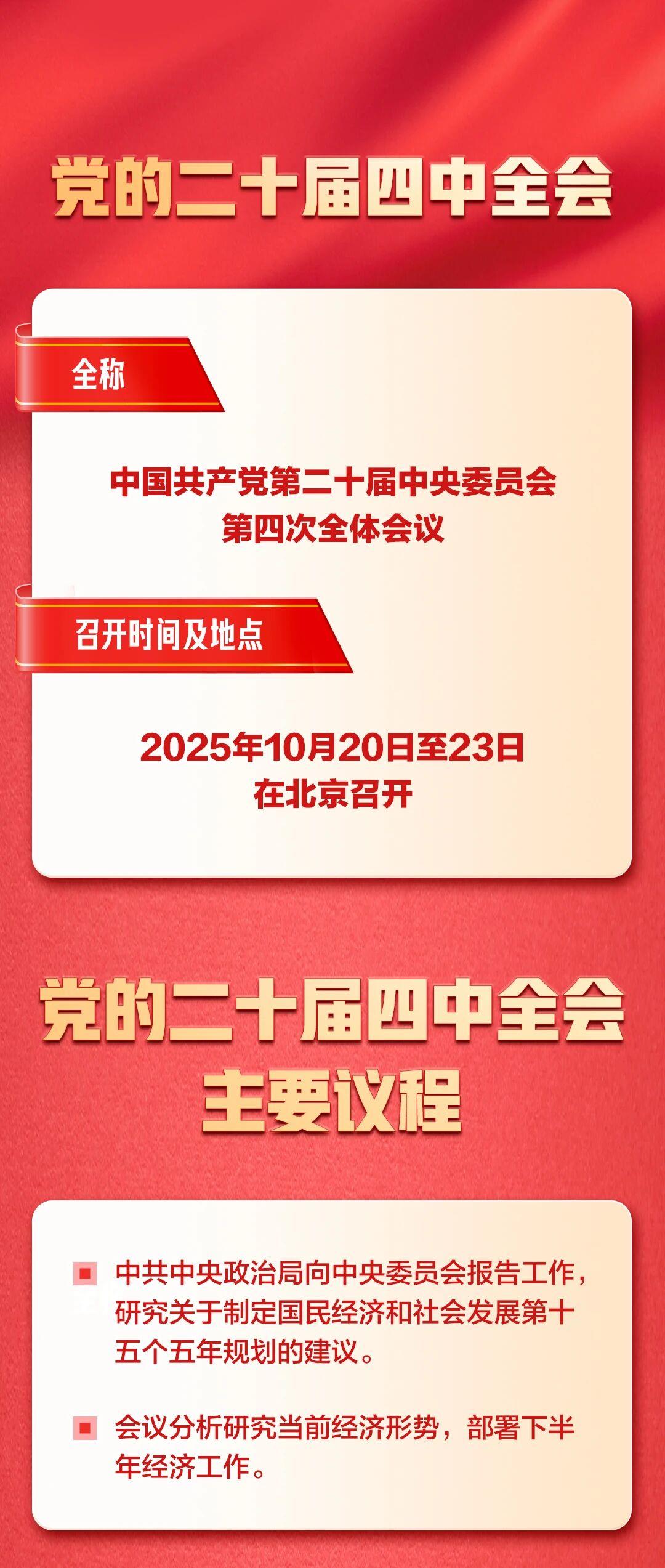
召开在即!一张图带你了解党的二十届四中全会
Yang Shi Xin Wen Ke Hu Duan· 2025-10-19 04:53
Group 1 - The Central Political Bureau of the Communist Party of China reported on work to the Central Committee, focusing on the formulation of the 15th Five-Year Plan for national economic and social development [4] - The meeting analyzed the current economic situation and deployed economic work for the second half of the year [4] Group 2 - Emphasis on the necessity of upholding the Party's comprehensive leadership and maintaining the authority of the Central Committee [6] - The principle of prioritizing the people, respecting their primary status, and ensuring that the benefits of modernization are distributed more equitably among all [7] - Commitment to high-quality development guided by new development concepts, promoting sustainable economic growth and comprehensive social progress [7] - Focus on deepening reforms and expanding high-level openness to continuously enhance development momentum and social vitality [7] - The combination of an effective market and a proactive government to better allocate resources and enhance government functions [7] - The importance of coordinating development and security, strengthening bottom-line thinking, and effectively preventing and mitigating various risks to ensure a new development pattern [7]
焦点访谈丨“风雨兼程见彩虹” 中国经济巨轮破浪前行
Yang Shi Xin Wen Ke Hu Duan· 2025-10-19 04:28
Economic Overview - The "14th Five-Year Plan" has guided China's economic and social development, achieving high-quality growth despite challenges [1][12][16] - China's GDP is projected to reach approximately 140 trillion yuan this year, with an average annual growth rate of 5.5% over the past four years [5][9] - The plan's target was to maintain GDP growth within a reasonable range, allowing for flexibility in macroeconomic governance [7][11] Consumption and Domestic Demand - Consumption contributed approximately 60% to economic growth during the "14th Five-Year Plan" period [21] - The government has implemented policies such as the "old-for-new" program, with 69 billion yuan allocated to stimulate consumption [22] - Service consumption is expected to grow at an annual rate of 9.6% from 2020 to 2024, reflecting increased demand for services as GDP per capita exceeds $13,000 [24][25] Foreign Trade and Global Positioning - China's foreign trade has shown resilience, with merchandise trade surpassing $6 trillion, maintaining its position as the world's largest trader [25][31] - Exports are projected to increase from $2.6 trillion in 2020 to $3.6 trillion by 2024, demonstrating strong growth despite global trade tensions [31] Research and Development - National R&D investment is expected to exceed 3.6 trillion yuan in 2024, marking a 48% increase since 2020, with R&D intensity reaching 2.68% [35][36] - The focus on innovation has led to significant advancements, including the operation of China's first fourth-generation nuclear power plant and the completion of the Tiangong space station [38][40] Industrial Transformation - The "14th Five-Year Plan" emphasizes the transformation of traditional industries and the growth of emerging sectors, with a focus on high-quality development [40][44] - Companies are increasingly adopting technology and sustainable practices to enhance productivity and product quality [42][44] Future Outlook - As the "14th Five-Year Plan" concludes, the groundwork is laid for the "15th Five-Year Plan," aiming for significant breakthroughs by 2035 [46][48]
全球财富管理论坛·2025上海苏河湾大会举行 专家建言“世界变革下的未来之路”
Jing Ji Guan Cha Wang· 2025-10-19 02:59
Group 1: Monetary Policy and Financial Regulation - The People's Bank of China emphasizes the dual function of monetary policy, focusing on both total and structural adjustments to address the structural challenges in the economy [1] - The design of structural monetary policy tools aims to create an incentive-compatible mechanism, linking the central bank's base currency issuance to commercial banks' lending to specific sectors [1] - The application of artificial intelligence in finance is expected to have significant and fundamental impacts, enhancing financial services and operational efficiency while ensuring risk management [2] Group 2: Financial Supply and Demand - AI technology is projected to drastically reduce the costs of financial product development and production, making it economically feasible to cater to previously neglected niche demands, thus generating a "long tail effect" [2] - Financial regulation encourages institutions to leverage the latest technologies to optimize services, reduce operational costs, and improve management efficiency while maintaining a balance between safety and efficiency [2] Group 3: Macro Policy and Economic Challenges - The rising global public debt and increasing leverage levels pose challenges, necessitating the use of macro policy space to enhance effective borrowing and investment in data-driven infrastructure [2][3] - China is advised to optimize its debt structure and implement comprehensive debt solutions while maintaining a sustainable government debt ratio aligned with economic resilience [3] - In the face of global protectionism and fragmented supply chains, China is adopting a more open approach to globalization and is actively constructing a new development pattern that balances safety and efficiency [3]
财政部原部长楼继伟:中国仍是全球产业链和市场互利共赢的重要力量
Guo Ji Jin Rong Bao· 2025-10-19 01:09
楼继伟以新能源汽车产业举例称,中国新能源汽车产业成功实践了"技术自主、供应链多元、市场全 球"的立体化策略。一方面,上半年出口量占全球市场份额的42%,动力电池国产化率超95%;另一方 面,产业链中的关键材料则通过全球化合作实现多元供应,既保障了供应链安全,又深度融入全球市场 和产业生态,彰显了中国仍是全球产业链和市场互利共赢的重要力量。 10月18日,全球财富管理论坛理事长、中国财政部原部长楼继伟在全球财富管理论坛·2025上海苏河湾 大会上表示,中国上半年GDP以5.2%的增速在全球居于前列,高技术产业投资同比增长10.6%,同时通 过多元化产能与市场布局积极破局,成功对冲了单一市场依赖风险。 更重要的是,面对全球保护主义暗流涌动,产业链的碎片化割裂、阵营化对抗倾向,中国既未因外部压 力选择"脱钩断链",更未以邻为壑,而是以更开放的姿态坚定拥抱全球化;也未固守传统发展路径,而 是主动构建新发展格局,探索安全与效率并重的增长模式。 楼继伟指出,中国提出的全球发展倡议、全球安全倡议、全球文明倡议和全球治理倡议,为世界注入了 新的活力与智慧。这四大倡议彰显了中国对于全球经济应是"共生共荣"和谐生态的坚定信念,也 ...