空间智能

Search documents
李飞飞的世界模型,大厂在反向操作?
虎嗅APP· 2025-06-06 13:56
Core Viewpoint - The article discusses the emergence of World Labs, a startup founded by AI expert Fei-Fei Li, focusing on developing the next generation of AI systems with "spatial intelligence" and world modeling capabilities. This shift signifies a new direction in AI development beyond traditional language models [2][3]. Group 1: Company Overview - World Labs was founded in 2024 by Fei-Fei Li and has quickly raised approximately $230 million in funding, achieving a valuation of over $1 billion, making it a new unicorn in the AI sector [2]. - The company has attracted significant investment from major players in the tech and venture capital space, including a16z, Radical Ventures, NEA, Nvidia NVentures, AMD Ventures, and Intel Capital [2]. Group 2: Importance of World Modeling - Fei-Fei Li emphasizes the importance of world modeling, which refers to AI's ability to understand the three-dimensional structure of the real world, moving beyond mere language processing [9][10]. - The concept of world modeling is likened to how humans perceive and interact with their environment, integrating visual, spatial, and motion information to create a comprehensive understanding of the world [10][12]. Group 3: Key Technologies for World Modeling - Several key technologies are being explored to enable AI to understand and reconstruct three-dimensional worlds, including: - Neural Radiance Fields (NeRF), which allows AI to reconstruct a 3D world from 2D images [17]. - Gaussian Splatting, which enhances rendering speed and efficiency for real-time applications [19]. - Diffusion Models, which improve AI's ability to understand and generate three-dimensional content [20]. - Multi-view data fusion, enabling AI to integrate information from various angles to form a complete understanding of objects [21]. - Physics simulation and dynamic modeling, allowing AI to predict and understand the movement and interaction of objects in the real world [23]. Group 4: Applications of World Modeling - The applications of world modeling technology are extensive, including: - In the gaming industry, AI can automatically generate realistic 3D environments from images or videos [25]. - In architecture, AI can quickly create detailed spatial structures, significantly reducing design time [26]. - In robotics, enhancing robots' spatial understanding allows them to navigate and interact with their environment more effectively [26]. - Digital twins can be created for factories, buildings, and cities, enabling simulations for testing and optimization [27]. Group 5: Challenges Ahead - Despite the promising direction of world modeling, several challenges remain: - Data availability is crucial; AI requires extensive and diverse real-world data to learn effectively [31]. - Computational power is a significant barrier, as many current technologies demand high resources, making large-scale deployment challenging [32]. - Generalization ability is limited; AI models often struggle to adapt to unfamiliar environments [33]. Group 6: Future Vision - Fei-Fei Li envisions a future where AI not only sees and reconstructs the world but also participates in it, enhancing human capabilities rather than replacing them [42][43]. - The ultimate goal of AI development is to achieve General Artificial Intelligence (AGI), which requires spatial perception, dynamic reasoning, and collaborative abilities [46][47].


“AI教母”李飞飞揭秘“世界模型”:要让AI像人类一样理解三维空间
3 6 Ke· 2025-06-06 12:31
Core Insights - The conversation highlighted the vision and research direction behind World Labs, founded by renowned AI expert Fei-Fei Li, focusing on the concept of "world models" that enable AI systems to understand and reason about both textual and physical realities [2][4][6] Group 1: Company Vision and Goals - World Labs aims to tackle unprecedented deep technology challenges, particularly in developing AI systems that possess spatial intelligence, which is crucial for understanding the three-dimensional physical world and virtual environments [2][4] - Fei-Fei Li emphasizes the need for a "perfect partner" who understands computer science and AI, as well as market dynamics, to help guide the company towards its goals [4][5] Group 2: Limitations of Current AI Models - The discussion began with the limitations of large language models (LLMs), with Li arguing that while language is a powerful tool, it is not the best medium for describing the complexities of the three-dimensional physical world [6][10] - Li points out that many capabilities exceed the scope of language, and understanding the world requires building human-like spatial models [11][12] Group 3: Applications of World Models - The potential applications of successfully developed world models are vast, including creativity in design, film, architecture, and robotics, where machines must adapt to and understand their three-dimensional environments [12][13] - Li envisions a future where advancements in world models will allow humans to live in "multiverses," expanding the boundaries of imagination and creativity [13] Group 4: Importance of Spatial Intelligence - Spatial intelligence is identified as a core capability for AI, essential for understanding and interacting with the three-dimensional world, which has been a fundamental aspect of human evolution [10][11] - Li shares personal experiences to illustrate the significance of three-dimensional perception, highlighting the challenges faced by AI systems that lack this capability [14]

李飞飞的世界模型,大厂在反向操作?
Hu Xiu· 2025-06-06 06:26
Group 1 - The core idea of the article revolves around Fei-Fei Li's new company, World Labs, which aims to develop the next generation of AI systems with "spatial intelligence" and world modeling capabilities [2][5][96] - World Labs has raised approximately $230 million in two funding rounds within three months, achieving a valuation of over $1 billion, thus becoming a new unicorn in the AI sector [3][4] - The company has attracted significant investment from major players in the tech and venture capital sectors, including a16z, Radical Ventures, NEA, Nvidia NVentures, AMD Ventures, and Intel Capital [4][5] Group 2 - Fei-Fei Li emphasizes that AI is transitioning from language models to world modeling, indicating a shift towards a more advanced stage of AI that can truly "see," "understand," and "reconstruct" the three-dimensional world [6][9][23] - The concept of a "world model" is described as AI's ability to understand the three-dimensional structure of reality, integrating visual, spatial, and motion information to simulate a near-real world [15][18][22] - Li argues that language models, while important, are limited as they compress information and fail to capture the full complexity of the real world, highlighting the necessity of spatial modeling for achieving true intelligence [14][23] Group 3 - Key technologies being explored for building world models include the ability to reconstruct three-dimensional environments from two-dimensional images, utilizing techniques like Neural Radiance Fields (NeRF) and Gaussian Splatting [28][32][48] - The article discusses the importance of multi-view data fusion, where AI must observe objects from various angles to form a complete understanding of their shape, position, and movement [40][41] - Li mentions that to enable AI to predict changes in the world, it must incorporate physical simulation and dynamic modeling, which presents significant challenges [45][46][48] Group 4 - The applications of world modeling technology are already being realized across various industries, such as gaming, architecture, robotics, and digital twins, where AI can generate realistic three-dimensional environments from minimal input [50][51][56] - Li highlights the potential of AI in the creative industries, where it can assist artists and designers by enhancing their spatial understanding and imagination [58][60] - The article notes that while the direction of world modeling is promising, challenges remain, including data availability, computational power, and the need for AI to generalize across different environments [61][66][67] Group 5 - Li emphasizes the importance of a multidisciplinary team at World Labs, combining expertise from various fields to tackle the complex challenges of developing world models [72][74] - The article discusses the evolving nature of AI research, moving from individual contributions to collaborative efforts that integrate diverse perspectives [77][78] - Li also addresses the societal implications of AI, advocating for a broader understanding of its impact on education, law, and ethics, emphasizing the need for responsible AI development [81][85][86] Group 6 - Li envisions a future where AI not only sees and reconstructs the world but also participates in it, serving as an intelligent extension of human capabilities [89][90][92] - The article suggests that the development of world models is a foundational step towards achieving Artificial General Intelligence (AGI), which requires spatial perception, dynamic reasoning, and interactive capabilities [94][96] - The potential for AI to transform various sectors, including healthcare and education, is highlighted, indicating a significant shift in how technology can enhance human understanding and interaction with the world [92][93][98]
周专题:空调6月排产同比+11.5%,大疆入局扫地机
HUAXI Securities· 2025-06-02 13:57
Investment Rating - Industry rating: Recommended [4] Core Insights - In June 2025, air conditioner production increased by 11.5% year-on-year, with total production of major home appliances reaching 35.15 million units, a 7.3% increase compared to the same period last year [8][1] - DJI is entering the vacuum cleaner market with a new product expected to launch in June, positioning it as a mid-to-high-end model [10][11] Summary by Sections 1. Weekly Topic: Air Conditioner Production and DJI's Entry into Vacuum Cleaners - Air conditioner production in June 2025 reached 20.5 million units, up 11.5% year-on-year. Domestic sales were affected by weather conditions, but the upcoming 618 shopping festival boosted production [8][1] - Refrigerator production was 7.9 million units, a 3.6% increase year-on-year, driven by promotional events and government subsidies [8][1] - Washing machine production remained flat at 6.75 million units year-on-year, with domestic demand showing signs of seasonal decline [9][1] 2. Company Highlights - Aima Technology plans to grant 14,175,524 restricted stock units, representing 1.645% of its total share capital, to 421 employees as part of its incentive plan [12] - Changhong Meiling announced an investment of approximately 296.42 million yuan to build a new air conditioner production line with an annual capacity of 4 million units [12] 3. Data Tracking - Raw material prices showed slight fluctuations, with copper and aluminum prices increasing by 0.3% [13][20] - Shipping rates increased, with the CCFI composite index rising by 0.92% [20][21] - Real estate data indicated a decline in sales area, completion area, and new construction area by 3%, 17%, and 24% respectively for the first four months of 2025 [23][24]
天猫精灵加码全屋智能 实现交互、连接和功能升级
Huan Qiu Wang· 2025-05-29 09:32
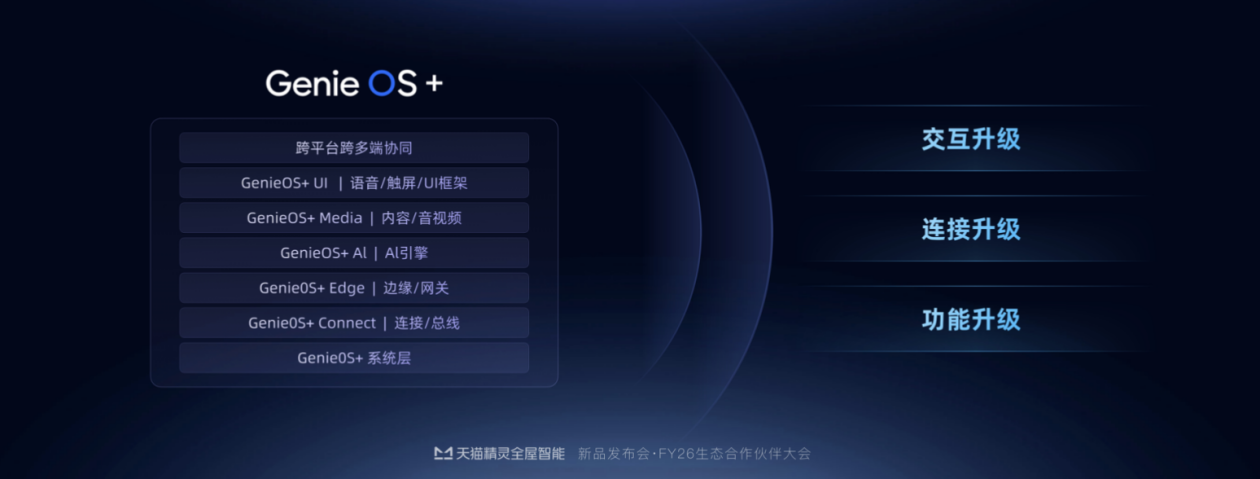
Core Insights - Tmall Genie has upgraded its Genie OS+ system with three major enhancements: interaction, connectivity, and functionality [1][3][4] - The system aims to create a smarter, more natural, and emotionally aware home automation experience by integrating IoT, large models, and multimodal interaction technologies [3][4] Group 1: Interaction Upgrade - The interaction upgrade features an integrated cross-end interaction framework that combines technology and aesthetics, making voice interaction more responsive and adding multi-dimensional sound color switching for enhanced user experience [1] - Tmall Genie has improved voice interaction convenience by deeply understanding user needs and quickly executing commands [4] Group 2: Connectivity Upgrade - The connectivity upgrade introduces a new cloud-edge-end architecture that significantly enhances cloud scene management efficiency, enabling edge data management and multi-gateway collaboration [1] - Bluetooth data transmission capacity has been expanded eightfold, facilitating smoother scene synchronization and large-scale control [1] Group 3: Functionality Upgrade - The functionality upgrade enriches entertainment content, including a wide range of music scene albums and AI music recommendations, while enhancing audio and video capabilities [1] - The latest space intelligence Agent can understand user preferences and home structure, providing more natural AI scene services [3] Group 4: Ecosystem Development - Tmall Genie continues to deepen its "1+3+N" ecosystem, supporting a wider range of ecological products and diverse application scenarios for faster and more stable connections [4] - Strategic partnerships with over 20 leading companies in sleep, lighting, home appliances, and audio-visual fields are established to further integrate space intelligence into daily life [4]

蔡崇信:机器人不必像人,年轻人要追求能力而非履历|BEYOND Expo 2025专题报道
Sou Hu Cai Jing· 2025-05-28 19:20
Group 1: Trust and Globalization - Trust is built over time through shared goals and mutual respect, which is essential for business cooperation [3][4] - Alibaba's mission to help small businesses access global markets remains relevant today, emphasizing the importance of understanding local cultures for entrepreneurs [3][5] - The global business environment has become unpredictable, necessitating proactive communication between companies and regulatory bodies [4][5] Group 2: Globalization Strategies - Alibaba's revenue is predominantly from the Chinese market, highlighting the importance of local understanding in international operations [5] - Successful globalization requires a combination of Chinese technology and local management teams, as demonstrated by Alibaba's approach in Turkey [5] - Language barriers present challenges for Chinese companies abroad, but advancements in AI and translation technology may offer solutions [5][6] Group 3: Robotics and AI - The integration of AI into robotics is transforming their capabilities, moving beyond simple automation to intelligent actions [6] - Most applications do not require humanoid robots, as functionality is prioritized over form [6] - The key challenge for the robotics industry lies in developing spatial intelligence, which remains superior in humans [6] Group 4: Sports and Culture - Sports can serve as a cultural product rather than just a competitive activity, allowing for global engagement [6] - The Brooklyn Nets aim to represent local culture on a global scale, expanding their brand beyond basketball [6] Group 5: Resilience and Career Development - Companies must adopt a mindset of resilience, viewing failures as opportunities for growth [7] - Young professionals should focus on acquiring skills and knowledge rather than merely building a resume, with an emphasis on finding mentors who foster growth [8] - Emotional value in the workplace is crucial, as positive contributions to team dynamics are remembered [8] Group 6: Future of Asia - Asia has been a major beneficiary of globalization, but the dismantling of global bridges necessitates increased internal connectivity among Asian countries [8]


特斯联加注“空间智能”筹码,AI市场谁主沉浮
Zhong Guo Ji Jin Bao· 2025-05-23 09:25
Core Insights - The article highlights the rapid growth and strategic upgrades of Teslin, an AIoT company, with a projected revenue of 1.843 billion yuan in 2024, marking an 83.2% increase from 2023, positioning it as one of the fastest-growing companies in China's AI sector [1][2] Group 1: Business Performance - In 2024, Teslin's AI industry digitalization revenue surged by 162.9% from 624 million yuan in 2023 to 1.64 billion yuan, indicating a more focused business strategy [2] - The total number of clients increased from 330 in 2023 to 342 in 2024, with 255 clients (approximately 74.5%) coming from the digitalization business, contributing to higher average revenue per client [2] - The company's total assets reached 4.1531 billion yuan in 2024, reflecting a 15.5% increase from 2023, showcasing a positive trend in asset and operational efficiency [6] Group 2: Strategic Upgrades - Teslin has upgraded its strategy to focus on three main areas: AIoT models, AIoT infrastructure, and AIoT intelligent agents, emphasizing spatial intelligence [2][3] - The company is leveraging a "space for time" strategy to quickly capture market share in the AIoT infrastructure sector, aiming for future growth [4][5] - The introduction of the upgraded green intelligent computing body supports various domestic chips and advanced models, enhancing the company's technological capabilities [3] Group 3: Financial Metrics - In 2024, Teslin's adjusted EBITDA loss was 970 million yuan, with the loss-to-revenue ratio improving from 59.6% in 2023 to 52.8%, outperforming comparable companies [4] - The company reduced its sales expenses as a percentage of revenue from 13.2% in 2023 to 8.5% in 2024, indicating improved cost management [6] Group 4: Market Position and Investor Confidence - Teslin's strategic moves have attracted significant capital, with new financing amounting to approximately 655 million yuan from various state-owned and industry funds [7] - The company has deployed products in over 800 clients across 160 cities globally, including notable projects in Dubai and Shanghai, enhancing its market presence [7]
机器人“最强大脑”竞赛白热化:特斯拉、Figure押注空间智能
2 1 Shi Ji Jing Ji Bao Dao· 2025-05-22 12:54
Group 1 - Tesla and Figure Robotics are making significant advancements in robotics, showcasing their capabilities in household chores and factory operations respectively [1][2] - Tesla's robots utilize a unified neural network model for training, learning from real human videos rather than traditional VR motion capture [1][4] - The rapid progress in robotics is attracting investment interest, with several companies securing substantial funding and forming strategic partnerships [2][3] Group 2 - The complexity of robotic operations in three-dimensional space is highlighted, with Tesla leveraging its experience in autonomous driving to enhance robotic models [4][5] - Current challenges in the industry include the high cost and time required for collecting real-world data, which is essential for training robots effectively [5][6] - The deployment of humanoid robots in factories is seen as a critical step towards commercialization, with several companies already integrating robots into their production lines [6][7] Group 3 - The cost of humanoid robots remains high, with prices ranging from 500,000 to 1,000,000 yuan per unit, which poses a barrier to widespread adoption [6] - Companies are exploring high-value industrial scenarios and rapid adaptation to overcome productivity bottlenecks and achieve scalability in humanoid robotics [6][7] - The integration of self-assembling robots could create a significant industrial market, as demonstrated by Figure's plans for large-scale production of humanoid robots [6][7]

特斯联完成战略升级:三项核心业务聚焦空间智能
Jing Ji Guan Cha Wang· 2025-05-22 08:23
Core Viewpoint - The company, Teslin, has submitted an updated prospectus to the Hong Kong Stock Exchange, revealing a strategic upgrade focusing on three key areas: AIoT models, AIoT infrastructure, and AIoT intelligent agents, with an emphasis on spatial intelligence [1][2]. Group 1: Strategic Focus - Teslin aims to drive industrial upgrades and sustainable development through technology, specifically in the AIoT sector, with products deployed in over 800 clients across more than 160 cities globally [2]. - The company’s AIoT domain model serves as an analytical engine, utilizing a "multi-modal" and "model + system + application" commercialization strategy to create specialized models and intelligent applications for various industries [2][3]. - The introduction of the upgraded green computing unit supports various advanced chips and models, establishing a fully domestically developed toolset from chips to platforms [3][5]. Group 2: Financial Performance - In its first year of strategic upgrade, Teslin reported a significant revenue increase of 83.2%, reaching 1.843 billion yuan, with a compound annual growth rate of 58.0% over three years [5][6]. - The company’s expense ratio decreased from 76.9% in 2023 to 45.0% in 2024, while accounts receivable turnover days improved from 238 days in 2022 to 104 days in 2024, indicating enhanced capital efficiency [5][6]. - The AI industrial digitization business saw a remarkable revenue increase of 162.9%, contributing significantly to the overall revenue growth, with a total of 342 clients by the end of 2024 [6]. Group 3: Market Outlook - The global spatial computing market is projected to grow from approximately $149.59 billion in 2024 to over $1,066.13 billion by 2034, with a compound annual growth rate of 21.7%, and the Asia-Pacific market expected to grow at 22.2% [7]. - The company faces the challenge of seizing opportunities in the spatial intelligence sector amidst a complex global market landscape [7].
能空翻≠能干活,我们离通用机器人还有多远?
3 6 Ke· 2025-05-22 02:28
Core Insights - Embodied intelligence has gained significant attention in both industry and academia, particularly in humanoid robots, which integrate perception, movement, and decision-making capabilities [1][4][30] - The development of embodied intelligence is seen as a pathway towards achieving general robotics, with ongoing discussions about the challenges and milestones that lie ahead [1][30] Group 1: Current State and Future Prospects - The industry anticipates that 2025 may mark the "year of embodied intelligence," with significant competition emerging in the multimodal and embodied intelligence sectors [3][4] - NVIDIA's CEO Jensen Huang has proclaimed that the era of general robotics has begun, outlining four stages of AI development, culminating in "physical AI," which focuses on understanding and interacting with the physical world [3][4] - Experts believe that while progress has been made, the journey towards true general robotics is still in its early stages, with many technical and conceptual hurdles remaining [31][32] Group 2: Technical Challenges and Opportunities - The current landscape of embodied intelligence is characterized by a lack of comprehensive models and algorithms, with many systems still not achieving convergence [32][33] - Key technical challenges include the integration of sensory feedback, the development of robust algorithms, and the need for advanced perception capabilities, such as tactile sensing [33][34] - The industry is witnessing a shift where many researchers from the autonomous driving sector are transitioning to embodied intelligence, leveraging their expertise in perception and interaction [15][19] Group 3: Application Scenarios - Potential application areas for embodied intelligence include home care, household services, and industrial automation, which are seen as practical and immediate needs [41] - The focus on specific vertical applications rather than general-purpose robots is emphasized, as the technology is still maturing and requires targeted development to meet real-world demands [36][41] - The integration of embodied intelligence into existing industrial systems is viewed as a promising avenue for scalability and broader adoption [39]