红利资产

Search documents
上半年超6400亿元险资新增入市 下半年险资如何配置
Jin Rong Shi Bao· 2025-08-27 01:45
Core Viewpoint - The A-share market has seen a significant surge in trading volume and index levels, with insurance funds playing a crucial role in this upward trend, marking a historic record in trading volume and a strong performance in major indices [1][2]. Group 1: Market Performance - On August 22, the trading volume in the Shanghai, Shenzhen, and Beijing markets exceeded 2 trillion yuan for the eighth consecutive trading day, breaking historical records for A-shares [1]. - The Shanghai Composite Index closed at 3825.76 points, up 1.45%, while the Shenzhen Component Index rose by 2.07%, and the ChiNext Index increased by 3.36%. The STAR Market 50 Index surged by 8.59% [1]. Group 2: Insurance Fund Inflows - Insurance funds have injected over 640 billion yuan into the stock market, significantly surpassing the total for the previous year [1][2]. - As of the end of Q2, the total balance of insurance funds reached 36.23 trillion yuan, a year-on-year increase of 17.39%, with stock investments amounting to 3.07 trillion yuan, representing 8.47% of the total, the highest since 2022 [1][3]. Group 3: Factors Driving Investment - Three main factors are driving insurance funds to increase stock market investments: policy guidance and regulatory easing, the need to address "asset shortages" and interest rate risk, and the inherent attractiveness of the equity market [3][4]. - Regulatory changes have encouraged long-term capital to enter the market, with adjustments to solvency regulations allowing for increased stock investments [3][4]. Group 4: Investment Preferences - Insurance funds have shown a preference for bank stocks, with 12 out of 30 reported equity stakes being in this sector, alongside interests in public utilities, non-bank financials, and other industries [5][6]. - The new accounting standards for insurance companies have led to increased equity stakes as a strategy to stabilize financial reporting and reduce profit volatility [7]. Group 5: Future Outlook - A research report predicts that by 2025, the insurance industry's original premium income will reach 6 trillion yuan, with an expected increase of 1.57 trillion yuan in fund utilization in the second half of the year [8]. - Insurance institutions are optimistic about the A-share market, particularly favoring sectors such as pharmaceuticals, electronics, banking, and technology, with a focus on high-dividend and innovative investments [8].
煤炭行业30年复盘
2025-08-26 15:02
Summary of Coal Industry Conference Call Industry Overview - The coal industry in China is projected to produce 4.74 billion tons in 2024, with imports reaching a historical high but accounting for less than 10% of total supply [1][2] - The cyclical nature of the coal industry is expected to weaken starting in 2024, moving towards a tight balance due to supply-side reforms [1][5] - Coal consumption in China remains high, exceeding 55%, with the power sector being the largest consumer [1][6] Key Points and Arguments - **Production and Demand**: In the first half of 2025, domestic coal production is expected to grow by 7% year-on-year, reaching approximately 2.4 billion tons, but a decrease in production is anticipated in the second half [2][3] - **Price Trends**: The average coal price is expected to be between 680-700 RMB per ton in the first half of 2025, with a peak not exceeding 720-750 RMB per ton in late summer [3][12] - **Investment Outlook**: The coal sector is currently at a low point, but there is potential for improvement in the coming years. Investors are encouraged to focus on high-quality leading companies in a low-interest-rate environment [1][7] Additional Insights - **Supply-Side Reforms**: The reforms have led to a significant increase in industry concentration, with large coal mines now accounting for over 85% of production and the CR8 concentration exceeding 50% [3][11] - **Seasonal Fluctuations**: The coal industry experiences seasonal demand fluctuations, with summer and winter being peak seasons, while March-April and September-October are typically off-peak [1][8] - **Long-Term Energy Structure**: China's energy structure is characterized by a high reliance on coal, with expectations that coal will maintain a significant share of over 45% in the next 5-10 years [6][10] Conclusion - The coal industry is undergoing significant changes influenced by supply-side reforms and shifting demand dynamics. While the current environment presents challenges, there are opportunities for strategic investments in leading companies as the market stabilizes and demand for coal remains robust in key sectors like electricity generation.
近三成理财产品近一周收益为负,破净率上升
2 1 Shi Ji Jing Ji Bao Dao· 2025-08-26 10:07
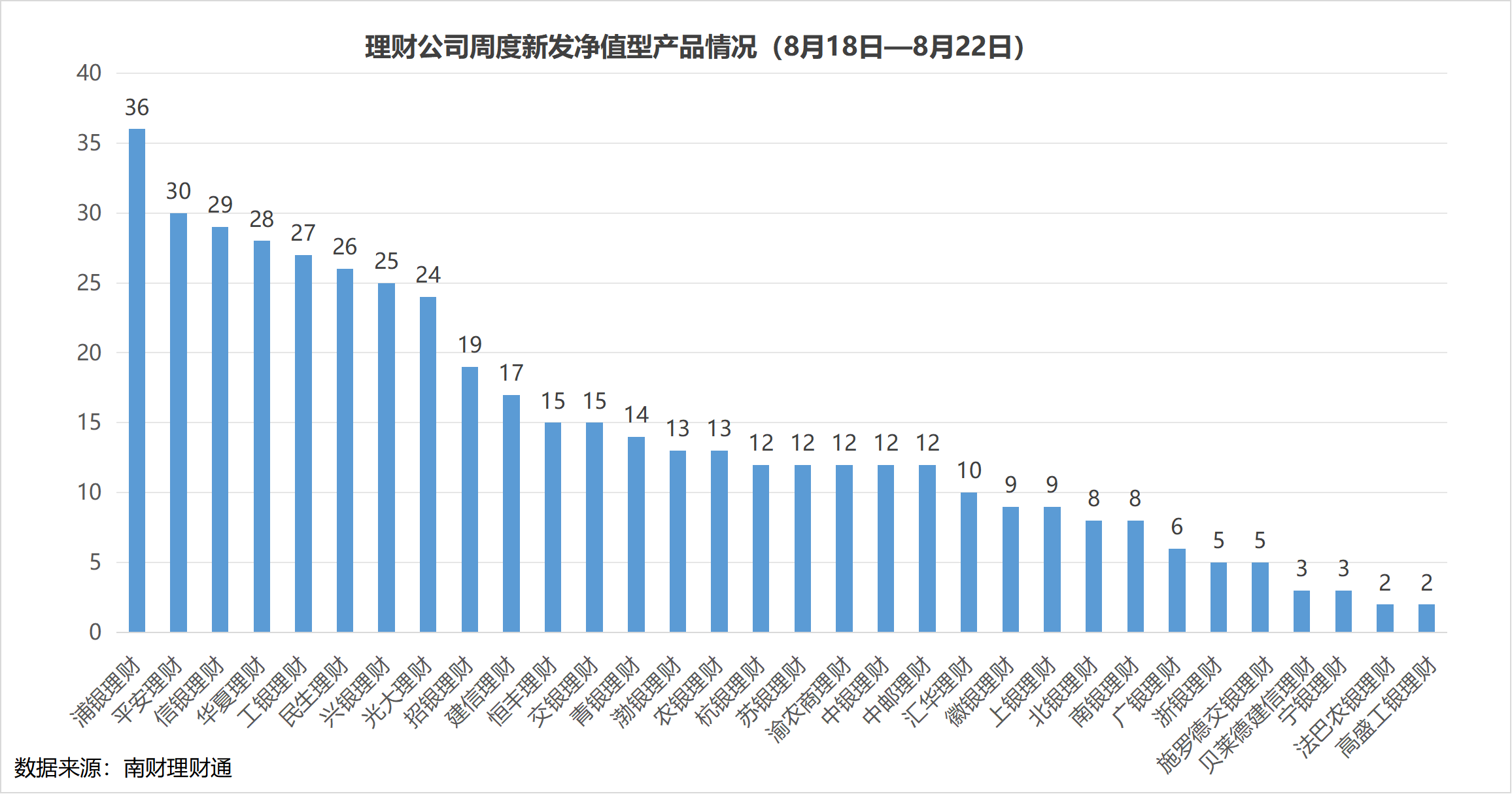
Market Overview - The A-share market saw significant gains last week, with the Sci-Tech Innovation 50 Index, Northbound 50 Index, and ChiNext Index rising by 13.31%, 8.4%, and 5.85% respectively, while the bond market experienced a general pullback [2] - The overall funding environment remained stable, with the weighted average price of DR007 at 1.467% and the yield on 10-year government bonds closing at 1.78% [2] Product Performance - The number of products below par is low, but the rate of products below par has increased, with a total of 25,444 public wealth management products, of which 316 have a cumulative net value below 1, resulting in a comprehensive par rate of 1.24% for bank wealth management [3] - The par rate for fixed income public wealth management products is 1.03%, while equity and mixed products have par rates of 28.57% and 4.5% respectively [3] New Product Issuance - A total of 461 wealth management products were issued by 32 wealth management companies from August 18 to August 22, with the highest issuance from joint-stock banks, including 36 from Ping An Wealth Management and 30 from Shanghai Pudong Development Bank Wealth Management [5] - New products primarily consist of R2 (medium-low risk), closed-end net value type, and fixed income public products, with only 5 mixed products issued and no new equity or derivative products [7] Product Pricing - There was a divergence in pricing for short-term and long-term products, with short-term products maintaining or slightly increasing their pricing, while long-term products saw a decline, particularly those with a maturity of over 3 years, which decreased by 40 basis points to 2.15% [7] Revenue Trends - Fixed income wealth management yields continued to decline, with an average net value growth rate of 0.0252% for fixed income products, while mixed and equity products had average growth rates of 0.2489% and 2.2894% respectively [10] - The highest weekly yield for fixed income products was observed in those with a maturity of less than 1 month, averaging a net value growth rate of 0.0424% [10] Cash Management Products - The average annualized yield for cash public wealth management products in RMB, USD, and AUD was 1.334%, 3.900%, and 2.84% respectively, with an increase in the proportion of negative yield products, particularly in fixed income categories [13] - Approximately 28.92% of RMB public wealth management products reported negative returns last week, with the highest proportion of negative yield products being those with a maturity of over 3 years at 48.84% [13] Industry Trends - Wealth management companies are increasingly partnering with rural commercial banks to tap into the growing wealth management demand in lower-tier cities, with over 35 rural commercial banks collaborating with various wealth management subsidiaries [15] - The focus on providing comprehensive service support beyond just products is emphasized for effective engagement with small and medium-sized banks [15] Company Performance - Ping An Wealth Management reported a net profit of 700 million RMB for the first half of 2025, with total assets of 13.548 billion RMB and a net asset value of 13.174 billion RMB, while the balance of managed wealth management products decreased by 4.47% compared to the end of the previous year [16]

周报 | 近三成理财产品近一周收益为负,破净率上升
2 1 Shi Ji Jing Ji Bao Dao· 2025-08-26 09:57
Market Overview - The A-share market saw strong gains last week, with the Sci-Tech Innovation 50 Index, Northbound 50 Index, and ChiNext Index rising by 13.31%, 8.4%, and 5.85% respectively, while the bond market experienced a correction [2] - The overall funding environment remained stable, with the weighted average price of DR007 at 1.467% and the yield on 10-year government bonds closing at 1.78% [2] Product Performance - The number of products below par is low, but the rate of products below par has increased, with a total of 25,444 public wealth management products, of which 316 have a cumulative net value below 1, resulting in a comprehensive par rate of 1.24% [3] - The par rates for equity and mixed wealth management products are 28.57% and 4.5% respectively, while fixed income public wealth management products have a par rate of 1.03% [3] - Fixed income products with maturities of over 3 years and 1-2 years have higher par rates of 3.98% and 2.27% respectively [3] New Product Issuance - A total of 461 wealth management products were issued by 32 wealth management companies from August 18 to August 22, with the highest issuance from joint-stock banks [4] - The newly issued products are primarily R2 (medium-low risk), closed-end net value type, and fixed income public products, with only 5 mixed products and no new equity or derivative products [4] - Short-term products (less than 6 months) saw stable or slightly rising pricing, with 1-3 month products increasing by 55 basis points to an average pricing of 2.81%, while products over 6 months saw a decline [4] Product Strategy - Several wealth management companies issued dividend strategy products, with a focus on fixed income products benefiting from policy guidance and low interest rates [5] - The overall performance of dividend assets has shown a "slight rise and differentiation" trend, with traditional banking and port sectors performing well [5] - Market experts believe that the pricing logic for dividend assets is shifting from defensive attributes to fundamental improvements, highlighting the importance of supply constraints and policy catalysts [5] Yield Situation - Fixed income product yields continued to decline, with short-term products performing relatively well, showing an average net value growth rate of 0.0252% for fixed income products [6] - Mixed and equity products had average net value growth rates of 0.2489% and 2.2894% respectively, with the highest yield for fixed income products under 1 month at 0.0424% [6] - The average annualized yield for cash public wealth management products in RMB, USD, and AUD was 1.334%, 3.900%, and 2.84% respectively [6] Negative Yield Situation - The proportion of negative yield products increased, primarily due to fixed income products, with 28.92% of RMB public wealth management products yielding negative returns [7] - The negative yield rates for fixed income, mixed, and equity products were 29.63%, 16.23%, and 5.13% respectively, with nearly 30% of fixed income products experiencing losses [7] - The highest proportion of negative yield products was for those with maturities over 3 years at 48.84%, while the lowest was for products under 1 month at 12.82% [7] Industry Trends - Wealth management companies are increasingly partnering with rural commercial banks to tap into the growing wealth management demand in lower-tier markets [8] - As of August 19, several wealth management subsidiaries have collaborated with over 35 rural commercial banks in regions like Zhejiang, Shanxi, and Shandong [8] - Experts suggest that wealth management companies may need to provide comprehensive support services to small banks, covering the entire service process from pre-sale to post-sale [8] Company Performance - Ping An Wealth Management reported a net profit of 700 million RMB for the first half of 2025, with total assets of 13.548 billion RMB and net assets of 13.174 billion RMB [9] - The balance of wealth management products managed by Ping An Wealth Management was 1,159.989 billion RMB, a decrease of 4.47% compared to the end of the previous year [9]
关注红利港股ETF(159331)投资机会,市场关注高股息板块配置价值
Mei Ri Jing Ji Xin Wen· 2025-08-26 08:38
Group 1 - The overall strong performance of the technology sector and the index in the third quarter is expected to continue, maintaining the allocation strategy of "technology + Hong Kong dividend + non-bank brokerages" [1] - With the recovery of market risk appetite and the emphasis on the capital market's role in "expectation management," the allocation value of high-dividend sectors in Hong Kong stocks is highlighted [1] - The trend of "deposit migration" among residents is becoming evident, leading to a gradual inflow of funds into the stock market, which may benefit dividend assets like high-dividend Hong Kong stocks due to optimistic market sentiment [1] Group 2 - There is a caution regarding increased volatility in early to mid-September, suggesting a focus on dividend and state-owned enterprise allocation opportunities [1] - In the long term, the capital market remains a core tool for policy to "stabilize confidence," and high-dividend assets in Hong Kong stocks continue to be attractive under the "14th Five-Year Plan" [1] - The Hong Kong Dividend ETF (159331) tracks the Hong Kong Stock Connect High Dividend Index (930914), which selects 30 securities with continuous dividends, good liquidity, and outstanding dividend yields from the Stock Connect range, focusing on traditional high-dividend sectors like finance, energy, and industry [1]
告别“过山车”,如何利用红利实现1+1>2的实战组合
Sou Hu Cai Jing· 2025-08-26 08:23
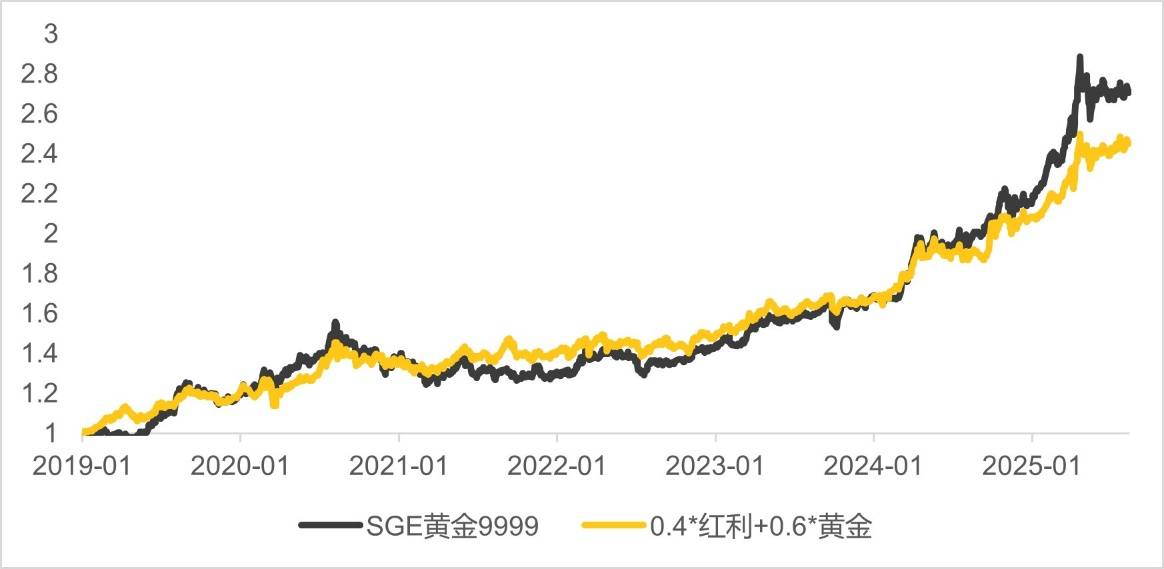
Core Viewpoint - Dividend assets serve as a dual-purpose investment, providing both growth potential akin to stocks and stable income similar to bonds, making them an effective balancing tool in investment portfolios [1]. Group 1: Dividend Assets Characteristics - Dividend assets are rooted in sectors closely tied to economic cycles, such as coal, petrochemicals, and finance, exhibiting strong stock-like characteristics while also offering regular dividends [1]. - The unique cross-asset nature of dividend assets allows them to effectively reduce overall portfolio volatility while potentially enhancing returns, achieving a surprising effect of 1+1>2 in holding experience [1]. Group 2: Performance with Other Assets - The "Dividend + Gold" combination effectively controls maximum drawdown while improving the risk-return ratio, especially beneficial during periods of gold market downturns [1][2]. - The "Dividend + Commodity" strategy enhances returns, risk-return ratios, and reduces maximum drawdown compared to holding commodities alone, demonstrating resilience during market downturns [5]. - The "Dividend + Bond" approach offers higher long-term compound return potential with limited increase in maximum drawdown, providing strong inflation resistance [8]. - The "Dividend + Growth" strategy lowers volatility and maximum drawdown while maintaining the elasticity of growth assets, thus improving the risk-return ratio [10]. Group 3: Investment Tools - The E Fund (515180), tracking the CSI Dividend Index, is highlighted as a low-fee quality option for investors seeking to allocate to A-share dividend products [12].
险资投资者下半年信心调查:股票是首选投资资产
Sou Hu Cai Jing· 2025-08-26 07:41
Core Viewpoint - The insurance asset management industry in China shows a stable outlook for the second half of 2025, with expectations of moderate economic growth and a preference for equities in investment strategies [1][2]. Economic Outlook - Most insurance institutions expect the macroeconomic environment to maintain stable growth, with GDP growth projected between 4.5% and 5.5%, CPI growth between 0% and 0.5%, and PPI growth between -3.5% and -2.0% [1]. - The RMB exchange rate is anticipated to appreciate steadily, with key areas of focus including exports, consumption, fiscal policy, and real estate investment [1]. Monetary and Fiscal Policy - Insurance institutions predict a moderately accommodative monetary policy in the second half of the year, with expectations for timely reserve requirement ratio and interest rate cuts to maintain ample liquidity [1]. - Fiscal policy is expected to be more proactive, leaning towards expansion to boost domestic demand and consumption, potentially through the issuance of ultra-long special bonds [1]. Asset Allocation Preferences - Equities are the preferred investment asset for insurance institutions in the second half of the year, followed by bonds and securities investment funds [1]. - Most institutions expect their asset allocation ratios to remain consistent with early 2025, with some considering slight increases in equity and bond investments [1]. Bond Market Outlook - A neutral to optimistic outlook is held for the bond market, with expectations for 10-year government bond yields to range between 1.4% and 1.6%, and medium to high-grade credit bond yields between 1.5% and 2.0% [2]. - There is a favorable view on ultra-long special bonds, perpetual bonds, convertible bonds, and credit bonds with maturities over 10 years, influenced by economic fundamentals, monetary policy easing, and market liquidity [2]. A-Share Market Outlook - A generally optimistic view is held for the A-share market, with expectations for the Shanghai Composite Index to likely remain between 3200 and 3800 points [2]. - Insurance institutions are particularly optimistic about stocks related to the CSI 300 index, focusing on sectors such as pharmaceuticals, electronics, banking, computing, telecommunications, and national defense [2]. Overseas Investment Preferences - Hong Kong stocks are favored for investment in the second half of the year, with 40% of insurance institutions also showing interest in bond and gold investments [3].
一个跟踪市场的另类情绪指标,中证红利40日收益差跌破-10%,意味着什么?
Sou Hu Cai Jing· 2025-08-26 04:34
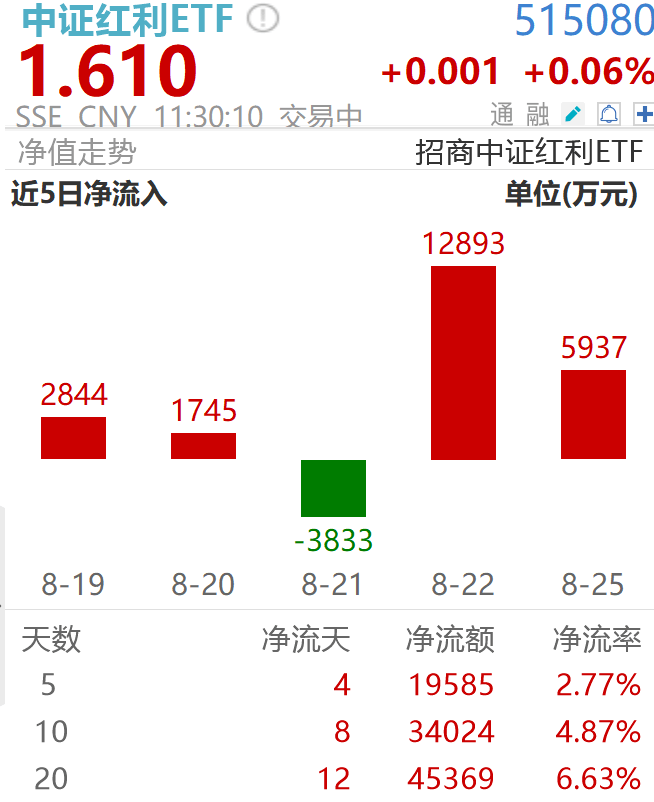
Core Insights - The recent decline of the 40-day return difference of the CSI Dividend Index to -10.28% indicates a historically extreme level of underperformance compared to the broader market [1][3] - Despite this underperformance, there is a notable influx of capital into dividend assets, suggesting that investors are taking advantage of the current market sentiment and fundamentals [1][3] Group 1: Market Signals - The drop below -10% in the return difference is a significant "contrarian signal," indicating a potential shift in the relative attractiveness of dividend assets [3] - The current level of -10.28% suggests that dividend stocks have been under pressure for too long, creating a potential opportunity for investors [3] Group 2: Capital Inflows - The CSI Dividend ETF (515080) has seen substantial net subscriptions, with recent inflows of 129 million and 59 million, totaling nearly 340 million over ten trading days, indicating strong demand [1] - This trend reflects a strategic move by investors to capitalize on the perceived value in dividend assets amidst market fluctuations [1][3] Group 3: Fundamental Changes - The ongoing earnings season has seen 288 companies announce mid-term dividend plans, with a total proposed payout of approximately 164.7 billion, signaling improved profitability and cash flow [3] - The increasing focus on dividends aligns with current policy directions encouraging shareholder returns, enhancing the appeal of dividend stocks as cash flow assets [3] Group 4: Investment Strategy - The attractiveness of dividend assets is rising due to their defensive nature and long-term return potential, making them a critical component of investment strategies [5] - Investors are encouraged to consider dollar-cost averaging or phased investments in the CSI Dividend ETF (515080) and related dividend quality products for a balanced approach [9]
险资权益配置稳健增长 青睐“绩优生”
Zhong Guo Jing Ji Wang· 2025-08-26 01:51
Core Insights - As of the end of Q2 2025, the balance of insurance funds exceeded 36 trillion yuan, marking a year-on-year growth of 17.4% [1][2] - Approximately 4.74 trillion yuan has been allocated to stocks and securities investment funds, with direct stock investments reaching 3.06 trillion yuan, an increase of about 1 trillion yuan compared to the same period last year [1][2] - The increase in insurance capital allocation to equities is driven by policy guidance and a recovery in the equity market, with a focus on value stocks, high dividend yield stocks, and companies with strong earnings [1][4] Investment Trends - The direct investment amount in stocks has significantly increased, with a year-on-year growth of nearly 1 trillion yuan [2][3] - By the end of Q2 2024, the balance of direct stock investments by property and life insurance companies was approximately 2.1 trillion yuan, with substantial growth in the second half of 2024 and the first half of 2025 [2][3] - The proportion of stock investments in the overall asset allocation of insurance funds has risen, with stocks accounting for 8.8% of the total allocation by the end of Q2 2025, up 0.4 percentage points from the previous quarter [2][3] Policy Influence - Multiple policy documents have been issued to encourage long-term investments by insurance funds, including adjustments to the regulatory ratios for equity assets [4][5] - The total amount approved for long-term investment pilot projects by the financial regulatory authority has reached 222 billion yuan [4] Market Outlook - Insurance institutions are optimistic about stocks as the preferred investment asset for the second half of 2025, with expectations for stable economic growth and a favorable outlook for the A-share market [8][9] - Key sectors of interest include pharmaceuticals, electronics, banking, and communication, with a focus on high dividend and innovative pharmaceutical investments [8][9] Asset Allocation Preferences - Insurance companies are expected to increase their allocation to equities due to the challenges in meeting duration matching needs with bonds and non-standard markets [5][6] - Analysts suggest that value stocks with stable return on equity (ROE) and cyclical industries at the bottom of their valuation cycles will be favored by insurance capital [6][7]
中国中车(601766):25H1业绩创历史新高,增加中期分红强化股东回报
Shenwan Hongyuan Securities· 2025-08-25 14:15
Investment Rating - The report maintains a "Buy" rating for the company [2] Core Insights - The company reported a record high performance in H1 2025, with revenue of 119.76 billion, a year-on-year increase of 32.99%, and a net profit attributable to shareholders of 7.25 billion, up 72.48% [5][8] - The railway equipment business showed the fastest growth, with revenue of 59.71 billion, a year-on-year increase of 42.21% [8] - The company plans to distribute a cash dividend of 1.1 yuan per 10 shares, totaling 3.16 billion, which represents 43.57% of the net profit for the first half of 2025 [8] - The profit margin and net profit for the first half of the year reached historical highs, with a net profit margin of 7.45% [8] Financial Data and Profit Forecast - The company expects total revenue for 2025 to be 265.21 billion, with a year-on-year growth rate of 7.6% [7] - The forecasted net profit for 2025 is 13.82 billion, reflecting an 11.6% increase compared to the previous year [7] - The projected earnings per share for 2025 is 0.48 yuan, with a price-to-earnings ratio of 16 [7] Business Segment Performance - The railway equipment repair and modification business generated revenue of 22.36 billion, a year-on-year increase of 11.81% [8] - The new industry segment reported revenue of 40.73 billion, up 35.59% year-on-year [8] - The modern service revenue reached 1.92 billion, with a growth of 16.39% [8] Market Context - National railway fixed asset investment for January to July 2025 was 433 billion, a year-on-year increase of 5.6%, indicating strong demand for railway services [8] - The company has exceeded the previous year's bidding volume for high-speed trains, with 278 sets of 350 km/h trains bid in the first eight months of 2025 [8]