人工智能应用

Search documents
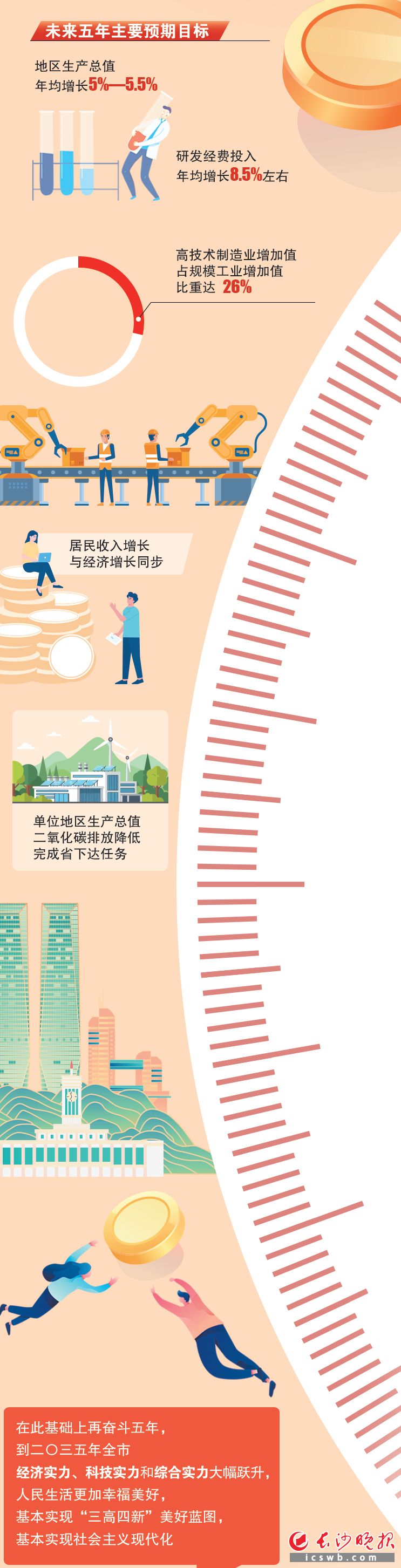
奋力在全国万亿城市版图中进位争先 ——《政府工作报告》“十五五”时期目标和任务
Chang Sha Wan Bao· 2026-01-08 02:47
Core Insights - The "15th Five-Year Plan" period is crucial for solidifying foundations and achieving comprehensive development, with a focus on enhancing the strategic position of Changsha as a major city in the central region of China [5] Group 1: Key Tasks for the Next Five Years - Focus on building "three high grounds" to consolidate and elevate Changsha's strategic position as a central city in the middle reaches of the Yangtze River [6] - Accelerate the creation of a national advanced manufacturing high ground by nurturing world-class and national-level advanced manufacturing clusters, while upgrading traditional industries and fostering emerging sectors like digital and intelligent industries [7] - Promote a dual empowerment of production and service sectors, implementing actions to enhance the quality and capacity of the service industry [8] Group 2: Technological and Innovation Development - Establish a core competitive technology innovation high ground by expanding global R&D centers and enhancing collaboration between educational institutions and innovation centers [9] - Strengthen the financial support for early-stage and long-term investments in hard technology, while improving the efficiency of technology transfer and intellectual property protection [9] Group 3: Reform and Opening Up - Accelerate the establishment of an inland reform and opening-up high ground, focusing on reforms in state-owned enterprises and fund management [10] - Enhance the capabilities of strategic open platforms like the Xiangjiang New Area and the Changsha Free Trade Zone [11] Group 4: Regional Integration and Infrastructure - Promote the integration of the Changsha-Zhuzhou-Xiangtan area to create a significant growth pole, focusing on industrial innovation and infrastructure development [13] - Develop a collaborative innovation system in the Changsha-Zhuzhou-Xiangtan region, establishing a national technology transfer demonstration zone [14] - Improve transportation and public service integration to enhance the quality of life and economic efficiency in the region [16][18] Group 5: Cultural and Tourism Development - Advance the integration of culture and technology, aiming for a cultural industry value exceeding 100 billion yuan [24] - Promote the deep integration of culture and tourism, developing high-quality tourist attractions and enhancing the city's cultural tourism brand [27] Group 6: Consumer Market Expansion - Enhance consumer capacity and quality by developing regional shopping centers and promoting new consumption scenarios [34] - Strengthen effective investment support in key areas such as infrastructure and social welfare [37] Group 7: Urban Development and Sustainability - Focus on urban development strategies that enhance the city's spatial layout and improve living conditions [42] - Promote green transformation initiatives, aiming for significant improvements in environmental quality and sustainability [49] Group 8: Social Welfare and Safety - Improve the employment support system and enhance services for the elderly and children, aiming for a more inclusive urban environment [51] - Establish a comprehensive public safety system to ensure the safety and well-being of residents [57]

人民币汇率,藏着A股的牛市密码
财富FORTUNE· 2026-01-07 13:04
Core Viewpoint - The A-share market has shown a strong performance at the beginning of 2026, characterized by a structural shift where sectors like commercial aerospace, artificial intelligence, and robotics are thriving, while many stocks lack macro and industrial narrative support [1] Group 1: Market Performance and Trends - The A-share market experienced a "14 consecutive days of gains," with the Shanghai Composite Index surpassing 4000 points, marking a ten-year high [1] - The market is witnessing a shift in investment style, driven by a stable RMB exchange rate, which is becoming a key anchor for global capital reassessing the value of Chinese assets [1][3] - In 2025, the RMB appreciated over 4.2% against the USD, and this trend continued into 2026, with the RMB remaining below 7.0 [3] Group 2: Foreign Investment and Capital Flows - Foreign net inflows into the Chinese stock market reached $50.6 billion in the first ten months of 2025, significantly exceeding the total for 2024 [4] - The RMB's appreciation is enhancing the attractiveness of A-shares in global asset portfolios, allowing foreign investors to diversify risks and benefit from China's economic growth [3][4] Group 3: Economic and Policy Outlook - The People's Bank of China aims to maintain the RMB exchange rate's basic stability, indicating a policy that allows for fluctuations but prevents excessive volatility [3] - The macroeconomic backdrop includes uncertainties in global economic policies, with potential risks such as concentrated currency settlement that could lead to an over-appreciation of the RMB [4] Group 4: Sector Focus and Investment Strategies - Investment strategies are increasingly focused on technology innovation, with sectors like AI, commercial aerospace, and high-end manufacturing attracting long-term capital [5] - Analysts predict that China's GDP growth will exceed market consensus, with stock market growth supported by earnings growth and valuation re-rating [5][6] - The current market dynamics suggest a transition from liquidity-driven to fundamentals-driven growth, with institutional investors taking a more significant role [6] Group 5: Future Implications for Investors - The anticipated appreciation of the RMB and the transformation of the Chinese economy are expected to lead to a global revaluation of high-quality core assets priced in RMB [6][7] - Investors are encouraged to shift from a trading mindset focused on market volatility to a holding strategy that embraces industrial trends and focuses on sectors with strong consensus [7]

A股午评:沪指13连阳,创十年新高,释放什么信号?牛市要加速?
Sou Hu Cai Jing· 2026-01-07 05:16
Market Overview - The A-share market opened strongly, with the Shanghai Composite Index surging past 4070 points, marking a ten-year high and a record-breaking 13 consecutive bullish days [1] - The trading volume is expected to reach 2.7 trillion yuan, significantly higher than the previous month's low levels, indicating a substantial influx of capital [1][6] Sector Performance - Financial sectors, particularly insurance and securities, played a crucial role in driving the index higher, with state-backed funds actively participating [2][4] - Following the financial sector's lead, cyclical stocks, including tourism and metals, also experienced significant gains, reflecting rapid capital movement across industries [2] - Technology growth stocks showed strong performance, particularly in brain-computer interface concepts and semiconductor equipment, driven by domestic advancements and expected production increases [3] Capital Flow and Market Sentiment - The market has seen a remarkable increase in trading volume, with a notable rise in margin financing, indicating accelerated entry of leveraged and external funds [6] - The phenomenon of "deposit migration" suggests that household savings are shifting towards the stock market, enhancing liquidity [6] - Despite strong index performance, many individual stocks have not outperformed the index, leading to a situation where investors are "earning the index but not making money" [8][9] Economic and Regulatory Environment - The macroeconomic outlook for 2026 is optimistic, with expectations of stable GDP growth around 5% and easing trade tensions between the US and China [12] - Regulatory measures are tightening, with a focus on improving the quality of listed companies, which is expected to enhance the overall investment value of the A-share market [10][13] - The anticipated easing of monetary policy by the Federal Reserve could further attract global capital to emerging markets, including China [12] Structural Changes in the Market - The A-share market is transitioning from a focus on scale expansion to prioritizing quality, as evidenced by a decrease in IPO numbers and financing amounts [13] - The increasing representation of high-tech and strategic emerging industries within the A-share market supports the foundation for a structural bull market [13]

2025年国家铁路运输总收入首次突破1万亿元
Zheng Quan Ri Bao· 2026-01-04 23:37
Core Viewpoint - The China National Railway Group (China Railway) has set ambitious goals for the "15th Five-Year Plan" and 2026, focusing on high-quality development and significant improvements in railway infrastructure and operations [1][2]. Group 1: Achievements and Financial Performance - In 2025, the total transportation revenue of national railways reached 1,020.4 billion yuan, a year-on-year increase of 3.1%, marking the first time it surpassed 1 trillion yuan [1]. - By the end of 2025, the asset-liability ratio of China Railway decreased to 62.5%, down 1 percentage point from the previous year [1]. - During the "14th Five-Year Plan," the total railway operating mileage increased from 146,300 kilometers to 165,000 kilometers, a growth of 12.8% [2]. - The total assets of China Railway rose from 8.7 trillion yuan to 10.2 trillion yuan, an increase of 17.1% [2]. - The transportation revenue surged from 650 billion yuan to 1,020.4 billion yuan, reflecting a growth of 56.8% [2]. Group 2: Future Goals and Strategic Plans - For the "15th Five-Year Plan," China Railway aims to achieve a world-class railway network by 2030, targeting approximately 180,000 kilometers of railway operating mileage, including around 60,000 kilometers of high-speed rail [2]. - In 2026, the goals include sending 4.402 billion passengers and 4.13 billion tons of goods, with year-on-year growth rates of 3.5% and 1.5%, respectively [3]. - China Railway plans to invest in over 2,000 kilometers of new lines in 2026 and focus on green development, aiming for carbon peak and carbon neutrality [3]. - The company will establish an "Artificial Intelligence+" research initiative in 2026 to enhance digital transformation in the railway sector [3].
对标国际一流,推动沈阳市营商环境持续优化
Xin Lang Cai Jing· 2026-01-02 22:39
日前,市营商局党组书记、局长李艳露在接受本报记者专访时表示,市营商局将认真贯彻落实市委经济 工作会议精神,按照市委、市政府关于"对标国际一流,持续优化营商环境"的工作部署要求,与各地 区、各有关部门一道,坚持把优化营商环境作为生命线,紧盯在全国副省级城市中名列前茅的目标,系 统谋划、综合施策、强力推进,着力解决营商环境中的突出问题,打造市场化、法治化、国际化一流营 商环境。 坚持系统思维,强化体系引领作用。健全完善营商环境"十五五"规划,深度谋划各重点领域、关键环节 改革任务。开展营商环境建设对标改革提升行动,做到营商环境在全国副省级城市中名列前茅。持续开 展"亲清会客厅"、营商环境体验监督等活动,畅通政企沟通服务渠道,听真话、解难题、聚合力,以精 准服务护航企业发展,营造"尊商重商亲商爱商"浓厚氛围。 深化政务服务改革,提升行政审批效能。认真贯彻落实关于优化政务服务、提升行政效能的决策部署, 推动政务服务数字化转型,加快人工智能应用,在全国率先推出一批"一件事""一类事"首创场景,线上 客服实现1分钟响应,平均申报时间压缩至20分钟以内,"数字员工"替代率达到30%。落实"高效办成一 件事",深化"只提交一 ...
宋清辉:2026年股市将更看重确定性方向,应抓牢低估值高分红主线
Sou Hu Cai Jing· 2025-12-30 22:23
Group 1 - The A-share market in 2026 is expected to face significant challenges, including external uncertainties and uneven recovery in corporate profits, which may hinder a comprehensive market rally [1][9] - The macroeconomic environment in 2025 showed a moderate recovery, with external factors like geopolitical tensions and trade frictions continuing to affect market sentiment [4][8] - The investment landscape is evolving, with institutional investors gaining more influence and a shift towards a focus on fundamentals and long-term logic, leading to a more stable and mature A-share market [7][8] Group 2 - The A-share market in 2025 exhibited a range-bound performance, with structural trends emerging as blue-chip stocks showed resilience supported by valuation recovery and dividend attributes [7] - In 2026, the economic growth "bottom" is likely to be established, with policies aimed at stabilizing growth and promoting reforms expected to gradually improve economic conditions [8] - The market structure in 2026 is anticipated to be characterized by moderate index performance and active sector dynamics, with high-dividend, low-valuation assets remaining attractive in a low-interest-rate environment [8]

中国公益慈善迈向“善治”新阶段|2025中国经济年报
Sou Hu Cai Jing· 2025-12-26 11:22
Core Viewpoint - The article discusses the significant advancements and challenges in China's public welfare and charity sector during the "14th Five-Year Plan" period, emphasizing a shift from quantity growth to quality improvement in charity initiatives [2][3]. Group 1: Growth and Achievements - During the "14th Five-Year Plan," the number of registered charity organizations in China increased by 70% from the end of 2020, reaching over 16,000, while the number of registered charity trusts grew nearly fourfold [2]. - The total annual charitable donations exceeded 200 billion yuan, highlighting the increasing role of public welfare in areas such as third distribution and social security [2]. - The charity sector has seen a significant increase in the establishment of technology-related social organizations, with 24,000 active in the field of technological innovation [4]. Group 2: Legal and Regulatory Framework - The legal framework for charity in China has seen substantial improvements, with the recent amendment to the Charity Law providing stronger legal guarantees for the healthy and orderly development of the sector [3]. - A series of supporting policies, including the "Charity Organization Recognition Measures" and "Charity Organization Public Fundraising Management Measures," have been introduced to create a more comprehensive regulatory system [3]. Group 3: Quality Development and Governance - The transition from quantity growth to high-quality development is characterized by enhanced regulatory requirements for charity organizations regarding governance structure, transparency, and compliance [4]. - The "Sunshine Charity" initiative has been implemented to improve the credibility and transparency of the charity sector through a comprehensive governance framework involving government oversight, industry self-regulation, social supervision, and internal controls [4]. Group 4: Technological and Community Innovations - The dual drive of technological charity and community charity has emerged as a key highlight of innovation in the public welfare sector, with digital tools significantly enhancing operational efficiency [5]. - Internet fundraising platforms have raised over 160 billion yuan, supporting rural revitalization and poverty alleviation efforts [5]. - Community charity has gained unprecedented attention, becoming an essential part of grassroots governance, with various local models being explored [5]. Group 5: Challenges and Future Directions - Despite notable achievements, the charity sector faces challenges in balancing regulation and promotion, as well as maintaining vitality amidst a slowdown in the growth of social organizations [7]. - The digital divide poses a risk, as smaller organizations may become marginalized due to disparities in resources and capabilities [8]. - The sector's talent structure is improving, but issues such as low compensation for professionals and grassroots workers remain barriers to attracting and retaining talent [9]. Group 6: Strategic Outlook - The future of China's charity sector is expected to focus on balancing order and vitality, with an emphasis on promoting and regulating charity development [9]. - The sector is anticipated to play a significant role in job creation and third distribution during the "15th Five-Year Plan," necessitating a collaborative effort to enhance policy incentives and address development bottlenecks [10]. - The establishment of a modern charity system that is both orderly and vibrant, capable of serving national strategies and meeting public needs, is a critical goal for the upcoming period [10].

不确定性时代,民营企业如何实现基业长青及二代传承
麦肯锡· 2025-12-26 09:06
Core Insights - The article emphasizes that entrepreneurs face significant uncertainty due to multiple factors, including disruptive digital technologies, prolonged high inflation, geopolitical risks, and talent competition [2] - McKinsey's research indicates that the next decade will present two core demands for Chinese entrepreneurs: leading transformation in an uncertain environment and ensuring successful succession to the next generation [5][6] Group 1: Leadership and Transformation - CEOs must exhibit exceptional leadership in five key dimensions: leading change, driving innovation and growth, navigating the AI era, formulating talent strategies, and undergoing personal transformation [11] - Effective transformation requires CEOs to set the tone, pace, and scope of change, ensuring alignment and collaboration across the organization [12][13] - Successful leaders must address five critical challenges during transformation, including the integration of transformation initiatives with daily operations and maintaining consistent momentum across departments [12][13] Group 2: Innovation and Growth - Boldly pursuing growth, even in turbulent times, is essential; high-growth companies achieve approximately 50% higher revenue than their peers [14] - Companies that successfully create a "second growth curve" leverage agile methodologies, data-driven analysis, and a culture of experimentation to drive value creation [14][15] - The article highlights that courage is crucial for CEOs to invest in new growth opportunities, especially during uncertain times [15] Group 3: AI and Business Model Transformation - The article notes that while 88% of companies have adopted AI, only 39% see measurable positive impacts on EBIT, indicating a gap in AI's effective implementation [31][32] - CEOs must drive AI initiatives, reshape business models, and undergo personal renewal to adapt to the evolving landscape [32][35] - Successful companies view AI as a catalyst for organizational transformation rather than merely a tool, integrating it into their core operations [33][35] Group 4: Talent Strategy - Identifying and empowering the critical 2% of roles that drive long-term value creation is essential for strategic success [39][40] - Companies should form agile "strike teams" around these key roles to tackle significant challenges and foster leadership development [41] - The role of CHRO is evolving to become a strategic partner to the CEO, focusing on talent management as a core component of business strategy [50] Group 5: CEO Transformation - CEOs must transition from managers to leaders, focusing on long-term vision and strategic decision-making rather than day-to-day operations [51][54] - Effective CEOs prioritize listening over speaking, fostering a culture of collaboration and shared vision within their teams [61][62] - The article outlines six essential traits for CEOs in a turbulent environment, including continuous learning, optimism, and resilience [65][66]

数字化转型培训提升应用能力
Xin Lang Cai Jing· 2025-12-25 19:23
Group 1 - The core viewpoint of the article highlights the organization of a digital transformation training program for over 130 personnel from various industries, including electric tools, magnetic materials, and clothing, by a technical college in Jinhua, Zhejiang [1] - The training covers areas such as digital level assessment, smart factory construction, AI application scenarios, and data security, aiming to enhance the participants' capabilities in digital transformation and AI application [1] - Participants also visited a technology company to observe demonstrations of humanoid robots, industrial logistics, and automatic sorting scenarios, which are intended to help translate learned knowledge into productivity [1]
大家提前做好准备,元旦将至,国内会出现5大趋势
Sou Hu Cai Jing· 2025-12-25 00:08
Core Insights - 2026 is identified as a pivotal year marking the beginning of the "15th Five-Year Plan," with a shift in policy direction and market trends anticipated [1] Group 1: Consumer Trends - The first trend indicates that consumer spending is becoming more rational, with individuals planning their purchases and focusing on quality over quantity, particularly in areas that bring personal satisfaction such as fitness and travel [3] - Consumers are encouraged to adjust their spending habits, prioritizing expenditures that enhance happiness and value rather than making impulsive purchases [4] Group 2: Employment and Skills - The second trend highlights the increasing demand for skilled workers, with policies promoting vocational training and subsidies for skill acquisition, particularly in sectors like renewable energy [6] - The third trend emphasizes the integration of AI into daily operations across various industries, suggesting that individuals should learn basic AI applications to enhance productivity and remain competitive in the job market [8] Group 3: Flexible Employment - The fourth trend points to a growing number of flexible workers, with 240 million currently engaged in such employment, and upcoming policies aimed at improving protections and benefits for these workers [8] - Individuals with stable jobs are encouraged to explore side hustles or prepare for transitions to flexible employment, as the environment is expected to become more supportive [9] Group 4: Domestic Consumption - The fifth trend focuses on the strengthening of the domestic market, with policies aimed at boosting local consumption and supporting homegrown brands [11] - There is a growing willingness among consumers to spend on local culture and brands, which presents opportunities for entrepreneurs to tap into local demand and unique offerings [12]