
债券收益率

Search documents
短中期英债收益率反弹超4个基点,脱离最近13个月最低位
Jin Rong Jie· 2026-01-15 18:16
Core Viewpoint - The UK bond yields have shown an upward trend, indicating a potential shift in market sentiment towards interest rates and inflation expectations [1] Group 1: Bond Yield Movements - The yield on the UK 10-year government bonds increased by 4.8 basis points, reaching 4.388%, rebounding from a low of 4.336% on January 14 [1] - The 2-year UK bond yield rose by 4.4 basis points to 3.670% [1] - The 30-year UK bond yield increased by 3.4 basis points, while the 50-year bond yield rose by 3.6 basis points [1] Group 2: Yield Spread - The yield spread between the 2-year and 10-year UK bonds decreased by 1.801 basis points, now at +71.928 basis points [1]
美高院暂缓关税裁决,市场最关注七个关键问题
Hua Er Jie Jian Wen· 2026-01-12 08:53
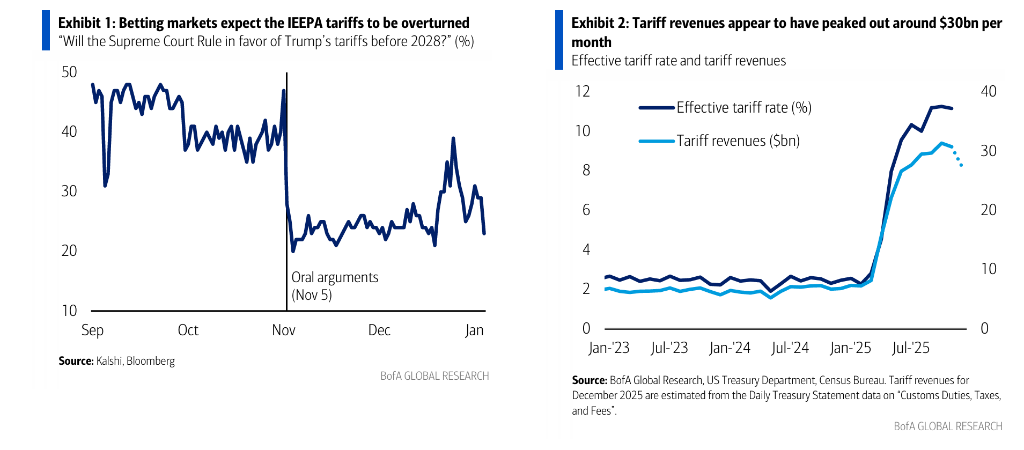
Core Viewpoint - The U.S. Supreme Court has delayed a decision on the global reciprocal tariffs imposed by the Trump administration under the International Emergency Economic Powers Act (IEEPA), leading to uncertainty in the market regarding future trade policies and their economic implications [1][2]. Group 1: Market Reactions and Expectations - The market anticipates that if the IEEPA tariffs are overturned, bond yields may rise due to concerns over fiscal deficits, while stock markets could benefit from eased profit pressures on retailers and a more relaxed fiscal stance [1][10]. - Conversely, if the tariffs are upheld, both bond yields and stock markets are expected to decline, with the market currently leaning towards the expectation of an overturn, which could lead to significant price impacts [10] Group 2: Revenue and Economic Impact - Current tariff revenues are estimated at approximately $30 billion per month, accounting for about 1.2% of GDP, with 55% to 65% of this revenue attributed to IEEPA-related tariffs [7]. - If the IEEPA tariffs are overturned, the government may resort to alternative legal provisions to recover some revenue, potentially leading to a net loss in overall tariff income of about 0.3% of GDP, equating to approximately $90 billion annually [8]. Group 3: Implications for Growth and Inflation - Regardless of the Supreme Court's ruling, trade policies are expected to support economic growth this year, with potential government actions aimed at reducing trade uncertainties and promoting more market-friendly outcomes [11]. - The short-term inflation impact may lean slightly downward, as retailers who have passed on tariff costs may hold prices steady or even reduce them, providing some room for the Federal Reserve to consider further rate cuts [11]. Group 4: Tariff Collection Discrepancies - The effective tariff rate has been lower than expected, currently at 11.2%, significantly below the theoretical rate of 14.5%, due to importers shifting towards lower-tariff products and exemptions [12]. - This discrepancy indicates that the Supreme Court's decision may have a muted impact on the market and macroeconomic conditions, as the actual revenue collected is less than anticipated [12].

机构:2026年铜或将极易受到股市上涨的影响
Ge Long Hui· 2026-01-08 07:35
Core Viewpoint - The rising copper prices in 2025 are a source of optimism for traders, but the copper market in 2026 may be significantly influenced by stock market performance, potentially leading to adverse outcomes for industrial metals [1] Price Trends - In early 2025, copper prices were approximately $4 per pound, with fluctuations that saw prices exceed $5.25 before dropping below $4.50, ultimately closing the year around $5.7 [1] - The potential for copper prices to remain above $6 in 2026 is contingent on the resilience of the stock market, with a normal correction risk pointing towards $4.50 [1]
【固收】为何央行只购入500亿国债?——2026年1月6日利率债观察(张旭)
光大证券研究· 2026-01-06 23:04
Core Viewpoint - The central bank's cautious approach to purchasing government bonds, with a net liquidity injection of only 50 billion yuan in December 2025, contrasts sharply with the higher monthly net purchases of 100 to 300 billion yuan seen from August to December 2024, indicating a strategy of prudent control over bond buying [4][5]. Group 1 - The limited bond purchases by the central bank are intended to manage liquidity and avoid excessive influence on bond yields, which can be affected through both supply-demand dynamics and investor expectations [5][6]. - The expectation of bond yield declines is largely driven by market speculation rather than direct actions from the central bank, as evidenced by the 14 basis point drop in the 10-year government bond yield from the first quarter to the end of July 2024, despite the central bank only starting bond purchases in August [5][6]. - The central bank aims to reduce the correlation between its bond purchases and yield movements to prevent market overreaction and maintain effective liquidity management [6][7]. Group 2 - The central bank may increase its bond purchase scale when market focus on this issue diminishes, indicating a shift in investor sentiment towards viewing bond operations similarly to daily reverse repo operations [7]. - The ideal scenario envisioned is one where the central bank can flexibly use bond buying to manage liquidity without causing significant fluctuations in bond yields, reflecting a more stable market environment [7].
汇丰策略师:对美股接近最大程度超配
Xin Lang Cai Jing· 2026-01-05 13:24
Group 1 - HSBC's Max Kettner and team maintain an "aggressive risk appetite" stance, nearing maximum overweight in US equities [1][2] - The stock market is currently near record highs following the passage of key risk events in December [1][2] - Mixed US economic data is favorable for the stock market, provided inflation remains neither too cold nor too hot, and bond yields stay away from levels that would be concerning for risk assets [1][2] - Kettner notes that the team's confidence and positioning are slowly approaching overbought territory [1][2]
施罗德投资:料今年美国经济增长将保持良好 经济“软着陆”机率上升
Zhi Tong Cai Jing· 2026-01-05 05:54
Group 1 - The core viewpoint is that Schroders believes the recent rise in bond yields has been overdone, and the potential for an economic "soft landing" presents attractive entry points for investors [1] - Schroders has increased the probability of an economic "soft landing" scenario, reflecting signs of stabilization in labor market indicators, such as small business hiring intentions [1] - The firm predicts a moderate economic slowdown by Q4 2025, considering a mild short-term inflation outlook and the potential dovish stance of the new Federal Reserve Chair [1] Group 2 - Schroders sees better bond investment opportunities emerging in regions outside the U.S., while expecting the U.S. interest rate curve to steepen [2] - The underperformance of 10-year and 30-year bonds compared to 2-year and 5-year bonds reflects the weak fiscal condition of the U.S. economy, characterized by a large budget deficit and rising debt-to-GDP ratio [2] - Any threat to the independence of the Federal Reserve could support the strategy of a steepening yield curve, as the market anticipates potential over-relaxation of monetary policy due to temporary labor market weakness [2]
欧元区债券收益率走高,追随美国国债走势
Xin Lang Cai Jing· 2026-01-02 08:10
Group 1 - The core viewpoint of the article highlights the rise in Eurozone government bond yields, following the trend of U.S. Treasury yields, as the market anticipates the release of manufacturing PMI data from the Eurozone's four largest economies: Germany, France, Italy, and Spain [1] - The 10-year German government bond yield increased by 3.4 basis points to 2.888% [1] - Upcoming government bond auctions are set to take place, with France and Spain scheduled to announce auction details next Thursday [1] Group 2 - Market liquidity is expected to remain thin on Friday [1]
2025年12月PMI数据点评:PMI超预期回升对2026年市场的启示
KAIYUAN SECURITIES· 2025-12-31 09:45
1. Report Industry Investment Rating No relevant content provided. 2. Core View of the Report - The significant rebound of PMI in December 2025 may be related to the policy intensification in October, and the policy has shown obvious effects [4][5]. - The replenishment of inventory may start, which is expected to drive economic recovery [6]. - The overall rhythm of the change in manufacturing PMI is similar to that in 2016 and 2019, indicating that the economic cycle may have started [7]. - The core of the policy is to disprove the view of "less - than - expected economic recovery", and after repeated disproving, the market will become optimistic [8]. - Regarding the bond market, the target range of the 10 - year Treasury bond is 2 - 3%, with a central value of about 2.5% [9]. 3. Summary by Related Catalog 3.1 Event Review - In December 2025, the manufacturing PMI was 50.1% (previous value: 49.2%), up 0.9 pct month - on - month; the non - manufacturing PMI was 50.2% (49.5%), up 0.7 pct month - on - month; the composite PMI was 50.7% (49.7%), up 1.0 pct month - on - month. The manufacturing PMI rebounded significantly beyond seasonality and expectations, reaching a new high since April [4]. 3.2 Reasons for PMI Rebound - **Policy Intensification**: In October, the policy intensified with 50 billion yuan of policy - based financial instruments and 50 billion yuan of local debt balance limits. After the policy efforts, the PMI improved slightly in November and significantly in December [5]. - **Inventory Replenishment**: After continuous destocking from October to November, the raw material inventory was at a historical low in December, and inventory replenishment started, which may drive economic recovery [6]. - **Similar Historical Patterns**: The sudden rebound of PMI above 50% in December 2025 is similar to the situations in 2016 and 2019, indicating that the economic cycle may have started [7]. 3.3 Policy Logic - The policy aims to disprove the view of "less - than - expected economic recovery". In history, there were periods of economic decline, but the economy recovered after policy support, and the view was disproved. After repeated disproving, the market will form optimistic expectations [8]. 3.4 Bond Market View - **Fundamentals**: The view of "less - than - expected economic recovery" is disproved, and the wide - credit and wide - fiscal policies at the beginning of 2026 may accelerate the economic cycle recovery [9]. - **Monetary Policy**: If there is a wide - monetary policy, it may be a reduction opportunity, similar to the situation in 2025 [9]. - **Inflation**: Pay attention to whether the month - on - month increase of PPI can remain positive [9]. - **Funds Rate**: If inflation rises month - on - month continuously, there is a possibility of tightening funds, and the yield of short - term bonds will rise [9]. - **Real Estate**: Real estate is not used as a means of stabilizing growth this time and may bottom out after the recovery of various economic indicators and the rise of the stock market [9]. - **Bonds**: The target range of the 10 - year Treasury bond is 2 - 3%, with a central value of about 2.5% [9].
欧洲债市:欧洲债券上涨 意大利国债领涨
Xin Lang Cai Jing· 2025-12-29 16:58
Core Viewpoint - European bond markets have risen following the public holiday, with Italian bonds leading the gains [1][4]. Market Summary - The yield on German 10-year bonds has fallen by 4 basis points to 2.83%, reaching the lowest level since December 8 [2][5][6]. - German bond futures increased by 38 points to 127.84 [3][6]. - The yield on Italian 10-year bonds decreased by 5 basis points to 3.50% [3][6]. - The spread between Italian and German bonds narrowed by 2 basis points to 67 basis points [3][6]. - The yield on French 10-year bonds dropped by 4 basis points to 3.52% [3][6]. - The yield on 10-year UK bonds fell by 2 basis points to 4.49% [3][6].
土耳其10年期里拉债券收益率下跌52个基点,降至3月以来最低水平
Mei Ri Jing Ji Xin Wen· 2025-12-29 13:01
Group 1 - The core point of the article is that the yield on Turkey's 10-year lira bonds has decreased by 52 basis points, reaching its lowest level since March [1] Group 2 - The decline in bond yield indicates a potential shift in investor sentiment towards Turkish government debt [1] - This drop in yield may reflect broader economic conditions and monetary policy adjustments in Turkey [1] - The current yield level could attract more foreign investment into Turkey's bond market [1]