利率走势

Search documents
天风固收|暖风再起,静待下行
2025-06-10 15:26
Summary of Conference Call Notes Industry Overview - The focus is on the bond market and its dynamics in 2024, particularly regarding deposit certificates and the movement of deposits due to seasonal pressures on bank liabilities [1][3] - The bond market has been influenced by two main themes: funding and liability shortages, and fundamental factors, especially the impact of overseas markets [2] Key Points and Arguments - **Monetary Policy and Market Stability**: The central bank's unexpected measures, such as a 1 trillion yuan reverse repurchase operation, have helped stabilize the funding environment, although ongoing observation of future measures is necessary [3][4] - **Fiscal Policy Impact**: The issuance of government bonds has accelerated, but the overall economic impact remains limited due to stricter self-auditing and economic conditions [5] - **Short-term and Long-term Interest Rates**: Short-term rates are stable, with deposit certificates maintaining rates below 1.7%. Long-term rates are expected to fluctuate based on fundamental expectations and market sentiment, with potential downward pressure if monetary policy is further eased [6][11] - **Future Economic Indicators**: Key factors to monitor include domestic economic recovery, upcoming political meetings, and the results of US-China negotiations, which will influence long-term interest rates [7][8] Additional Important Insights - **Credit Market Dynamics**: The credit bond market in 2025 shows unique characteristics, with short-term bonds sometimes outperforming deposit certificates, while the supply of credit bonds remains constrained [9] - **Liquidity Premiums**: There has been a rebound in credit spreads, with high-grade, pledgeable securities experiencing compressed liquidity premiums. The stable attitude of the central bank has contributed to a smoother market logic [10] - **Investment Recommendations**: There is a recommendation to focus on long-term interest rate compression opportunities and to consider slightly flawed but yield-potential securities in the three to four-year category [11][12] - **Market Performance of Financial Products**: The performance of financial products and public funds has been less favorable compared to last year, with limited space for interest rate declines leading to lower volatility in certain securities [12]
利率 - 中美即将谈判,债市如何交易?
2025-06-09 15:30
Summary of Conference Call Records Industry Overview - The records primarily discuss the bond market and the implications of U.S.-China relations on interest rates and liquidity in the financial system [1][3][7]. Key Points and Arguments 1. **Global Economic Trends**: There is a consensus that global economic decoupling and fragmentation are long-term trends, with short-term tariff adjustments unlikely to reverse the overall direction of U.S.-China relations [1][7]. 2. **Interest Rate Projections**: - A complete removal of reciprocal tariffs could lead to an estimated interest rate rebound of about 12 basis points, but the impact is expected to be limited [1][3]. - The 10-year government bond yield is projected to have an upper limit adjustment to 1.75% if tariffs are fully removed, although current macroeconomic conditions do not support a strong rebound to 1.4% [6][8]. 3. **Market Sentiment**: - June has seen improved liquidity conditions, with bond market sentiment turning positive and the 2001 bond effectively breaking below 1.4% [1][4]. - The negative factors that suppressed the market in May are dissipating, indicating clear trend opportunities [4][5]. 4. **Central Bank Policies**: - The central bank is maintaining a tightening stance, which, along with a recovering real estate sector, supports market sentiment [8][9]. - Recent announcements of reverse repos by the central bank aim to stabilize market expectations and signal liquidity support [10]. 5. **Future Liquidity Expectations**: - There is a shift towards a more accommodative liquidity outlook, with the DR001 rate breaking below 1.4%, indicating enhanced liquidity sentiment [2][12]. - The central bank's actions suggest potential for further liquidity increases if market conditions remain tight [11][12]. 6. **Investment Opportunities**: - The outlook for medium to long-term bond funds is positive, with expected returns of 2.5-3% this year, encouraging investors to seize current market trends [13][14]. Other Important Insights - The impact of U.S.-China tariffs on market reactions has diminished, with the market forming a consensus that long-term trends will prevail despite short-term fluctuations [3][7]. - Structural tariffs and trade measures, such as Section 301 and Section 232, continue to pose risks to the economic relationship between the U.S. and China [7][9]. - The central bank's flexible approach to liquidity management reflects its responsiveness to uncertainties in U.S.-China relations and domestic economic pressures [10].
美联储理事库克在讲话中未对经济前景和利率走势发表评论。
news flash· 2025-06-04 12:37
Core Viewpoint - The Federal Reserve Governor Cook did not provide comments on the economic outlook or interest rate trends [1] Group 1 - The absence of commentary on the economic outlook suggests a cautious approach from the Federal Reserve [1] - Lack of guidance on interest rate movements may indicate uncertainty in monetary policy direction [1]
【环球财经】东京股市反弹 日经225指数上涨0.47%
Xin Hua Cai Jing· 2025-05-23 08:12
Group 1 - Tokyo stock market rebounded on the 23rd, with the Nikkei 225 index rising by 174.60 points to close at 37160.47, an increase of 0.47% [1] - The Tokyo Stock Exchange stock price index increased by 18.43 points, closing at 2735.52, reflecting a rise of 0.68% [1] - The rise was influenced by the overnight increase in the Nasdaq index, particularly in high-tech stocks, and a slight depreciation of the yen, which boosted expectations for improved performance from export-related companies [1] Group 2 - Over 80% of the 33 industry sectors on the Tokyo Stock Exchange saw gains, with other products rising by 3.62% and non-ferrous metals increasing by nearly 3% [1] - However, six sectors, including mining, securities and commodity futures trading, and electric and gas industries, experienced slight declines [1] - Despite improvements in Japanese corporate sentiment and a better PMI report from the US, the Tokyo stock market has struggled to maintain trading enthusiasm, with the 200-day moving average acting as a resistance level [2]
双重顶形态触发止损潮!技术面崩塌叠加政策转向:金价还要跌到什么时候?
Jin Shi Shu Ju· 2025-05-15 12:40
Group 1 - Gold prices fell to a one-month low as trade tensions between major economies eased, leading to suppressed demand and investors awaiting U.S. economic data for interest rate direction [1][2] - Spot gold decreased by 0.33% to $3167.04 per ounce, reaching its lowest level since April 10, while U.S. gold futures dropped by 0.52% to $3171.3 per ounce [1] - Analysts indicate that the market is in an overbought state, with short positions increasing significantly [1] Group 2 - President Trump’s comments on Iran nearing a nuclear deal further reduced demand for gold [2] - Market focus shifted to the U.S. Producer Price Index (PPI) data, with attention on Federal Reserve Chairman Powell's upcoming speech for clues on interest rate paths [2] - Expectations for a 50 basis point rate cut this year, starting in October, could lead to stronger performance for non-yielding gold [3] Group 3 - Gold has broken below the double top neckline support, indicating potential short-term downside risk, with price expectations moving towards the $3000 - $3050 range [3] - Key chart support at $3190 has been breached, suggesting a continued corrective move in gold prices [3] - Other precious metals also saw declines, with spot silver down 1% to $31.89 per ounce, palladium down 0.2% to $949.07 per ounce, and platinum steady at $976 per ounce [3]
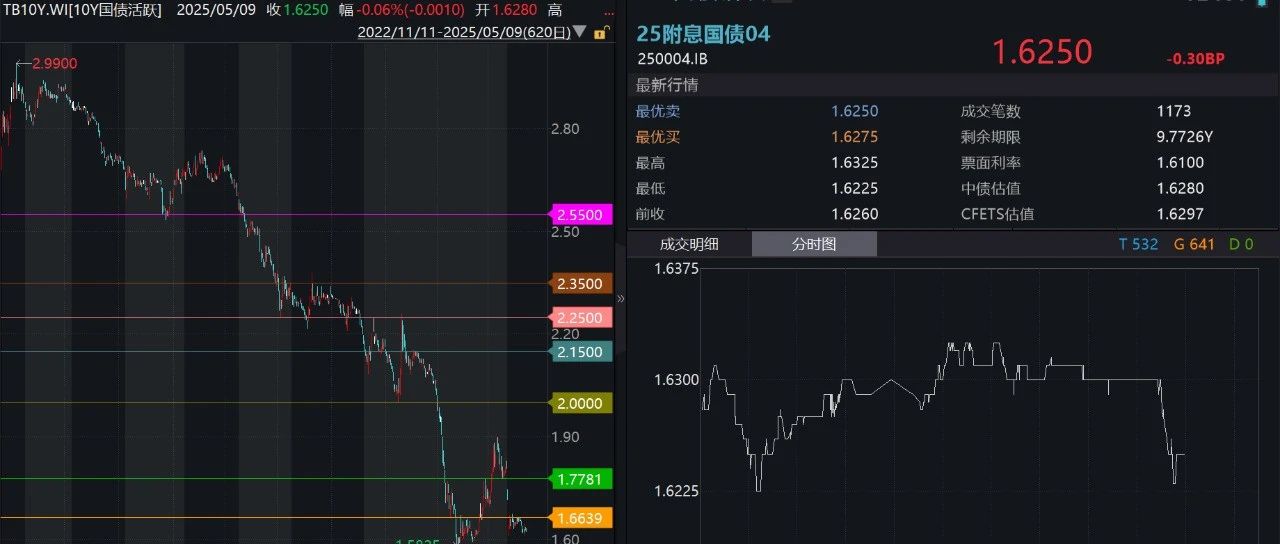
【笔记20250509— 两个战场,胜者为王】
债券笔记· 2025-05-10 08:08
Core Viewpoint - The article discusses the dynamics of market sentiment and interest rates, emphasizing the impact of external events on investment behavior and market fluctuations. Group 1: Market Dynamics - When market conditions are favorable, investors tend to be greedy, hoping for further gains, but during market corrections, they may panic and exit positions to secure profits [1] - The recent April import and export data exceeded expectations, contributing to cautious market sentiment amid U.S.-China trade discussions and a meeting in Switzerland [2][6] - The central bank's decision to resume government bond trading operations is seen as a potential factor influencing interest rates [6] Group 2: Interest Rate Movements - The central bank conducted a 770 billion yuan reverse repurchase operation, resulting in a net injection of liquidity into the market [3] - The funding environment remains balanced and loose, with the DR001 rate dropping below 1.5% to 1.49% and DR007 decreasing to 1.54% [4] - The weighted average rates for various repo codes showed a decline, with R001 at 1.52% (down 5 basis points) and R007 at 1.58% (down 7 basis points) [5]

机构行为的十大伪规律
Huaan Securities· 2025-05-06 10:59
1. Report Industry Investment Rating No relevant content provided. 2. Core Views of the Report In the current low - interest - rate and trading - oriented bond market environment in 2025, the research on institutional behavior has greater significance for interest rate guidance. The report focuses on ten pseudo - laws of institutional behavior, including data caliber, trading nature misjudgments, and model limitations [2]. 3. Summary According to the Directory 3.1 Why We Focus on Pseudo - Laws of Institutional Behavior In the low - interest - rate and trading - oriented bond market environment this year, the research on institutional behavior has increased significance for interest rate guidance, and there are many pseudo - laws in institutional behavior that need to be explored [14]. 3.2 Ten Pseudo - Laws of Institutional Behavior 3.2.1 Are Spot Bond Trading Data T + 0 or T + 1? —— It Should Be T + 1 Spot bond trading data should be analyzed with a one - day lag from interest rate trends because the transactions are usually negotiated the day before [16]. 3.2.2 Do Banks and Brokerages Only Sell Bonds for Distribution? —— There Is Also a Lot of Proprietary Trading Banks and brokerages often show net selling, which may be due to "primary subscription and secondary distribution." Observing old - bond transactions of banks and bond lending of brokerages can help understand their real trading intentions [20][21]. 3.2.3 Is Selling "Smashing" and Buying "Snatching"? —— Focus on the Active Party's Behavior In the secondary spot bond market, it is a zero - sum game. Market trends are driven by the active party. For example, the relationship between rural commercial banks and funds should be analyzed in combination with the active party's behavior [33][34]. 3.2.4 Is Fund Selling a "Redemption Wave"? —— Not Necessarily Historically The current market's panic about fund redemptions may be more of a preventive redemption by wealth management. Measuring the liability - side pressure of funds through the comprehensive holding - cost indicator shows that the current redemption pressure on bond funds is controllable [39][43]. 3.2.5 Are Insurance Companies All Allocation - Oriented? —— The Proportion of Trading - Oriented Has Significantly Increased The trading - oriented proportion of insurance companies has increased, as shown by the fact that they may buy 30Y Treasury bonds for trading purposes and the increase in their 30Y bond selling volume [47]. 3.2.6 Can't We Observe Foreign Investment in Bonds at a High Frequency? —— Most of the "Other" Institutions May Be Foreign Investors Foreign investors' trading behavior can be observed through the "other" type of institutions in high - frequency secondary spot bond trading data. For example, in April, the net buying of "other" institutions was roughly equivalent to the net buying of foreign investors mentioned by the SAFE [53]. 3.2.7 Does Institutional Allocation Increase in the Custody Caliber Mean Buying? —— It May Just Be Due to High Bond Supply An increase in institutional custody may be due to more primary - market bond underwriting or bond maturity, rather than active buying [6]. 3.2.8 High - Winning - Rate Institutional Behavior Indicators May Have Errors —— Interference from the Bull - Market Model Some high - winning - rate institutional behavior indicators may have asymmetric winning rates for buying and selling signals, which may be affected by the previous bull market. When constructing models, the weight of volatile or bear markets should be increased [6]. 3.2.9 Are Non - Linearly Extrapolatable Institutional Behavior Indicators Useless? —— "Direction Sense" Can Also Improve Investment Winning Rates Although some institutional behavior indicators have poor "prediction" effects, they can help investors find the core driving factors of market changes and provide a "direction sense" in investment [7]. 3.2.10 Boundaries of Institutional Behavior Quantitative Models —— Some Errors Such as Short - Term Emotions and Event Impacts Are Still Difficult to Eliminate The existing institutional behavior models have common errors, such as overfitting, being affected by short - term events, and errors in weight assignment. These errors can be reduced but cannot be completely eliminated, so dynamic adjustment and other subjective and objective research are needed [7].
利率 - 一季度像2019年,二季度呢?
2025-04-15 00:58
Summary of Conference Call Notes Industry or Company Involved - The discussion primarily revolves around the current market environment, monetary policy, and economic conditions in China, with a focus on interest rates and their implications for investment strategies. Core Points and Arguments - The current market environment shows similarities to Q2 2019, particularly in terms of fundamentals and US-China relations, leading to a medium-term bullish outlook despite potential short-term volatility [2][3][4] - The central bank is adopting a macro-prudential stance, indicating that there will not be rapid interest rate cuts or hikes in the short term, which could lead to upward pressure on rates if fiscal policies are not aligned [3][10][12] - Credit supply is shifting from being supply-constrained to demand-constrained, necessitating a sequence of fiscal expansion before monetary easing to avoid idle capital [3][13] - The likelihood of a comprehensive interest rate cut in April is low, but a reduction in reserve requirements is more probable, with short-term rate declines being difficult unless unexpected events occur [3][16] - The current interest rate rebound is limited, and significant policy changes are required to see a notable increase in rates, with a potential for a volatile market in Q2 [7][15] - The experience from Q2 2022 suggests that a wait-and-see approach can lead to greater economic losses, emphasizing the need for proactive measures to mitigate risks [8][9] Other Important but Possibly Overlooked Content - The central bank's lack of coordination with fiscal policy during the first quarter has led to a situation where increased government bond issuance has not been matched by monetary easing, resulting in higher rates that could suppress consumption and investment [10][12] - The current geopolitical climate, particularly the challenges in US-China relations, mirrors the uncertainties faced during the pandemic, which could impact market stability and investor sentiment [6][8] - Investors are advised against large-scale duration management or reversal strategies in the current volatile environment, suggesting a focus on gradual adjustments and identifying buying opportunities [11][16] - The historical context of policy responses during previous economic disruptions provides valuable insights for navigating the current market landscape, highlighting the importance of timely interventions [8][14]
【广发宏观钟林楠】怎么看利率走势
郭磊宏观茶座· 2025-03-30 12:01
Core Viewpoint - Since mid-February 2025, the bond market has experienced a notable adjustment, with the 10-year government bond yield rising from around 1.6% to approximately 1.9% [1][9]. Group 1: Market Adjustments and Trends - The rise in bond yields is attributed to three main factors: a significant breakthrough in Deep Seek, increased micro expectations and risk appetite in the financial market following a private entrepreneur symposium, and a clear front-loading of government bond issuance [1][9]. - The current pricing phase appears to be largely completed, with the 10-year government bond yield slightly decreasing to around 1.8% after peaking at 1.9% [1][10]. - The narrow liquidity has stabilized in March, with the central rate of funds not rising further, indicating a potential easing of market expectations regarding monetary policy tightening [1][10]. Group 2: Policy Rate Framework - The expected fluctuation range for the 10-year government bond yield this year is approximately 1.7% to 1.9%, with a projected reduction in policy rates by about 20-40 basis points to a range of 1.1% to 1.3% [2][12]. - The spread is expected to correlate well with the broad credit pulse, which is anticipated to be around 25%-26% this year, leading to a corresponding spread center of 60 basis points [2][12]. Group 3: Future Pricing Trends - Historical data indicates that the 10-year government bond yield has undergone significant adjustments in the past, with most returning to a downward trend after a 25-35 basis point adjustment. However, two instances in 2016 and 2020 saw trend reversals due to fundamental confirmations and shifts in monetary policy [3][13]. - The future trajectory of interest rates will be significantly influenced by the state of narrow liquidity, monetary policy, and economic fundamentals [3][13]. Group 4: Economic Fundamentals - The construction industry's performance is crucial in determining interest rate trends, with recent stabilization observed in the sector contributing to the upward movement of the yield center [6][20]. - Fiscal policies, including the issuance of special bonds and adjustments to high-risk debt areas, are expected to support the construction sector and overall economic recovery [6][20]. - Current low price levels are anticipated to rise, with policy adjustments aimed at stabilizing nominal growth and encouraging investment [7][22][23]. Group 5: Summary of Risks and Opportunities - The 10-year government bond yield is expected to trigger phase-specific opportunities upon reaching the upper limit of its fluctuation range, although expectations for narrow liquidity should remain tempered [8][25]. - Key risks include potential upward pressure from the construction sector and rising price levels, which require close monitoring of supply-side developments [8][25].