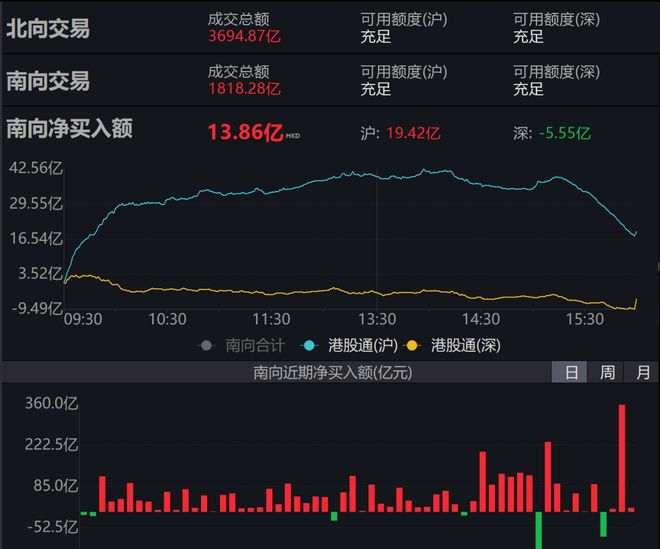
南向资金流入

Search documents
南向资金一周净流入超600亿港元 互联网龙头获重点加仓
Xin Lang Cai Jing· 2025-09-14 05:34
Market Performance - The Hong Kong stock market indices collectively rose during the week from September 8 to September 12, with the Hang Seng Index increasing by 3.82% [1] - The Hang Seng Tech Index saw a rise of 5.31%, while the Hang Seng China Enterprises Index increased by 3.4% [1] Capital Inflow - Southbound capital recorded a total net inflow of 60.822 billion HKD, marking the highest weekly net inflow since May, with an increase of 83.97% compared to the previous week [1] - This inflow has continued for 17 consecutive weeks [1] Active Stocks - A total of 29 stocks made it to the list of the top ten most active stocks during the week [1] - Alibaba-W had the highest total trading volume through the Hong Kong Stock Connect, reaching 70.27 billion HKD [1] - Other notable stocks with trading volumes exceeding 20 billion HKD included Meituan-W, SMIC, and Tencent Holdings [1]


万亿资金南下买了啥?互联网与红利板块受青睐
Shang Hai Zheng Quan Bao· 2025-09-13 06:34
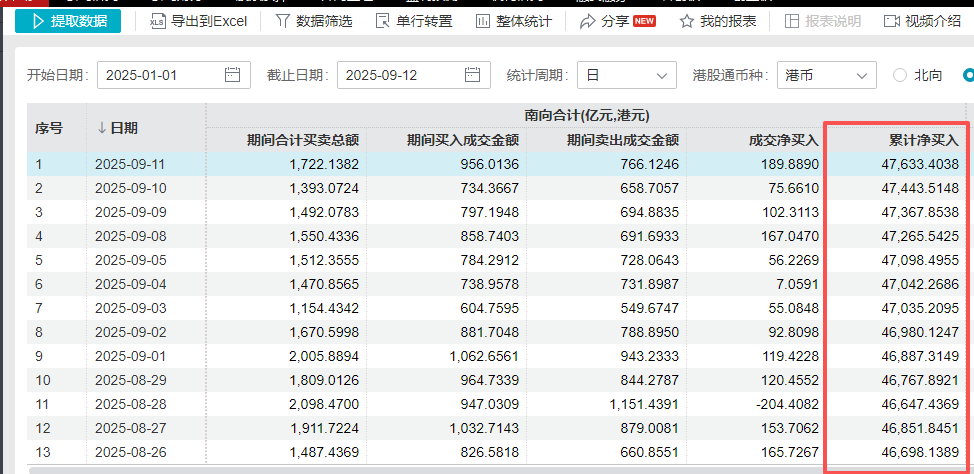
Core Viewpoint - A significant influx of capital has been observed in the Hong Kong stock market, with southbound funds achieving a net inflow exceeding 1 trillion HKD this year, marking a more than 100% increase compared to the same period in 2024 [1][5]. Group 1: Capital Inflow Data - As of September 11, southbound funds have recorded a cumulative net inflow of 10,655.49 billion HKD this year, significantly surpassing the total for the previous year [2][5]. - In September alone, southbound funds have seen net inflows for nine consecutive trading days, with the first week of September contributing over 30 billion HKD, an increase of over 10 billion HKD compared to the previous week [2][5]. Group 2: Investment Preferences - The top three stocks attracting the most net inflow from southbound funds this year are Alibaba, Meituan, and China Construction Bank, with Alibaba alone receiving over 110 billion HKD [1][10]. - The sectors receiving the most attention from southbound funds include consumer discretionary retail, banking, non-bank financials, and pharmaceutical biotechnology, with consumer discretionary retail leading at 1,782.85 billion HKD [6][8]. Group 3: Market Outlook - Analysts suggest that the revaluation of Chinese assets is ongoing, particularly with the expectation of interest rate cuts by the Federal Reserve, which may lead to a bullish trend in the Hong Kong stock market [1][13]. - Investment opportunities are expected to focus on sectors such as technology, pharmaceuticals, consumer goods, and manufacturing, with a particular emphasis on high-dividend stocks benefiting from declining risk-free rates [13].

读创财经晨汇|①南向资金年内净流入超万亿港元②国际金价创下历史新高
Sou Hu Cai Jing· 2025-09-04 00:28
Group 1 - The General Administration of Customs released the 2024 National Comprehensive Bonded Zone Development Performance Evaluation Ranking, with Qianhai Comprehensive Bonded Zone ranking third nationally, becoming the only bonded zone in the Guangdong-Hong Kong-Macao Greater Bay Area to enter the top three [1] - In 2024, Qianhai Comprehensive Bonded Zone achieved a total import and export value of 375.25 billion yuan, a year-on-year increase of 49.9%, significantly surpassing the national average growth rate [1] - From January to July this year, the import and export scale reached 221.5 billion yuan, marking a historical high for the same period, with a year-on-year growth of 19.1% [1] Group 2 - Longgang District in Shenzhen has seen a net increase of 84,000 enterprises over the past year, the highest in the city, bringing the total number of enterprises to nearly 570,000 [2] - The district has implemented a "cadre assistance to enterprises" initiative, with 1,872 cadres pairing with 8,404 key enterprises to address challenges and facilitate cooperation [2] - The "Longi Enterprise" platform achieved a 95% resolution rate for requests in the first half of the year, reflecting a proactive service approach [2] Group 3 - Shenzhen's Industrial and Information Technology Bureau is publicly soliciting opinions and suggestions for the "14th Five-Year Plan" in the industrial and information sector, aiming to enhance the planning's scientific, democratic, and transparent nature [3] - The solicitation focuses on key areas such as promoting manufacturing, advancing new industrialization, and fostering the integration of technological and industrial innovation [3] Group 4 - The Ministry of Finance and the People's Bank of China held a second group leader meeting to promote more proactive macro policies and strengthen coordination between fiscal and monetary policies [4] - The meeting acknowledged the achievements of the joint working group since its establishment and discussed topics such as financial market operations and government bond issuance management [4] Group 5 - FTSE Russell announced changes to the FTSE China A50 Index, including the addition of stocks like NewEase and Zhongji Xuchuang, which are expected to attract more passive fund inflows [6] - The changes will take effect after the market closes on September 19, with a backup list of stocks available for future adjustments [6] Group 6 - Southbound capital has seen a net inflow exceeding 1 trillion Hong Kong dollars this year, marking the highest annual inflow since the launch of the Stock Connect mechanism [7] - The Hang Seng Index and Hang Seng Tech Index have both risen over 25% year-to-date, reflecting strong market performance [7] Group 7 - In August, local government bond issuance reached 977.6 billion yuan, with special bonds accounting for nearly half of the total [8] - The cumulative issuance of new special bonds from January to August reached 3.26 trillion yuan, representing 74% of the annual quota [8] Group 8 - The price of gold reached a historical high, with London gold hitting $3,546.9 per ounce, driven by expectations of a potential interest rate cut by the Federal Reserve [9][10] - The increase in gold prices is attributed to weak economic data from the U.S. and concerns over the independence of the Federal Reserve [9][11] Group 9 - Apple plans to launch its first foldable iPhone in 2026, with expected shipments of 8 to 10 million units, and a foldable iPad in 2028 [12] - The foldable iPad is anticipated to have a larger display area, with a more premium pricing strategy [12] Group 10 - The expiration of the electric vehicle tax credit in the U.S. on September 30 may lead to a significant drop in sales for manufacturers like Tesla and General Motors, with estimates suggesting a potential 50% decrease in electric vehicle sales [13] - The tax credit, established under the Inflation Reduction Act, incentivized purchases of electric vehicles, and its removal is expected to negatively impact market dynamics [13]
南向资金改写定价逻辑 港股中长期上涨趋势确立
Zhong Guo Zheng Quan Bao· 2025-09-02 22:33
Core Viewpoint - The A-share and Hong Kong stock markets have entered a rare "alternating leadership" trend since 2024, breaking the traditional correlation model, with a significant influx of southbound capital reshaping the pricing logic of the Hong Kong market [1][2]. Group 1: Market Dynamics - The southbound capital inflow is gradually reconstructing the pricing logic of the Hong Kong market, moving from an "offshore market dominated by foreign capital" to a more "onshore" model led by domestic capital [2][3]. - In the first quarter of 2024, the Hong Kong stock market began a reversal, with the Hang Seng Index outperforming major A-share indices, a trend that continued until the "924" market [2]. - By mid-2025, the Hong Kong market showed a sustained outperformance compared to A-shares, with sectors like the internet, new consumption, and innovative pharmaceuticals experiencing structural rallies [2][3]. Group 2: Capital Structure and Trends - The influx of southbound capital is driven by the improved profitability of the Hong Kong market, with high-quality companies listing in Hong Kong enhancing market vitality [3]. - As of December 31, 2024, the circulation market value of the consumer, technology, and healthcare sectors in the Hong Kong market reached HKD 169,052 million, accounting for 49.0% of the total market value, which increased to 52.3% by August 25, 2025 [3]. - The trend of domestic capital flowing south is expected to continue, supported by a low interest rate environment in mainland China, with long-term funds like insurance capital becoming significant buyers of Hong Kong stocks [3][4]. Group 3: Investment Opportunities - The current market environment is characterized by multiple positive factors, suggesting a potential new upward trend in the Hong Kong stock market in the fourth quarter of 2025 [9]. - Key investment themes include technology, consumption, dividends, and innovative pharmaceuticals, with a focus on companies that can sustain growth and improve profitability [9][11]. - The technology sector is expected to see a value reassessment driven by AI empowerment, with the Hang Seng Technology Index's price-to-earnings ratio significantly lower than major global technology indices [9][10]. Group 4: Sector-Specific Insights - In the hardware sector, opportunities are seen in breakthroughs in domestic computing chips and semiconductor equipment, while software applications are expected to benefit from accelerated digital transformation [10]. - The new consumption sector is becoming a highlight for southbound capital, with a shift in investment logic from thematic speculation to performance verification [11]. - The innovative pharmaceutical sector is poised for growth, with Chinese companies transitioning from "followers" to "leaders" in global markets, supported by policy backing and competitive advancements [12].
南向资金年内净买入近万亿港元,这些板块将受益
Xin Lang Cai Jing· 2025-09-02 07:02
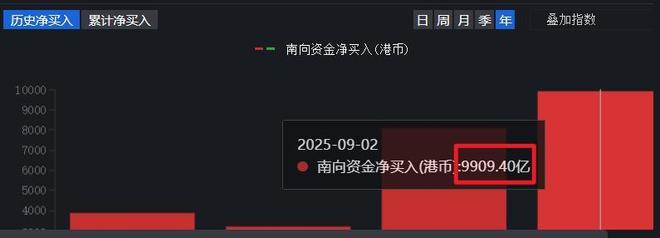
Group 1 - Southbound funds have continuously flowed into Hong Kong stocks, with a cumulative net purchase amount exceeding 990 billion HKD this year, indicating strong investor confidence in the Hong Kong market [1] - Key sectors attracting significant investment include pharmaceuticals, technology, internet, and consumer markets, reflecting a focused investment strategy [1] Group 2 - Institutional views on the Hong Kong and A-share markets are optimistic, citing strong resilience in the fundamentals and ongoing policy support, which has led to a notable recovery in investor confidence [1] - The acceleration of southbound fund inflows, combined with expectations of interest rate cuts by the Federal Reserve, suggests a favorable liquidity environment that may further boost the Hong Kong market [1] Group 3 - Technology, pharmaceuticals, and internet sectors are expected to benefit from the increased liquidity, as these sectors are more sensitive to changes in market conditions [1] - Specific ETFs mentioned include the Hang Seng Technology ETF, focusing on tech leaders and new energy vehicle manufacturers, the Hang Seng Internet ETF, targeting Hong Kong internet leaders, and the Hang Seng Pharmaceuticals ETF, which emphasizes innovative drugs and CXO services [1]
港股通央企红利ETF天弘(159281)明日上市!
Sou Hu Cai Jing· 2025-09-01 06:41
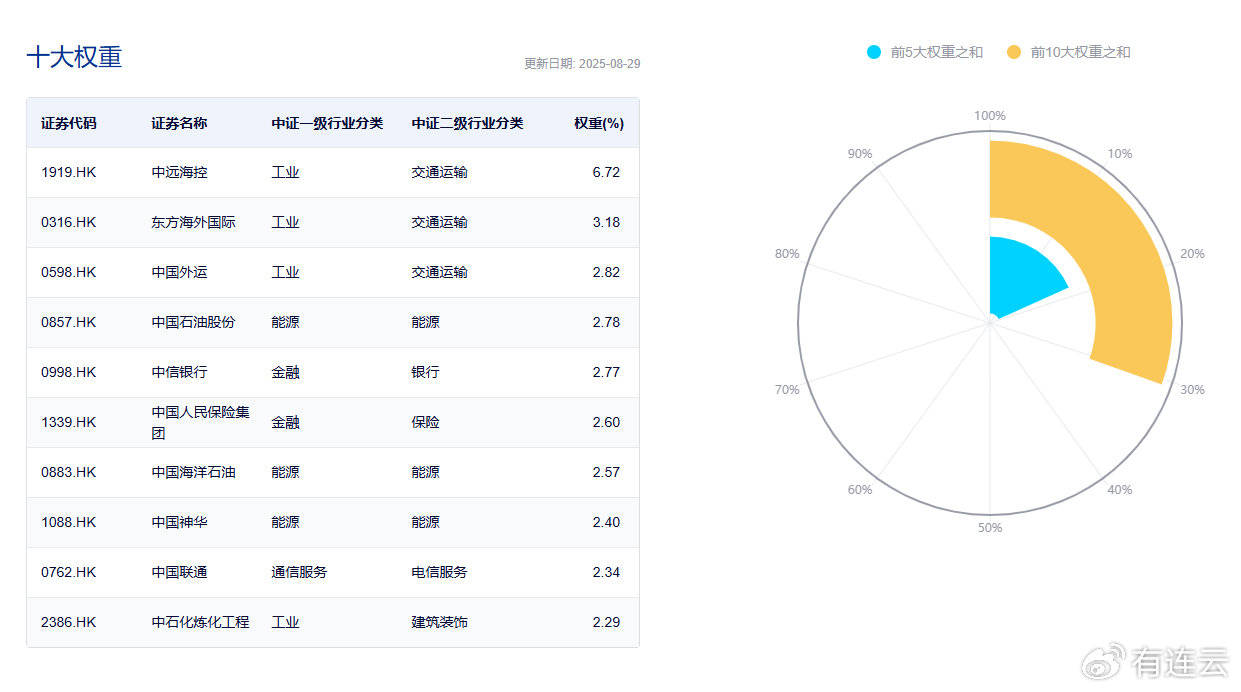
Core Viewpoint - The Hong Kong Stock Connect Central Enterprise Dividend ETF Tianhong (159281) will be listed on September 2, 2025, providing investors with a new tool to invest in high-dividend central enterprises within the Hong Kong Stock Connect framework [1]. Group 1: Fund Overview - The fund closely tracks the CSI Hong Kong Stock Connect Central Enterprise Dividend Index, which consists of 50 listed companies controlled by central enterprises, selected for their stable dividend levels and high dividend yields [1]. - The index is weighted by dividend yield and has strict requirements for the sustainability of dividends, with a cap on individual sample weights, focusing primarily on the financial and industrial sectors [1]. Group 2: Top Holdings - The top ten weighted stocks in the index include COSCO Shipping Holdings, Orient Overseas International, China National Freight, PetroChina, CITIC Bank, China Pacific Insurance, CNOOC, China Shenhua Energy, China Unicom, and Sinopec Engineering, collectively accounting for 30.47% of the index as of August 29 [1][2]. Group 3: Investment Strategy and Benefits - The index offers a strategic overlay by allowing mainland investors to conveniently invest in scarce high-dividend central enterprise stocks in the Hong Kong market, avoiding QDII quota restrictions [4]. - Central enterprises exhibit strong operational stability and cash flow, demonstrating resilience during macroeconomic fluctuations [4]. - The index's dividend yield as of August 29 is 5.89%, outperforming the 4.29% yield of the CSI Central Enterprise Dividend 50 Index [4]. Group 4: Market Context - The Hong Kong dividend market continues to benefit from inflows of southbound capital, enhancing the investment value of the Hong Kong Stock Connect Central Enterprise Dividend ETF amid weak economic expectations [4]. - The combination of stable dividends, structural opportunities, and supportive government policies contributes to the attractiveness of this investment vehicle for conservative investors seeking stable cash flow and asset preservation [5].
“T+0”+分红+高股息,港股通央企红利ETF天弘(159281)明日上市交易
2 1 Shi Ji Jing Ji Bao Dao· 2025-09-01 05:29
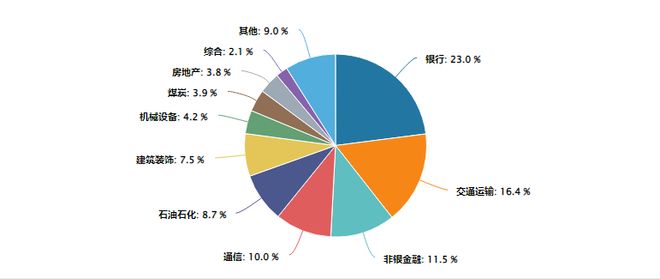
Core Viewpoint - The Hong Kong stock market is showing strength, particularly in cyclical sectors such as consumer discretionary, metals, pharmaceuticals, coal, and steel, with the launch of the Tianhong Central Enterprise Dividend ETF (159281) on September 2, 2023, which aims to track high dividend-yielding central enterprises [1] Group 1: ETF and Index Details - The Tianhong Central Enterprise Dividend ETF has an annual management fee of 0.5% and a custody fee of 0.1% [1] - The ETF closely tracks the Hong Kong Stock Connect Central Enterprise Dividend Index (931233), which selects stable dividend-paying companies controlled by central enterprises within the Stock Connect framework [1] - As of the end of Q2 2025, the index's sector distribution includes banking, transportation, non-bank financials, telecommunications, and oil and petrochemicals, with the top ten constituents accounting for 31% of the index [1] Group 2: Performance Metrics - The index has a dividend yield exceeding 7% as of the end of Q2 2025 [3] - Historical performance shows that the index achieved an annualized return of 14.27% over the past five years, with an annualized volatility of 22.02% as of July 9, 2025 [3] Group 3: Investment Outlook - The investment value of Hong Kong central enterprise dividends is expected to continue benefiting from inflows of southbound capital, structural market conditions, and a focus on investor returns through improved dividend policies [4] - The Hong Kong market is anticipated to rise further in the second half of the year, driven by three positive factors, including the AI cycle benefiting technology stocks and the low-interest-rate environment enhancing dividend attractiveness [4]


港股科技ETF(513020)午后翻红,资金抢筹,连续10日净流入超6.8亿元!
Mei Ri Jing Ji Xin Wen· 2025-08-29 09:40
Group 1 - The core viewpoint is that Hong Kong stocks, particularly in the technology sector, are expected to rise again in the second half of the year due to three positive catalytic factors [2] - The first factor is that leading technology companies in Hong Kong are likely to benefit from new technological breakthroughs, especially in the AI sector, where they have a competitive edge and are increasing capital expenditure [2] - The second factor is the potential for foreign capital to exceed expectations as the Federal Reserve may restart interest rate cuts, improving liquidity and stabilizing Sino-US trade relations [2] - The third factor is that there is still room for increased southbound capital inflows, with an expected net inflow of over 1.2 trillion yuan for the year [2] Group 2 - The Hong Kong Technology ETF (513020) tracks the Hong Kong Stock Connect Technology Index (931573), which selects up to 50 quality companies from the technology sector listed under the Stock Connect program [3] - The index covers multiple sub-sectors including internet, biomedicine, new energy vehicles, and chips, aiming to reflect the overall performance of core technology enterprises in the Hong Kong market [3] - Investors without stock accounts can consider the linked funds, such as the Guotai Zhongzheng Hong Kong Stock Connect Technology ETF Initiating Linkage C (015740) and A (015739) [3]
0819港股日评:恒生指数高开低走,港股通纺织服装领涨-20250820
Changjiang Securities· 2025-08-19 23:30
Core Insights - The Hong Kong stock market experienced a trading volume of HKD 278.22 billion on August 19, 2025, with net inflows from southbound funds amounting to HKD 18.573 billion. The market showed a pattern of opening high and closing low, influenced by market sentiment fluctuations and sector rotation effects [2][9]. - The textile and apparel sector saw a rise of 3.31%, driven by the government's commitment to hosting international sports events during the 14th Five-Year Plan, which is expected to positively impact the industry. The food and beverage sector also benefited from measures aimed at stabilizing the real estate market, leading to a 1.66% increase [5][9]. - The steel sector gained 2.26% due to the U.S. government's expansion of tariffs on steel and aluminum products, which may favor domestic special steel enterprises with import substitution capabilities [2][9]. Market Performance - The Hang Seng Index fell by 0.21% to 25,122.9, while the Hang Seng Technology Index and the Hang Seng China Enterprises Index decreased by 0.67% and 0.30%, respectively. In the A-share market, the Shanghai Composite Index and the CSI 300 also experienced slight declines [5][9]. - Among the sectors, textiles and apparel, steel, and food and beverage led the gains, while defense and military, electronics, and power equipment and new energy sectors faced declines [5][9]. Future Outlook - The report anticipates three core directions for the Hong Kong stock market to reach new highs: 1) AI technology and new consumption are expected to have significant growth potential, driving market increases; 2) Continued inflows from southbound funds will enhance pricing power; 3) The transition from loose monetary policy to loose credit, along with potential U.S. interest rate cuts, will support further market growth [9].
外资加仓中国,资金为什么爆买港股
2 1 Shi Ji Jing Ji Bao Dao· 2025-08-18 15:24
Core Viewpoint - Foreign capital is continuously increasing its investment in China, with southbound funds experiencing explosive growth, reaching a record net inflow of over 940 billion HKD as of August 18 this year [1][4][7]. Group 1: Southbound Fund Inflows - As of August 18, southbound funds have accumulated a net inflow of 940.3 billion HKD, surpassing the total for the entire year of 2024, marking a historical high [7]. - It is projected that the total net inflow of southbound funds for the year could exceed 1.2 trillion HKD, which is expected to support the upward trend of the Hong Kong stock market [2][8]. - Recent data shows that southbound funds have been actively buying into Hong Kong stocks even during market pullbacks, with a record single-day net purchase of 358.76 billion HKD on August 15 [7]. Group 2: Investment Strategies - Current investment strategies for southbound funds focus on two main areas: undervalued, high-dividend assets and technology-related assets [2][12]. - Institutional investors are generally optimistic about high-dividend stocks in the Hong Kong market, emphasizing the importance of value and growth expectations in their investment principles [13][14]. - The investment approach includes a "barbell strategy," balancing between low-valuation, high-dividend assets and high-growth, high-volatility technology stocks [12][14]. Group 3: Market Performance and Comparisons - The Hang Seng Index and Hang Seng Technology Index saw significant gains earlier in the year, with maximum increases of 33% and 49% respectively, but have underperformed compared to the A-share market since mid-June [4][5]. - The recent performance divergence between A-shares and Hong Kong stocks is attributed to the latter being in a period of intensive half-year report releases, leading to a more cautious investment sentiment [10][11]. - Despite the recent underperformance, the long-term value of Hong Kong stocks remains attractive due to their unique assets and lower valuations compared to A-shares [11][14].