宏观审慎

Search documents
央行:保持流动性充裕 引导金融机构加大货币信贷投放力度 使社会融资规模、货币供应量增长同经济增长、价格总水平预期目标相匹配
Mei Ri Jing Ji Xin Wen· 2025-09-26 11:14
Core Viewpoint - The People's Bank of China emphasizes the need for proactive and targeted monetary policy adjustments to align with domestic and international economic conditions, aiming to enhance the effectiveness of policy measures [1] Monetary Policy Strategy - The meeting discussed strengthening monetary policy regulation and improving its foresight, targeting, and effectiveness based on economic and financial market conditions [1] - It is suggested to maintain ample liquidity and encourage financial institutions to increase credit supply, ensuring that the growth of social financing and money supply aligns with economic growth and price level expectations [1] Interest Rate Management - The central bank aims to reinforce the guidance of policy interest rates and improve the transmission mechanism of market-based interest rates, enhancing the self-discipline of market interest rate pricing [1] - There is a focus on executing and supervising interest rate policies to promote a decrease in the overall financing costs for society [1] Debt Market Monitoring - From a macro-prudential perspective, the meeting highlighted the importance of observing and assessing the debt market's performance, particularly the changes in long-term yields [1] Currency Stability - The central bank intends to enhance the resilience of the foreign exchange market, stabilize market expectations, and prevent excessive fluctuations in the exchange rate, maintaining the RMB's stability at a reasonable and balanced level [1]
人民银行行长潘功胜: 货币政策坚持以我为主 兼顾内外均衡
Zhong Guo Zheng Quan Bao· 2025-09-22 20:23
Core Insights - The People's Bank of China (PBOC) emphasizes the significant achievements in China's financial sector under the strong leadership of the Central Committee, highlighting a focus on maintaining systemic financial stability [1][2] Group 1: Financial Sector Achievements - As of June 2023, China's banking sector total assets reached nearly 470 trillion yuan, ranking first globally; stock and bond market sizes are second in the world; and foreign exchange reserves have been the largest for 20 consecutive years [2] - The quality and efficiency of financial services to the real economy have significantly improved, with a supportive monetary policy stance aiding the successful completion of the "14th Five-Year Plan" economic and social development goals [2] - During the "14th Five-Year" period, loans to technology-based small and medium-sized enterprises, inclusive small and micro loans, and green loans have seen an average annual growth rate exceeding 20% [2] Group 2: Risk Management and Financial Stability - The PBOC is actively addressing prominent risk points in the financial sector as per central directives, effectively mitigating external risks to protect the interests of depositors and small investors [2] - The overall financial system remains stable, with financial institutions in good health and financial markets operating smoothly [2] Group 3: Monetary Policy and Economic Support - The PBOC maintains a supportive monetary policy stance, ensuring liquidity and promoting a decline in overall financing costs to boost consumption and expand effective investment [3] - The central bank plans to utilize various monetary policy tools based on macroeconomic conditions to maintain financial market stability and keep the RMB exchange rate at a reasonable and balanced level [3] - The PBOC emphasizes the need for long-term efforts to build a strong financial nation, aligning with central decision-making to plan for the development of the financial sector during the "15th Five-Year Plan" [3]
货币政策坚持以我为主 兼顾内外均衡
Zhong Guo Zheng Quan Bao· 2025-09-22 20:15
Core Insights - The People's Bank of China (PBOC) emphasizes the significant achievements in China's financial sector under the strong leadership of the Central Committee, highlighting the importance of maintaining systemic financial stability [1][2] Financial Sector Performance - As of June 2023, China's banking sector total assets reached nearly 470 trillion yuan, ranking first globally; the stock and bond markets are the second largest in the world; and foreign exchange reserves have maintained the top position for 20 consecutive years [1] - The effectiveness of financial services to the real economy has significantly improved, with a supportive monetary policy stance contributing to the successful completion of the "14th Five-Year Plan" economic and social development goals [1] Risk Management - The PBOC is actively addressing prominent financial risks in accordance with central directives, effectively mitigating external risks to protect the interests of depositors and small investors [2] - The overall stability of the financial system and health of financial institutions are affirmed, with a commitment to preventing systemic financial risks [2] Monetary Policy and Economic Support - The current monetary policy stance is supportive and moderately accommodative, aimed at fostering economic recovery and stabilizing financial markets [2][3] - The PBOC plans to utilize various monetary policy tools to ensure ample liquidity, reduce financing costs, and support consumption and effective investment [3] Future Outlook - The PBOC aims to contribute more to the modernization of China through high-standard planning for the "15th Five-Year Plan" in financial development, recognizing that building a strong financial nation requires long-term efforts [3]
中国人民银行行长潘功胜:截至6月末我国融资平台数量已较2023年初下降超60%
Xin Hua Cai Jing· 2025-09-22 14:58
Core Insights - The number of financing platforms in China has decreased by over 60% compared to the beginning of 2023, and the scale of financial debt has dropped by over 50% as of June 2023 [1] - The People's Bank of China (PBOC) has implemented various policies to support risk resolution in the real estate sector, including optimizing down payment ratios and mortgage rates, which could reduce interest expenses by approximately 300 billion yuan for over 50 million households annually [1] - The PBOC emphasizes that during the 14th Five-Year Plan period, financial risks are generally controllable, and the financial system is operating steadily, providing strong support for high-quality economic development [1] Group 1 - The PBOC is focused on balancing economic growth and financial risk prevention, recognizing the interconnection between economic issues and financial risks [2] - The PBOC is actively working to resolve key area risks, including the debt risks of financing platforms, by promoting local governments to manage funds and assets effectively [2] - The PBOC has achieved significant progress in reducing the number of high-risk small and medium-sized banks through various measures such as online repairs and mergers [2] Group 2 - The PBOC is committed to maintaining stable financial markets, ensuring the basic stability of the RMB exchange rate amid changing external environments [2] - The bond market is being closely monitored by the PBOC, which has implemented measures to mitigate risk accumulation and maintain a low default rate [2] - The PBOC is exploring monetary policy tools to stabilize the capital market, collaborating with the China Securities Regulatory Commission to create mechanisms that support market stability [2][3] Group 3 - The PBOC is enhancing the financial stability guarantee system through legislative efforts and the establishment of a financial stability guarantee fund [3] - Continuous improvement of financial risk monitoring, assessment, and early warning systems is a priority for the PBOC [3]
潘功胜、李云泽、吴清、朱鹤新同日发声
财联社· 2025-09-22 09:16
Core Viewpoint - The article discusses the current state and future direction of China's financial system during the 14th Five-Year Plan, emphasizing stability, reform, and the enhancement of international financial influence. Group 1: Financial System Stability - China's financial system is overall stable, with financial institutions remaining healthy and the financial market operating smoothly [3] - As of June, the total assets of China's banking sector reached nearly 470 trillion yuan, ranking first in the world [4] Group 2: Regulatory Developments - The China Securities Regulatory Commission (CSRC) has introduced over 60 supporting regulations, fundamentally restructuring the basic system and regulatory logic [7] - The banking and insurance sectors have provided an additional 170 trillion yuan in funding to the real economy over the past five years [8] Group 3: Market Performance and Investor Confidence - The annualized volatility of the Shanghai Composite Index is 15.9%, a decrease of 2.8 percentage points compared to the 13th Five-Year Plan [9] - The market capitalization of technology companies in A-shares has increased, with their share rising to over 25% [9] - Foreign investment in A-shares has reached 3.4 trillion yuan, indicating an expanding capital market [9] Group 4: Foreign Exchange and Cross-Border Trade - Since the beginning of the 14th Five-Year Plan, China's foreign exchange reserves have remained stable at over 3 trillion USD [12] - By the end of July, foreign institutions and individuals held over 10 trillion yuan in domestic stocks, bonds, and deposits [12] - The use of the renminbi in cross-border trade has increased to nearly 30% [12]


潘功胜:将进一步探索拓展中央银行的宏观审慎和金融稳定功能
Sou Hu Cai Jing· 2025-09-22 09:11
Core Viewpoint - The People's Bank of China (PBOC) emphasizes the importance of maintaining financial stability and preventing systemic financial risks during the "14th Five-Year Plan" period, while also supporting the real economy [1][7]. Group 1: Financial Support and Risk Prevention - The PBOC aims to balance economic growth and risk prevention, recognizing that many economic issues manifest through financial channels and are interconnected with financial risks [3]. - Significant progress has been made in addressing key risk areas, including a reduction of over 60% in the number of financing platforms and a decrease of over 50% in financial debt scale compared to the beginning of 2023 [4]. Group 2: Financial Market Stability - The PBOC has maintained basic stability in the RMB exchange rate and has observed a low bond default rate, indicating a stable bond market [5]. - New monetary policy tools have been created to support capital market stability, including swap facilities and stock repurchase loans [5]. Group 3: Financial Stability Framework - The PBOC is advancing legislation related to financial stability and has established a financial stability guarantee fund to enhance risk monitoring and assessment [6]. - Key experiences include the importance of centralized leadership in financial work, a macro perspective on economic and financial risks, and the need for market-oriented risk resolution [6]. Group 4: Strengthening Financial Regulation - The PBOC is committed to enhancing financial regulation and combating financial corruption, emphasizing early identification and management of financial risks [7].
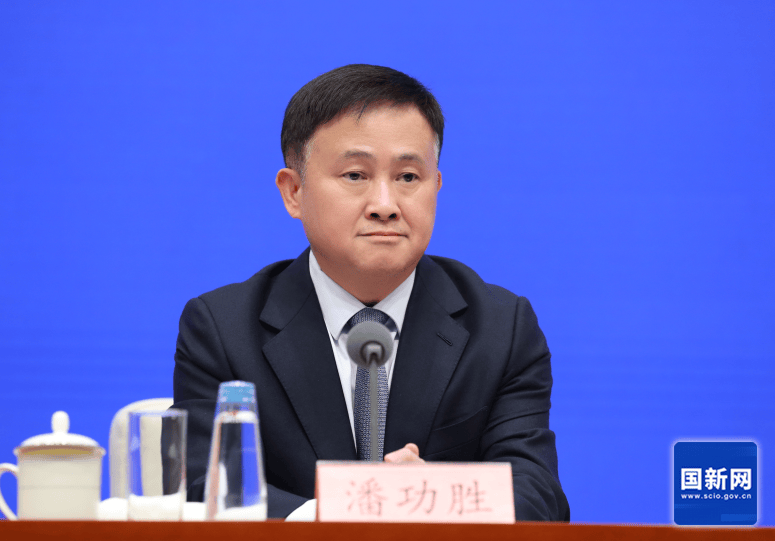
央行开展1640亿元7天期逆回购操作
Zheng Quan Ri Bao· 2025-08-08 07:21
Group 1 - The People's Bank of China (PBOC) conducted a 7-day reverse repo operation of 164 billion yuan at a fixed rate of 1.40%, resulting in a net withdrawal of 50.9 billion yuan on June 11, 2023 [1] - As of June 11, the PBOC has withdrawn a total of 804.7 billion yuan in June through reverse repos [1] - The PBOC announced a rare advance notice for a 10 trillion yuan buyout reverse repo operation for 3 months, which is a shift from the usual end-of-month announcements, enhancing market transparency [1][2] Group 2 - Analysts suggest that the PBOC may conduct further operations within the month, as the new announcement schedule allows for better observation of market conditions and liquidity needs [2] - The market is closely watching for the resumption of government bond purchases, which have not occurred for five consecutive months, as the PBOC aims to maintain liquidity and stabilize the bond market [2][3] - Analysts expect that the likelihood of resuming government bond purchases in the short term is low due to the current low yield levels, but there may be a higher chance in the second half of the year as government bond issuance peaks [3]
月末人民银行加大流动性投放,资金面相对宽松,债市修复
Bei Jing Shang Bao· 2025-07-28 11:41
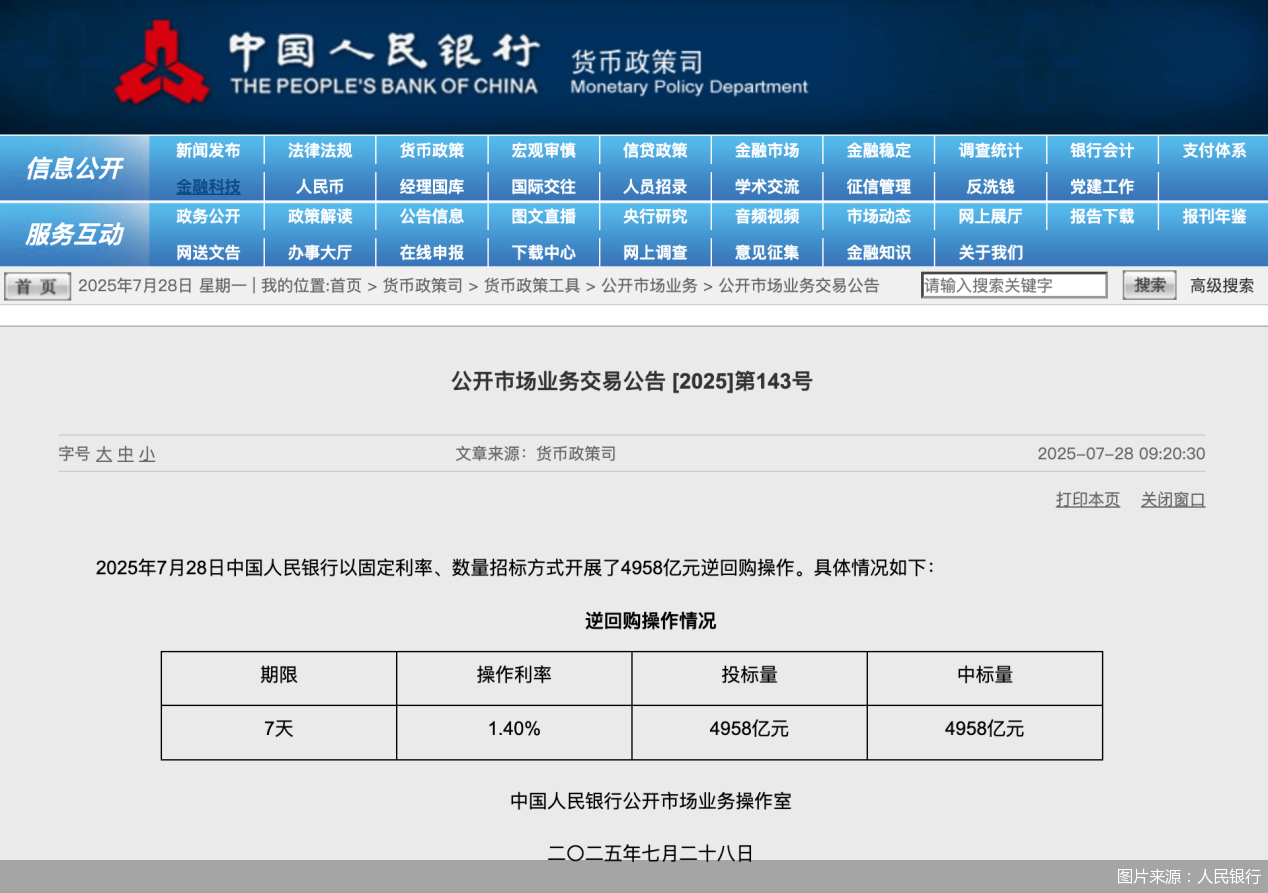
Group 1 - The People's Bank of China (PBOC) announced a 7-day reverse repurchase operation of 495.8 billion yuan at a fixed rate of 1.4%, resulting in a net injection of 325.1 billion yuan on July 28 [1][6][7] - The PBOC's actions are aimed at maintaining liquidity in the market, especially as the end of the month approaches, which typically sees seasonal tightening of funds [8][12] - The bond market has shown signs of recovery following the PBOC's increased liquidity measures, with yields on government bonds declining across various maturities [10][11] Group 2 - The recent increase in liquidity is a response to rising interest rates and tightening market conditions, particularly influenced by the recent surge in commodity prices [7][12] - Analysts expect the PBOC to continue implementing significant net liquidity injections to stabilize market expectations and prevent excessive interest rate increases [12][14] - The bond market has experienced fluctuations, with the 30-year government bond yield rising to 1.98% before the PBOC's interventions led to a decrease in yields [10][11]
中国人民银行货币政策委员会:加大货币财政政策协同配合,保持经济稳定增长和物价处于合理水平|政策与监管
清华金融评论· 2025-06-28 14:36
Core Viewpoint - The People's Bank of China emphasizes the need for a moderately loose monetary policy to support stable economic growth and maintain reasonable price levels amidst a complex external environment and domestic challenges [2][3][4]. Group 1: Monetary Policy Implementation - The meeting highlighted the importance of implementing a moderately loose monetary policy and enhancing counter-cyclical adjustments to better utilize monetary policy tools for both total and structural functions [2][3]. - It was noted that the effectiveness of the loan market quotation rate reform continues to be released, and the market-oriented adjustment mechanism for deposit rates is functioning effectively, leading to enhanced monetary policy transmission efficiency [2][3]. Group 2: Economic and Financial Environment - The current external environment is increasingly complex, with weakening global economic growth, rising trade barriers, and divergent economic performances among major economies, creating uncertainties in inflation trends and monetary policy adjustments [3]. - Despite the positive trends in China's economy, including improved social confidence and solid progress in high-quality development, challenges such as insufficient domestic demand and persistent low prices remain [3]. Group 3: Future Monetary Policy Directions - The meeting proposed increasing the intensity of monetary policy regulation, enhancing its foresight, targeting, and effectiveness, while maintaining ample liquidity and guiding financial institutions to increase credit supply [4]. - It emphasized the need to strengthen the central bank's policy interest rate guidance and improve the market-oriented interest rate formation transmission mechanism [4]. Group 4: Financial Supply-Side Structural Reform - The meeting discussed deepening financial supply-side structural reforms, urging large banks to play a leading role in serving the real economy and supporting small and medium-sized banks in focusing on their core responsibilities [6]. - It was highlighted that effective implementation of various structural monetary policy tools is essential to support key areas such as technological innovation and consumption [6]. Group 5: Policy Coordination and Development Goals - The meeting underscored the importance of adhering to the guiding principles of Xi Jinping's thought and fully implementing the decisions made by the Central Committee, with a focus on high-quality development and the construction of a new development pattern [7]. - It called for a better balance between total supply and demand, enhancing macro policy coordination, and effectively utilizing both existing and new policies to stimulate domestic demand and stabilize expectations [7].
【申万固收】关税预期反复下的核心矛盾梳理与策略应对——近期市场反馈及思考3
申万宏源研究· 2025-05-29 01:12
Core Viewpoints - The article discusses the current concerns of investors regarding macro interest rates, credit, and convertible bonds, and provides insights on these topics [2][12]. Group 1: Bond Market Dynamics - Bond interest rates are positively correlated with domestic demand and negatively correlated with external demand, indicating that despite unexpected tariff changes, the core contradiction in the bond market remains focused on domestic demand [3][14]. - The liquidity environment is improving gradually, with funding rates decreasing from around 1.8% to a range of 1.4%-1.6%, suggesting that negative carry is becoming a thing of the past [4][19]. - The long-end interest rates, particularly the 10-year government bond, require a decline in deposit rates to facilitate further downward movement [20][21]. Group 2: Macro-Prudential Support - The People's Bank of China is focusing on macro-prudential measures to support the healthy development of the bond market, which includes monitoring risks and enhancing regulatory coordination [5][24]. - The current credit environment shows weak growth in broad credit, with local government bonds expanding, indicating that investors may face more interest rate risks [25]. Group 3: Credit Bond Market - The credit bond market is expected to see a shift towards stronger credit performance and weaker interest rates, driven by a decrease in deposit rates and increased allocation towards credit bonds by wealth management products [7][28]. - The performance of credit strategies is likely to favor short to medium-term bonds, particularly those with a maturity of 2-3 years, with a ranking of value from city investment bonds to industry bonds [8][30]. Group 4: Investment Opportunities - The recent surge in sci-tech bonds presents unique investment opportunities, especially with new issuers and private sector participation, although investors should remain cautious of potential credit risks [10][32]. - The recommendation for a near-term convertible bond strategy is based on the increasing market focus on bonds with shorter maturities, particularly those with a strong repayment capability [11][34].