巴菲特指标

Search documents
“申”挖数据 | 估值水温表
申万宏源证券上海北京西路营业部· 2025-11-04 02:09
Core Viewpoint - The current PE valuation (TTM) for the food and beverage and agriculture, forestry, animal husbandry, and fishery sectors is below the 20th percentile level of the past decade, indicating potential investment opportunities [1][7]. Valuation Historical Percentile Levels - The PE valuation (TTM) for major broad market indices is above 20%, with the Shenzhen Component Index, CSI 300, SSE 50, SSE Composite Index, STAR Market 50, Northbound 50, and CSI A100 at the 82.06%, 83.66%, 87.82%, 94.57%, 96.95%, 97.64%, and 99.59% percentiles respectively, suggesting relatively high valuations and associated risks [6][7]. Industry Valuation Levels - The PE valuation (TTM) for the food and beverage sector is at the 8.37th percentile, while agriculture, forestry, animal husbandry, and fishery is at the 11.44th percentile, making them key areas for attention [7]. - Other industries such as construction materials, coal, media, automotive, steel, retail, electronics, computing, and real estate have PE valuations at the 80.41%, 81.12%, 81.71%, 82.06%, 84.86%, 87.90%, 95.43%, 97.35%, and 99.30% percentiles respectively, indicating higher investment risks [7]. Market Overall Situation - The total market capitalization for listed companies in Shanghai is approximately 638.48 billion, with an average PE ratio of 16.19 [21]. - In Shenzhen, the total market capitalization is around 425.78 billion, with an average PE ratio of 31.26 [22]. Buffett Indicator - The current Buffett indicator for A-shares stands at 89.18%, which is relatively high and above the safe zone [5][24].


10月股指期货市场走势分化
Hua Long Qi Huo· 2025-11-03 05:28
Report Industry Investment Rating - Not provided in the content Core Viewpoints of the Report - In October, the stock index futures market showed a structural differentiation trend. The market is expected to maintain a volatile pattern in the short - term. The economic fundamentals are resilient, and the non - manufacturing sector is expanding, with generally optimistic corporate expectations. However, manufacturing slowdown, external uncertainties, and high valuation levels may affect market confidence and limit the upside space of the index [28][29] - It is recommended to maintain a neutral mindset, pay attention to layout opportunities after market adjustments, and closely track subsequent economic data and policy trends [30] Summary by Relevant Catalogs 1. Market Performance - **Stock Index Futures**: In October, A - share major indices showed differentiation. The Shanghai Composite Index rose 1.85% and had a 6 - month consecutive positive line, while the Shenzhen Component Index and the ChiNext Index both fell by over 1%. Among stock index futures, the CSI 300 futures (IF) was basically flat, the CSI 500 futures (IC) and CSI 1000 futures (IM) closed slightly lower, and the SSE 50 futures (IH) performed outstandingly [5] - **Bond Futures**: In October, all bond futures closed higher. The 30 - year, 10 - year, 5 - year, and 2 - year bond futures had monthly increases of 2.44%, 0.77%, 0.41%, and 0.17% respectively [6] 2. Fundamental Analysis - In October, the manufacturing PMI was 49.0%, down 0.8 percentage points from the previous month, indicating a decline in manufacturing prosperity. The non - manufacturing business activity index was 50.1%, up 0.1 percentage points, entering the expansion range. The composite PMI output index was 50.0%, down 0.6 percentage points, indicating overall stable corporate production and business activities [7][9][12] 3. Valuation Analysis - As of October 31, the PE and PB of major indices such as the CSI 300, SSE 50, CSI 500, and CSI 1000, along with their percentile positions, showed that the overall market valuation attractiveness was limited [13] - The "total market capitalization/GDP" ratio's percentile in historical data was close to 90%, indicating that the overall market valuation pressure still existed [26][28] 4. Other Data - **Stock - Bond Yield Spread**: There are two formulas for calculating the stock - bond yield spread, using the reciprocal of the price - earnings ratio and the dividend yield respectively [21] - **China - Buffett Indicator**: The "total market capitalization/GDP" ratio was 89.80% on November 31, 2025, with a high percentile in historical data, suggesting relatively high market valuation [26] 5. Comprehensive Analysis and Outlook - The market is expected to maintain a volatile pattern in the short - term. Positive factors include economic resilience, non - manufacturing expansion, and positive policy signals. Negative factors include manufacturing slowdown, external uncertainties, and high valuation levels [28][29] 6. Operation Suggestions - **Overall Strategy**: Maintain a neutral mindset, pay attention to layout opportunities after market adjustments, and closely track economic data and policy trends [30] - **Specific Operations**: For single - side trading, buy on dips but beware of valuation risks; for arbitrage, participate in the IM/IH spread convergence strategy and pay attention to style - switching signals; for options, use covered call writing to increase returns or buy put options to hedge against volatility risks [31]
时隔十年!上证再现4000点!这一次4000点,和十年前还是一回事儿吗?……
对冲研投· 2025-10-28 12:00
Core Viewpoint - The article discusses the significance of the Shanghai Composite Index reaching 4000 points again after ten years, highlighting the differences in market conditions, valuation levels, and ownership structures compared to previous instances in 2007, 2008, and 2015 [6][13]. Valuation Levels - The current market valuation is compared using two indicators: the stock-bond yield ratio and the Buffett Indicator (total market capitalization/GDP). The stock-bond yield ratio for the CSI 300 is at 5.03, which is slightly below the median of the past decade, while the overall A-share market's ratio is at 2.59, also below its median [7][10]. - The Buffett Indicator for the A-share market is currently at 79%, which is lower than the 84% seen in December 2021 and significantly below the 95% during the peak of the 2015 bull market. This suggests that there is still potential for upward movement in the index if it approaches historical highs [10][11]. Ownership Structure - The ownership structure of the market has shifted significantly. Ten years ago, retail investors and speculative funds dominated, while now institutional investors hold over 40% of the free-floating market capitalization, with large-cap stocks primarily owned by major institutions [13]. - The article suggests that retail investors may take time to shift their funds from savings to the stock market, indicating a gradual transition rather than an immediate influx of capital [14][15]. Investment Strategies - The article emphasizes the importance of a measured approach to investing, suggesting that products like "fixed income plus" could see increased demand as retail investors gradually move their excess savings into the market. It estimates that if 20% of the anticipated 4.5-5 trillion yuan in excess savings enters the stock market, it could result in an additional 1 trillion yuan in investments [15][16]. - The article concludes that the current 4000-point mark may represent a slow bull market phase, encouraging investors to adopt strategies that align with their risk tolerance and investment beliefs rather than comparing themselves to others [16].

This Stock Market Indicator Issues a Major Warning for Investors -- but There's a Silver Lining
Yahoo Finance· 2025-10-21 17:45
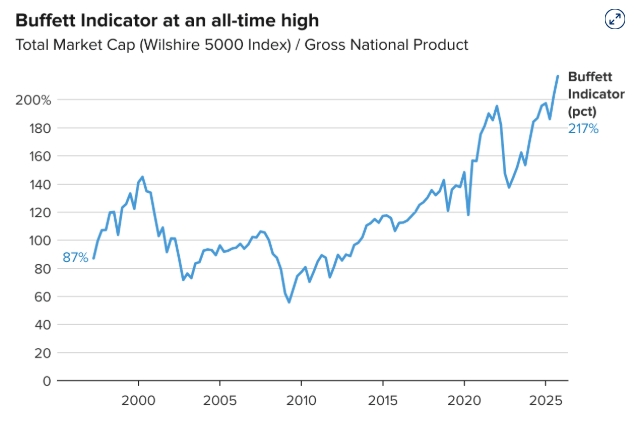
Market Performance - The stock market has shown significant gains in 2025, with the S&P 500 up nearly 15% year to date as of October 20, and over 35% since its low in April [1][2] Market Concerns - Experts suggest the current market may be in a bubble, primarily driven by the artificial intelligence boom, indicating a potential for a significant downturn [2][6] - The Buffett Indicator, which measures the ratio of total U.S. stock value to GDP, currently stands at 219%, suggesting overvaluation [5][6] Historical Context - Warren Buffett previously used the Buffett Indicator to predict the tech bubble burst in the late 1990s, warning that a ratio above 200% indicates high risk [4][5] Indicator Reliability - While the Buffett Indicator is at a record high, it is noted that no single market metric is infallible, and a high ratio does not guarantee an imminent bear market [6]
“申”挖数据 | 估值水温表
申万宏源证券上海北京西路营业部· 2025-10-21 02:52
Core Viewpoint - The current PE valuations (TTM) for the food and beverage and agriculture, forestry, animal husbandry, and fishery sectors are below the 20th percentile of the past decade, indicating potential investment opportunities [1][8]. Valuation Levels - The current Buffett Indicator for A-shares stands at 85.99%, which is relatively high and above the safe zone [6][22]. - Major broad market indices have PE valuations (TTM) above the 20th percentile, with the following levels: - CSI 300: 85.47% - Northbound 50: 88.32% - SSE 50: 91.44% - SSE Composite: 95.68% - STAR Market 50: 98.07% - CSI A100: 99.51% [7][27]. Industry Valuation Levels - The PE valuations (TTM) for the food and beverage and agriculture, forestry, animal husbandry, and fishery sectors are at 10.23% and 10.58% of their historical levels, respectively, suggesting they are worth monitoring [8][31]. - Other industries such as coal, steel, retail, electronics, computers, and real estate have PE valuations (TTM) at 80.98%, 84.16%, 86.58%, 91.52%, 95.80%, and 99.30% of their historical levels, indicating higher investment risks [8][31]. Market Overview - The total market comprises 2,288 listed companies with a total market capitalization of approximately 617.61 billion yuan and a circulating market value of about 583.34 billion yuan, with an average PE ratio of 15.74 [18][25]. Industry-Specific Valuation Levels - The PE valuation levels for various industries are as follows: - Agriculture, Forestry, Animal Husbandry, and Fishery: 14.95 - Food and Beverage: 16.52 - Electronics: 20.31 - Real Estate: 70.11 [33][36]. Industry PB Valuation Levels - The PB valuation levels for key industries are: - Agriculture, Forestry, Animal Husbandry, and Fishery: 2.02 - Food and Beverage: 3.32 - Electronics: 1.92 [36][39].

“牛市尾声”的蛛丝马迹:“牛尾”最肥与人人看涨
美股IPO· 2025-10-12 04:23
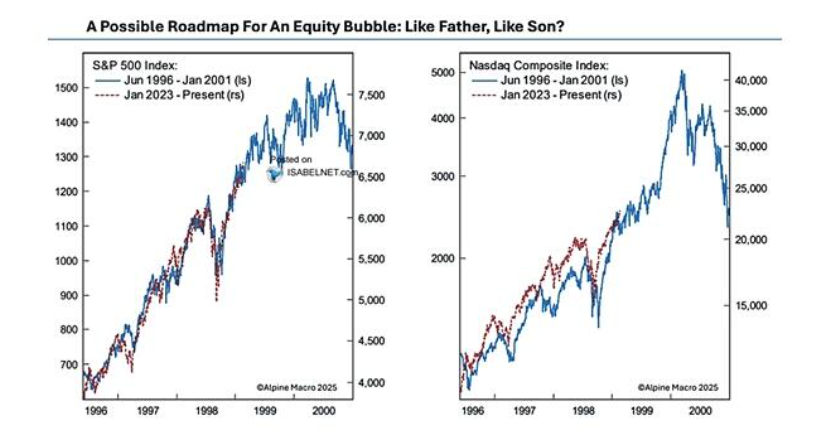
Core Viewpoint - Legendary investor Paul Tudor Jones believes that the U.S. stock market is on the brink of a significant reversal, likening the current environment to the late stages of the 1999 bubble driven by AI narratives and a "fear of missing out" mentality [1][3][4] Market Conditions - The recent market downturn saw the Nasdaq drop over 3%, marking its worst performance in six months, indicating a growing sense of danger among investors [3] - Jones warns that while a strong rally may still occur, it will likely be followed by a sharp reversal, a common outcome in speculative market phases [3][4] Psychological Factors - Investor psychology has become increasingly fragile, with behaviors shifting from rational investment to a "fear of missing out" as noted by seasoned investor Leon Cooperman [3][8] - The current market rally appears disconnected from fundamental support, driven instead by price increases alone [3][5] Historical Comparisons - The current market environment bears striking similarities to the 1999 internet bubble, where the last year of a bull market often yields substantial returns but also increased volatility [4][5] - Both periods are characterized by a compelling narrative—1999's was the internet, while today's is artificial intelligence—leading to similar investor behaviors [5] Market Indicators - The "Buffett Indicator," which measures the total market capitalization against GDP, has surpassed 200%, indicating a severe disconnection between the stock market and the real economy [8][10] - The market has entered a "bad news is good news" phase, where weak economic data may lead to stock price increases due to expectations of Federal Reserve intervention [11][12] Risks and Speculation - The current market is marked by excessive liquidity, large fiscal deficits, and global central bank rate cuts, which, while supporting the bull market, also contribute to instability [7] - The consensus among investors has become overly crowded, making the market sensitive to negative news, which could trigger disproportionate reactions [10][11]

“牛市尾声”的蛛丝马迹:“牛尾”最肥与人人看涨
Hua Er Jie Jian Wen· 2025-10-12 03:38
Group 1 - The core viewpoint of the articles suggests that the current market may be nearing the end of a bull market, with significant volatility expected ahead [1][2][4] - Historical parallels are drawn between the current market environment and the 1999 internet bubble, highlighting the psychological factors driving investor behavior, such as the fear of missing out (FOMO) [2][4] - The "Buffett Indicator," which measures the ratio of total market capitalization to GDP, has surpassed 200%, indicating a severe disconnection between the stock market and the real economy [5][7] Group 2 - The market has entered a "bad news is good news" phase, where weak economic data may lead to stock market gains due to expectations of monetary easing by the Federal Reserve, a pattern observed before previous market tops [8][9] - Current market conditions are characterized by excessive liquidity, large fiscal deficits, and global central bank rate cuts, which, while supporting the bull market, also contribute to instability [4][5] - There is a growing concern about the potential for a speculative bubble in the AI sector, with record valuations and increasing investor speculation, making it uncertain whether the market is merely experiencing a "mid-game pause" [9]
螺丝钉股市牛熊信号板来啦:当前市场估值如何|2025年10月份
银行螺丝钉· 2025-10-10 05:30
Core Viewpoint - The article discusses the current state of the stock market as of October 2025, highlighting various quantitative and qualitative signals that indicate market conditions, including valuation metrics and investor sentiment [1][55]. Quantitative Signals - The Buffett Indicator shows a market valuation of 80% below GDP, indicating a relatively low market valuation [25]. - The price-to-book ratio percentile indicates that the market is at 71.51% for large-cap value stocks and 83.49% for small-cap value stocks, suggesting that large-cap stocks are relatively undervalued [3][5]. - The stock-bond yield ratio is at 2.46, which is above the threshold of 2, indicating that stocks are undervalued compared to bonds [29]. - The financing balance in the A-share market is at 23,784 billion, reflecting a cooling market sentiment [9][10]. - The current trading volume percentile is at 99.60%, indicating a high level of trading activity compared to historical data [11]. Qualitative Signals - The number of new stock issuances has decreased significantly, and the high rate of new stock failures suggests a bearish market sentiment [36]. - The M2 money supply is used as a liquidity indicator, with the market's performance closely tracking its movements [38]. - The scale of old funds has decreased significantly, with many funds down by 50%-60% compared to their peak in 2021, indicating a lack of investor confidence [41]. - The issuance of new funds remains low, with recent data showing a historical low in new fund sizes, reflecting a bearish market environment [45]. - The proportion of limited purchase funds is at 17.39%, indicating a cautious approach from fund managers in a potentially overvalued market [50]. Market Trends - The article notes two significant market lows in early 2024, both at a star rating of 5.9, indicating extreme undervaluation [56]. - Following these lows, the market has shown signs of recovery, with the star rating improving to around 4.1 by October 2025, suggesting a gradual return to normal valuation levels [57]. - The small-cap growth style has seen significant gains, reaching overvalued levels, while other styles remain closer to normal or undervalued [57].

投资者押注美政府关门影响有限 标普500指数突破6700点 华尔街传奇投资人发出崩盘警告
智通财经网· 2025-10-01 23:12
Market Performance - The U.S. stock market reached a new all-time high on Wednesday, indicating limited investor concern over the government shutdown and expectations for a short duration with manageable economic impact [1] - The S&P 500 index rose by 0.34% to 6,711.20 points, while the Nasdaq Composite increased by 0.42% to 22,755.16 points, and the Dow Jones Industrial Average gained 43.21 points to 46,441.10 points [1] - The S&P 500 has accumulated a rise of over 3.5% in September, continuing its strong momentum [1] Economic Impact of Government Shutdown - The government shutdown has led to the suspension of operations in agencies like the Labor Department, causing delays in the September non-farm payroll report, which may create a "data vacuum" for the Federal Reserve ahead of its meeting [2] - The ADP employment data released on Wednesday showed a decrease of 32,000 jobs in the private sector, significantly below the expected increase of 45,000, marking the largest decline since March 2023 [2] - This has heightened expectations that the Federal Reserve will implement its second rate cut of the year this month, with a potential for another cut in December [2] Market Sentiment and Valuation Concerns - Despite the optimistic market atmosphere, some prominent investors have raised warnings, comparing current market sentiment to the late 1990s tech bubble [2] - The S&P 500 has rebounded nearly 40% since its April low, primarily driven by large technology companies [2] - The "Buffett Indicator," which measures total market capitalization against GDP, has surged to 217%, significantly higher than during the internet bubble and the peak of the COVID-19 pandemic [2] Investment Perspectives - Some investors, like Cooperman, believe that in a high-inflation environment, the risk associated with stocks may be lower than that of bonds, as fixed nominal rates on bonds can be eroded by inflation [5]
若政府机构“停摆”,美国旅游业将受冲击
Sou Hu Cai Jing· 2025-09-29 13:37
Core Viewpoint - The risk of a U.S. federal government shutdown is increasing as bipartisan negotiations stall, potentially leading to significant economic losses, particularly in the tourism sector, estimated at up to $1 billion per week if the shutdown occurs [1][3]. Group 1: Impact on Tourism Industry - The American Tourism Association has warned that a government shutdown could result in weekly losses of up to $1 billion for the tourism industry [3]. - Specific impacts include longer wait times at airport security due to staff shortages, increased flight delays and cancellations, and the closure or reduced services of national parks and federally operated museums [5]. - A survey indicates that 60% of U.S. residents would cancel or avoid air travel during a shutdown, with over 80% believing it would harm the economy and inconvenience travelers [5]. Group 2: Market Conditions and Valuation - Historical patterns show that government shutdowns often lead to political stalemates, which markets typically overlook; however, current market conditions are different, with U.S. stock valuations at historical highs, making the market more susceptible to negative events [7]. - The "Buffett Indicator," which measures the total market capitalization against U.S. GDP, currently stands at 217%, significantly exceeding levels seen during the dot-com bubble and indicating that stock market expansion is outpacing economic growth [9]. Group 3: Employment Market Concerns - The impending government shutdown could lead to up to 900,000 federal employees being forced to take unpaid leave, impacting the labor market [11]. - There is concern that the shutdown may prevent the release of critical employment data, which is essential for market analysis [13].