
成长风格

Search documents
招商证券:市场在未来一段时间将会以震荡为主 节后指数有望强于节前 风格层面继续推荐成长风格
智通财经网· 2026-02-03 23:53
Core Viewpoint - The market is expected to experience volatility in February, with indices likely to perform better post-holiday compared to pre-holiday levels. The report emphasizes a preference for growth style investments, particularly in small-cap and growth sectors, as the market remains in a spring rally phase [1][2]. Market Style Outlook - Growth style is favored, with a convergence in performance between large-cap and small-cap stocks anticipated. The recommended indices include CSI 1000, ChiNext 50, CSI 300 Quality, and CSI 800 Information [2]. - Historical data from 2016-2025 indicates that small-cap and growth styles have a higher success rate in February. The late timing of the Spring Festival and the upcoming Two Sessions are expected to enhance the performance of small-cap stocks due to increased market risk appetite [2]. Fundamental Analysis - The manufacturing PMI for January recorded at 49.3, indicating a return to contraction territory, with both production and demand showing marginal declines. The ongoing structural issue of insufficient domestic demand remains, with policies aimed at expanding domestic consumption expected to be a primary focus [2]. - On the international front, expectations regarding the Federal Reserve's policies and a weaker dollar may lead to a temporary strengthening of the dollar, which could exert pressure on A-share cyclical styles. However, sectors benefiting from industrial trends, such as technology and AI, are likely to be less affected [2]. Liquidity and Capital Supply-Demand - February is projected to see continued net inflows of incremental capital, with foreign capital expected to continue flowing in before the holiday and financing likely to rebound afterward. The central bank's measures to counteract liquidity tightening from government bond issuances in January are expected to maintain a stable and ample liquidity environment in February [3][4]. - The stock market experienced a net outflow of tracked capital in January, with financing becoming the main source of incremental capital. The demand side shows an increase in net reductions by major shareholders, while IPO and refinancing scales have decreased, keeping overall funding demand stable [4]. Market Sentiment and Capital Preferences - In January, the risk premium for the entire A-share market fluctuated, with major indices experiencing initial gains followed by volatility. The technology sector remained the dominant style, with significant trading activity in small-cap growth and STAR 50 indices, while large-cap growth styles saw lower trading concentration [4].

2月基金配置展望:继续看好权益与小盘、成长风格
Ping An Securities· 2026-02-02 09:13
证券研究报告 继续看好权益与小盘、成长风格 ——2月基金配置展望 证券分析师 郭子睿 投资咨询资格编号:S1060520070003 任书康 投资咨询资格编号:S1060525050001 陈 瑶 投资咨询资格编号:S1060524120003 高 越 一般从业资格编号:S1060124070014 胡心怡 一般从业资格编号:S1060124030069 研究助理 2026年2月2日 请务必阅读正文后免责条款 基金配置建议:继续看好权益与小盘、成长风格 2 1月回顾:A股、美股上涨;美债利率上行,国债利率下行;商品价格上涨;美元指数下行,人民币升值。A股春季行情延续,市场活跃度大幅提 升,A股、港股表现亮眼,中盘成长风格基金涨幅最大。美国经济数据表现韧性,美股震荡上涨,美债利率上行。国内央行释放流动性,国债利 率下行,期限利差小幅走阔。在全球流动性宽松与地缘风险等因素驱动下,海内外商品价格上涨,贵金属价格涨幅大幅居前。 2月展望:资产配置的逻辑。股债轮动模型显示,2025年12月私人部门融资增速继续上行,通胀因子低位回升,基本面模型延续经济复苏信号。 我们在1月基金月报《增配权益,看好成长》中建议增配权益资产 ...
——25Q4基金季报专题研究:四类基金画像:加仓、减仓、调仓、极致风格
Huachuang Securities· 2026-01-30 06:42
Group 1 - The overall change in public fund holdings shows an increase in allocation to non-ferrous metals and communications, while reducing allocation to electronics and pharmaceuticals. The top five industries with increased holdings are non-ferrous metals (up 2.1 percentage points), communications (1.8 percentage points), non-bank financials (0.9 percentage points), chemicals (0.8 percentage points), and machinery (0.7 percentage points). The top five industries with reduced holdings are electronics (-1.6 percentage points), pharmaceuticals (-1.6 percentage points), media (-1.2 percentage points), electric new energy (-0.9 percentage points), and computers (-0.8 percentage points) [1][8][12] Group 2 - The report categorizes funds into four types: increasing, decreasing, adjusting, and extreme style. The increasing funds focus on growth style, adding positions in industrial metals, military electronics, and photovoltaic equipment, while reducing positions in batteries, digital media, and social networks. Decreasing funds are shifting from growth to value, adding positions in components, liquor, and coal mining, while reducing positions in communication equipment, semiconductors, and passenger vehicles. Adjusting funds show a balanced configuration, adding positions in semiconductors, industrial metals, and insurance, while reducing positions in consumer electronics, batteries, and state-owned banks. Extreme style funds make internal adjustments within their styles, adding communication equipment and renovation materials while reducing consumer electronics and bioproducts [7][15][16] Group 3 - The report highlights that the consensus for selling includes bioproducts, internet e-commerce, consumer electronics, social media, batteries, and digital media, while the consensus for buying includes insurance, securities, chemical products, components, photovoltaic equipment, and industrial metals [15][16][18] Group 4 - The analysis indicates that increasing funds prefer large-cap and high-valuation stocks, while decreasing and adjusting funds focus on both growth and profitability. Extreme growth funds tend to hold small-cap, high-valuation stocks with pressured profitability, while extreme value funds focus on low-valuation, large-cap stocks with low earnings growth [7][18][25]
一图看懂:主动优选基金经理,在2025年4季报里都说了啥?
银行螺丝钉· 2026-01-28 13:59
Core Viewpoint - The article provides an overview of fund managers' perspectives and data from their Q4 2025 reports, highlighting different investment styles and strategies across various funds [1][2]. Group 1: Investment Styles - Fund managers are categorized into different investment styles, including deep value, growth value, and balanced styles, each with distinct characteristics and strategies [7][26]. - Deep value style focuses on low valuation metrics such as low P/E and P/B ratios, primarily investing in sectors like finance, real estate, and energy [9][10]. - Growth value style emphasizes companies with strong profitability and cash flow, often holding stocks for the long term, with notable managers like Zhang Kun representing this style [15][16]. - Balanced style, represented by Peter Lynch, seeks a combination of growth and valuation, looking for stocks that offer good value [27][28]. Group 2: Fund Manager Insights - Fund managers provided insights on market conditions and future expectations, with some expressing optimism about the recovery of consumer demand and housing prices [19][20]. - Adjustments in fund allocations were noted, with some managers reducing exposure to underperforming sectors while increasing investments in technology and energy-related companies [20][23]. - The overall sentiment indicates a cautious yet optimistic outlook for 2026, with expectations of improved economic conditions and potential investment opportunities in various sectors [41][54]. Group 3: Sector Focus - Specific sectors highlighted include AI, renewable energy, and consumer goods, with managers emphasizing the importance of selecting companies with strong fundamentals and growth potential [52][59]. - The article notes a trend towards increasing allocations in sectors like chemicals and machinery, reflecting a structural adjustment in response to market conditions [21][23]. - Fund managers are also paying attention to the impact of macroeconomic factors, such as inflation and government policies, on investment strategies [41][56].


[1月28日]指数估值数据(红利、港股大涨,组合新高;这轮牛市的风格是什么;《红利指数基金投资指南》荣登榜首)
银行螺丝钉· 2026-01-28 13:59
文 | 银行螺丝钉 (转载请注明出处) 今天大盘整体微涨,波动不大,截止到收盘,还在3.8星。 港股也整体上涨。 今天港股涨幅比A股还高。 沪深300、中证500等大中盘股上涨。 中证500今天上涨后,也达到了高估。 价值风格大幅上涨。 现金流指数、红利类指数大幅上涨。 这两周价值风格品种也开始补涨了。 低估品种总会有上涨的阶段~ 前两周咱们主动优选做了调仓,止盈了部分高估的成长风格,加仓了价值风格。 刚好匹配最近的市场风格。 今天几个组合整体上涨,主动、指数、 月薪宝 、 365 等都创下历史新高。 恒生指数上涨超2%。 恒生红利低波、港股科技等都上涨明显。 港股中很多也属于人民币类资产,只不过欧美投资者占比高一些。 一般老外看好人民币资产,考虑港股会多一些。 1. 去年螺丝钉也介绍过,这轮牛市的风格,跟2013-2017年比较相似。 (1)2013年,A股上市公司盈利下滑,A股整体也在5点几星的熊市。 (2)2014年下半年,开始了各种刺激政策。人民币利率也大幅下降。 在利率大幅下降的背景下,市场开始大幅上涨。 第一波领涨的品种是证券。 (3)2015年上半年,市场风格切换。第二波领涨的品种,变成了小盘、 ...

A股尾盘,突然异动!宽基ETF成交再度放量
券商中国· 2026-01-28 08:41
Core Viewpoint - The A-share market is experiencing significant net outflows from broad-based ETFs, despite strong overall market performance and high trading volumes [2][4][6]. Group 1: ETF Market Dynamics - On January 28, the trading volume of multiple broad-based ETFs surged, with total ETF trading reaching a record high of 762.8 billion yuan [3]. - As of January 27, 11 broad-based stock ETFs had net outflows exceeding 10 billion yuan each, totaling over 720 billion yuan in outflows [4]. - Major ETFs such as Huatai-PB CSI 300 ETF and E Fund CSI 300 ETF faced net outflows exceeding 100 billion yuan each [4][6]. Group 2: Sector Performance - Despite the outflows from broad-based ETFs, sectors like non-ferrous metals, chemicals, electric grid equipment, semiconductors, and satellites have shown strong performance [4]. - Specific ETFs in these sectors, such as Southern CSI Nonferrous Metals ETF and Huaxia CSI Electric Grid Equipment ETF, have attracted over 10 billion yuan in net inflows [4]. Group 3: Market Trends and Investor Behavior - The A-share market is characterized by a clear divergence in performance, with indices like Sci-Tech 200 and Sci-Tech 100 performing well, while large-cap indices like CSI 300 and SSE 50 lag behind [6][7]. - The current market environment is marked by a strong "opening red" expectation, which supports investor confidence, despite significant net redemptions in broad-based ETFs [7]. - The growth of narrow-based, cross-border, and commodity ETFs contrasts with the decline in broad-based and bond ETFs, indicating a shift in investor preferences [4][8].

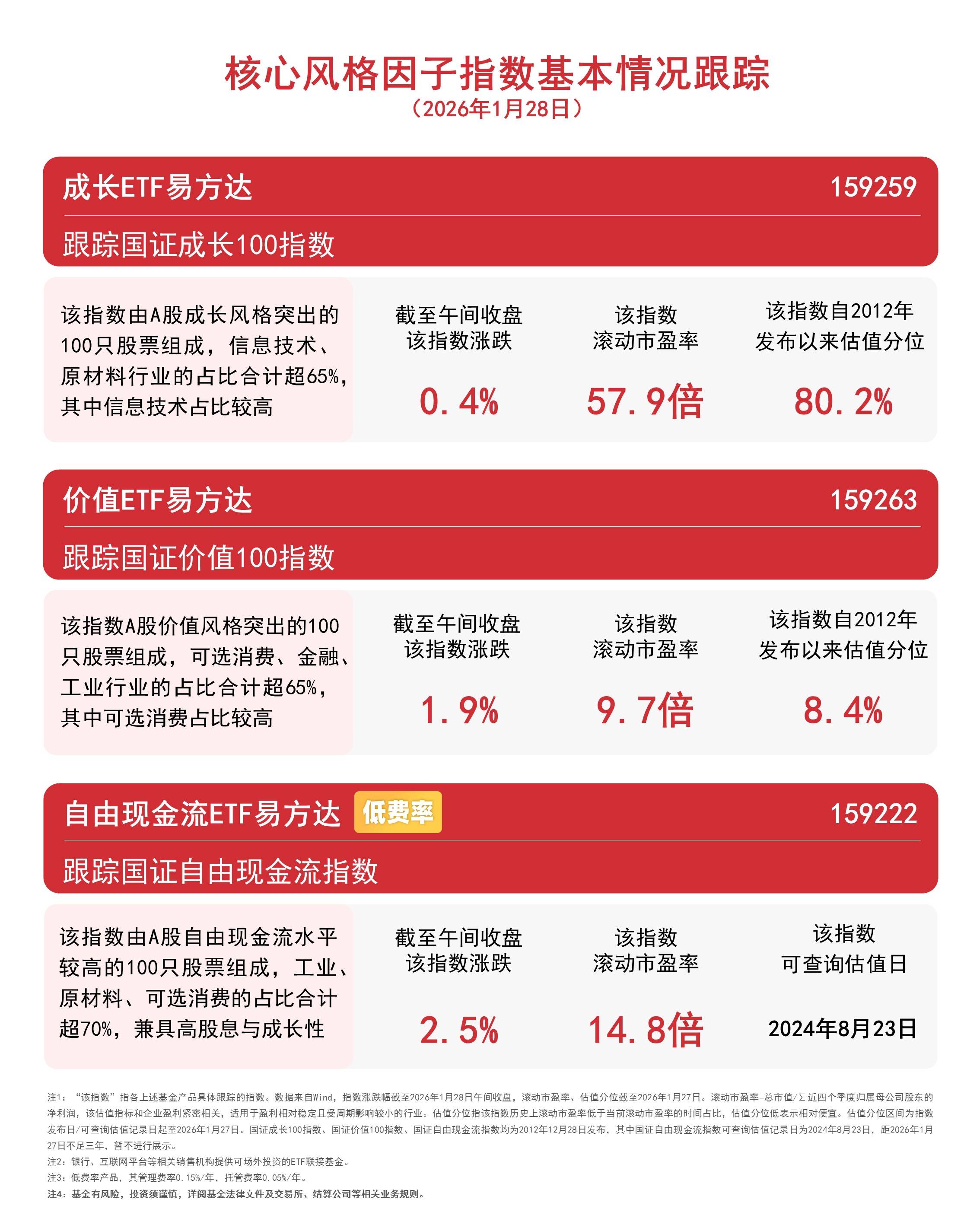
自由现金流指数半日涨2.5%,持续关注自由现金流ETF易方达(159222)等产品布局机会
Sou Hu Cai Jing· 2026-01-28 05:27
Group 1 - The core viewpoint of the news highlights a collective strength in sectors such as non-ferrous metals, chemicals, and coal, leading to an upward movement in related indices [1] - As of the midday close, the Guozheng Free Cash Flow Index increased by 2.5%, the Guozheng Value 100 Index rose by 1%, and the Guozheng Growth 100 Index saw a rise of 0.4% [1] Group 2 - The Growth ETF managed by E Fund tracks the Guozheng Growth 100 Index, which consists of 100 stocks with a strong growth style in the A-share market, with over 65% of its composition in the information technology and materials sectors, particularly with a high proportion in information technology [3] - The Value ETF also managed by E Fund tracks the Guozheng Value 100 Index, which is composed of 100 stocks with a strong value style in the A-share market, focusing on consumer discretionary and financial sectors [3]
新手投资指数基金,适合从哪些品种入门?|第424期精品课程
银行螺丝钉· 2026-01-28 04:01
Core Viewpoint - The article discusses the recognition of various stock indices by institutional investors and their suitability for ordinary investors, particularly beginners. It emphasizes the importance of diversified allocation and rebalancing in index investing [1]. Group 1: Common Stock Index Guidance - The rapid growth of index funds is noted, with projections indicating that by 2025, the total scale of index funds will exceed 5.5 trillion, making it the largest type of stock fund in China [4]. - The introduction of new indices, such as the China Securities A500 index fund launched in September 2024, which reached several hundred billion in scale within just over a year, highlights the increasing variety of index funds available [5]. - The article identifies common stock index guidance suitable for both institutional and ordinary investors, focusing on key indices that can serve as investment references [7][8]. Group 2: Public Fund Performance Benchmark Library - The establishment of a standardized "benchmark library" for public funds aims to address issues of vague performance benchmarks and inconsistent investment strategies among funds [12]. - The current public fund performance benchmark library includes a variety of stock indices, with 69 indices in the first category and 72 in the second category, focusing on strong market representation and high recognition [14]. - The first category includes widely recognized indices such as the CSI 300 and the CSI 500, which are essential for fund managers in developing actively managed funds [14][15]. Group 3: Personal Pension Accounts - The introduction of the personal pension system in 2022 allows individuals to voluntarily open accounts with a maximum annual contribution of 12,000 yuan, which can be deducted from taxable income [17]. - By the end of 2025, the number of pension index funds will expand to 91, covering 16 mainstream indices, indicating a growing focus on retirement investment options [19]. - The first batch of pension index funds includes 85 funds, emphasizing the importance of risk control for new investors [21]. Group 4: Constant Proportion Stock-Bond Indices - Constant proportion stock-bond indices are designed to maintain a fixed ratio of stocks and bonds, with periodic rebalancing to adhere to this ratio [23]. - These indices typically have a higher allocation to bonds, often exceeding 70%, and are characterized by a target risk strategy [28]. - The introduction of these indices aligns with the trend of multi-asset investment strategies, which may include stocks, bonds, and potentially other assets like gold in the future [24]. Group 5: Insurance Company Risk Factor Adjustments - In December 2025, regulatory adjustments reduced the risk factors for insurance companies investing in indices like the CSI 300 and the low-volatility dividend index, allowing for more capital to be allocated to these assets [32]. - The reduction in risk factors from 0.3 to 0.27 for the CSI 300 means that insurance companies can free up more funds for investment, enhancing their capacity to invest in stable assets [38][39]. - The implications of these adjustments are significant for ordinary investors, as they reflect a conservative investment approach focused on long-term value appreciation with manageable volatility [40]. Group 6: Suitable Indices for Beginner Investors - The article identifies the most frequently referenced indices in various guidance categories as suitable for beginner investors, primarily focusing on broad-based indices like the CSI 300 and CSI 500 [67]. - The recommended investment strategy for beginners includes a combination of broad-based indices and growth/value strategies, such as the leading strategy and dividend strategy [68]. - The article suggests that new investors can benefit from diversified exposure to both growth and value styles, which can enhance returns while managing risk [45].

市场情绪平稳,价量一致性高位震荡——量化择时周报20260125
申万宏源金工· 2026-01-27 01:03
Core Viewpoint - The market sentiment is stable with high price-volume consistency, indicating a sideways trend in the market [1] Group 1: Market Sentiment Indicators - The market sentiment indicator value as of January 23 is 2.35, a slight increase from 2.25 the previous week, indicating a neutral sentiment [3] - Key indicators such as the proportion of transactions in the Sci-Tech 50 and inter-industry trading volatility have shown signs of recovery, suggesting a marginal improvement in market risk appetite [6][15][17] - The price-volume consistency indicator remains high, reflecting a strong correlation between market attention and stock price movements, indicating active market sentiment [9] - The financing balance ratio has shown a slight upward trend, indicating that leveraged funds are maintaining a high level of sentiment, suggesting overall market risk appetite remains positive [22] Group 2: Industry Trends and Performance - The scoring model indicates that non-ferrous metals, communication, and defense industries are leading in trend scores, with non-ferrous metals achieving a short-term score of 100.00, the highest among industries [30][31] - The average industry congestion level is highest in utilities, computers, media, banks, and oil and petrochemicals, while the lowest is in environmental protection, textiles, and light manufacturing [33] - The correlation between industry congestion and weekly price changes is negligible, indicating that high congestion sectors like oil and petrochemicals are experiencing significant price increases, while sectors with low congestion are lagging [35] Group 3: Technical Indicators - The RSI indicator has shown a decline, suggesting a decrease in short-term upward momentum and an increase in selling pressure, indicating a potential weakening of market sentiment [25][37] - The model indicates that small-cap and growth styles are currently favored, although there are signs of weakening in the short-term signals for these styles [38]

风格Smartbeta组合跟踪周报-20260126
GUOTAI HAITONG SECURITIES· 2026-01-26 14:55
Quantitative Models and Construction Methods - **Model Name**: Value Smart Beta Portfolio **Model Construction Idea**: The model is based on selecting stocks with low historical correlation and aims to achieve high beta elasticity and long-term stable excess returns[5] **Model Construction Process**: The Value Smart Beta Portfolio includes two sub-portfolios: Value 50 Portfolio and Value Balanced 50 Portfolio. These portfolios are constructed by selecting stocks that align with the value style and optimizing for beta elasticity and excess return stability. The detailed construction process is referenced in a prior report[5] **Model Evaluation**: The Value Balanced 50 Portfolio outperformed the Value 50 Portfolio in terms of weekly, monthly, and yearly returns, demonstrating its superior performance in capturing value style excess returns[3][6] - **Model Name**: Growth Smart Beta Portfolio **Model Construction Idea**: Similar to the value model, this portfolio focuses on stocks with low historical correlation, targeting high beta elasticity and stable excess returns in the growth style[5] **Model Construction Process**: The Growth Smart Beta Portfolio includes Growth 50 Portfolio and Growth Balanced 50 Portfolio. Stocks are selected based on growth style characteristics, and the portfolios are optimized for beta elasticity and excess return stability. The detailed methodology is referenced in a prior report[5] **Model Evaluation**: The Growth Balanced 50 Portfolio consistently outperformed the Growth 50 Portfolio, indicating its effectiveness in capturing growth style excess returns[3][6] - **Model Name**: Small-Cap Smart Beta Portfolio **Model Construction Idea**: This portfolio targets small-cap stocks with low historical correlation, aiming for high beta elasticity and stable excess returns[5] **Model Construction Process**: The Small-Cap Smart Beta Portfolio includes Small-Cap 50 Portfolio and Small-Cap Balanced 50 Portfolio. Stocks are selected based on small-cap style characteristics, and the portfolios are optimized for beta elasticity and excess return stability. The detailed methodology is referenced in a prior report[5] **Model Evaluation**: The Small-Cap Balanced 50 Portfolio outperformed the Small-Cap 50 Portfolio, showcasing its ability to capture small-cap style excess returns effectively[3][6] --- Model Backtesting Results - **Value Smart Beta Portfolio** - **Value 50 Portfolio**: Weekly return: 1.38%, Monthly return: -0.11%, Yearly return: -0.11%, Maximum relative drawdown: 2.43%[6] - **Value Balanced 50 Portfolio**: Weekly return: 4.59%, Monthly return: 8.27%, Yearly return: 8.27%, Maximum relative drawdown: 0.56%[6] - **Growth Smart Beta Portfolio** - **Growth 50 Portfolio**: Weekly return: -0.37%, Monthly return: 5.13%, Yearly return: 5.13%, Maximum relative drawdown: 1.30%[6] - **Growth Balanced 50 Portfolio**: Weekly return: 3.79%, Monthly return: 10.01%, Yearly return: 10.01%, Maximum relative drawdown: 1.33%[6] - **Small-Cap Smart Beta Portfolio** - **Small-Cap 50 Portfolio**: Weekly return: 3.71%, Monthly return: 11.57%, Yearly return: 11.57%, Maximum relative drawdown: 3.08%[6] - **Small-Cap Balanced 50 Portfolio**: Weekly return: 4.27%, Monthly return: 12.88%, Yearly return: 12.88%, Maximum relative drawdown: 2.38%[6]