
政策支持

Search documents
光伏50ETF(159864)涨超1.6%,行业景气与反内卷博弈成焦点
Mei Ri Jing Ji Xin Wen· 2025-12-08 06:12
Core Insights - The power equipment industry is benefiting from a surge in global electricity demand, with the International Energy Agency projecting an average annual growth rate of 4% in global electricity demand from 2025 to 2027, primarily driven by the expansion of data centers and AI training clusters [1] Industry Summary - Strong demand for UHV (Ultra High Voltage) in China, with the first five batches of bidding orders expected to grow by 30% year-on-year before 2025 [1] - Imbalance in overseas grid investment and renewable energy integration, with over 3000 GW of projects awaiting grid connection, driving demand for cables [1] - In the photovoltaic equipment sector, despite a projected adjustment in China's installed capacity to 180 GW in 2026, global demand remains high, with expected global installations of 590 GW, 538 GW, and 599 GW from 2025 to 2027 [1] - Energy storage equipment is also experiencing explosive growth, with global installations expected to reach 92 GW, 123 GW, and 138 GW during the same period, and battery shipment volumes projected to grow year-on-year by 69%, 50%, and 10% [1] - Industry technology upgrades and policy support, such as the "anti-involution" benchmark, are extending the lifecycle of products, optimizing the supply-demand structure, and allowing the power and photovoltaic equipment sectors to continue benefiting from the transition between old and new growth drivers [1] Investment Product Summary - The Photovoltaic 50 ETF (159864) tracks the photovoltaic industry index (931151), which selects listed company securities involved in silicon materials, silicon wafers, battery cells, modules, and photovoltaic equipment to reflect the overall performance of related listed companies across the photovoltaic industry chain [1] - This index focuses on the new energy sector, characterized by high growth potential and technological innovation [1]
东阿阿胶推出上市以来首次回购注销方案 上限2亿元
Zheng Quan Ri Bao Wang· 2025-12-04 13:26
Core Viewpoint - Dong'e Ejiao plans to repurchase shares worth 100 million to 200 million yuan, marking its first share buyback since listing, aimed at enhancing shareholder value through share cancellation and improving financial metrics [1] Group 1: Share Buyback and Financial Strategy - The repurchased shares will be used for capital reduction, directly enhancing earnings per share and return on equity [1] - Since 2025, Dong'e Ejiao's total dividends and buyback amounts have exceeded 1.8 billion yuan, showcasing a strong commitment to shareholder returns [1] - The company has maintained a high cash dividend ratio, with cumulative dividends surpassing 10 billion yuan, positioning it favorably within the consumer sector and A-share market [1] Group 2: Financial Performance - In the first three quarters of this year, Dong'e Ejiao reported a net cash flow from operating activities greater than 1, supporting its ongoing dividend and buyback initiatives [2] - The company achieved a revenue of 1.716 billion yuan in Q3, reflecting an 8.5% year-on-year increase, and a net profit of 456 million yuan, up 10.27% [2] - The product portfolio includes core items like Ejiao blocks and compound Ejiao syrup, with a diversified product system driving growth [2] Group 3: Market and Industry Trends - The recovery of the pharmacy channel and the end of industry adjustments provide a favorable sales environment for Dong'e Ejiao [2] - The company has expanded its online sales through e-commerce and live streaming, increasing its revenue share from digital channels [3] - National policies promoting consumption are expected to benefit the food, beverage, and health sectors, positioning Dong'e Ejiao to capitalize on demand growth [3] - Stable medical insurance and centralized procurement policies create a supportive environment for traditional Chinese medicine companies, enhancing market opportunities for Dong'e Ejiao [3]

半导体并购众生相
Bei Jing Shang Bao· 2025-12-03 16:01
Core Viewpoint - The semiconductor industry is experiencing a wave of mergers and acquisitions (M&A) driven by the integration of capital and technology, with expansion being the central theme for 2025. However, the outcomes of these M&A activities are varied, with some companies facing challenges in profitability despite aggressive acquisition strategies [1][8]. Group 1: M&A Activity and Market Trends - The semiconductor sector is witnessing a surge in M&A announcements, with significant transactions such as the acquisition of Chengxin Micro by Hidi Micro for 310 million yuan and the acquisition of 86.12% of Aola Semiconductor by SIRUI [3][4]. - The total disclosed transaction value in China's M&A market exceeded 170 billion USD in the first half of 2025, marking a 45% increase year-on-year, with high-tech and health sectors being prominent areas for large-scale M&A [3][4]. Group 2: Strategic Motivations for M&A - Companies are pursuing M&A to rapidly acquire technology and strategically position themselves in the market, with a focus on achieving synergies between products and customer resources [4][7]. - The recovery of the consumer electronics market is providing a favorable environment for business integration post-M&A, as evidenced by Hidi Micro's projected revenue growth of 38.56% in 2024 [5][6]. Group 3: Challenges and Risks in M&A - Not all M&A transactions yield the expected results, as high technical barriers and strong business interconnections in the semiconductor industry complicate post-merger integration [8][10]. - For instance, Kangda New Materials faced significant challenges after acquiring several companies, leading to a decline in profitability and substantial goodwill impairments due to underperformance of acquired entities [9][10].





经合组织上调全球经济增长展望
Xin Lang Cai Jing· 2025-12-02 15:45
责任编辑:张俊 SF065 责任编辑:张俊 SF065 尽管面临关税阻力,经合组织(OECD)表示AI投资和政策支持使经济增长保持韧性,并上调了对美国 和欧元区2025年的预测。 尽管面临关税阻力,经合组织(OECD)表示AI投资和政策支持使经济增长保持韧性,并上调了对美国 和欧元区2025年的预测。 ...
加快形成推动未来产业发展的社会合力
Zheng Quan Ri Bao· 2025-11-19 16:21
Core Viewpoint - Future industries are leading the technological revolution and represent a strategic high ground in global competition, encompassing areas such as artificial intelligence, quantum computing, biomanufacturing, and aerospace technology [1] Summary by Categories Technological Innovation - Technological innovation is the core engine driving the development of future industries, with breakthroughs in disruptive technologies being essential for progress. For instance, the "Nine Chapters No. 3" quantum computing prototype developed by the University of Science and Technology of China can solve Gaussian boson sampling problems one quintillion times faster than the fastest supercomputer globally, positioning China as a leader in the quantum computing sector [2] Policy Support - Policy support is crucial for the development of future industries, which are characterized by high investment, long cycles, and significant uncertainty. The Central Committee's recommendations for the 15th Five-Year Plan emphasize the need for forward-looking layouts in future industries and the promotion of sectors like quantum technology, biomanufacturing, hydrogen energy, and sixth-generation mobile communications as new economic growth points [2] Capital Empowerment - Sufficient and diverse capital supply is key to accelerating the transition of technologies from laboratories to markets, thereby forming future industries. China has established a multi-tiered capital market system, including the main board, Sci-Tech Innovation Board, Growth Enterprise Market, New Third Board, and regional equity markets, enhancing the capital market's ability to support technological innovation and high-level self-reliance [2] Talent Development - Talent cultivation is a lasting driving force for future industries, as competition fundamentally revolves around high-end talent. There is a growing need for interdisciplinary talent who understand both fundamental research and industrial applications. Cities like Shanghai and Guangzhou are implementing talent introduction policies to support core R&D personnel in future industries, with financial incentives of up to 500,000 yuan [3] Systematic Integration - The development of future industries is not merely a combination of the four core elements but requires a collaborative and integrated approach. For example, technological innovation provides value targets for capital empowerment, while policy support and talent development facilitate continuous breakthroughs in technological innovation [3]
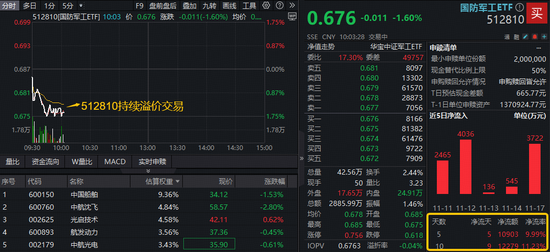
中字头军工股普跌,国防军工ETF回调逾1%触及半年线,场内溢价再起!资金连续6日净申购!
Xin Lang Ji Jin· 2025-11-18 02:11
Core Viewpoint - The defense and military industry sector is experiencing a significant pullback, with the popular defense ETF (512810) declining over 1% and hitting a six-month low, while major military stocks are also seeing declines [1][2]. Group 1: Market Performance - The defense military ETF (512810) has seen a decline of 1.60%, trading at 0.676, with a drop of 0.011 [2]. - Major military stocks such as AVIC Shenyang Aircraft Corporation and China Shipbuilding Industry Corporation have dropped nearly 3% and over 1% respectively [1]. Group 2: Investment Opportunities - The ETF has attracted over 100 million yuan in net subscriptions over the past six trading days, indicating active interest from investors [1]. - Analysts suggest that the fourth quarter may see the gradual realization of "14th Five-Year Plan" related orders, coupled with military trade catalysts, which could lead to a resurgence in the defense and military market [1]. - The defense industry is expected to benefit from geopolitical risks, technological advancements, and policy support, with potential for high-end weapon exports and a revaluation of core asset values [1]. Group 3: Strategic Insights - CITIC Securities' report indicates a shift in China's defense industry from "cyclical growth" to "comprehensive growth," driven by domestic demand, foreign trade expansion, and civilian contributions [3]. - The defense ETF (512810) is highlighted as an efficient tool for investing in core defense assets, covering various hot themes such as commercial aerospace, low-altitude economy, and military AI [3].
铠侠财报带崩全球存储公司股价 A股存储板块大跌
Jing Ji Guan Cha Wang· 2025-11-14 05:52
Core Viewpoint - Kioxia's disappointing financial results reflect uncertainties at the tail end of the industry's cyclical low, yet there is optimism regarding the overall upward trend in NAND prices [2][7]. Financial Performance - Kioxia reported a net profit of 40.7 billion yen (approximately 1.873 billion RMB) for Q2 of FY2025 (July-September), a significant decline of 62% year-on-year, falling short of market expectations of around 47.4 billion yen [4][5]. - The poor performance is attributed to seasonal smartphone demand, which led to a high proportion (35%) of low-margin smart device products, while the share of high-margin AI data center products remained low [4]. Market Reaction - Following Kioxia's financial report, its stock price plummeted by 23.03% to 10,025 yen, causing a ripple effect in the U.S. market, with major storage companies like SanDisk, Seagate, and Western Digital experiencing declines of 15.6%, 7.31%, and 5.39% respectively [5][6]. - Concerns over global storage chip supply-demand imbalances were heightened, despite strong AI and data center demand, as Kioxia's results revealed profitability pressures [5]. A-Share Market Impact - The negative impact of Kioxia's report extended to the A-share market, with stocks like Zhaoyi Innovation and Baiwei Storage dropping by over 3% and 11% respectively [6]. - The A-share storage sector had previously benefited from a "price surge" in the global storage chip market and the explosive demand from AI [6]. Future Outlook - Analysts remain optimistic about the storage sector's rebound, driven by AI demand, despite the short-term panic triggered by Kioxia's results [7]. - Kioxia anticipates record revenue and profit for Q3 of FY2025 (October-December), primarily due to higher average selling prices and increased NAND demand related to AI [7].



超千亿!翻倍牛股,成交额A股第一
Zhong Guo Zheng Quan Bao· 2025-11-08 06:29
Core Insights - The A-share market has shown strong performance in sectors related to "electricity," with many stocks in the power equipment industry reaching historical highs this week [1] - The surge in power equipment stocks is driven by increased electricity demand from data centers, policy support, and a resonance of domestic and international demand [1][2] Group 1: Market Performance - This week, 94 stocks reached historical highs, a decrease from 107 the previous week, with a total of 980 stocks achieving this milestone since the beginning of the year [1] - Among the 94 stocks, the power equipment, electronics, and machinery equipment sectors had the highest concentration of new highs, with 22, 14, and 14 stocks respectively [1] - The top stocks by trading volume this week included Sungrow Power Supply (1000.85 billion), TBEA (694.69 billion), and others, indicating strong market activity [3] Group 2: Sector Drivers - The demand for electricity in data centers is expected to increase due to the accelerated development of AI and the deployment of intelligent computing centers, which will drive the need for electrical equipment [2][3] - The photovoltaic and lithium battery sectors are experiencing improved supply expectations and demand, with potential price turning points on the horizon [2] - Breakthroughs in solid-state battery technology are expanding the development space for new energy, enhancing market optimism for new energy equipment demand [3] Group 3: Stock Highlights - The stocks with the highest trading volumes among the 94 that reached historical highs included Sungrow Power Supply, TBEA, and others, with significant trading amounts [3] - The total market capitalization of the stocks reaching historical highs has decreased, with only 5 stocks exceeding 100 billion in market capitalization compared to 14 the previous week [5] - Notable stock price increases this week included Jingquan Technology (48.41%), TBEA (40.06%), and others, reflecting strong performance in the market [6]


AI需求+政策支持双轮驱动 小型模块化反应堆产业拐点已至
Zheng Quan Shi Bao Wang· 2025-11-05 01:46
Group 1 - The core viewpoint is that the market value of small modular reactor (SMR) companies in the U.S. has rapidly increased following the executive orders signed by Trump on May 23, 2025, aimed at promoting the nuclear power industry [1][2] - According to Boston Consulting data, under an optimistic scenario, the share of electricity consumption related to AI in the U.S. is expected to rise from 2.5% in 2022 to 7.5% by 2030 [1] - The U.S. nuclear power capacity is projected to expand from 96.7 GW in 2024 to 400 GW by 2050, leveraging small modular reactor technology as per the executive order titled "REINVIGORATING THE NUCLEAR INDUSTRIAL BASE" [1] Group 2 - The regulatory environment for small modular reactors in the U.S. has shown a trend of continuous relaxation since the executive order was signed [2] - On the demand side, the rapid growth in electricity demand from data centers is expected to maintain a premium for nuclear power; on the supply side, the technology is maturing, with commercial operations anticipated as early as 2027-2028 [2] - The total investment scale in the U.S. small modular reactor industry is expected to approach $1 trillion over the next 20 years, with annual construction market investments exceeding $30 billion and the fuel market size reaching $18.3 billion by 2048 [2] - The upstream fuel and raw material supply and the midstream equipment manufacturing sectors are expected to benefit first, as small modular reactors are still on the verge of commercialization [2]
中信证券:AI需求+政策支持双轮驱动,小型模块化反应堆产业拐点已至
Mei Ri Jing Ji Xin Wen· 2025-11-05 00:34
Core Insights - The U.S. small modular reactor (SMR) industry is experiencing a trend of regulatory relaxation since the executive order signed by Trump on May 23, 2025, aimed at promoting the nuclear power sector [1] - The demand side is driven by the rapid growth in electricity demand from data centers, maintaining a premium for nuclear power, while the supply side sees maturing technology, with commercial operations expected as early as 2027-2028 [1] - With the dual drivers of AI demand and policy support, total investment in the U.S. SMR industry is projected to approach $1 trillion over the next 20 years, with annual construction market investments exceeding $30 billion and a fuel market size reaching $18.3 billion by 2048 [1] - The upstream fuel and raw materials supply and the midstream equipment manufacturing sectors are expected to benefit first, as the SMR industry is still in the pre-commercialization phase [1]
