
日元套利交易

Search documents
日元加息引爆全球警报!悲观派警告:恐成新金融危机导火索
Sou Hu Cai Jing· 2025-12-19 04:51
Core Viewpoint - The Bank of Japan raised its policy interest rate by 25 basis points to 0.75%, which is perceived as a "dovish rate hike" by the market, aligning with 94% of expectations, but has raised concerns among economists and investors about potential systemic risks in the global financial market [1][3]. Group 1: Economic Impact - The potential for a "margin call tsunami" from "yen carry trades" is a core concern, as global investors have borrowed yen at near-zero costs to invest in high-yield assets, creating a leverage of several trillion dollars [3]. - The rise in yen interest rates to a 30-year high has significantly increased borrowing costs, and the rapid appreciation of the yen against the dollar has narrowed the arbitrage opportunities [3]. - Historical precedents, such as the bursting of the dot-com bubble in 2000 and the 2008 financial crisis, began with seemingly localized liquidity tightening, which could lead to a systemic crisis today given the high asset valuations globally [3]. Group 2: Market Reactions - Signs of market distress have already emerged, with over 300,000 cryptocurrency liquidations and losses of $600 million occurring around the time of the rate hike announcement, alongside significant declines in Asian stock markets [5]. - The Japanese economy's structural vulnerabilities are highlighted by its national debt, which is 260% of GDP, indicating that even a small rate increase could lead to substantial increases in government interest payments [5]. - Optimists argue that Japan's economy is only 5% of the global economy and that the Federal Reserve's rate cuts could mitigate liquidity issues, but pessimists warn of the broader implications of rising costs of "cheap money" on global asset valuations [5]. Group 3: Investor Sentiment - The real danger for ordinary investors lies not in the rate hike itself but in misjudging the impact of this "gray rhino" event, as complacency often precedes significant market disruptions [6].


加息即是“绝响”?周五之后,日本央行或长时间关闭紧缩大门
Xin Lang Cai Jing· 2025-12-18 09:09
Core Viewpoint - The Bank of Japan is expected to raise short-term interest rates to 0.75%, the highest level since 1995, amid pressures from market forces and political dynamics [1][8]. Group 1: Interest Rate Changes - The anticipated interest rate hike is a response to rising bond yields, which have reached an 18-year high due to actions by "bond vigilantes" [1][8]. - This will be the second rate increase this year, with a 25 basis point adjustment [1][8]. Group 2: Economic Context - The economic plan of Prime Minister Sanna Hayashi, known as "Hayashi Economics," relies heavily on low interest rates and increased deficit spending [1][8]. - Japan's economy contracted by 2.3% year-on-year in the third quarter, highlighting the challenges faced by the government and the central bank [4][11]. Group 3: Historical Precedents - The current situation mirrors past experiences under former Bank of Japan governors, particularly Toshihiko Fukui, who faced similar dilemmas and had to reverse rate hikes after economic downturns [2][9]. - The previous governor, Haruhiko Kuroda, left a challenging legacy for the current governor, Kazuo Ueda, who has been cautious in policy adjustments [3][11]. Group 4: Future Risks - There are concerns that if GDP growth stagnates further by 2026, Ueda may face significant political backlash, as central bank leaders often become scapegoats for economic issues [5][12]. - Geopolitical tensions, including trade wars and regional conflicts, pose additional risks to Japan's economic stability [6][12]. Group 5: Long-term Implications - Experts acknowledge that over 25 years of zero interest rates have hindered necessary economic reforms and innovation in Japan [13]. - The current economic strategy does not adequately address competitiveness or the need for structural changes in the labor market and corporate governance [13].
美国降息,日本加息,为何让币圈交易员紧张不安?
Sou Hu Cai Jing· 2025-12-17 09:56
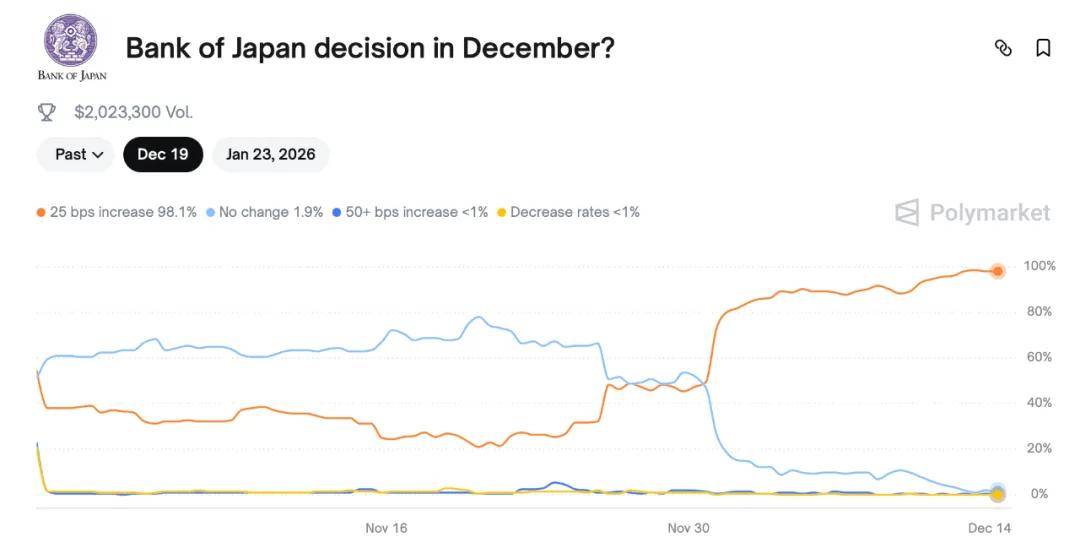
冰与火之歌 2025年的冬季,加密货币市场并未迎来预想中的"圣诞老人行情",反而笼罩在一片紧张与不确定的迷雾之中。比特币价格在90,000美元的心理关口附近徘 徊,多空双方激烈博弈,市场情绪如履薄冰。这股寒意的背后,并非源于加密世界内部的黑天鹅,而是来自全球两大经济体——美国与日本,截然相反的 货币政策路径所引发的一场完美风暴。 一边是美联储开启降息通道,释放流动性;另一边是日本央行(BOJ)磨刀霍霍,准备终结数十年的负利率时代。这"一松一紧"的宏观大戏,为何会让习 惯了风浪的币圈交易员们感到前所未有的紧张?答案隐藏在一个深刻影响全球资本流动的机制,以及比特币对全球流动性的高度敏感性之中。 在这双重压力下,理性的选择便是"平仓",即解除套利交易。投资者会开始抛售他们此前购买的风险资产(包括比特币),将所得资金换回日元以偿还债 务。如果这种平仓行为形成浪潮,将对全球市场造成巨大的卖压,形成一场"去杠杆化"风暴。 当前市场最直接的恐惧,源于日本央行即将在12月19日召开的政策会议。根据Polymarket等预测市场的数据,市场普遍认为日本央行此次加息25个基点的 概率高达98%,这将使其基准利率达到0.75%,进 ...
飙升的日债收益率:美股的灰犀牛?
智通财经网· 2025-12-17 08:35
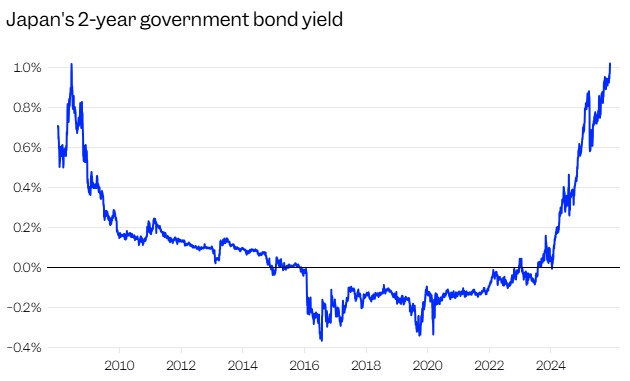
Core Viewpoint - Japan's long-term bond yields have reached multi-year highs, indicating weak investor demand due to concerns over increased government spending and a potential interest rate hike on December 19 [1][4]. Group 1: Market Dynamics - The Japanese bond market, valued at $7.5 trillion, has experienced unusual volatility in recent months, starting from May when a poorly received 20-year bond auction led to soaring yields [1][4]. - The Bank of Japan (BOJ), which holds over half of the country's sovereign bonds, has begun to gradually reduce its balance sheet and decrease bond purchases, leaving a gap in the market that other buyers have not filled [1][4]. - Despite recent weak demand, there are signs of recovery, with a 30-year bond auction on December 4 attracting the strongest demand since 2019, particularly from foreign buyers seeking higher yields [5]. Group 2: Economic Implications - The BOJ's exit from the market coincides with Japan's transition out of a deflationary period, which has historically involved heavy bond purchases to stimulate the economy [4]. - Concerns over rising yields are compounded by a significant economic stimulus plan approved by the Japanese government, amounting to ¥21.3 trillion (approximately $1.37 billion), which may necessitate increased borrowing and bond issuance [8][9]. Group 3: Central Bank Response - The BOJ is aware of the increasing volatility in bond yields and plans to slow its exit from the bond market, reducing monthly bond purchases by ¥200 billion instead of ¥400 billion starting next fiscal year [7]. - The government is also attempting to mitigate yield pressure by relying on short-term debt issuance rather than long-term bonds to fund its stimulus plan [9]. Group 4: Global Market Impact - Rising Japanese bond yields are significant for global financial markets, as Japan has been a major player in the low-interest-rate environment that has influenced global investment strategies [11]. - The narrowing yield spread between Japanese and U.S. bonds could lead to a reversal of "yen carry trades," where investors borrow in yen to invest in higher-yielding assets, potentially causing market disruptions [11][14]. - Analysts warn that a significant unwinding of Japanese carry trades could impact U.S. markets, especially given the current fiscal challenges faced by the U.S. government [14].
股市热?板块回撤,债市表现分化
Zhong Xin Qi Huo· 2025-12-17 01:23
1. Report's Industry Investment Rating - Not provided in the content 2. Core Views of the Report - In the stock index futures market, the pullback of popular sectors has dragged down sentiment. In mid - to late December, it is recommended to focus on risk - avoidance allocations, with a short - term combination of high - dividend and price - increase chains [1][9]. - In the stock index options market, volatility has rebounded, and a short - term defensive strategy is advisable, with a short - term protective put option recommended [2][9]. - In the treasury bond futures market, the bond market shows differentiation. Short - term caution is needed for the ultra - long - end, while the short - end has relatively stronger support [3][11][12]. 3. Summary of Each Directory 3.1 Market Views Stock Index Futures - On Tuesday, the equity market accelerated its correction, with popular sectors such as non - ferrous metals, new energy, and communications leading the decline. The market trading volume was around 17.5 trillion. The IC and IM contracts saw significant increases in positions, indicating hedging demand. The market attributes the pullback to various factors, but the core issue is the unclear leading funds. The operation suggestion is to hold IC and the dividend index [1][9]. Stock Index Options - The underlying market fell across the board. The total trading volume of the options market reached 9.854 billion yuan, a 60.16% increase from the previous day. The proportion of put option trading volume increased, showing a defensive sentiment. The sentiment indicators suggest a weak medium - term view. Volatility rebounded, and a short - term protective put option is recommended [2][9]. Treasury Bond Futures - Treasury bond futures showed differentiation. The T, TF, TS, and TL main contracts changed by 0.05%, 0.03%, - 0.02%, and - 0.19% respectively. The T main contract was volatile, and the ultra - long - end TL contract continued to decline, while the short - end TS contract adjusted. The market sentiment needs to improve. The operation suggestions include a trend strategy of range - bound trading, paying attention to short - selling hedging at low basis levels, focusing on basis widening, and expecting a steep yield curve [3][11][12]. 3.2 Economic Calendar - It includes data such as China's reserve currency in November 2025, the US non - farm payrolls change in November 2025, and upcoming data on the US core CPI and PCE price index in November 2025 [13]. 3.3 Important Information and News Tracking - **Domestic Macroeconomics**: The National Development and Reform Commission proposed measures to boost domestic demand, including stabilizing bulk consumption, implementing key projects in consumption - related fields, and improving market order [14]. - **Financial Technology**: Baidu's no - code application building platform "Miaoda" has generated over 500,000 commercial applications in 8 months. Baidu also launched a long - term support plan for creators [14]. - **Non - ferrous Metals**: The London Metal Exchange plans to implement new position limit rules from July next year to comply with UK financial regulatory requirements [15]. 3.4 Derivatives Market Monitoring - **Stock Index Futures Data**: Not detailed in the provided content [16]. - **Stock Index Options Data**: Not detailed in the provided content [20]. - **Treasury Bond Futures Data**: Not detailed in the provided content [32].
全球“廉价资金”末日来临?日本加息暗藏三大杀招,中国如何接招?
Sou Hu Cai Jing· 2025-12-16 13:55
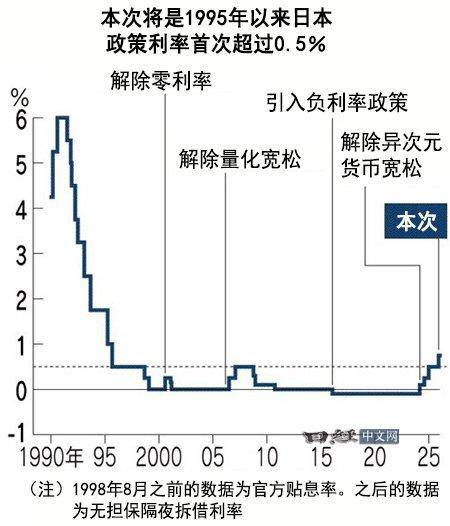
Group 1 - The Bank of Japan's monetary normalization is anticipated as a black swan event, with a 94% probability of a 25 basis point rate hike from 0.5% to 0.75% [1][2][25] - This rate increase marks a significant change for the yen, reaching levels not seen since 1995, which could disrupt the global cheap funding environment [3][10] - Japan's core CPI has remained above the central bank's 2% target for 28 consecutive months, indicating a shift from deflation to inflation driven by wage increases in the service sector [7][9][12] Group 2 - The output gap in Japan has been positive for three consecutive quarters, suggesting that demand is exceeding supply, leading to a resurgence in consumer spending [11][12] - The current interest rates in Japan are significantly lower than those in the US, creating a mismatch with inflation rates, which could lead to market corrections [14][16] - The Japanese government has a debt of 1,333.6 trillion yen, with interest payments consuming 22.4% of the budget, raising concerns about the impact of rate hikes on fiscal sustainability [21] Group 3 - A 25 basis point rate hike could lead to a significant tightening of global liquidity, affecting emerging markets and potentially causing capital outflows [44][50] - Japanese investors are the largest foreign holders of US Treasuries, and a shift in interest rates could accelerate the trend of selling US debt [41] - The anticipated rate hike could lead to a negative impact on high-valuation tech stocks globally, as liquidity conditions tighten [50] Group 4 - For Japanese banks, the rate hike is expected to improve net interest margins, with Mitsubishi UFJ Bank predicting a profit increase of 480 billion yen due to the rate change [53][54] - However, the real estate market, which has benefited from low mortgage rates, may face challenges as higher rates could lead to a decrease in new home transactions by 12% [56] - Small and medium-sized enterprises may struggle with increased borrowing costs, potentially leading to higher bankruptcy rates and unemployment [58]
日本黑天鹅来袭
Ge Long Hui· 2025-12-16 13:50
Group 1 - The Bank of Japan's monetary normalization is anticipated as a black swan event, with a 94% probability of a 25 basis point rate hike, marking a significant shift from a long-standing low-interest environment [2][22] - Japan's core CPI has remained above the central bank's 2% target for 28 consecutive months, indicating a shift from imported inflation to domestic wage-driven inflation [5][8] - The average wage increase in Japan reached 5.46% in 2025, the highest in 34 years, signaling a change in consumer purchasing power and inflation dynamics [8][9] Group 2 - The Japanese economy is experiencing a rare situation where demand exceeds supply, leading to a positive output gap for three consecutive quarters [10][11] - The long-standing low-interest rate environment is becoming incompatible with the rising consumer demand, as Japan transitions from a low-desire society to one with increased consumption [12][13] - The current interest rate of 0.5% is significantly misaligned with the inflation rate, necessitating market corrections [13] Group 3 - The yen's depreciation and rising import costs, particularly for oil and LNG, are contributing to overall price increases, prompting discussions on the need for interest rate hikes [15] - Japan's government debt exceeds 1,333.6 trillion yen, with interest payments consuming 22.4% of the budget, raising concerns about the implications of rate hikes on fiscal sustainability [17][18] - The slow pace of interest rate increases reflects the government's cautious approach to avoid exacerbating debt burdens [19] Group 4 - A 25 basis point increase in interest rates will raise the cost of yen financing, potentially triggering a deleveraging effect among global quantitative funds that rely on low-cost yen borrowing [35][38] - The anticipated rate hike could lead to significant asset reallocations, particularly from U.S. Treasuries, as Japanese investors seek better returns domestically [45][46] - Emerging markets may face severe repercussions from capital outflows as global liquidity tightens, reminiscent of past financial crises [48][50] Group 5 - Major Japanese banks are expected to benefit from the rate hike, with projections indicating a potential increase in net profits due to improved net interest margins [58] - However, the real estate sector may suffer as rising mortgage rates could dampen housing demand, with forecasts suggesting a 12% decline in new home transactions [61] - Small and medium-sized enterprises may struggle with increased borrowing costs, leading to higher bankruptcy rates and economic "cleansing" [63]

人民币持续升值,港股为何创下本轮调整新低?
Di Yi Cai Jing Zi Xun· 2025-12-16 06:06
Group 1 - The core point of the article highlights the recent decline in the Hong Kong stock market despite the appreciation of the Renminbi against the US dollar, with the Hang Seng Index dropping significantly [2] - The Hang Seng Index fell by 1.91% on December 16, closing at 25,139 points, marking a cumulative decline of over 2,000 points in the fourth quarter [2] - Analysts attribute the market adjustment to several factors, including high previous gains in 2025, southbound fund reallocation, rising US Treasury yields following the Fed's hawkish stance, and geopolitical uncertainties [2][3] Group 2 - The offshore US dollar to Renminbi exchange rate broke 7.04, with the latest rate at 7.038 [2] - Analysts from Everbright Securities noted that the recent adjustments in the Hong Kong market are primarily due to significant year-to-date gains and insufficient capital inflow as the year-end approaches [2] - Concerns over geopolitical factors and differing views on the global economic outlook are also impacting market sentiment [2][3] Group 3 - The expectation of a potential interest rate hike by the Bank of Japan on December 19 could reverse long-standing arbitrage trading logic, leading to capital withdrawal from emerging markets like Hong Kong [3] - Liquidity issues are highlighted, with a slowdown in southbound fund inflows possibly linked to new regulatory guidelines affecting fund performance assessments [3] - Structural differences between the Hong Kong and A-share markets amplify the sensitivity of Hong Kong stocks to fundamental changes, particularly in sectors like artificial intelligence [3][4]

人民币持续升值,港股为何创下本轮调整新低?|市场观察
Di Yi Cai Jing· 2025-12-16 05:27
投资者担忧美债利率回升、日本央行加息预期。 人民币持续升值,美元兑人民币已经逼近7的整数关口,然而以前人民币升值最受益的港股却出现了持 续调整。 12月16日上午,恒生指数再跌1.91%,成交1071亿港元,中午报收25139点,第四季度累计调整超过 2000点,也跌破了10月和11月的低点,创出本轮调整新低。 对于背后原因,有业内人士分析认为,2025年港股一度涨幅比较高,本来就有一定调整需求;另一方 面,受南向资金调仓、美联储"鹰派降息"后美债利率回升、地缘政治等因素影响,加上12月19日日本央 行是否加息依然不确定,有投资者担忧市场受到冲击。 12月16日,离岸美元兑人民币汇率破7.04,最新报7.038。 光大证券国际策略师伍礼贤表示,港股近期调整主要源于年内累计涨幅较大,临近年末资金入场意愿不 足。此外,地缘政治因素对市场情绪形成压制,市场对明年全球经济前景有一定分歧。技术面来看,投 资者要关注25000点整数关口支撑,若失守或进一步下探;日本央行的加息预期,会影响日元套利交易 平仓,科技股走弱等,都对区域市场形成压力。 博大资本国际行政总裁温天纳指出,美联储降息后全球市场波动率显著上升,12月19 ...
Yuan at 14-Month High as Fed-BOJ-PBOC Split — Crypto Impact
Yahoo Finance· 2025-12-15 09:03
US sanctions, China, crypto ban. Photo by BeInCrypto China's yuan climbed to a fresh 14-month high against the dollar on Monday, adding another layer of complexity to an already turbulent macro environment for risk assets, including cryptocurrencies. The world's three largest central banks are now moving in distinctly different directions. The Federal Reserve just delivered a hawkish rate cut, the Bank of Japan is poised to raise rates this week, and China's PBOC is navigating yuan strength amid a slowing ...